SF Office-to-Housing: 901 Market Plans 136 Homes
Hudson Pacific filed plans to convert the historic 901 Market building into 136 homes, the clearest sign San Francisco's office-to-housing push is reaching the heart of Mid-Market.

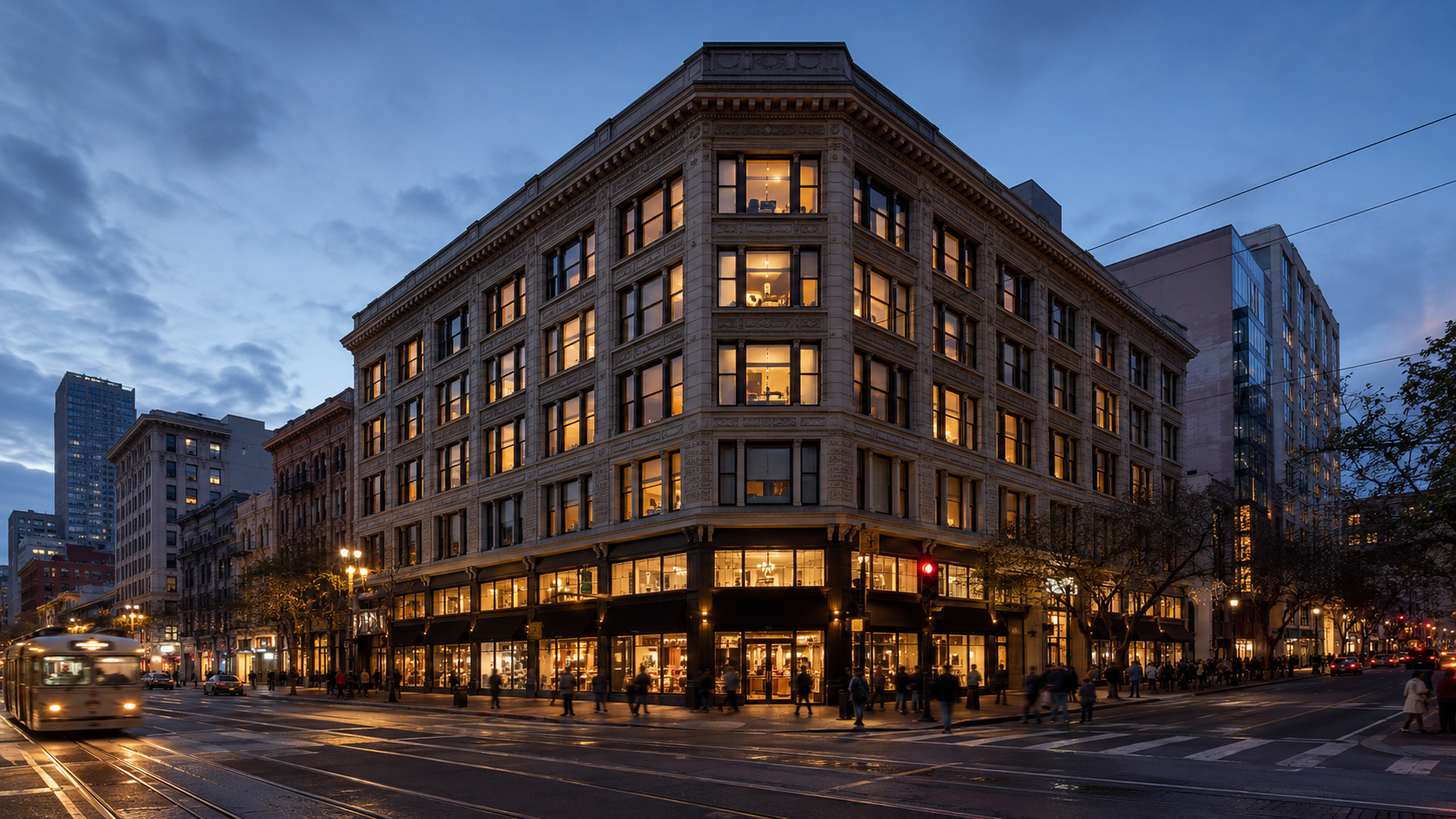
The historic 901 Market Street building in San Francisco's Mid-Market, site of a proposed office-to-housing conversion into 136 homes. Photo: Houseberry
The paperwork landed on July 1. Hudson Pacific Properties filed planning permits to strip the upper floors of 901 Market Street and rebuild them as 136 homes, with the shops at street level staying put. If you have walked the corner of Market and 5th lately, you know the building even if you never learned the address. It is the big historic one across from the shuttered mall, mostly dark for years. This is what a San Francisco office-to-housing conversion looks like once it reaches the actual center of downtown, not just the edges.
The building has been waiting for a second act. The Reid Brothers designed it in 1912 for the Hale Brothers Department Store, and J.C. Penney ran a store inside from 1944 to 1971. Six stories, 132 feet, a real slab of old San Francisco retail. Now Hudson Pacific wants to turn about 138,500 square feet of it into apartments and keep roughly 76,000 square feet of ground-floor and basement space commercial. The corner keeps its shops. The floors above them stop being empty offices and start being where people sleep.
Two things stand out. The unit mix leans hard toward singles and couples, with 102 of the 136 homes being studios or one-bedrooms, which fits a downtown address better than it fits families. And there is no clock. Hudson Pacific has not shared a construction cost or a completion date, which is normal at the filing stage. So treat this as a serious proposal that is early, not a project with a leasing office.
Why San Francisco's office-to-housing math finally works downtown
For years the honest answer to why more empty offices did not become homes was that the numbers did not work. Converting a building is expensive, and downtown land still carried office-era price tags. That changed on purpose. In February 2026, Mayor Daniel Lurie signed the Downtown Revitalization Financing District, a $610.5 million program that hands conversion developers back a share of the new property tax their projects generate for up to 30 years. Developers have until 2032 to enroll, and the district covers the Market Street corridor from the waterfront to Civic Center, which puts 901 Market squarely inside the lines.
That sits on top of an earlier move. In March 2025 the city waived inclusionary housing requirements and impact fees on up to 7 million square feet of adaptive reuse. Stack the two together and a conversion that penciled at a loss two years ago can pencil at a profit now. Independent analysis cited by the city figures roughly 50 downtown properties are viable conversion candidates, enough for about 4,400 homes if they all moved. 901 Market is one of the first big ones to actually file.
This is the kind of policy that works, and it is worth being plain about why. San Francisco does not have a shortage of empty offices, and it does not have a shortage of people who would live near the center of the city. It had a rule-and-cost problem wedged between the two. Fixing that is less photogenic than a groundbreaking, but it is exactly the lever that turns a dead floor into a lived-in one.
What 136 residents do to a block like Mid-Market
Here is where we tend to read these stories a little differently. A conversion is not only a housing-count story. It is a neighborhood story, because 136 occupied homes change how a block behaves.
Right now the stretch of Market around 5th empties out the moment the commuters leave. The San Francisco Centre sits shuttered across the street, and foot traffic thins until the sidewalk feels abandoned by early evening. Drop a couple hundred residents into 901 Market and the arithmetic of the block shifts. Someone is buying coffee at 7 a.m. and walking home at 9 p.m., which is the quiet ingredient every struggling downtown corridor is missing. The newly opened Serif SF next door already added residents and a hotel. Another 136 households pushes the same direction.
The comments on the filing captured the tension perfectly. One neighbor asked who would ever want to live on that corner. Another answered that getting people to live on that corner is the entire point. Both are right. The corner is rough today. It also does not improve until people are there at night who want it to.
The honest read on Mid-Market before you buy the story
None of this means you should race to buy the first Mid-Market conversion unit that hits the market. It means close to the opposite. This is exactly the kind of address that rewards studying the neighborhood before the floor plan.
Mid-Market is a real place with real problems a nice lobby does not erase. Street conditions, open-air drug activity, and a retail vacancy rate that one building cannot fix are all part of the deal today, and anyone comparing a unit here against one in a calmer neighborhood should price that in honestly rather than assume the block will turn on a schedule. The upside case is simple. If conversions arrive in a cluster instead of one at a time, the corridor finally gets the residential density it has never had, and early buyers are the ones who got in before the block filled. The downside case is just as simple. If 901 Market ends up a lonely island of housing ringed by empty storefronts, it lives or dies on its own amenities.
That gap between the two outcomes is the whole reason we look at the area before the address. If you are weighing downtown against the rest of the city, line up San Francisco's neighborhoods by overall score and where the value actually sits rather than trusting a single glossy listing. Mid-Market may well be the best-value bet in the city five years from now. It is not automatically the best place to live today, and those are two different questions that a conversion headline tends to blur.
What to watch next on 901 Market
For now, 901 Market is a filing, not a done deal. The signals worth tracking are whether Hudson Pacific enrolls the project in the financing district, whether the historic-preservation review over the facade and that new courtyard goes smoothly, and when a real construction timeline appears. Those three will tell you whether this is a 2028 building or a someday building.
The bigger thing to watch is whether 901 Market stays rare or becomes routine. If the roughly 50 candidate buildings downtown start filing in a wave, the demand picture for central San Francisco shifts, and it ties directly to the rent pressure we walked through when San Francisco rent neared $4,100. More downtown homes is the pressure valve that market has been missing. And if you are the kind of buyer or renter who likes to be early, the neighborhood-first habit we built Houseberry around, studying schools, safety, value, and the trajectory of a block before you commit, is worth more on a corner like this than almost anywhere else in the city. A block in transition is where that homework pays the most.
Sources
San Francisco YIMBY, Plans Filed For Office-to-Housing Conversion at 901 Market Street
SF Planning, Downtown Adaptive Reuse Program
Houseberry, San Francisco neighborhoods by overall score
Houseberry, best-value San Francisco neighborhoods
Houseberry, San Francisco Rent Nears $4,100 and Bends the Buy Math
The Houseberry Research Team is Houseberry's reporting team: Bay Area real estate analysts, data specialists and longtime local market watchers. Every day we check the public record: building permits, city council and planning agendas, county recorder filings, state housing bills, police incident data and school results. Then we tie each story to what it means for specific neighborhoods, using Houseberry's own neighborhood data on prices, appreciation, safety, schools and amenities. Questions or corrections: Contact us.
All information provided on this website including but not limited to - school ratings, safety, amenities, user opinions, and property data - is for general informational purposes only. We do not guarantee its reliability, accuracy, or completeness. Users should independently verify information and consult appropriate professionals as needed. By using this website, you agree Houseberry is not responsible for actions, decisions, or consequences arising from reliance on the information provided
houseberry.com - CA DRE# 01847391
 Bay East ©2025. CCAR ©2025. bridgeMLS ©2025. Information Deemed Reliable But Not Guaranteed. This information is being provided by the Bay East MLS, or CCAR MLS, or bridgeMLS. The listings presented here may or may not be listed by the Broker/Agent operating this website. This information is intended for the personal use of consumers and may not be used for any purpose other than to identify prospective properties consumers may be interested in purchasing. Data last updated at October 3, 2026 12:00 AM