Bernal Heights Safeway Redevelopment: 379 Homes Filed
Align Real Estate has filed formal plans for 379 rental homes above a new Safeway at 3350 Mission Street. Here is what the project means for daily errands, walkability, and homebuying on the Bernal and Mission border.
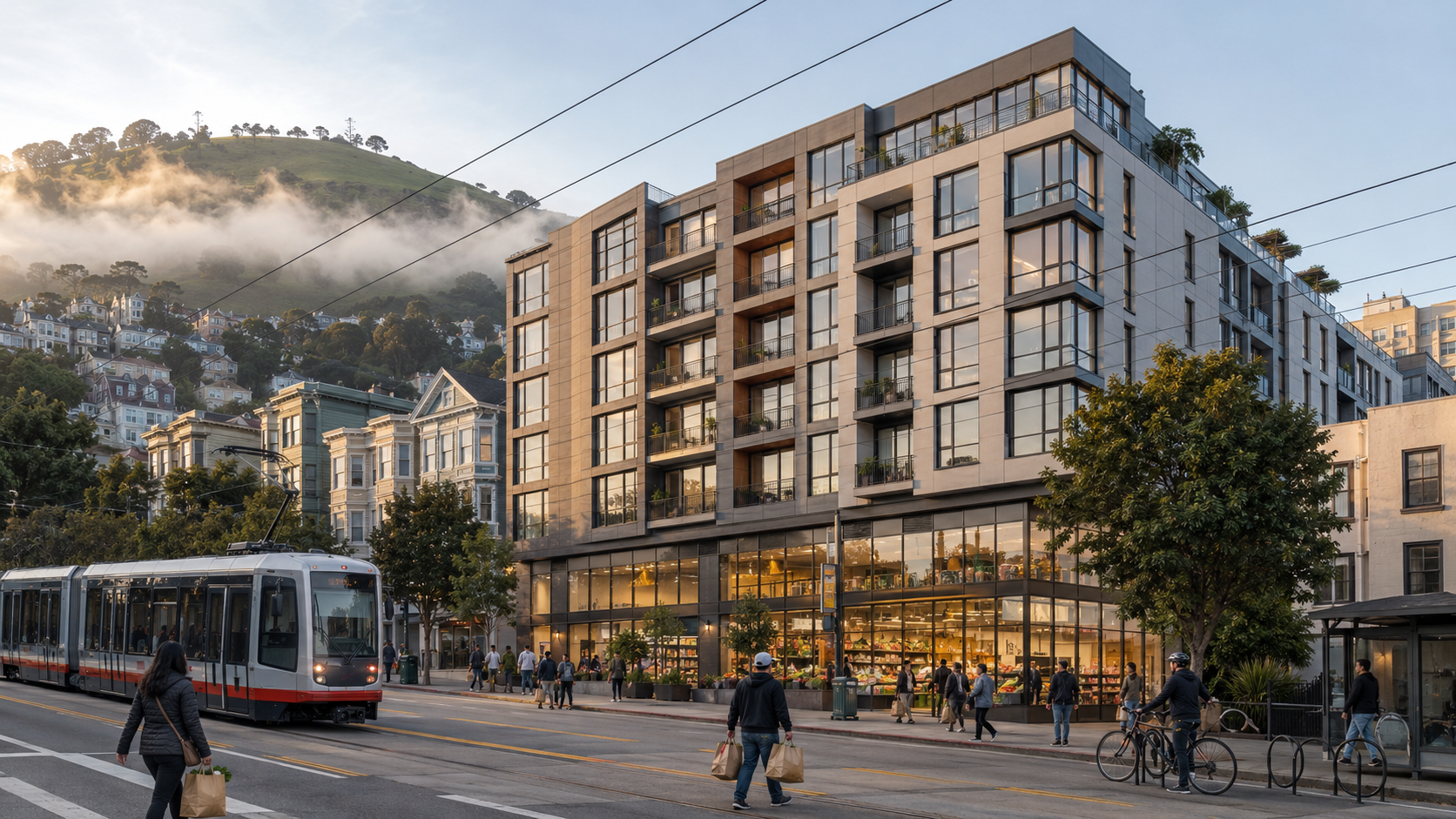
Photo: Houseberry
The Safeway at 30th and Mission has one of the more baffling parking lots in San Francisco. I have watched more than one driver give up on the skinny 29th Street driveway and just circle the block. That parking lot is now officially on the clock. On June 11, Align Real Estate filed the formal application for the Bernal Heights Safeway redevelopment at 3350 Mission Street, a plan to put 379 rental homes above a brand-new ground-floor Safeway, as reported by SF YIMBY.
A formal application is the step that matters. It starts the official review clock at the Planning Department, and this one arrives with two state laws attached that limit how much the city can shrink it or stall it. For anyone shopping, living, or house-hunting near the Bernal and Mission border, this project stopped being hypothetical this week.
What the Bernal Heights Safeway Redevelopment Includes
According to the filing details reported by SF YIMBY, the roughly 90-foot-tall building would total about 479,000 square feet on the 2.15-acre site between Mission Street and San Jose Avenue, keeping that narrow access point out to 29th Street. The plan includes 274,200 square feet of housing, 55,000 square feet of commercial space for a replacement Safeway on the ground floor, and a 291-car garage. There is also parking for 286 bikes. Nearly one bike space per car space, a ratio you almost never saw in a filing ten years ago.
The 379 apartments break down as 65 studios, 185 one-bedrooms, 89 two-bedrooms, and 40 three-bedrooms. Of those, 76 will be deed-restricted affordable, about 20 percent. That affordability share is what lets Align invoke the State Density Bonus law and Senate Bill 330, which together streamline approvals and cap how many hearings the project can be dragged through. Earlier coverage pegged the project around 370 units. The formal filing nudges it to 379.
Perry Architects designed the podium-style complex, with three courtyards on top of the podium, a rooftop balcony overlooking Mission Street, and a white and wood-look exterior with a dark metal wrap defining the ground floor. Construction is estimated around $170 million, not counting all development costs, and no groundbreaking date has been shared.
One Piece of a Much Bigger Safeway Housing Bet
This is not a one-off. Align is working through a six-project portfolio with Safeway’s parent company Albertsons that would build more than 4,000 apartments across the Bay Area, with five of the six sites getting a replacement grocery store, per SF YIMBY. The sixth, an Albertsons-owned site in Oakland occupied by Trader Joe’s, is slated for senior housing instead, according to The Real Deal. Here is the San Francisco scorecard as of this week:
| Site | Neighborhood | Homes proposed | Where it stands |
| 3350 Mission St | Bernal Heights | 379 | Formal application filed June 2026 |
| 1335 Webster St | Fillmore | ~1,800 | Plans filed November 2025 |
| 850 La Playa St | Outer Richmond | 526 | Preliminary plans filed November 2025 |
| Marina Safeway | Marina | ~790 | 25-story proposal facing loud opposition |
The Fillmore and Outer Richmond filings were covered by SFist and SF YIMBY last fall, and the Marina proposal drew immediate pushback, as The Real Deal reported in December.
My read: Bernal is the easiest of the four. It keeps the grocery store, it is a mid-rise rather than a waterfront tower, and it sits on a transit corridor where the density conversation has mostly already happened. If you want a preview of how the harder fights go, watch the Marina.
Why Grocery-Over-Housing Matters for Homebuyers
The practical question for buyers is not the architecture. It is the errand loop. This site puts a full-service grocery store under 379 households, a two-minute walk from the J Church where it runs on its own right-of-way along San Jose Avenue, and an eight-minute bus ride from 24th Street BART, per the project filing. Mitchell’s Ice Cream has been scooping around the corner at 29th and San Jose since 1953. The Cortland Avenue strip is a ten-minute walk up the hill. This corner already works on foot. The project makes the on-foot life denser and more useful.
Two honest caveats. First, construction at a corner like this takes years, and Mission Street will feel it through staging, lane closures, and noise. Second, nobody can promise what any single project does to nearby home prices, and you should be suspicious of anyone who claims otherwise. What can be said is that buyers consistently weigh daily convenience when comparing blocks, and a corridor that keeps its anchor grocery while adding hundreds of customers for every nearby business is positioning itself well. The risk case, a beloved store closing and leaving a dead corner, is the one outcome this plan is specifically built to avoid.
What This Could Mean for the Mission Street Corridor
The flat stretch between the Mission proper and Bernal Hill, the strip some locals still call La Lengua, has always been the workhorse errand zone for both neighborhoods. Adding 379 households means more weekday foot traffic for every storefront between the tail end of Valencia and the base of Cortland. That is how corridors fill vacant retail, not through merchant association strategy memos.
What is not yet clear is phasing. The filing does not say whether the existing Safeway stays open during construction, and that gap between old store and new store, if there is one, is the detail neighbors will care about most. The 29th Street driveway’s future is another open question that commenters were already asking about the morning the story ran.
The bigger picture is hard to argue with. A 2.15-acre parking lot two minutes from light rail is exactly the kind of site San Francisco has to use if it wants to add homes without touching a single Victorian. Calling asphalt “neighborhood character” was never going to hold.
The Houseberry Angle
A filing like this changes the research question. For buyers comparing Bernal Heightsagainst the Mission, the question is no longer just what a block feels like today but what is already filed to change within a half mile of it. A house on Coleridge Street and a house in Glen Park can look similar on paper while sitting in very different five-year trajectories.
That is the gap Houseberry’s neighborhood scores are built to close. Amenities, walkability, and value signals are exactly the things a project like this moves, and they are worth checking across the top neighborhoods in San Francisco before you anchor your search to a single listing.
What to Watch Next
The application now goes through Planning Department review under SB 330’s streamlined timelines, which limit hearings and prevent the city from reducing the project’s density mid-process. Watch for three things: a phasing plan that answers the store-closure question, a groundbreaking timeline, which will depend as much on construction financing as on approvals given the $170 million construction estimate, and the fate of the Marina and Fillmore proposals, which will signal how much appetite the city has for the rest of the portfolio.
Final Thoughts
San Francisco spent decades treating its grocery store parking lots as untouchable. Now the company that owns them wants to build housing on top, keep the stores, and do it next to transit. The Bernal version is the cleanest test case in the city. If this one cannot move, none of them can.
Bernal Heights Safeway Redevelopment FAQs
How many homes are in the Bernal Heights Safeway redevelopment?
The formal application proposes 379 rental homes at 3350 Mission Street: 65 studios, 185 one-bedrooms, 89 two-bedrooms, and 40 three-bedrooms, with 76 units deed-restricted as affordable, per SF YIMBY. Earlier reports cited roughly 370 units before the formal filing.
Will the Safeway at 3350 Mission Street close?
The project includes a 55,000-square-foot replacement Safeway on the ground floor, so the store is part of the long-term plan. Whether the existing store stays open during construction has not been announced, and that phasing detail is worth watching as the application moves through review.
How close is 3350 Mission Street to transit?
Very close. Residents would be a two-minute walk from the J Church Muni light rail stop where the line runs along San Jose Avenue, and about an eight-minute bus ride from 24th Street BART, according to the project filing.
Will the project change home values in Bernal Heights?
No single project guarantees a price effect, and anyone promising one is selling something. The practical takeaway is that the corridor keeps its anchor grocery store while gaining hundreds of residents, which supports the daily-convenience factors buyers weigh when comparing Bernal Heights blocks against nearby alternatives.
When will construction start?
No groundbreaking date has been shared. Construction is estimated to cost around $170 million, and the project still needs to complete Planning Department review, though SB 330 and the State Density Bonus law streamline that process.
Sources
Formal Application For Bernal Heights Safeway Redevelopment, San Francisco (SF YIMBY, June 11, 2026)
Preliminary Plans Filed For Safeway in Outer Richmond, San Francisco (SF YIMBY, November 2025)
Align Real Estate defends its approach at Marina Safeway (SF Standard, December 23, 2025)
All information provided on this website including but not limited to - school ratings, safety, amenities, user opinions, and property data - is for general informational purposes only. We do not guarantee its reliability, accuracy, or completeness. Users should independently verify information and consult appropriate professionals as needed. By using this website, you agree Houseberry is not responsible for actions, decisions, or consequences arising from reliance on the information provided
houseberry.com - CA DRE# 01847391
 Bay East ©2025. CCAR ©2025. bridgeMLS ©2025. Information Deemed Reliable But Not Guaranteed. This information is being provided by the Bay East MLS, or CCAR MLS, or bridgeMLS. The listings presented here may or may not be listed by the Broker/Agent operating this website. This information is intended for the personal use of consumers and may not be used for any purpose other than to identify prospective properties consumers may be interested in purchasing. Data last updated at September 14, 2026 12:00 AM