California Housing Bond 2026: What a Yes Vote Funds
California's $11.25 billion housing bond goes to voters on November 3. Here is what it would actually fund, and which Bay Area pipelines are positioned to use the money first.
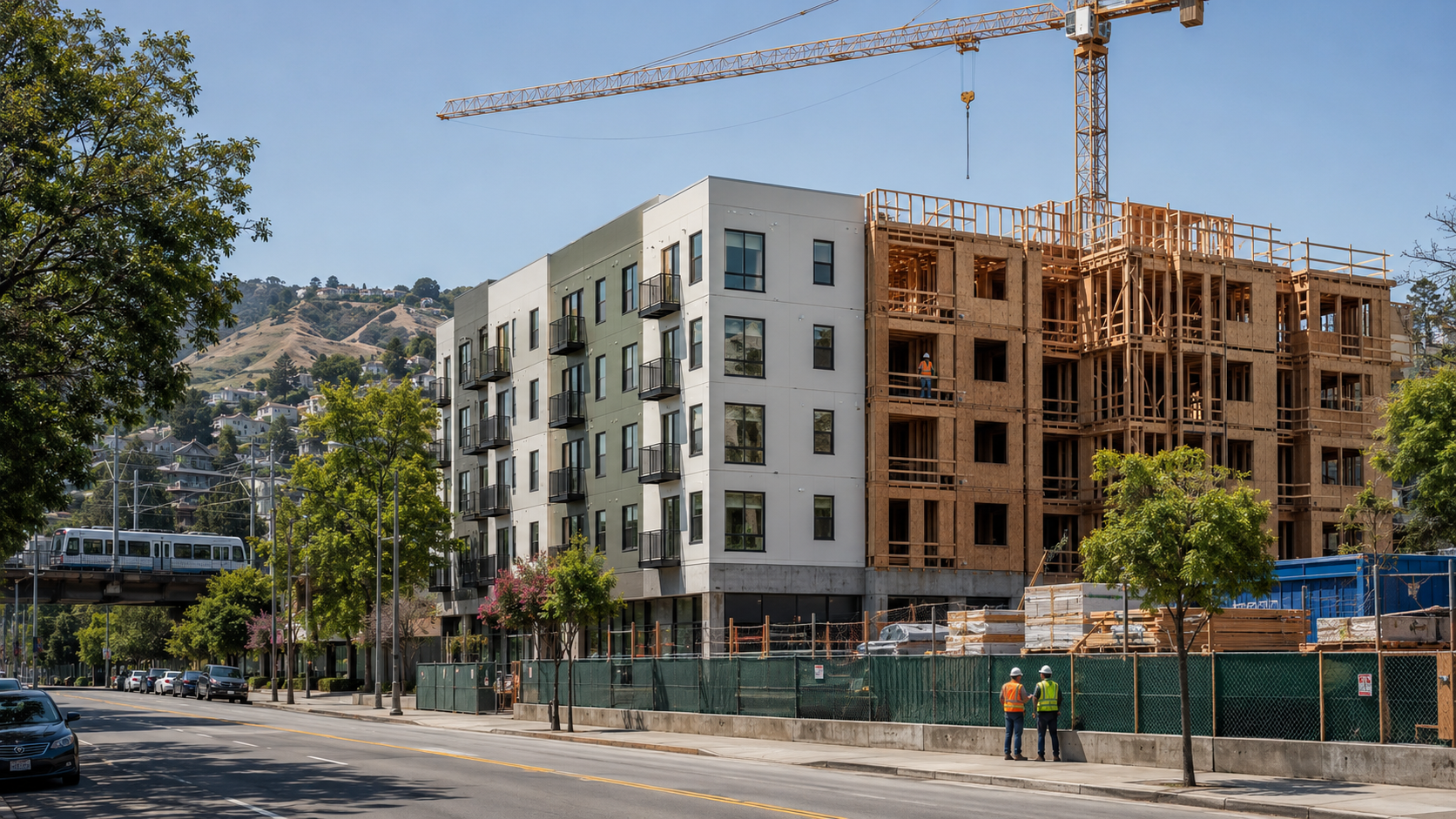
A mid-rise affordable apartment building under construction in a Bay Area neighborhood, illustrating California's 2026 housing bond. Photo: Houseberry
Tens of thousands of affordable apartments in California are fully designed, fully permitted, and sitting idle. Not because of angry neighbors, not because of zoning. Because the last check never showed up. On November 3, voters get a direct say in whether that changes. The California housing bond on the 2026 ballot, formally the Veterans and Affordable Housing Bond Act of 2026 (SB 417), asks for $11.25 billion. The Legislature gave it final approval on June 25 with a 61-7 Assembly vote and a 29-2 Senate concurrence, and the governor signed it, placing the measure on the November ballot.
Most coverage stops at that headline number. The more useful question, if you actually watch Bay Area neighborhoods, is narrower: what does this money build, and which places are set up to grab it first.
Inside the $10 billion, the dollars run through the state's existing affordable housing machinery, led by the Multifamily Housing Program, plus targeted set-asides for farmworker housing, tribal communities, college students (about $350 million for student housing), homeless and at-risk youth, and down payment help for moderate-income first-time buyers.
The state's whole pitch is leverage. For every $1 the bond puts in, the administration estimates roughly $4 more shows up from federal tax credits, local money, private financing, and rents. Whether that ratio holds in practice is fair to question. But the underlying mechanic is real: state money is usually the last layer that unlocks a stack of federal and private dollars already lined up behind it.
The real bottleneck is not permits anymore. It is the last check
Here is what makes this bond land differently than past ones. For years, the fight over affordable housing in the Bay Area was about approvals. Getting a low-income project past a city council and a hostile crowd was the hard part. The state spent the last several years dismantling a lot of those local roadblocks, especially for affordable projects, as CalMatters has documented.
So the traffic jam moved. A 2026 report from Enterprise Community Partners counts roughly 39,880 affordable units across California that are now shovel-ready, fully designed and approved, but stuck waiting on the final layer of public financing. That is 461 developments. Clearing the backlog would take about $4.1 billion.
This is exactly where a neighborhood-first habit and a statewide bond intersect. A project that is approved but unfunded is not abstract. It is a specific corner that stays a parking lot for another two years, or a building that finally goes up and changes who can afford to live nearby. MidPen Housing, an affordable developer based in San Mateo County, told CalMatters it has 1,198 units across seven developments just waiting on that last bit of money. Their line, paraphrased: if a funding source appears, the pipeline is ready to go.
And that is roughly what a working housing system looks like. Projects cleared, queued, and held up only by a funding gap a voter-approved bond is built to fill. The objection that usually stalls housing, who might move in, does not really apply to a building that is already approved.
California's last housing bond versus this one
Voters have done this before. The last big infusion was Proposition 1 in 2018, a $4 billion housing bond. That money has essentially run dry, which is part of why the pipeline backed up. Here is how the two stack up.
| Prop 1 (2018) | 2026 housing bond | |
|---|---|---|
| Total | $4 billion | $11.25 billion |
| Structure | General obligation bonds | $10B general obligation + $1.25B CalVet revenue bonds |
| Status | Approved, funds now exhausted | On the Nov. 3, 2026 ballot |
| Homeownership | Limited | Aims to help 40,000+ households buy |
One detail worth holding onto: affordable homes built with this money have to stay affordable for at least 55 years. That is not a one-cycle subsidy. It locks in below-market rents for more than half a century, which is the kind of long horizon that shapes a neighborhood's trajectory, not just its current listings.
Which Bay Area places are positioned to grab it first
This is a competitive statewide pot, not a check mailed to every city. The money chases projects that are furthest along and can pull in matching federal credits fast. So the Bay Area winners, if voters approve it, will be the places that already did the unglamorous work: assembling sites, winning approvals, and stacking local funding.
A few are obvious candidates. Santa Clara County has a track record here. In 2016, voters passed Measure A, a $950 million county housing bond that State Senator Dave Cortese championed, and it funded thousands of affordable and supportive homes, by his own account. A county that has already built that pipeline knows how to deploy state dollars quickly. If you are weighing options across the top-ranked neighborhoods in San Jose, the practical takeaway is that new affordable production tends to land where the local groundwork already exists.
The East Bay is the other place to watch. Concord's approved redevelopment of the former Naval Weapons Station is one of the largest entitled housing pipelines in the region, and big master-planned sites with affordable components are exactly what gap funding accelerates. Buyers tracking Concord neighborhoods or the broader Oakland market should treat the bond as one more input into how fast local supply actually shows up.
None of this moves a neighborhood's score overnight. What it moves is the pace at which approved-but-stalled projects become real, which over a few years can shift everything from rents to foot traffic to which blocks finally feel finished. That is the same reason we built Houseberry around researching the area before the address. The home you tour is fixed. The neighborhood around it is always moving, and public money is one of the forces moving it.
The cost problem the bond does not solve
It would be dishonest to sell this as a cure-all. California builds affordable housing expensively. A 2025 RAND study found tax-credit projects here cost two to four times what comparable ones do in Colorado or Texas. Part of that is land and labor. Part is the slow drip of stacked funding sources, where each added source delays construction by about four months and adds roughly $20,000 per unit, per the UC Berkeley Terner Center.
More money helps. It does not, by itself, make California build cheaply. Both things are true at once, and a clear-eyed voter should hold them together rather than pick the more convenient one.
What happens between now and November
The measure is set for the November 3, 2026 statewide ballot and needs a simple majority to pass. Expect the usual bond fight over decades of borrowing costs versus the price of doing nothing. If it passes, the first shovels in the ground will not be new ideas. They will be the projects already sitting in the queue, which is why the local pipeline matters more than the statewide headline.
If you want to see how a supply shift like this plays out block by block, our guide to comparing Bay Area neighborhoods with real data on schools, safety, value, and amenities is a good companion to keep open while the results come in.
Quick answers on the 2026 housing bond
Does the housing bond raise my taxes?
The $10 billion piece is a general obligation bond, repaid from the state's general fund over roughly three decades, so it is a long-term state obligation rather than a new line on your local tax bill. The $1.25 billion CalVet portion is repaid by veterans' mortgage payments, not taxpayers.
Will it lower Bay Area home prices?
Not directly, and not fast. It targets affordable and below-market housing plus down payment help, aiming to help more than 40,000 households buy. Any effect on overall prices is indirect and gradual, working through added supply rather than a price cut.
How does it actually help people buy a home?
Through down payment assistance, affordable mortgage financing, and the expanded CalVet loan program for veterans. The state estimates more than 40,000 buyers helped, weighted toward first-time and lower- to moderate-income households.
When do I vote on it?
November 3, 2026, statewide. A simple majority decides it.
Sources
- Office of Governor Gavin Newsom, announcement of the Veterans and Affordable Housing Bond Act of 2026
- California Legislature, SB 417 bill text and status
- CalMatters, California's shovel-ready affordable housing bottleneck
- Office of Senator Dave Cortese, statement on the bond and Santa Clara County Measure A
- Daily Bruin, student housing allocation in the 2026 bond
All information provided on this website including but not limited to - school ratings, safety, amenities, user opinions, and property data - is for general informational purposes only. We do not guarantee its reliability, accuracy, or completeness. Users should independently verify information and consult appropriate professionals as needed. By using this website, you agree Houseberry is not responsible for actions, decisions, or consequences arising from reliance on the information provided
houseberry.com - CA DRE# 01847391
 Bay East ©2025. CCAR ©2025. bridgeMLS ©2025. Information Deemed Reliable But Not Guaranteed. This information is being provided by the Bay East MLS, or CCAR MLS, or bridgeMLS. The listings presented here may or may not be listed by the Broker/Agent operating this website. This information is intended for the personal use of consumers and may not be used for any purpose other than to identify prospective properties consumers may be interested in purchasing. Data last updated at September 30, 2026 12:00 AM