Concord Naval Weapons Station Plan: 12,272 Homes Approved
Concord just approved a 30-year plan to build 12,272 homes on the former Naval Weapons Station. Here is what it means for East Bay buyers comparing Concord, Pittsburg, Pleasant Hill, Walnut Creek, and the Highway 4 corridor.
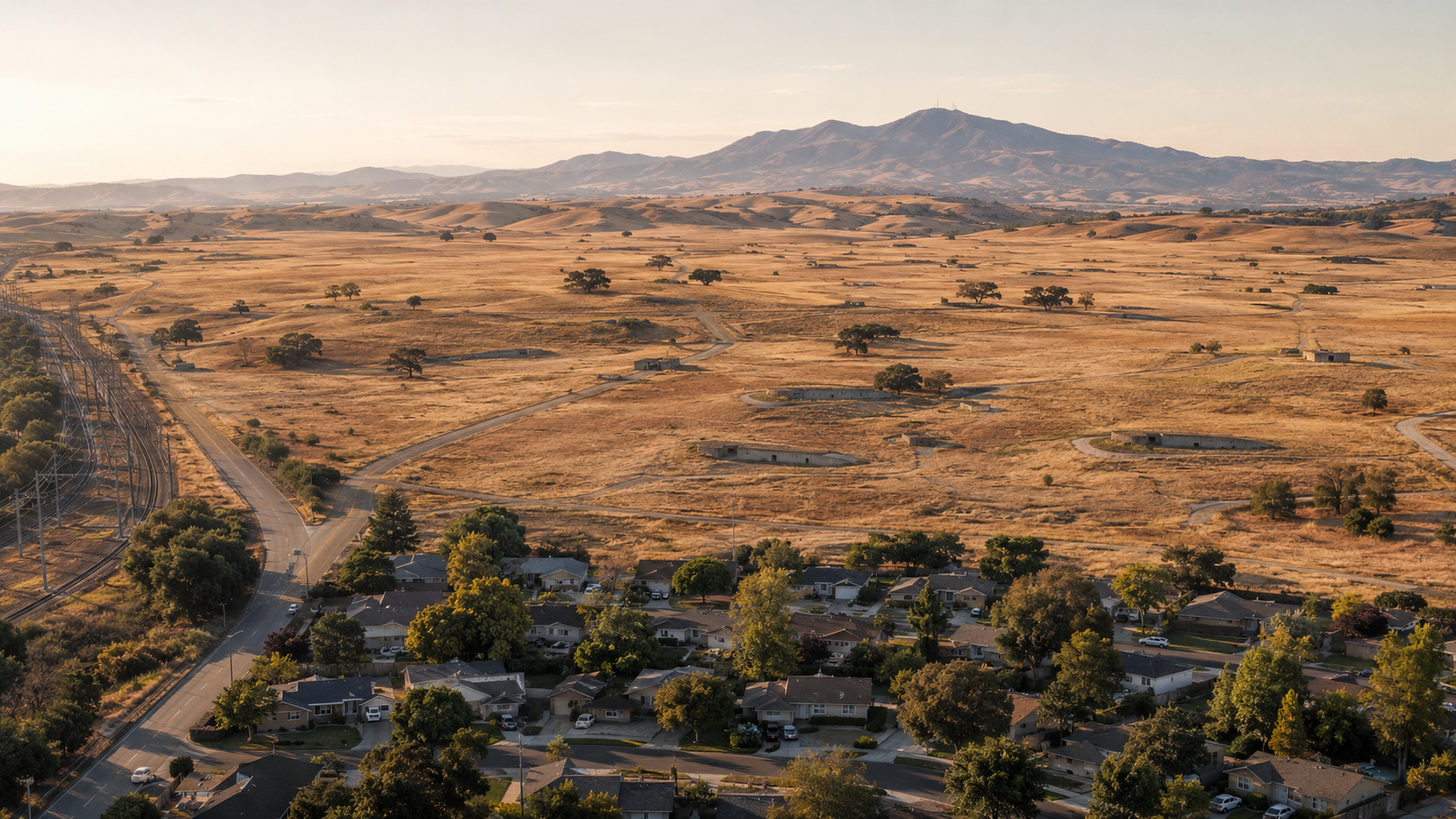
Photo: Houseberry
The Concord Naval Weapons Station redevelopment just took its biggest step in 20 years. On May 26, 2026, the Concord City Council unanimously approved a financial agreement between the U.S. Navy and Brookfield Properties to build 12,272 homes, 6 million square feet of commercial space, and more than 800 acres of parks on 2,422 acres of former military land.
For buyers across the East Bay, this reaches well past Concord. It is the largest active master plan in the Bay Area, it sits next to a BART station, and it will quietly shape resale demand and price-per-foot in Pittsburg, Pleasant Hill, Walnut Creek, and the Highway 4 corridor for the next 30 years.
Here is what is actually in the deal, what is still uncertain, and how to think about it if you are comparing neighborhoods today.
Concord Naval Weapons Station Redevelopment by the Numbers
The site is the inland 2,422-acre portion of the base that closed in 2005. Under the approved agreement, Brookfield Properties will pay the Navy $628 million over roughly three decades, starting with a $4.6 million deposit at the planned land transfer in 2030.
The headline numbers from the city and developer:
- 12,272 total homes across five phases over 30 years
- 3,068 deed-restricted affordable units, or 25 percent of the housing
- 6 million square feet of commercial space
- More than 800 acres of parks, trails, and open space
- First phase of 1,696 market-rate plus 562 affordable homes targeted to break ground in 2030
Brookfield is expected to submit the full Specific Plan, Environmental Impact Report, and Disposition and Development Agreement to the city in summer 2029, with permits and entitlements locked in by December 2029. The Concord BP Project site keeps the running version of that timeline.
Two things are worth flagging up front. The build-out is sequenced, not simultaneous, so most of those 12,272 homes will not hit the market until well into the 2030s and 2040s. And the agreement is a financial milestone, not the final entitlement. The Specific Plan and EIR still have to clear public review.
Why This Matters for Homebuyers
A project this size changes the math for buyers in three ways.
First, supply. The Bay Area has produced very little new for-sale housing relative to demand for years. A pipeline of 12,272 homes, even spread over 30 years, is a real number. The first phase alone, at 2,258 units, is larger than most full Bay Area master plans.
Second, mix. A quarter of the units are deed-restricted affordable. That is unusually high for a Bay Area greenfield project and will pull in a different buyer and renter profile than the surrounding Concord market does today.
Third, amenities. The plan includes 6 million square feet of commercial space and an 800-plus acre park system. New commercial nodes and parks usually do more for resale demand in nearby existing neighborhoods than they do for the master plan itself in the first few years. As a comparison point, Concord's current median sale price sits around $725,000 to $740,000 as of spring 2026, with inventory under one month of supply.
What It Means for Concord, Pittsburg, Pleasant Hill, and Walnut Creek
Each of these markets will feel the project differently.
Concord is the most directly exposed. Today the city is a mid-tier East Bay market, with prices well below Pleasant Hill and Walnut Creek and above Pittsburg. Most of the price pressure here will come from existing Concord neighborhoods becoming the close-in, already-built alternative to a long-running construction zone. Buyers who want a Concord address but do not want to wait or live next to active phases will likely bid more aggressively for established neighborhoods near Todos Santos Plaza, Dana Estates, and the Clayton Valley side of town.
Pittsburg is the affordability release valve. With a median sale price around $639,000 in spring 2026, Pittsburg already absorbs a lot of East Bay buyers priced out of Concord. New deed-restricted units at the base could redirect some of that demand back toward Concord, which would soften the upward pressure on Pittsburg over time. The flipside is that Pittsburg gets a closer, better-amenitized neighbor, which usually helps perception and resale for nearby ZIPs.
Pleasant Hill is the least exposed of the four. With a median around $1.2 million in early 2026, it sits in a different price tier. The likely effect is indirect. Higher-income households who would have considered Concord for value may stay in Pleasant Hill instead during the construction years, which could keep Pleasant Hill inventory tight.
Walnut Creek is the wildcard. Its median is around $795,500 in spring 2026. Walnut Creek already functions as the regional shopping and dining hub. A new commercial district at the base could pull some daily-spend dollars out of Walnut Creek over time, especially for buyers who want shorter trips for groceries, gym, or coffee. That is more a 2035 question than a 2027 one.
The North Concord BART Question
The first 2,200-ish units sit closest to the North Concord/Martinez BART station, which today is one of the least-used stops on the system. Multiple prior transit-oriented development attempts at that station have failed, including one developer who withdrew in 2022 partly because of uncertainty around the base.
If the first phase delivers on schedule, North Concord/Martinez goes from a parking-lot station to a walkable origin point for thousands of new households. That changes the commute math for buyers in two ways. It makes North Concord a real BART address rather than a marginal one, and it puts modest upward pressure on existing homes within walking distance of the station, where today the walk score is held back by gaps in pedestrian infrastructure on the station's east side.
The BART access question is also the biggest uncertainty. Without a real pedestrian connection between the station and the first phase, the project risks repeating the car-first pattern of other East Bay developments. Watch for the Specific Plan in 2029 to spell out exactly how that connection gets built.
The Highway 4 Corridor Buyer Ladder
Further east, the Highway 4 corridor has been the affordability ladder for the East Bay for years. Antioch's median sits in the low $600,000s in spring 2026, with Brentwood and Bay Point filling in around it.
A 30-year buildout in Concord does a few things to that ladder. It gives Highway 4 buyers a new option closer to BART and closer to Walnut Creek-style amenities. It expands the deed-restricted affordable inventory in central Contra Costa, which is currently concentrated further east. And it makes the commute trade-off sharper for buyers who currently choose Antioch or Brentwood mostly on price.
None of that means Antioch or Brentwood prices fall. The far more likely outcome is slower appreciation in the entry-level Highway 4 tier as buyers gain more choices closer in, while the higher-priced corners of Brentwood that compete on schools and acreage continue to do their own thing.
The Houseberry Angle
Stories like this are exactly why Houseberry focuses on neighborhood-level research instead of just listing-level details. A 30-year master plan changes schools, traffic, parks, retail, and resale dynamics across multiple cities, and almost none of that shows up in a single home's listing page.
If you are comparing East Bay neighborhoods right now, the practical questions are not about the master plan itself. They are about which existing neighborhoods quietly benefit from being the closer-in, already-built alternative, which ones lose some of their amenity edge over time, and which BART-adjacent areas have real walking infrastructure today instead of someday.
What to Watch Next
- Brookfield's full Specific Plan, EIR, and Disposition and Development Agreement, expected by summer 2029
- Permits and entitlements deadline in December 2029
- Land transfer from the Navy and $4.6 million initial deposit in 2030
- First-phase groundbreaking targeted for 2030
- Any updates to North Concord/Martinez BART pedestrian and bike access plans
- Concord and Contra Costa County school district boundary and capacity planning for the first phase
Final Thoughts
The Concord Naval Weapons Station redevelopment is one of the rare Bay Area projects big enough to shift how buyers compare neighborhoods across multiple cities at once. It is also early. Most of the actual housing is years away, and the parts that matter most for daily life, like the BART connection and the park network, still have to be designed in public.
For buyers today, the smartest move is not to chase the project itself. It is to understand which nearby neighborhoods are already getting upgraded by sitting next to it.
Concord Naval Weapons Station Redevelopment FAQs
When will homes at the Concord Naval Weapons Station actually be available?
The first phase of 1,696 market-rate and 562 affordable units is targeted to break ground in 2030, after the Navy transfers the land. Move-ins for the earliest units would realistically come a few years after that. Later phases will deliver into the 2040s and 2050s.
How will this affect Concord home prices in the short term?
Most of the near-term effect is on existing Concord neighborhoods that become the already-built, walkable alternative to a long construction site. Concord's median sale price was around $725,000 to $740,000 in spring 2026. Expect competition to sharpen first in established neighborhoods near downtown and on the Clayton Valley side, before any new units arrive.
Will the project bring more affordable housing to the East Bay?
Yes. The plan reserves 25 percent of units, or 3,068 homes, as deed-restricted affordable housing. That is high for a Bay Area master plan and will add meaningful affordable inventory to central Contra Costa, although the units will deliver in phases over 30 years rather than all at once.
Does the project improve BART access?
It has the potential to. North Concord/Martinez BART is one of the least-used stations in the system today, partly because it is hemmed in by the base. The first phase sits next to the station, which could turn it into a real walkable transit hub if the Specific Plan delivers strong pedestrian and bike connections. That is still to be designed.
How should I compare East Bay neighborhoods while this plays out?
Look beyond the headline. Compare schools, safety, walkability, parks, commute, and amenities at the neighborhood level, and treat the Concord project as a long-running input rather than a single event. Houseberry is built for exactly that kind of side-by-side neighborhood research.
Sources
- Local News Matters: Concord reaches milestone agreement to transform former naval weapons station
- Contra Costa News: Concord City Council approves financial agreement with the U.S. Navy
- The Real Deal: Concord approves Brookfield deal for Navy station homes
- Claycord: Concord City Council approves agreement for developing former Naval Weapons Station
- Concord BP Project (Brookfield Properties project site)
- BART: North Concord/Martinez station
- Redfin: Concord housing market
- Redfin: Pittsburg housing market
- Redfin: Pleasant Hill housing market
- Redfin: Walnut Creek housing market
- Redfin: Antioch housing market
All information provided on this website including but not limited to - school ratings, safety, amenities, user opinions, and property data - is for general informational purposes only. We do not guarantee its reliability, accuracy, or completeness. Users should independently verify information and consult appropriate professionals as needed. By using this website, you agree Houseberry is not responsible for actions, decisions, or consequences arising from reliance on the information provided
houseberry.com - CA DRE# 01847391
 Bay East ©2025. CCAR ©2025. bridgeMLS ©2025. Information Deemed Reliable But Not Guaranteed. This information is being provided by the Bay East MLS, or CCAR MLS, or bridgeMLS. The listings presented here may or may not be listed by the Broker/Agent operating this website. This information is intended for the personal use of consumers and may not be used for any purpose other than to identify prospective properties consumers may be interested in purchasing. Data last updated at September 13, 2026 12:00 AM