East Palo Alto Affordable Housing Rules Survive Pushback
A staff plan to temporarily ease East Palo Alto’s affordable housing requirements collapsed after residents and former council members pushed back. Here is what the stalled rollback means for the development pipeline and for buyers watching the city.
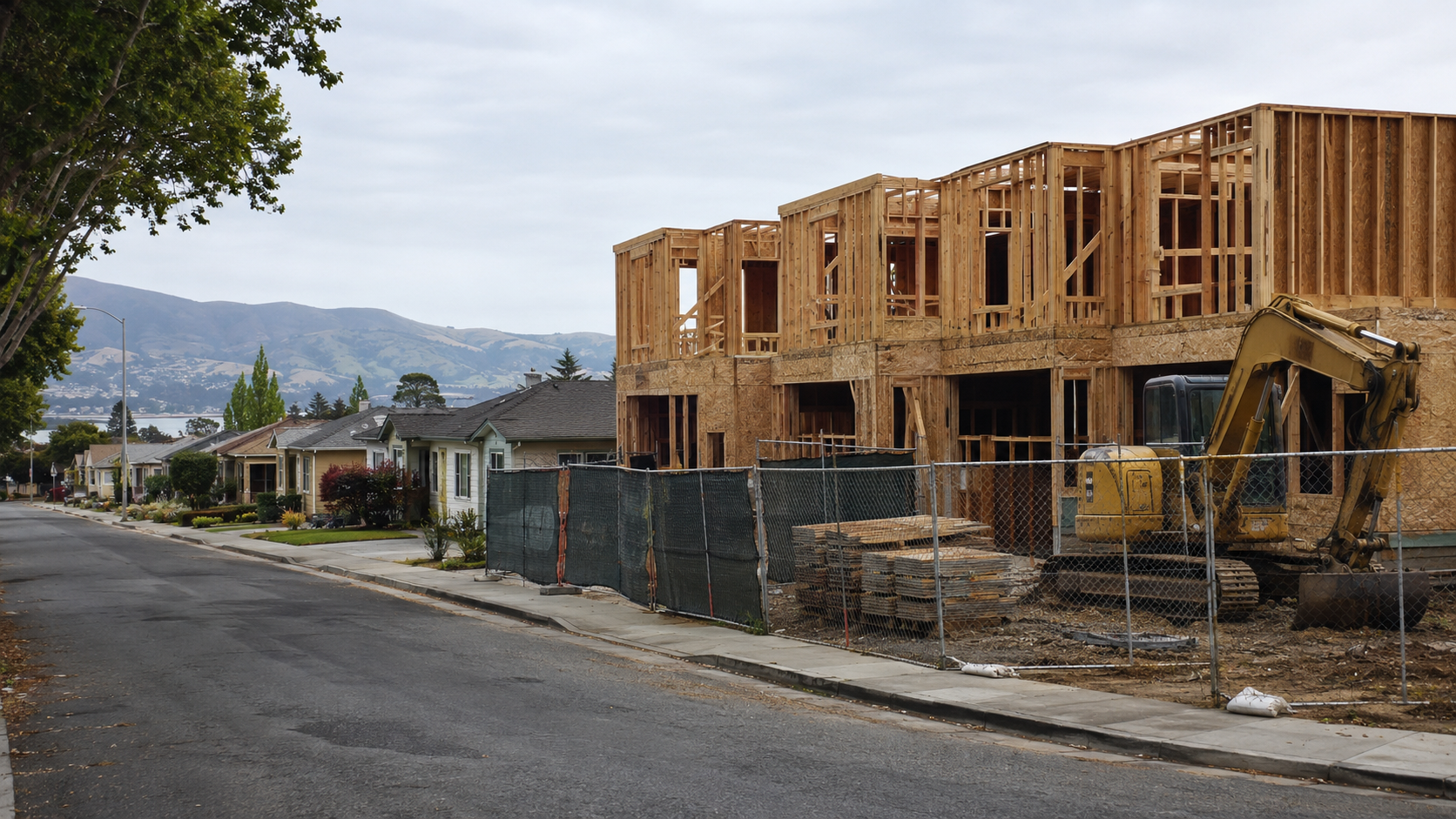
A paused townhome construction site on a quiet East Palo Alto street, reflecting the city’s affordable housing development debate. Photo: Houseberry
East Palo Alto spent another long night arguing about who gets to live there. On June 9, the City Council walked right up to the edge of loosening its East Palo Alto affordable housing rules, looked out at a packed room, and backed away.
A staff plan would have temporarily eased the city’s affordable housing requirements to coax stalled projects off the ground. It collapsed. Only Mayor Webster Lincoln and Council member Mark Dinan backed the incentive program, and with the rest of the dais unconvinced, the idea was shelved indefinitely after dozens of residents, community leaders, and former council members lined up against it, as Palo Alto Online reported.
For a city of fewer than 30,000 people wedged between the bay and Highway 101, this is a bigger deal than it sounds. The fight over what builders owe the community is, in practice, a fight over which projects actually get built. And that shapes nearly everything a buyer should care about here.
East Palo Alto’s Affordable Housing Rollback Stalls Out
The proposal was a temporary housing development incentive program. The pitch from supporters was straightforward: hit pause on the strictest local requirements while San Mateo County finishes a broader housing study that East Palo Alto paid $85,000 to join back in October. The council had planned to permanently rewrite the ordinance once that data lands in early 2027. The temporary program was meant to keep projects moving in the meantime.
It did not get there. When the votes were counted, the incentive plan had two supporters and not much else, so it was set aside with no timeline to return. The council did not kill the larger review, just this stopgap. For now, the existing rules stay exactly as they were.
What East Palo Alto’s Inclusionary Rules Actually Require
Here is the part most headlines skip. Under East Palo Alto’s inclusionary housing ordinance, 20 percent of the units in a new for-sale or rental project have to be affordable. For rentals, the city splits that further: 5 percent of units restricted at 35 percent of area median income, 10 percent at 50 percent, and 5 percent at 60 percent, per the City of East Palo Alto. Smaller projects with fewer than five units either provide at least one affordable unit or pay an in-lieu fee instead.
That fee is the number that keeps coming up. It runs about $299,200 per required unit this fiscal year. The current 20 percent on-site standard dates to 2019, though residents trace the city’s commitment to inclusionary housing back decades and treat it as part of East Palo Alto’s identity. That history is a big reason the room pushed back so hard.
The “20 Percent of Zero” Argument
The case for easing the rules is not nothing, and it is worth taking seriously. Supporters, including Dinan, argue that the policy has produced almost no affordable housing in practice. By their count, the 20 percent requirement has generated roughly one affordable unit in six years, which is where the slogan “20 percent of zero is zero” comes from. The argument: set the bar so high that nothing pencils out, and you do not get affordable units, you get no units at all.
The Regional Housing Needs Allocation numbers back up the worry. In the last cycle the city was on the hook for 266 market-rate units and built 28, and it hit about 67 percent of its moderate-income target. City Manager Melvin Gaines has warned the council that East Palo Alto still owes more than 70 very-low-income units and roughly 100 middle-income units by 2028, and that missing those targets risks the state decertifying its housing element. We are pro-housing here, and that math is real. When fees and mandates are steep enough to freeze construction, the people who lose first are usually renters staring at a market with almost no vacancy.
But the residents who showed up are not wrong either. Easing requirements does not automatically produce affordable homes, it just lowers what builders have to deliver. The council already showed it can cut deals project by project. Last September it let Sand Hill Property Company omit very-low-income units and reduce affordable townhomes at the long-vacant Four Corners parcel at University Avenue and Bay Road, and a townhome project at 1201 Runnymede Street has been cited as stuck on cost. Former Mayor Duane Bay urged the council to keep doing it that way, case by case, instead of a blanket rollback. Activist Ruben Abrica called the broader effort a “half-cooked process.” That is the standoff in one sentence: real shortage, real distrust, and not much middle ground yet.
Why This Matters for Homebuyers
If you are watching East Palo Alto, the lesson is not “rules good” or “rules bad.” It is that a city’s affordability fight is a leading indicator for its development pipeline, and the pipeline is what eventually shows up as inventory, new construction quality, and price pressure on the blocks you are comparing.
This is the habit we built Houseberry around. Before you fall for a listing, look at what the city is actually approving and where. A neighborhood with stalled projects and a contentious council can stay supply-starved for years, which props up prices on existing homes but also means fewer new options and slower change. A city that finally gets building can shift the feel of a corridor within a couple of cycles. It is the same dynamic we tracked in our piece on the Bay Area townhouse pipeline. Either way, the policy story tells you what the next few years probably look like, and that belongs on your checklist next to schools, commute, and insurance.
What This Could Mean for East Palo Alto
Start with price, because East Palo Alto’s position on the Peninsula is unusual. It sits right next to some of the most expensive housing in the country, yet its own median is a fraction of its neighbor’s. Here is the contrast, using Redfin data from February 2026:
| Area | Median sale price | Price per sq ft |
| East Palo Alto | ~$1.1M | ~$808 |
| Palo Alto (94301 core) | ~$4.3M | ~$2,080 |
| Palo Alto (94303, EPA border) | ~$1.2M | ~$1,050 |
A few things jump out. East Palo Alto’s median sat around $1.1 million, with price per square foot up about 20 percent year over year, so demand is clearly there even with thin supply. Meanwhile, look at the 94303 row. That is the Palo Alto-side zip that wraps right up to the East Palo Alto line, and its median runs close to East Palo Alto’s own, while the Palo Alto core in 94301 sits near $4.3 million (Redfin, February 2026). That border is exactly the kind of detail that disappears in a citywide average and shows up clearly when you compare East Palo Alto block by block.
Now layer the policy fight on top. With the temporary rollback shelved, the projects that supporters say are stuck stay stuck a while longer, and the county study becomes the real decision point. If East Palo Alto eventually loosens its requirements and building picks up near University Avenue and the Four Corners area, that changes traffic, retail, and the supply of newer homes. If it holds the line, expect the current pattern to continue: strong demand, tight inventory, and steady pressure on the homes that already exist.
What to Watch Next
A handful of signals will tell you which way this goes. First, the San Mateo countywide housing study, with data expected in early 2027, which is what the council says will drive any permanent change to the ordinance. Second, the 2028 RHNA deadline, since the closer it gets without progress, the more pressure builds to act. Third, individual projects like 1201 Runnymede Street and anything new at Four Corners, because case-by-case approvals are how this council has actually moved housing so far. And fourth, the council itself, where the split between the newer members pushing change and the residents defending the 2019 policy is not going away.
Final Thoughts
East Palo Alto did not settle anything on June 9. It hit pause on a stopgap and kicked the real decision to 2027. That is frustrating if you want movement, but it is also clarifying: the city’s affordability fight is now the single best thing to watch if you want to know where its housing market is headed.
If you are weighing a home here or anywhere on the Peninsula, the takeaway is to treat the local development story as data, not background noise. Reading the council fight, the pipeline, and the price gaps at the border is the whole reason we built Houseberry, because the neighborhood usually decides how a home actually lives day to day. For a sense of how that plays out one town over, our look at Palo Alto neighborhoods worth comparing is a useful companion to this one.
East Palo Alto Affordable Housing FAQs
What did East Palo Alto decide about its affordable housing rules?
On June 9, 2026, the City Council declined to move forward with a temporary plan to ease the city’s inclusionary housing requirements. Only Mayor Webster Lincoln and Council member Mark Dinan supported the incentive program, so it was shelved indefinitely after strong resident opposition. The existing rules remain in place, and a broader review continues.
What is East Palo Alto’s inclusionary housing requirement?
New for-sale and rental projects must make 20 percent of their units affordable. For rentals, that breaks down into 5 percent at 35 percent of area median income, 10 percent at 50 percent, and 5 percent at 60 percent. Smaller projects can provide one affordable unit or pay an in-lieu fee of roughly $299,200 per unit instead.
How does the stalled rollback affect new housing in East Palo Alto?
Projects that developers say are stuck on cost, like a townhome plan at 1201 Runnymede Street, do not get the temporary relief the incentive program would have offered. The council has still approved case-by-case reductions before, such as at the Four Corners site, so individual projects can move even while the citywide rules hold.
Is East Palo Alto a good place to buy a home right now?
It depends on what you value. East Palo Alto offers a far lower entry point than neighboring Palo Alto, with a median near $1.1 million in early 2026, but inventory is tight and the development picture is unsettled. Compare schools, safety, commute, and the local pipeline before deciding, rather than judging the city by one news story.
When could East Palo Alto change its affordable housing rules?
The council has tied any permanent change to a San Mateo countywide housing study, with data expected in early 2027. The 2028 Regional Housing Needs Allocation deadline adds pressure to act. Until then, the current 20 percent requirement and in-lieu fee structure stay in effect.
Sources
- Palo Alto Online — Protection or obstruction? East Palo Alto leaders clash over city’s affordable-housing law (June 12, 2026)
- Palo Alto Online / The Almanac — East Palo Alto backs review of affordable-housing rules (Oct 22, 2025)
- The Almanac — Council allows East Palo Alto housing project to reduce affordable units (Sept 3, 2025)
- Hoodline — East Palo Alto Power Play Puts Affordable Housing Rules on the Chopping Block (Mar 29, 2026)
- East Palo Alto Sun — 20% of Zero is Zero (op-ed by Council Member Mark Dinan)
- City of East Palo Alto — Inclusionary Housing
- Redfin — East Palo Alto Housing Market (Feb 2026)
- Redfin — Palo Alto 94301 Housing Market (Feb 2026)
All information provided on this website including but not limited to - school ratings, safety, amenities, user opinions, and property data - is for general informational purposes only. We do not guarantee its reliability, accuracy, or completeness. Users should independently verify information and consult appropriate professionals as needed. By using this website, you agree Houseberry is not responsible for actions, decisions, or consequences arising from reliance on the information provided
houseberry.com - CA DRE# 01847391
 Bay East ©2025. CCAR ©2025. bridgeMLS ©2025. Information Deemed Reliable But Not Guaranteed. This information is being provided by the Bay East MLS, or CCAR MLS, or bridgeMLS. The listings presented here may or may not be listed by the Broker/Agent operating this website. This information is intended for the personal use of consumers and may not be used for any purpose other than to identify prospective properties consumers may be interested in purchasing. Data last updated at September 15, 2026 12:00 AM