How AI Is Splitting the Bay Area Housing Market
A new Redfin report shows AI wealth is splitting the Bay Area housing market in two, with luxury zip codes up 13.4% while the most affordable ones have lost value. Here is what it means for buyers comparing neighborhoods.
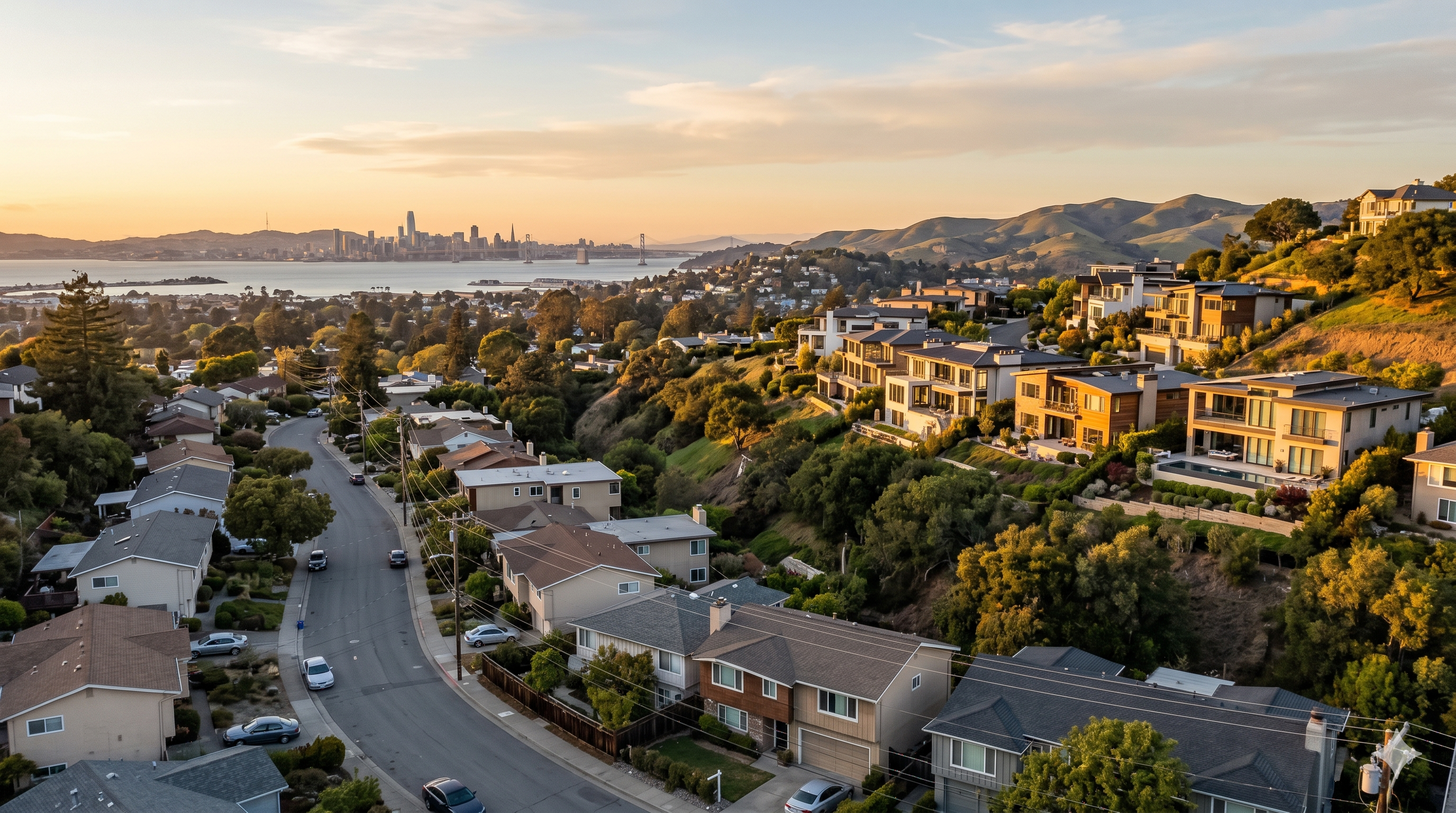
Photo: Houseberry
A new Redfin analysis shows the AI Bay Area housing market is moving in two very different directions at once. Luxury homes in the region have jumped 13.4% since ChatGPT launched in November 2022, while the most affordable Bay Area zip codes have actually lost value, falling 3.8% over the same period.
For buyers comparing neighborhoods right now, the story matters well beyond the high end. The gap between Bay Area neighborhoods is widening fast, and the old assumption that "all Bay Area homes go up" no longer holds. Where you buy matters more than it used to.
According to Fortune's coverage of the report, Redfin senior economist Yingqi Xu called this "another sign of the K-shaped economy taking shape in the Bay Area, with AI lifting the fortunes of some households and neighborhoods much more than others."
It is a sharp break from the recent past. Between 2020 and 2022, before ChatGPT, Bay Area home prices grew at roughly the same pace across all tiers, around 20%, mostly driven by low mortgage rates and pandemic-era demand. Now the top is pulling away from the bottom.
The pattern appears to be specific to the Bay Area. New York's luxury zip codes have seen the slowest growth since ChatGPT, the opposite trend. Los Angeles luxury outperformed slightly but not meaningfully. Seattle's price tiers moved together. The Redfin report concluded that the absence of this divergence elsewhere suggests "the AI boom is what is fueling divergence in the Bay Area."
The broader market is heating up at the top too. The San Francisco metro median sale price hit a record $1.7 million in March 2026, up 14.4% year over year, according to Redfin data cited in the Fortune coverage.
Why This Matters for Homebuyers
For anyone shopping in the Bay Area, the takeaway is that neighborhood-level performance now differs more than it has in years. A 13% gain in one zip code and a 4% loss in another is not the kind of variation that gets averaged out in a regional report.
A few things worth thinking about:
The cheaper-on-paper home is not always the better value. Redfin chief economist Daryl Fairweather pointed out that many of the lower-end Bay Area properties losing value are older condos with high HOA fees or homes that need significant repairs. "It is not so much that these homes are becoming more affordable, but rather that they're being devalued by homebuyers," she said.
Salaried white-collar buyers and AI-windfall buyers are now shopping in different worlds. Most ordinary buyers cannot compete on the luxury end, and the lower end carries its own friction (HOA dues, repair backlogs, older systems). The middle of the market is where most actual decision-making happens, and that is where neighborhood research pays off.
Past appreciation is not guaranteed future appreciation. A neighborhood that grew 20% a year during the pandemic boom is not automatically going to keep growing. The AI divide shows that local conditions, like who is buying, what kind of jobs they have, and what the housing stock looks like, matter more than a regional average.
What This Could Mean for Bay Area Neighborhoods
The Redfin report does not name specific zip codes, but the implication is clear. Bay Area neighborhoods clustered around major AI employers, including Atherton, parts of Palo Alto, the higher-end Peninsula, and the higher-priced parts of San Francisco, are likely doing the heavy lifting in that 13.4% luxury number.
Neighborhoods at the lower end of the price spectrum, often in the outer East Bay or parts of the South Bay with older condo stock, may be where the 3.8% decline is concentrated.
For homeowners, this is a mixed signal. If your neighborhood sits in a luxury-adjacent zone, your equity may have grown faster than you realized. If your neighborhood is in the lower tier, the question is less about whether to sell and more about whether the surrounding fundamentals (schools, safety, walkability, amenities, condition of nearby housing) justify long-term confidence.
For buyers, the takeaway is that "the Bay Area" is no longer one market. Comparing two neighborhoods 10 miles apart can mean comparing very different price trajectories.
The Houseberry Angle
Stories like this are why neighborhood-level research matters more than listing-level scrolling. A K-shaped Bay Area market means an averaged regional number can hide a lot. Two homes at the same price in two different zip codes can have very different next-five-year stories.
Houseberry is built around comparing neighborhoods on the things that actually shape long-term value: schools, safety, amenities, public spaces, and how an area is changing. When the regional average says one thing and the neighborhood-level data says another, the neighborhood view is the one worth trusting.
What to Watch Next
A few signals worth tracking if you are following the Bay Area housing market:
Whether AI-related layoffs in 2026 start to flatten the luxury surge. Several large tech companies have announced workforce reductions tied to AI-driven productivity gains. If those cuts hit the salaried workers who would normally be moving up into the lux range, demand could soften.
Whether lower-tier price declines stabilize. A 3.8% drop over a couple of years is not a collapse, but if HOA fees, insurance costs, and repair backlogs keep climbing, that tier could see more pain.
How school district performance and rezoning decisions shift demand. Even in a K-shaped market, school quality remains one of the strongest drivers of neighborhood demand in the Bay Area.
Whether other AI-heavy metros like Seattle start showing the same pattern. So far, the Bay Area is alone in this divergence. If Seattle starts diverging too, it would suggest the pattern is structural to AI hubs, not just to the Bay.
Final Thoughts
The AI Bay Area housing market story is really a neighborhood story dressed up as a tech story. Big regional headlines about a 13% luxury surge or a record $1.7M median miss the fact that gains and losses are concentrated in specific zip codes. For anyone choosing where to buy, the right move is to stop reading the regional average and start comparing neighborhoods on the fundamentals.
AI Bay Area Housing Market FAQs
Why are luxury Bay Area homes outperforming affordable ones?
Redfin's report ties the gap to AI wealth. Executives, founders, and investors with windfalls from the AI boom are concentrated in the Bay Area and have been buying multi-million-dollar homes, while salaried workers feeling pressure from AI job risk have pulled back. The pattern does not appear in New York, Los Angeles, or Seattle in the same way.
Does this mean lower-end Bay Area homes are a bargain?
Not automatically. According to Redfin chief economist Daryl Fairweather, many of the homes in the declining tier are older condos with high HOA fees or properties that need significant repairs. A lower asking price can be offset by carrying costs or capital improvements, so the math has to be checked individually.
Which Bay Area neighborhoods are gaining the most?
The Redfin report does not name specific zip codes, but the luxury tier ($3.1M to $7.6M) is heavily concentrated in neighborhoods near major AI employers. Atherton, Palo Alto, Hillsborough, and similar high-end Peninsula and San Francisco zip codes are likely doing the heavy lifting.
How can I compare Bay Area neighborhoods before buying?
Look beyond the listing price. Compare schools (state testing data), safety (city-level reports), amenities and walkability, public spaces, HOA structure if relevant, and how the surrounding zip codes are trending. Houseberry is built specifically for this kind of neighborhood-to-neighborhood comparison.
Is the K-shaped housing market a Bay Area thing only?
For now, mostly yes. Redfin found that the AI-driven luxury surge with a simultaneous low-end decline is unique to the Bay Area among major metros. New York's luxury market has actually grown slowest, and Seattle's tiers have moved together. If AI wealth concentrates elsewhere, that could change.
Sources
- AI is quietly splitting the housing market in two: Bay Area luxury homes are up 13%, affordable ones are collapsing (Fortune, May 7, 2026)
- Bay Area Luxury Home Prices Have Jumped 13% Since Launch of ChatGPT (Redfin via BusinessWire)
- ChatGPT's impact on Bay Area luxury home prices (Real Estate News, May 5, 2026)
- Bay Area luxury home prices surge 13% since AI boom, Redfin finds (Fox Business)
All information provided on this website including but not limited to - school ratings, safety, amenities, user opinions, and property data - is for general informational purposes only. We do not guarantee its reliability, accuracy, or completeness. Users should independently verify information and consult appropriate professionals as needed. By using this website, you agree Houseberry is not responsible for actions, decisions, or consequences arising from reliance on the information provided
houseberry.com - CA DRE# 01847391
 Bay East ©2025. CCAR ©2025. bridgeMLS ©2025. Information Deemed Reliable But Not Guaranteed. This information is being provided by the Bay East MLS, or CCAR MLS, or bridgeMLS. The listings presented here may or may not be listed by the Broker/Agent operating this website. This information is intended for the personal use of consumers and may not be used for any purpose other than to identify prospective properties consumers may be interested in purchasing. Data last updated at September 14, 2026 12:00 AM