Lafayette Breaks Ground on a Seven-Story BART Project
Diamond Construction broke ground on a seven-story, roughly 90-home building steps from the Lafayette BART station, a notably tall transit-oriented development for a low-rise town.

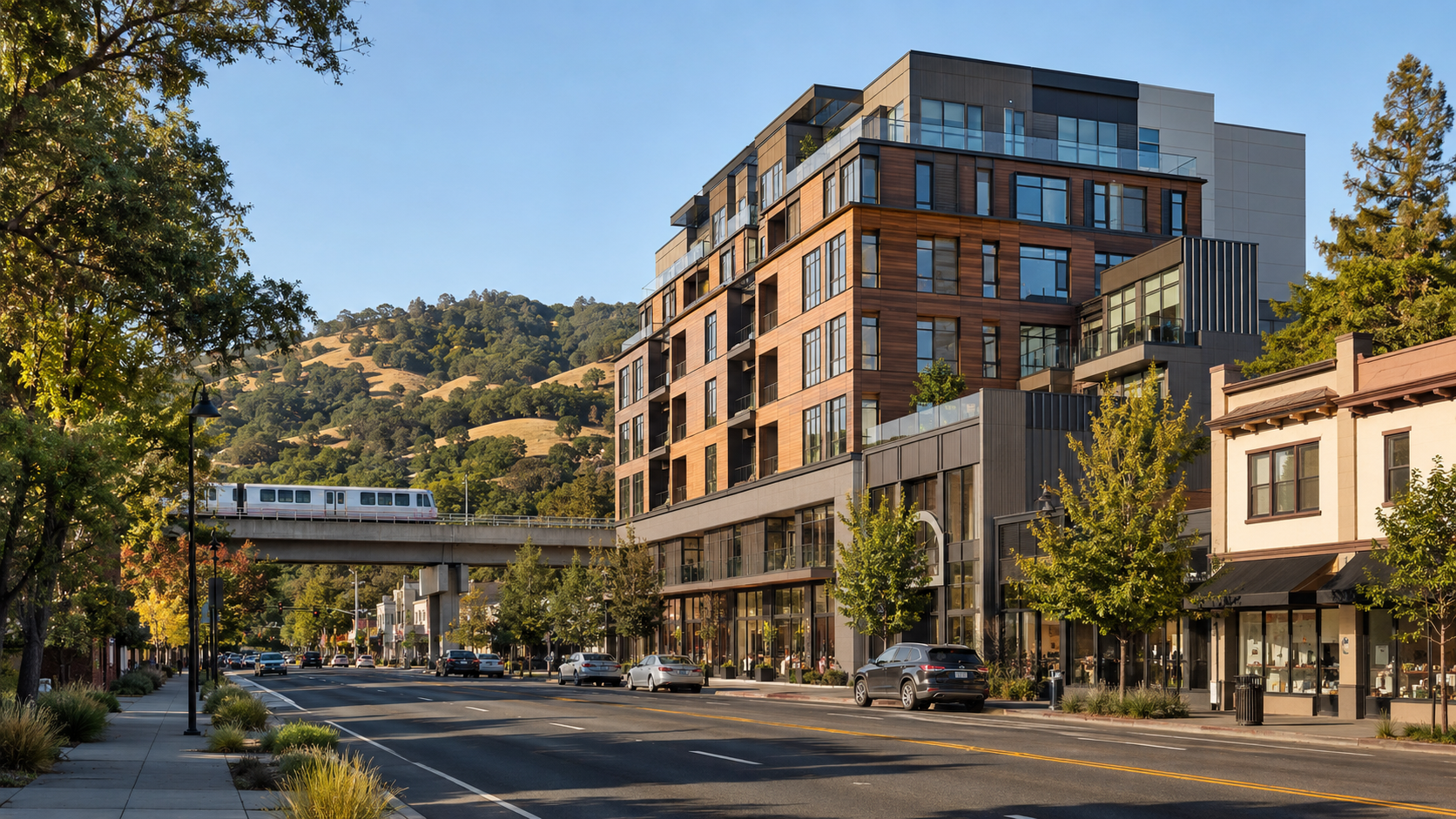
A seven-story mixed-use transit-oriented development under construction near the Lafayette BART station in the East Bay. Photo: Houseberry
On June 25, crews broke ground at 1001 Oak Hill Road, one block from the Lafayette BART station, on a building that will rise seven stories and 87 feet. In most of the Bay Area that is a shrug. In Lafayette, a town that measures its downtown in one- and two-story storefronts, a seven-story transit-oriented development is close to a skyline event. Diamond Construction is the builder, and completion is targeted for summer 2028.
For a city long defined by big lots and detached single-family homes, this is a genuinely new shape. And it is going in the one spot where the height makes the most sense, which is right next to the train.
What is going up at 1001 Oak Hill Road
The project has been through several rounds of design since the first application in 2022, growing along the way. Here is where the current version landed, per the plans filed with the city:
- Seven stories and 87 feet on a 1.2-acre lot, about 172,400 square feet in all
- Around 90 homes, a mix of 19 one-bedrooms, 49 two-bedrooms, and 22 three-bedrooms
- 11 of those homes set aside as below market rate, five for very low income and six for moderate income households
- 2,000 square feet of ground-floor retail
- A two-level garage using car stackers to fit 186 vehicles, plus room for 52 bikes
- Two interior courtyards, a fourth-floor pool deck, and stepped terraces on the top three floors
- Owned and developed by local builder Jeff Stone of Diamond Construction, with design by SDTarch, formerly Trachtenberg Architects
One housekeeping note, because sources vary. A regional construction brief credited the developer as Related California, but the city filings and the property owner of record point to Diamond Construction and Jeff Stone, so that is who we are crediting. A separate report also pegged the unit count nearer 85 than 90, the kind of small drift you expect as a project moves from design into permits. Call it about 90 homes and you are close enough.
What a seven-story BART project means for Lafayette
The interesting part is not the pool deck. It is the family-size unit mix. Seventy-one of the roughly 90 homes are two- and three-bedrooms, which is unusual for a transit-oriented building. A lot of BART-adjacent projects are studios and one-bedrooms aimed at solo commuters. This one is built for households that want to stay, not just sleep near the platform. In a town where the main way in has been buying a detached house on a big lot, that is a real second door.
It is also, honestly, the kind of project Lamorinda has resisted for decades. Lafayette, Moraga, and Orinda have long leaned toward keeping things low and green, and a seven-story building a block off Mount Diablo Boulevard is a visible break from that. The plan tries to soften the jump with setbacks that step the mass back from the street and a facade of metal panels, plaster, and wood-look siding meant to read as restrained rather than looming.
It is fair to name the costs. Getting here meant demolishing two existing buildings and removing 22 trees, and the design leans on 186 stacked parking spaces, a large garage for a project whose entire selling point is that you can walk to the train. That parking count is a concession to the reality that this is still a car-first town. But the core trade is a good one. Putting roughly 90 homes, 11 of them affordable, on a walk to regional rail is close to the textbook definition of where the region should be adding housing. If the Bay Area wants people to drive less, this is what it physically looks like.
What it means if you are shopping Lafayette
For buyers, a building like this quietly widens what Lafayette even offers. The town's reputation runs to multimillion-dollar estates, the kind we looked at when a Happy Valley home listed at $4.45 million after 59 years in one family. This is the other end of the same city, an apartment you can rent, or possibly own if any of the homes sell as condos, within a short walk of BART, without taking on an acre of land and a 1960s roof.
That range is exactly why we push people to compare Lafayette at the neighborhood level instead of treating it as one uniform price tag. The blocks near downtown and the station live very differently from the hillside estate pockets, on commute, on walkability, and on price. Before you decide Lafayette is out of reach or automatically worth the premium, line up the top-ranked neighborhoods in Lafayette and where the value sits, and read the Lafayette city guide for the plain-English version of what the town scores well and poorly on. A single new building near BART does not remake the whole city. It does add one more option to a market that has been short on them.
A few quick questions
Is Lafayette adding more high-density housing?
Slowly, and mostly near BART. 1001 Oak Hill Road is the most prominent example, a seven-story, roughly 90-home building a block from the station, and it joins a handful of other multi-story projects clustered around the Lafayette BART area. The town stays overwhelmingly single-family, so these transit-adjacent sites are where the density is going.
How close is 1001 Oak Hill Road to BART?
About a block. The site sits on Oak Hill Road near Mount Diablo Boulevard, an easy walk from the Lafayette BART station and across from the Plaza Center shopping strip anchored by Safeway and Whole Foods. That walkability is the entire case for building tall here rather than somewhere off the transit line.
Will a project like this change Lafayette home values?
Not by itself, and not overnight. A single building of about 90 homes does not move a whole city's prices. What it does is add rental, and possibly entry-level, options in a market dominated by expensive detached houses, which over time gives more people a way into a town they otherwise could not touch. Completion is targeted for 2028, so any real effect is years out.
Sources
Atlas Premier, Bay Area Development and Construction Brief: July 1 through July 7, 2026
San Francisco YIMBY, Increased Plans Revealed for 1001 Oak Hill Road, Lafayette
The Registry, Lafayette's Downtown to Gain 90-Unit Mixed-Use Development at 1001-1009 Oak Hill Road
Houseberry, Happy Valley Lafayette and the Math of a 59-Year Hold
Houseberry, top-ranked neighborhoods in Lafayette
The Houseberry Research Team is Houseberry's reporting team: Bay Area real estate analysts, data specialists and longtime local market watchers. Every day we check the public record: building permits, city council and planning agendas, county recorder filings, state housing bills, police incident data and school results. Then we tie each story to what it means for specific neighborhoods, using Houseberry's own neighborhood data on prices, appreciation, safety, schools and amenities. Questions or corrections: Contact us.
Map of Lafayette Neighborhoods
Loading map...
View Full Map
Top Neighborhoods in Lafayette, CA


All information provided on this website including but not limited to - school ratings, safety, amenities, user opinions, and property data - is for general informational purposes only. We do not guarantee its reliability, accuracy, or completeness. Users should independently verify information and consult appropriate professionals as needed. By using this website, you agree Houseberry is not responsible for actions, decisions, or consequences arising from reliance on the information provided
houseberry.com - CA DRE# 01847391
 Bay East ©2025. CCAR ©2025. bridgeMLS ©2025. Information Deemed Reliable But Not Guaranteed. This information is being provided by the Bay East MLS, or CCAR MLS, or bridgeMLS. The listings presented here may or may not be listed by the Broker/Agent operating this website. This information is intended for the personal use of consumers and may not be used for any purpose other than to identify prospective properties consumers may be interested in purchasing. Data last updated at October 3, 2026 12:00 AM