New Oakland Trail Reshapes East Oakland Walkability
Oakland’s East Bay Greenway just added an off-street walk and bike path from Coliseum BART to Seminary Avenue, with new lighting and street trees that change daily life and walkability for East Oakland neighborhoods near the line.
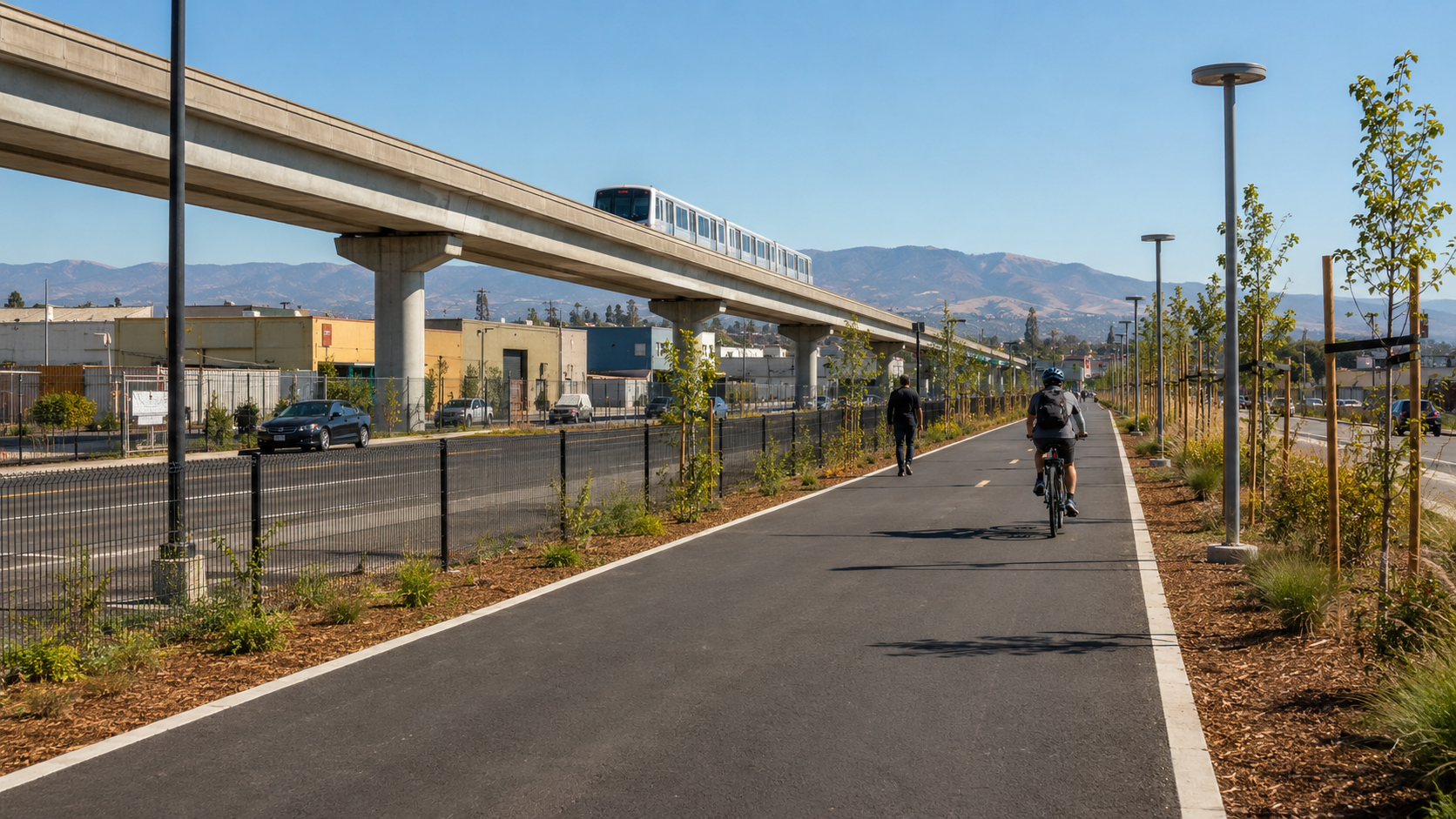
Photo: Houseberry
On Wednesday, June 10, Oakland cut the ribbon on the newest stretch of the East Bay Greenway, a half-mile off-street walking and biking path that runs north from Coliseum BART up to Seminary Avenue. If you have ever tried to walk along San Leandro Street, you know why this matters. That corridor was built for trucks and fast cars, not for people. Now there is a wide, lit, tree-lined path where there used to be none.
The Oakland East Bay Greenway is more than a bike lane. It is a 12-foot-wide shared path separated from traffic by fencing, paired with new pedestrian-scale lighting, street trees, drought-tolerant landscaping, and safer crossings at Seminary, 66th, and 69th Avenues. For the Elmhurst and Coliseum-area neighborhoods that hug this part of East Oakland, the everyday math of getting around just shifted.
What the East Bay Greenway Actually Built in Oakland
Here is the part that gets lost in the press release. This is Phase II, and it fills a gap.OakDOT built the first phase back in November 2019, a half-mile shared path from Coliseum BART near 73rd Avenue up to 85th Avenue. Good, but it stranded a stub of trail with no comfortable way to reach it from the north.
Phase II extends that same 12-foot path along San Leandro Street from Seminary Avenue down to 69th Avenue, then transitions to striped bike lanes from 69th to 75th that tie into the existing 2019 segment. So now you can move on a continuous, protected route from Seminary all the way to 85th. The project scope also includes fencing to keep the path away from high-speed traffic, plus three years of bike education workshops for residents of the nearby Coliseum Place affordable housing development.
It was paid for with a mix of state Affordable Housing and Sustainable Communities money, drawn from California’s Greenhouse Gas Reduction Fund, and Federal Transit Administration grant dollars. The funding is tied to two affordable housing projects next to Coliseum BART, Coliseum Connections and Coliseum Place. That is the whole point of the program. Build homes near transit, then make it safe to actually walk and bike to that transit.
Why This Matters for Homebuyers
Walkability is not a vibe. It is infrastructure, and infrastructure is exactly the kind of thing that quietly moves a neighborhood’s livability over a five-year window. A continuous off-street path changes how a kid gets to a friend’s house, how someone without a car reaches the BART platform, and whether an evening walk feels safe enough to bother with. Lighting and street trees do real work here.
For buyers, the practical question is not whether one trail makes East Oakland a better deal overnight. It does not. The question is which blocks now sit within an easy, pleasant walk of regional transit, and whether that access is likely to keep improving. Homes within a few hundred feet of a quiet, lit path are a different daily experience than homes facing four lanes of San Leandro Street traffic. Same listing photos, very different lived reality.
This is also a reminder that the Coliseum area is mid-transformation. The Coliseum Connections housing at the BART station added 110 mixed-income units. More housing near transit, plus safer ways to reach it, is roughly what every regional plan says the Bay Area needs. When you see the public money following that pattern, it tells you where the city is trying to push growth.
What This Could Mean for East Oakland Neighborhoods
Be honest about the limits. One half-mile segment does not erase decades of disinvestment along the San Leandro Street corridor, and it does not fix the things East Oakland residents will tell you matter most. Trees take years to throw real shade. A path is only as good as how well it is maintained and how safe it feels after dark.
But the direction is right, and it is part of something much bigger. This Oakland work is one piece of the 16-mile East Bay Greenway that Alameda CTC is assembling from Lake Merritt BART down to South Hayward BART, connecting seven BART stations through Oakland, San Leandro, and Hayward. The next Oakland segment, from 35th Avenue to 54th Avenue, already has a finished design and has been advertised for construction bids, with work expected to start in late 2026 or early 2027. The line is slowly getting stitched together.
If you are comparing blocks in East Oakland and the wider city, the smart move is to look at where the Greenway already runs, and where it is heading next. Proximity to a future segment is the kind of thing that is cheap to research now and obvious in hindsight later.
The Houseberry Angle
Stories like this are exactly why Houseberry focuses on neighborhood-level research instead of only listing-level details. A home two blocks off the new path and a home directly on a loud, fast arterial can sit in the same zip code and even carry similar prices, but they are not the same place to live. Walkability, transit access, lighting, and public space all shape what a neighborhood actually feels like day to day.
If you are weighing options across Oakland neighborhoods, it helps to look past the curb appeal of any single house and compare the things that change slowly and matter for years: schools, safety, amenities, and the walking and transit network around it. A new trail is one data point. The full picture is the neighborhood.
What to Watch Next
The 35th to 54th Avenue Oakland segment, advertised for bids, with construction expected in late 2026 or early 2027.
How the new path is maintained and lit through its first winter. Upkeep is the real test of whether infrastructure delivers.
Whether the Coliseum BART area keeps adding transit-oriented housing as the Greenway fills in.
Progress on the broader 16-mile Lake Merritt to South Hayward route, which determines how connected these neighborhoods eventually become.
Final Thoughts
A half-mile of trail will not make headlines for long. But for the people who live near San Leandro Street, a safe, lit, tree-lined way to reach BART on foot or by bike is the kind of slow, real improvement that adds up. Watch where the rest of the line goes. That is where the next quiet change in East Oakland walkability will show up first.
East Bay Greenway Oakland FAQs
Where is the new East Bay Greenway trail segment in Oakland?
The newest segment runs along San Leandro Street in East Oakland, from Seminary Avenue south to 69th Avenue near Coliseum BART, then connects via bike lanes from 69th to 75th into the existing 2019 path that continues to 85th Avenue.
Does a walking and biking trail affect home values?
It can, indirectly. Trails improve walkability and transit access, which are part of what makes a neighborhood desirable over time. One short segment will not move prices on its own, but better infrastructure near transit tends to support demand. It is one factor to research, not a guarantee.
Is East Oakland a good place to buy a home?
It depends heavily on the specific block. East Oakland is large and varied, and conditions change street to street. Investments like the East Bay Greenway are positive signals, but buyers should compare schools, safety, amenities, and transit access at the neighborhood level rather than treating the whole area as one thing.
What is the full East Bay Greenway project?
It is a planned 16-mile walking and biking corridor following the BART line from Lake Merritt BART in Oakland to South Hayward BART, connecting seven BART stations across Oakland, San Leandro, and Hayward. It is being built in segments by Alameda CTC and partner cities over several years.
How can I compare Oakland neighborhoods before buying?
Look at neighborhood-level data rather than just a single listing. Houseberry lets you compare Oakland neighborhoods across schools, safety, amenities, value, and walkability so you can understand the area around a home before you focus your search there.
Sources
City of Oakland, East Bay Greenway Phase II
Bike East Bay, East Bay Greenway campaign
Alameda CTC, East Bay Greenway: Lake Merritt BART to South Hayward BART
Oaklandside, East Bay Greenway expansion coverage (Feb 2026)
California HCD, Affordable Housing and Sustainable Communities Program
All information provided on this website including but not limited to - school ratings, safety, amenities, user opinions, and property data - is for general informational purposes only. We do not guarantee its reliability, accuracy, or completeness. Users should independently verify information and consult appropriate professionals as needed. By using this website, you agree Houseberry is not responsible for actions, decisions, or consequences arising from reliance on the information provided
houseberry.com - CA DRE# 01847391
 Bay East ©2025. CCAR ©2025. bridgeMLS ©2025. Information Deemed Reliable But Not Guaranteed. This information is being provided by the Bay East MLS, or CCAR MLS, or bridgeMLS. The listings presented here may or may not be listed by the Broker/Agent operating this website. This information is intended for the personal use of consumers and may not be used for any purpose other than to identify prospective properties consumers may be interested in purchasing. Data last updated at September 14, 2026 12:00 AM