Oakland Coliseum Sale Races a June 30 Deadline
Alameda County just approved terms to sell its half of the Oakland Coliseum to AASEG by June 30, clearing the way for a $5 billion redevelopment. Here is what it means for East Oakland home values and how long buyers should expect to wait.
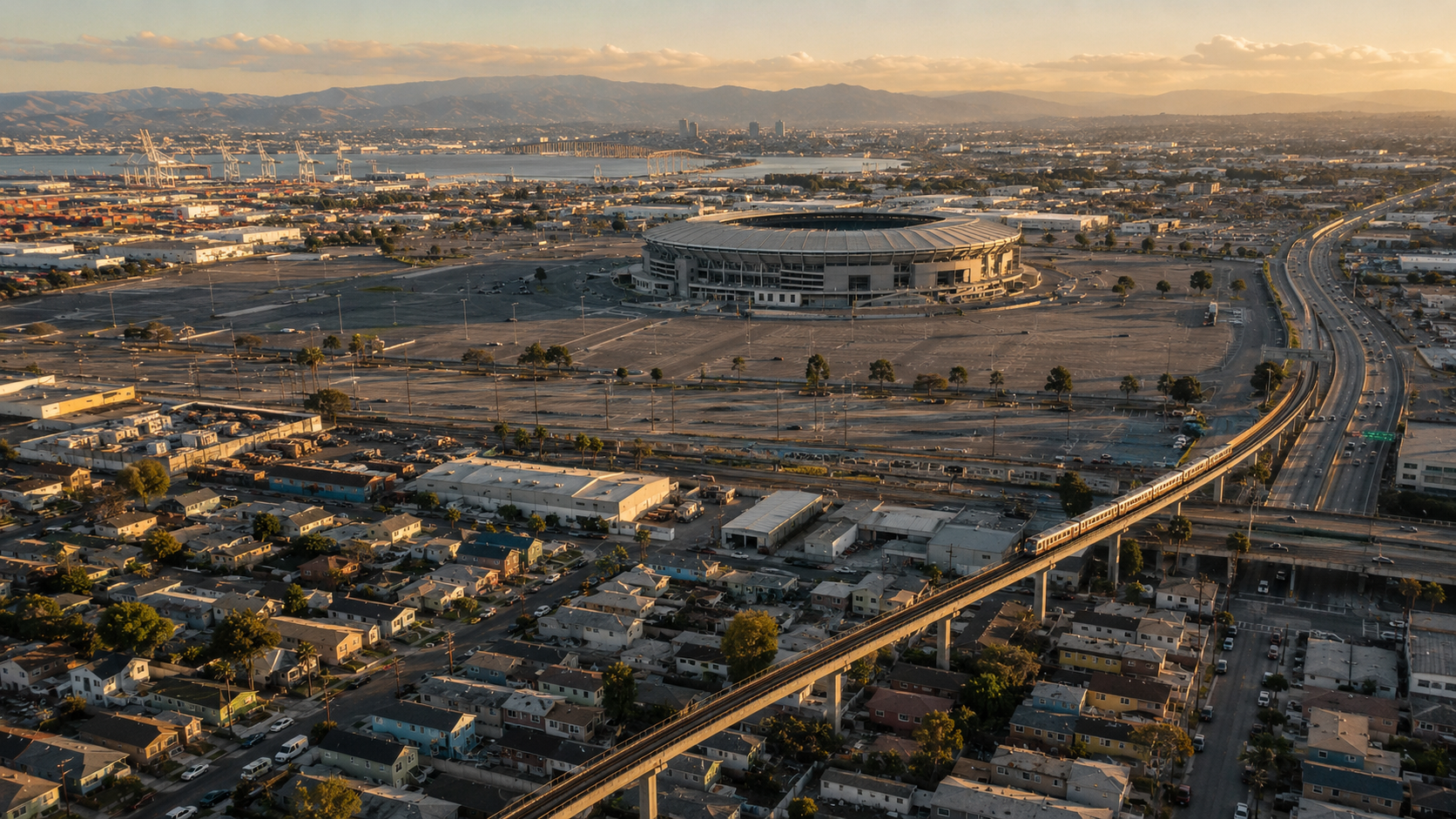
A wide view of the Oakland Coliseum site and the surrounding East Oakland neighborhood at the center of a $5 billion sale and redevelopment plan. Photo: Houseberry
The Oakland Coliseum sale has a date on it now. June 30. That is the deadline for Alameda County to finish handing its half of the 112-acre Coliseum complex to the African American Sports and Entertainment Group, the Black-led developer team that wants to turn the site into a roughly $5 billion mix of homes, retail, and entertainment. On May 28, the county Board of Supervisors unanimously approved a nonbinding term sheet laying out how to get there, according to The Oaklandside. The vote moved the deal forward. It did not finish it.
If you live near the Coliseum, or you are weighing a home anywhere in the East Oakland flatlands, this is the rare local story where the timeline matters as much as the headline. A $5 billion plan sounds like a sure thing. The calendar says otherwise.
What the June 30 deadline actually covers
Start with what is being sold, because it is easy to get lost. Oakland already sold its half of the Coliseum to AASEG back in 2024, a deal The Oaklandside covered at the time. The piece racing the clock now is the county's half. Under the term sheet, Alameda County would first buy back its share of the complex from the Oakland Athletics, then turn around and sell the whole site to AASEG.
The price on the county's half is $115 million, paid in three installments over several years, with 5 percent interest compounding annually on the unpaid balance. That structure tells you something. AASEG is not writing one big check. It is buying time to line up financing for a project that will take decades to build.
None of this is final until it closes. The supervisors approved terms, not a signature. The actual transfer still has to clear a closing by June 30, and Oakland leaders have already moved this finish line once, from mid-2025 to mid-2026, when the city pushed its timeline to line up with the county. A deadline that has already slipped once is not a deadline you bet the house on.
The $5 billion vision, and the part that is actually locked in
Here is the long-game pitch. AASEG wants to spend north of $5 billion redeveloping the full 112 acres into housing, retail, restaurants, and entertainment space over roughly 30 years. It is sold as an economic-revitalization engine for a part of the city that has gone without serious private investment for a long time. That is a real need, and it is also a 30-year forecast, which is a genre of optimism. Hold the vision and the verified pieces in separate hands.
The number that matters most for neighbors is the housing commitment, and it is firmer than the rest:
- About a quarter of the housing on the site is set aside as deed-restricted affordable homes
- The site is roughly 112 acres of infill, sitting directly on Coliseum BART and steps from the Amtrak Capitol Corridor stop
- Build-out is phased across about 30 years, not delivered all at once
- The exact final home count depends on a specific plan that does not exist yet
A quarter of the homes kept affordable, on a large infill parcel parked right on top of BART, is close to a textbook case for what the region keeps saying it wants. More homes, more density near transit, in a flatland neighborhood that has been starved of investment for decades. The math here is not the problem. The execution is.
The environmental fight that could still blow the date
The biggest threat to a June 30 close is not money or politics. It is buried in the ground.
The county wants AASEG to release it from liability for hazardous-waste cleanup on the site, a cost no one has publicly priced but that could run into the tens of millions or more, The Oaklandside reported. In the approved terms, the developer takes on most of that environmental burden. But AASEG has now asked for a carveout for the arena property. Co-founder Ray Bobbitt told the board the issue could affect the group's situation, in his word, tremendously.
Translation. There is a real, unresolved disagreement over who eats the cleanup risk, and it is exactly the kind of thing that gets hashed out behind closed doors right up against a deadline. It may get solved in time. It may push the date again. Both outcomes are on the table, and anyone telling you this deal is done has not read the fine print.
What this does to East Oakland home values, honestly
Now the question we actually care about. What does a project this size do to the neighborhoods around it.
Short answer. Not much, yet. And probably not as fast as a $5 billion headline implies.
The Coliseum sits in the East Oakland flatlands, the Elmhurst and Coliseum side of the city, one of the most affordable parts of Oakland by a wide margin. Central East Oakland homes sold for a median around $565,000 in early 2026, according to Redfin. Compare that to the city as a whole. Oakland's citywide median ran close to $977,000 in May 2026 in the MLS data behind our Oakland city page. The flatlands around the Coliseum trade at roughly 40 percent below the citywide number.
| Area | Median sale price | When |
| East Oakland flatlands (Central East Oakland, near the Coliseum) | About $565,000 | Early 2026, Redfin |
| Oakland citywide | About $977,000 | May 2026, MLS data |
| The gap | Roughly 40% below the citywide median | — |
That gap is the whole story, in both directions. It is why a major investment here could matter a lot over time, because there is room to move. And it is why the payoff is slow, because a single megaproject does not erase a 40 percent discount in a year or two. Value in this part of East Oakland is held down by real, persistent things. School scores, public safety, and amenities that have lagged the rest of the city for a long time. An amphitheater and a few thousand homes a decade out do not change that overnight.
The way we look at it when we compare neighborhoods, the smart move is to separate what is already real from what is promised. Coliseum BART is real today. So is the new stretch of the East Bay Greenway that just opened nearby, which we walked through here, adding a lit, off-street path toward the station. Those are concrete reasons a specific block might be a better daily place to live right now. The $5 billion buildout is a maybe, on a 30-year clock.
How long until the payoff
If you are buying near the Coliseum partly on the bet that this project lifts values, be honest with yourself about the timeline.
Even in the best case, the order of operations is long. Close the sale by June 30. Settle the environmental liability. Line up financing for a multi-billion-dollar plan. Write and certify a specific plan and an environmental impact report. Then start phased construction that runs into the 2040s and beyond. The earliest homes and amenities are years out, and the full payoff is a generational horizon, not a five-year flip.
That does not make the area a bad buy. It makes it a buy you should underwrite on today's fundamentals, not tomorrow's rendering. If the price makes sense given the schools, the commute, the safety trend, and the transit access that exist right now, the Coliseum project is upside you are not paying full freight for. If you are stretching to overpay because a megaproject might land in 2040, that is speculation wearing a homebuyer's hat.
For anyone comparing East Oakland blocks, it is worth seeing how Oakland neighborhoods rank on value and which ones have actually been appreciating before leaning on a 30-year promise. Looking past the listing photos at schools, safety, value, and transit is the whole reason we built Houseberry, and it matters more, not less, when a neighborhood's story is still being written.
Questions buyers are asking about the Coliseum deal
Is the Oakland Coliseum sale final?
Not yet. On May 28, 2026, the Alameda County supervisors approved a nonbinding term sheet, and the sale of the county's half to AASEG is targeted to close by June 30, 2026. Oakland already sold its half in 2024. A disagreement over environmental-cleanup liability still has to be resolved, and the deadline has already been moved once.
How many homes will be built at the Coliseum site?
The plan calls for thousands of new homes across the 112-acre site over about 30 years, with roughly a quarter set aside as deed-restricted affordable housing. The exact unit count depends on a specific plan that has not been finalized, so treat any single figure as preliminary.
Will the Coliseum project raise East Oakland home prices?
Possibly over the long run, but not quickly. The flatlands around the Coliseum are among Oakland's most affordable areas, with a Central East Oakland median near $565,000 in early 2026. A phased, 30-year buildout is a slow-moving input, not an overnight value bump. Underwrite a purchase on current fundamentals.
When would construction actually start?
Not soon. Even if the sale closes on time, financing, a specific plan, an environmental impact report, and cleanup all come first. Phased construction would run into the 2040s and beyond, so the earliest homes and amenities are years away.
Sources
- The Oaklandside: Oakland Coliseum sale to Black-led developer group inches forward (May 28, 2026)
- The Oaklandside: Oakland finalizes sale of its share of the Coliseum to AASEG (2024)
- ABC7 News: Oakland delays sale of Coliseum site to AASEG to 2026
- Redfin: Central East Oakland housing market
- Houseberry: Oakland, CA city guide
Map of Oakland Neighborhoods
Loading map...
View Full Map
Top Neighborhoods in Oakland, CA






All information provided on this website including but not limited to - school ratings, safety, amenities, user opinions, and property data - is for general informational purposes only. We do not guarantee its reliability, accuracy, or completeness. Users should independently verify information and consult appropriate professionals as needed. By using this website, you agree Houseberry is not responsible for actions, decisions, or consequences arising from reliance on the information provided
houseberry.com - CA DRE# 01847391
 Bay East ©2025. CCAR ©2025. bridgeMLS ©2025. Information Deemed Reliable But Not Guaranteed. This information is being provided by the Bay East MLS, or CCAR MLS, or bridgeMLS. The listings presented here may or may not be listed by the Broker/Agent operating this website. This information is intended for the personal use of consumers and may not be used for any purpose other than to identify prospective properties consumers may be interested in purchasing. Data last updated at September 21, 2026 12:00 AM