Oakland Vacancy Tax: What the First Audit Found
Oakland's vacant-property tax brings in about $6 million a year, the city's first audit says, but six years in it is not clearly pushing empty lots back into use. What that means block by block.

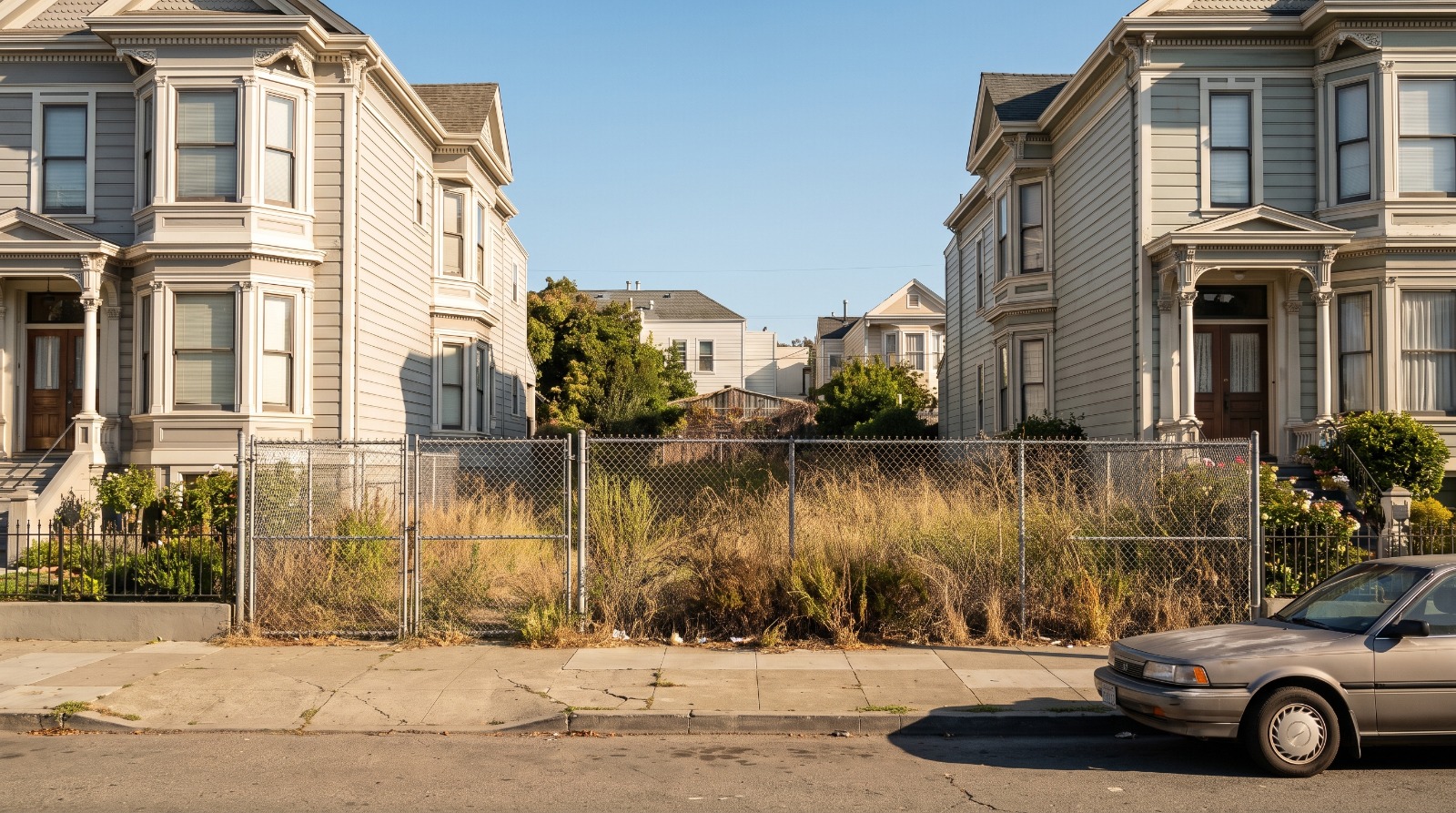
A fenced, weedy vacant lot on a West Oakland block lined with Victorian homes, subject to the Oakland vacancy tax. Photo: Houseberry
About $6 million a year. That is what Oakland's tax on vacant property now pulls in, and the number is climbing. But six years after voters passed it, the city's first audit of the Oakland vacancy tax lands on an awkward finding. The money is real. The empty lots it was supposed to fill are mostly still empty.
That gap, between a tax that works as a revenue tool and a tax that changes what happens on the ground, is the whole story for anyone who owns, buys, or lives near a fenced-off parcel in Oakland.
What Measure W was supposed to do
In 2018, Oakland voters approved the city's first vacant property tax. Owners of undeveloped lots and empty buildings pay a flat $3,000 to $6,000 a year, with exemptions for low-income owners, nonprofits, and others. A property counts as vacant if it is in use fewer than 50 days in a year, which sweeps in everything from weedy lots to shuttered storefronts to empty homes. On the ballot, Measure W promised to fund homeless services, pay for illegal-dumping cleanup, and discourage owners from letting property sit idle while a housing shortage raged around them. At least 25 percent of the money had to go to illegal dumping, and no more than 15 percent to administration.
Where the money is actually going
City Auditor Michael Houston published the first report on the tax last week, according to The Oaklandside. The administrative marks are decent. Oakland is generally complying with the law and getting better at applying it. Last year it taxed 1,966 properties and made far fewer mistakes, falsely flagging fewer properties as vacant than it used to. The revenue, about $6 million a year, keeps rising as the city identifies parcels more accurately.
The priorities are where it gets uncomfortable. Instead of the 25 percent floor for illegal dumping, Oakland has spent 66 percent of the tax revenue fighting illegal dumping, and the auditor found the city appears to underutilize the funds for homelessness services, which the measure described as a primary purpose. Houston made three recommendations: define clearly what counts as an administrative cost, actually track vacancy trends and causes, and file the annual reports state law requires, which has mostly not happened. The city's finance director agreed with the findings but pushed back on one point, arguing you cannot really deduce from the data why an owner keeps a property empty. Those decisions, he wrote, rest with private owners weighing whether to build, wait for a better market, or put the land to use.
The flat-rate problem
The most useful thing in the audit is a comparison. Oakland taxes every vacant property at the same flat rate regardless of what it is worth. Most cities that raise real money from vacancy taxes do not. They scale the bill by value or size. Run the same $2 million empty house through three systems and the difference is stark:
| City | Annual tax on a vacant $2M house |
|---|---|
| Oakland | $6,000 (flat) |
| Vancouver | $60,000 |
| Washington, D.C. | $100,000 to $200,000 |
A flat $6,000 is a rounding error for an owner sitting on a $2 million parcel and waiting for the market to turn. That is the core reason the tax raises money without moving much property. Other cities that tie the bill to value create real pressure to build or sell. San Francisco tried a version keyed to square footage, and it is tied up in court after landlords argued it violates their property rights. Some Berkeley owners are withholding their vacancy payments while they wait for the ruling. The design choice, not the intent, is what decides whether a vacancy tax nudges or bites.
Where the empty lots actually are
For a buyer, the audit's geography is the practical part. The vast majority of taxed parcels are undeveloped land, not empty buildings, and the biggest concentrations sit in the Oakland hills, especially Claremont, Forestland, and Piedmont Pines, plus West Oakland's Prescott area. The hills are exactly where building is hardest, high wildfire risk and steep, expensive infrastructure. So a chunk of the tax lands on lots that are vacant for reasons a $6,000 bill will never fix. Overall the tax touches only about 2 percent of Oakland properties, and even that overstates coverage, since a 50-unit empty building counts as a single property.
The way we look at it when we compare neighborhoods, a fenced lot on your block is a live question, not just an eyesore. Is it stuck, or about to become housing? Measure W nudges the answer but rarely decides it, because owners still move on the market's schedule. If you are weighing East Bay blocks, that empty parcel shapes how the street feels and where values drift, which is why it belongs in your research alongside how Oakland neighborhoods rank on safety and the broader question of whether Oakland is getting better. One encouraging fix already landed: at the end of 2025 the City Council created a new exemption so a nonprofit or buyer who acquires a vacant lot to build housing is no longer stuck with the prior owner's tax bill.
The bottom line: the audit gives Oakland pretty good marks as a tax collector and a gentle nudge as a housing tool. If the city wants the empty lots filled rather than just taxed, the lever the audit points to is a value-based rate, and the thing to watch is the San Francisco court case that could reshape every Bay Area empty-homes tax at once.
Sources
The Oaklandside: First audit of Oakland's vacant property tax gives pretty good marks
The Houseberry Research Team is Houseberry's reporting team: Bay Area real estate analysts, data specialists and longtime local market watchers. Every day we check the public record: building permits, city council and planning agendas, county recorder filings, state housing bills, police incident data and school results. Then we tie each story to what it means for specific neighborhoods, using Houseberry's own neighborhood data on prices, appreciation, safety, schools and amenities. Questions or corrections: Contact us.
All information provided on this website including but not limited to - school ratings, safety, amenities, user opinions, and property data - is for general informational purposes only. We do not guarantee its reliability, accuracy, or completeness. Users should independently verify information and consult appropriate professionals as needed. By using this website, you agree Houseberry is not responsible for actions, decisions, or consequences arising from reliance on the information provided
houseberry.com - CA DRE# 01847391
 Bay East ©2025. CCAR ©2025. bridgeMLS ©2025. Information Deemed Reliable But Not Guaranteed. This information is being provided by the Bay East MLS, or CCAR MLS, or bridgeMLS. The listings presented here may or may not be listed by the Broker/Agent operating this website. This information is intended for the personal use of consumers and may not be used for any purpose other than to identify prospective properties consumers may be interested in purchasing. Data last updated at October 13, 2026 12:00 AM