Pacifica Pier's Future: Repair, Replace, or Retreat
Pacifica has closed its crumbling municipal pier and demolished the Chit Chat Cafe. With repair estimates ballooning past $60 million, the city now has to decide what a coastal landmark is worth.

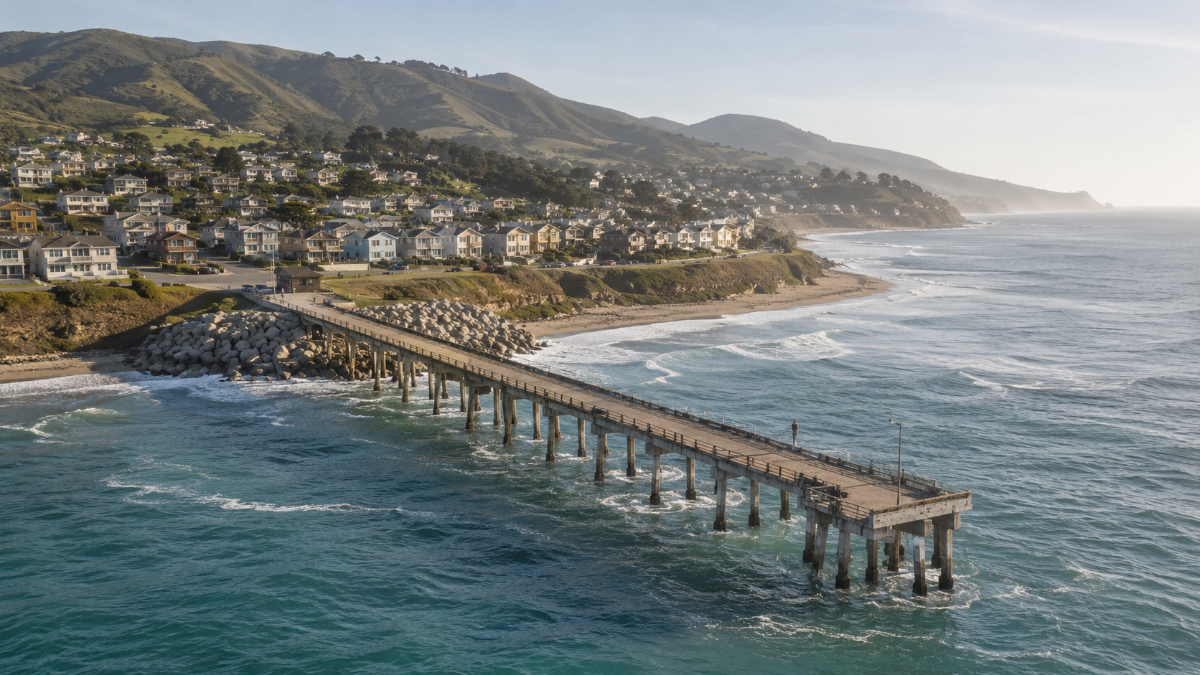
An elevated view of the aging Pacifica Pier meeting the shoreline, with stabilization boulders at its base and the coastal town rising on the bluff behind it. Photo: Houseberry
At low tide in June, crews began stacking about 150 boulders along both sides of the Pacifica Pier, trying to buy the 53-year-old landmark a little more time (ABC7). It is a strange thing to watch a town shore up a structure it is not sure it can afford to keep. The question hanging over the Pacifica Pier future is no longer whether it needs work. It is whether Pacifica repairs it, replaces it, or eventually lets the ocean have it.
The city closed the pier on June 4 after inspectors found significant new cracking near the abutment that ties the deck to land. Four days later the City Council voted unanimously to declare a local emergency and demolish the Chit Chat Cafe at the pier's entrance before it could fall into the surf. The cafe came down that week. Its owner, Ginger Davis, who met her husband working there two decades ago and bought the place three years earlier, put it plainly to NBC Bay Area: the whole fishing community was losing something gigantic.
The repair bill keeps outrunning the plan
This is the part that should give any coastal city pause. The numbers have not just grown. They have lapped the city's ability to plan around them.
A 2021 estimate pegged pier repairs at about $21 million (ABC7). After winter storms battered it two years ago, Pacifica spent close to $20 million patching it back together (NBC Bay Area). A 2023 assessment put full restoration near $19 million, and as recently as April 2026 the city lined up a design contract to move that work forward. Then the abutment cracked. Local reporting now puts the damage estimate at roughly $64 million, including a few million in emergency stabilization and sixty-plus million in longer repairs (Coastside News).
City Manager Sean Charpentier thinks the crack likely opened during 2023 storms and widened with high tides since (ABC7). Whatever the exact trigger, the pattern is the tell. Every time the city catches up to one estimate, the ocean writes a bigger one.
Repair, replace, or let the coast take it
Officials have not committed to a path, and they have been unusually honest that demolition sits on the table alongside repair (NBC Bay Area). Broadly, Pacifica has three options, and none of them is cheap or simple.
It can keep repairing, which means pouring tens of millions into a structure the surf will keep attacking. It can replace the pier outright, which one resident floated at “$100 million or a little more,” pointing to what San Diego has spent on its waterfront (Coastside News). Or it can do what coastal planners call managed retreat, letting parts of the structure go and rethinking the shoreline around it. That last option is the one nobody wants to say out loud at a council meeting. But on an eroding coast facing sea level rise, it is a real choice, not a surrender.
The honest answer right now is that Pacifica does not know. Anyone deciding whether that uncertainty matters for a home nearby should sit with it rather than wait for a tidy headline.
The $18 million problem
Here is why this is so hard for one small city to solve. Pacifica is a full-service city that collects about $18 million a year in property tax (ABC7). A $64 million repair bill, let alone a nine-figure replacement, is not something a town that size absorbs on its own.
So the search is on for outside money. Congressman Sam Liccardo has called for federal aid and says he will introduce an “Ounce of Preservation Act” to let local governments spend Community Development Block Grant money on disaster prevention before a disaster hits, not only after (ABC7). San Mateo County Supervisor Ray Mueller argues Pacifica already had a fix-it plan and lost it when federal BRIC grants were canceled last year, though Charpentier has been careful to note it is unclear that money would have prevented the damage. Sorting out who pays, and how fast, is the whole ballgame. The emergency declarations at the city and state level are partly about prying that help loose.
What a pier is worth to a town
Strip away the funding mechanics and you are left with the question the KQED podcast The Bay put to residents: what does a coastal community owe the thing that makes it feel like itself (KQED). The pier is more than a fishing spot. It is the free front porch of a stretch of coast where you do not need a boat or a license to catch a fish (City of Pacifica), and it is the visual anchor of the Sharp Park neighborhood.
That matters for how the loss would land, and it would not land evenly. In our Pacifica neighborhood rankings, Sharp Park scores 2.9 out of 5 overall, the lowest in the city, and it is also one of the more accessible places to buy, with prices near $1.1 million in a city where most neighborhoods run higher. The pier is a big part of Sharp Park's amenity case. Take it away for years, and the neighborhood most exposed to the loss is also the one with the least cushion.
Contrast that with the neighborhoods that carry their own weight. Rockaway Beach tops our list of which Pacifica neighborhoods score best on amenities, with its own beach, hotels, and restaurant row. Linda Mar has its own surf beach and retail strip and sits near the top of the city overall. Those places barely blink if the pier stays dark. Sharp Park is where a long closure actually changes the texture of a Saturday. The way we look at it when we compare neighborhoods, an amenity is only as valuable as it is hard to replace, and this pier is very hard to replace.
So is Pacifica still a good place to buy
None of this makes Pacifica a worse place to live. It makes it a place where you should look at more than the view. If you are weighing a Coastside home here, treat coastal infrastructure the way you would treat schools, insurance, or a commute: as a real input with a real cost attached. Ask who pays when the ocean sends a bill, how close a given street sits to the erosion line, and whether the amenities you are buying near depend on a single aging structure or stand on their own. Our Pacifica city guide is a reasonable place to start comparing those tradeoffs block by block.
The pier decision is a preview, not a one-off. Every town on this coast will eventually face some version of it. Watching how Pacifica answers, at the next council meetings and in whatever state and federal money does or does not arrive, tells you a lot about how the region plans to hold onto its coast. That is worth following, whether or not you ever drop a line off the end of it.
Sources
- KQED, What Will Pacifica Do About Its Iconic but Deteriorating Pier?
- NBC Bay Area, Historic Pacifica Municipal Pier damage leads to demolition of popular cafe
- ABC7 News, Congressman Sam Liccardo seeks federal aid for Pacifica Pier repairs
- Coastside News, Pacifica seeks state emergency declaration as pier damage estimate reaches $64 million
- City of Pacifica, Pacifica Municipal Pier
The Houseberry Research Team is Houseberry's reporting team: Bay Area real estate analysts, data specialists and longtime local market watchers. Every day we check the public record: building permits, city council and planning agendas, county recorder filings, state housing bills, police incident data and school results. Then we tie each story to what it means for specific neighborhoods, using Houseberry's own neighborhood data on prices, appreciation, safety, schools and amenities. Questions or corrections: Contact us.
All information provided on this website including but not limited to - school ratings, safety, amenities, user opinions, and property data - is for general informational purposes only. We do not guarantee its reliability, accuracy, or completeness. Users should independently verify information and consult appropriate professionals as needed. By using this website, you agree Houseberry is not responsible for actions, decisions, or consequences arising from reliance on the information provided
houseberry.com - CA DRE# 01847391
 Bay East ©2025. CCAR ©2025. bridgeMLS ©2025. Information Deemed Reliable But Not Guaranteed. This information is being provided by the Bay East MLS, or CCAR MLS, or bridgeMLS. The listings presented here may or may not be listed by the Broker/Agent operating this website. This information is intended for the personal use of consumers and may not be used for any purpose other than to identify prospective properties consumers may be interested in purchasing. Data last updated at October 6, 2026 12:00 AM