SB 79 Is Live. Bay Area Cities Are Split on It
SB 79 takes effect July 1, 2026, but the Bay Area map is a patchwork. Here is which counties and cities are opening up near transit and which are quietly opting out.
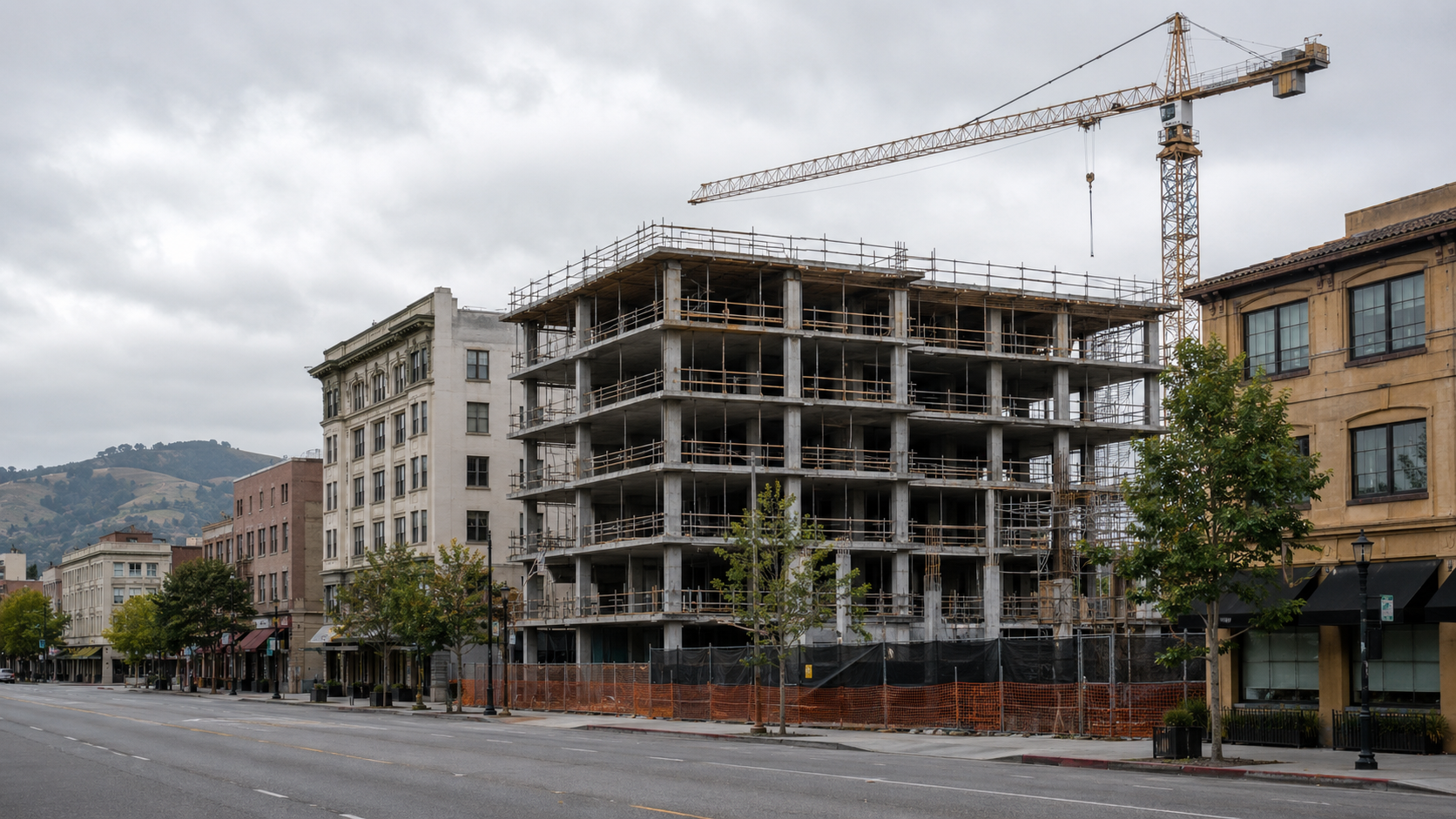
An aerial view of a Bay Area rail corridor where SB 79 transit density brings new mid-rise apartments on one side of the tracks while older single-family blocks stay low on the other. Photo: Houseberry
As of today, July 1, 2026, the biggest change to Bay Area zoning in years is technically the law of the land. SB 79, the state's transit-density bill, is in effect, and cities that qualify now have to process taller apartment and condo projects near their busiest train stops whether the local zoning map says so or not. That is the headline. The reality on the ground is messier, and a lot more interesting.
Because SB 79 in the Bay Area did not arrive as a single switch that flipped everywhere at once. It arrived as a patchwork. Some counties are not covered at all. Some cities are leaning into it. And a surprising number spent the spring quietly writing ordinances designed to slow it down or route around it before the train left the station, to borrow the phrase every land-use lawyer is using this month. If you are trying to read what actually changes near you, the map matters more than the calendar.
What flips on July 1, and where it does not
Start with the boundary almost nobody mentions. SB 79 only applies in an urban transit county, which the law defines as a county with more than 15 passenger rail stations. In the Bay Area that means four counties are in: Alameda, San Francisco, San Mateo, and Santa Clara, per the regional planning agency's summary. Contra Costa is out. It does not clear the rail-station threshold, so the BART-rich stretches through Walnut Creek, Concord, and Pleasant Hill are untouched by SB 79 for now. Same station, different county, completely different rules.
Inside the covered counties, the law sorts qualifying stops into two tiers. Tier 1 is heavy and high-frequency commuter rail, which here means BART and Caltrain. Tier 2 is light rail and rapid bus, mostly VTA in the South Bay and Muni Metro in San Francisco. Governor Newsom signed the bill in October 2025, and the state's Department of Housing and Community Development confirms the standards take effect July 1. Here is roughly what a qualifying parcel can hold, measured by how close it sits to the platform:
- Near a Tier 1 stop like BART or Caltrain: buildings up to about 75 feet and 120 homes per acre within a quarter mile, easing to roughly 65 feet within a half mile.
- Near a Tier 2 stop like VTA light rail: up to about 65 feet within a quarter mile and 55 feet within a half mile.
- Right next to a stop: an adjacency bump adds roughly 20 more feet plus higher density, which pushes the tallest qualifying sites toward 95 feet.
For scale, 75 feet is about seven stories. On a block of 1950s ranch houses, that is a real change. But eligibility is not the same as a groundbreaking, and this is exactly where cities have found room to maneuver.
Cities are quietly writing their way around it
SB 79 hands cities two big levers, and most Bay Area cities grabbed at least one before the deadline. The first is an implementing ordinance that can carve out certain parcels, either permanently or temporarily. The second is a TOD alternative plan that lets a city rewrite the default heights and densities as long as it keeps roughly the same total capacity near transit.
The permanent carve-outs are narrow. A city can exempt sites with no real pedestrian access to the stop, and it can exempt designated industrial employment hubs, an option limited to the handful of cities with at least 15 qualifying stops of their own. The temporary carve-outs are where the action is. The one drawing the most attention lets a city upzone covered sites to just 50 percent of SB 79's default capacity, then exclude those same sites from the full law until the next Housing Element cycle. Several cities are reading that provision broadly enough to delay SB 79 across their entire footprint, as Holland & Knight lays out in its implementation tracker. Whether the state will bless a blanket 50 percent dodge is still an open question.
So the same law produces very different outcomes a few miles apart. San Jose's neighborhoods sit under an approved exclusion of industrial land plus a longer-term alternative plan. Palo Alto is using the 50 percent provision to slow-walk the whole city. San Francisco is running exclusions and an alternative plan at the same time. Here is the near-term scoreboard for a few cities that qualify, drawn from the state tracker:
| City | Near-term SB 79 strategy | Where it stands |
|---|---|---|
| San Jose | Permanent exclusion of industrial employment hubs, with a longer-term TOD alternative plan in the works | HCD certified the exclusion ordinance on June 4, 2026 |
| San Francisco | Industrial-hub exclusion plus a TOD alternative plan, pursued together | Both moving as a joint strategy |
| Oakland | Relying on implementing-ordinance exclusions now, alternative plan later | In progress |
| Palo Alto | Using the 50 percent capacity provision to delay the law citywide | Leaning on the temporary-exclusion loophole |
| Mountain View | TOD alternative plan as its only near-term move | Plan not yet adopted |
| Beverly Hills (SoCal reference) | Adopted a TOD alternative plan as its sole strategy | Rejected by HCD on May 8, 2026, with a response due July 7 |
The pattern is not pro-housing cities versus anti-housing cities so much as everyone buying time. Even places that support more homes near transit are using the tools to control the where and the how, rather than letting the state's defaults land block by block. That is legal, and it is also the whole ballgame for anyone trying to guess which corridors actually densify first.
HCD is the referee, and it has started blowing the whistle
None of these local moves are final on their own. Every implementing ordinance and alternative plan has to clear the Department of Housing and Community Development, and the agency has a defined window to review adopted ordinances, up to 90 days with a possible extension. HCD has already ruled twice, and the two calls point in opposite directions. On June 4, 2026 it certified San Jose's industrial-hub exclusion as compliant. A month earlier, on May 8, it rejected Beverly Hills' alternative plan outright and gave the city until July 7 to fix it.
The takeaway for the Bay Area is that a city announcing an SB 79 workaround is the start of the process, not the end. An ordinance can look settled locally and still get bounced by the state months later. For a buyer or a homeowner watching a specific corridor, that means the honest answer to what can get built here is often still being written, and will be for the rest of the year.
What the patchwork means block by block
Here is where the way we think about neighborhoods actually earns its keep. A change in what is legally allowed on a parcel is not the same as a change on the ground. SB 79 raises the ceiling on hundreds of transit-adjacent blocks, but a higher ceiling only matters when someone finances, designs, and builds under it. Plenty will not, at least not soon.
We watched this play out in real time a few blocks from West Oakland BART, where a site cleared years ago for more than a thousand homes now wants to become a parking lot while it waits for the market to turn. An entitlement on file and a delivered building are very different signals, and SB 79 mostly adds to the entitlement column. So if you are comparing Oakland neighborhoods or blocks across San Francisco partly on the bet that upzoning reshapes them, underwrite what exists today, not what the law now permits.
None of this is a reason to root against the law. More homes near BART and Caltrain is roughly what the region needs if it wants to stop pricing people out. It just means “SB 79 makes this block eligible for seven stories” belongs in the research pile next to schools, safety, commute, and price, as one input among many rather than a done deal. The parcel next door to a station is worth a closer look now. It is not automatically about to change.
Quick questions on SB 79 in the Bay Area
Does SB 79 apply everywhere in the Bay Area?
No. It only applies in urban transit counties, which are Alameda, San Francisco, San Mateo, and Santa Clara. Contra Costa does not qualify, so its BART-adjacent areas are not covered right now, even though they sit on the same lines.
Will taller buildings actually go up near my station on July 1?
Not overnight. July 1 changes what is legally allowed, not what is funded or under construction. Many cities have also adopted exclusions or alternative plans that delay or reshape where the new capacity lands, and several of those are still awaiting state review.
What is the 50 percent loophole cities keep using?
SB 79 lets a city upzone covered sites to half of the law's default capacity and then temporarily exclude those sites from the full standards until the next Housing Element cycle. Some cities are using it to delay SB 79 broadly. The state has not yet said whether a blanket version of that move is allowed.
How should I factor SB 79 into comparing neighborhoods?
Treat it as one signal, not a verdict. Check whether a nearby site is merely entitled or actually financed and under construction, and weigh that alongside schools, safety, commute, and price rather than assuming upzoning transforms a block on its own.
Sources
All information provided on this website including but not limited to - school ratings, safety, amenities, user opinions, and property data - is for general informational purposes only. We do not guarantee its reliability, accuracy, or completeness. Users should independently verify information and consult appropriate professionals as needed. By using this website, you agree Houseberry is not responsible for actions, decisions, or consequences arising from reliance on the information provided
houseberry.com - CA DRE# 01847391
 Bay East ©2025. CCAR ©2025. bridgeMLS ©2025. Information Deemed Reliable But Not Guaranteed. This information is being provided by the Bay East MLS, or CCAR MLS, or bridgeMLS. The listings presented here may or may not be listed by the Broker/Agent operating this website. This information is intended for the personal use of consumers and may not be used for any purpose other than to identify prospective properties consumers may be interested in purchasing. Data last updated at September 30, 2026 12:00 AM