The SF-Oakland Rent Gap Is Now About $2,000 a Month
The average one-bedroom in San Francisco now runs close to $2,000 a month more than in Oakland, roughly $24,000 a year. We break down the SF vs Oakland rent gap and rank the East Bay areas near BART and still under $2,200 that are best placed to catch the spillover.

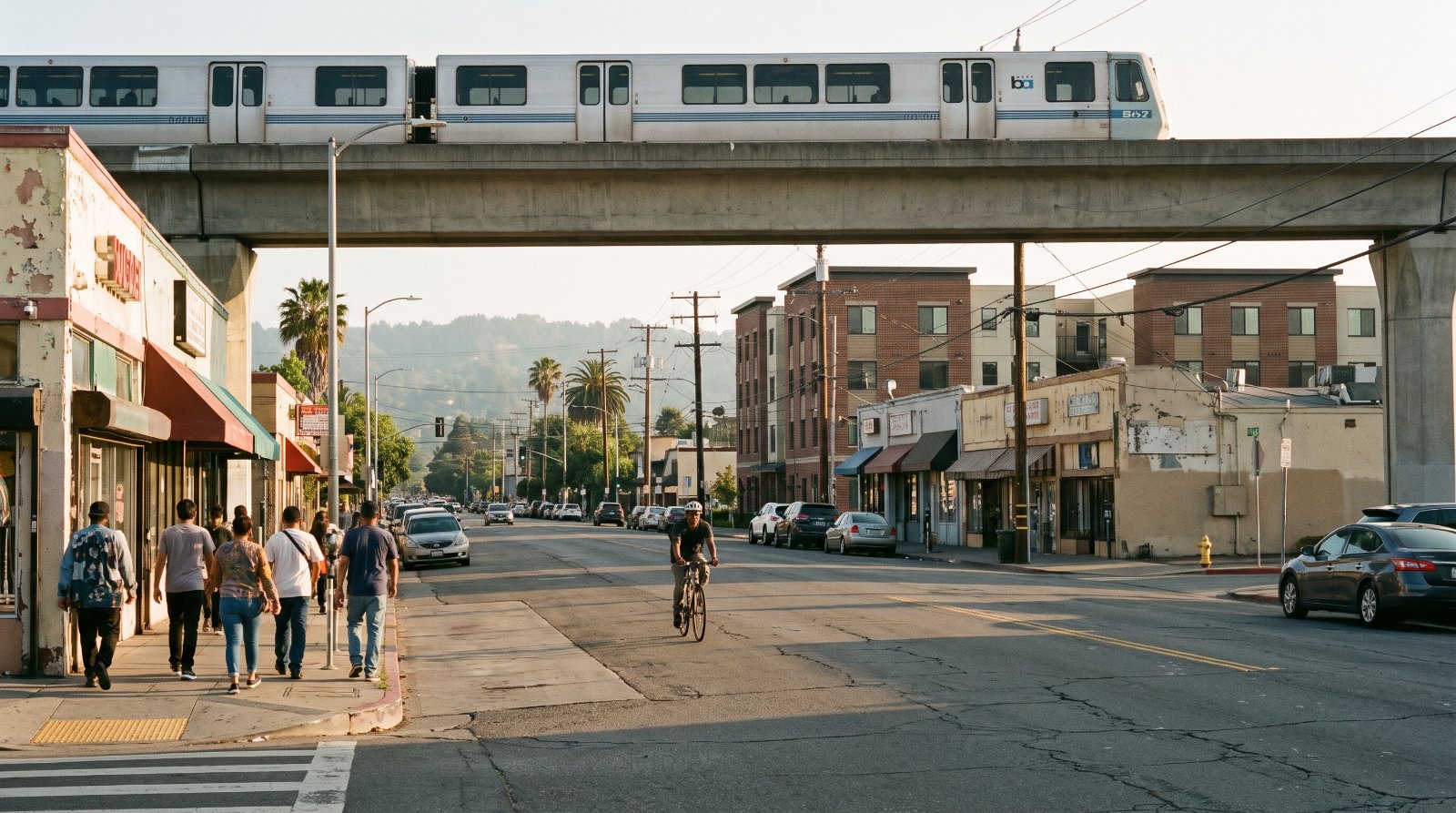
An elevated BART train crossing a walkable East Oakland commercial street, where the average rent in Oakland stays far below San Francisco's. Photo: Houseberry
Cross the Bay Bridge and a one-bedroom gets about $2,000 a month cheaper. That is the whole story in one line, and it is somehow the part nobody wrote down while everyone was busy watching San Francisco rent sail past $4,000. Zumper's July read puts the average rent in Oakland at about $2,070 for a one-bedroom, against roughly $4,060 across the bay in San Francisco. Same region, same BART map, a difference of nearly $2,000 every month.
Run that out and it is about $24,000 a year, for what is often a fifteen-minute ride under the bay. That is not a rounding error. That is a used car, a maxed-out retirement contribution, or the down-payment clock moving a lot faster. Oakland is cheaper than San Francisco, and it also undercuts San Jose, where one-bedrooms run about $2,760. Right now it is the closest thing the urban Bay Area has to a rent bargain.
Cross the bridge, save about $24,000 a year
Here is the spread in plain numbers, all from Zumper's July 2026 national rent report. San Francisco one-bedrooms average about $4,060, up a startling 21.9 percent in a year, the steepest jump of any big city in the country. Oakland sits at roughly $2,070, up 6.2 percent. San Jose lands in between at about $2,760, up just 2.6 percent.
So the San Francisco to Oakland gap is close to $1,990 a month. In dollar terms that spread is about as wide as it has ever been, because SF rent is climbing more than three times faster than Oakland's and eight times faster than San Jose's. The bargain is not that Oakland got cheap. It is that San Francisco ran away from everyone, and the bridge is the cheapest fix on the board.
One honest note before anyone packs a truck. A lower rent is not free money. You trade a shorter commute for a slightly longer one, and you trade the parts of San Francisco you actually liked for a different city with its own quirks. But on the single biggest line in most household budgets, the math is not close.
Oakland's 6.2 percent is the tell
The number that matters is not the gap. It is the direction. San Jose barely moved. San Francisco went vertical. Oakland's 6.2 percent sits quietly in between, and that is what the leading edge of a spillover looks like.
When one city gets unaffordable fast, the demand does not vanish. It walks to the next-cheapest place with a train downtown. Oakland is that place, and its rent curve is starting to bend up while much of the rest of the East Bay stays flat or soft. That is the arbitrage closing in slow motion. It is also why timing matters. The East Bay spots that are walkable, on BART, and still under $2,200 have the most room to catch San Francisco renters before their own rents catch up.
Ranking the East Bay's last rent bargains
We lined up the East Bay areas best positioned to absorb a San Francisco renter, judged on three things: a direct BART ride downtown, a walkable core you would actually use without a car, and a median one-bedroom still under $2,200. Ranked by how well they balance all three.
| Rank | Area (walkable core) | Nearest BART, approx. ride to downtown SF | Median 1BR | Why it is positioned |
|---|---|---|---|---|
| 1 | Oakland (Fruitvale, West Oakland, Lake Merritt/Uptown) | West Oakland ~9 min, Lake Merritt ~10 min | ~$2,070 | Closest to SF, deepest BART coverage, several real walkable cores. The anchor. |
| 2 | San Leandro (Downtown) | Downtown San Leandro ~30 min | ~$1,980 | Walkable downtown, new housing by the station, direct line. |
| 3 | Hayward (Downtown / B Street) | Hayward ~38 min | ~$1,992 | Compact, walkable B Street core, cheaper, farther out. |
| 4 | Richmond (near Richmond BART, Marina Bay) | Richmond ~37 min | ~$1,900 | Cheap and on BART, walkability concentrated near the station. |
| 5 | Concord (Todos Santos Plaza) | Concord ~45 min | ~$1,795 | Cheapest of the bunch and a genuinely walkable plaza, longest ride. |
A few things the table cannot say out loud. Inside Oakland, the pattern holds unevenly, which is exactly why we look at the area before the address. West Oakland is one stop under the bay and getting most of the new apartment supply, though parts of it are still more warehouse than walkable. Lake Merritt and Uptown are the easy walkable win and sit at the top of the budget. Fruitvale hands you a genuinely lively main street around Fruitvale Village for some of the lowest rent on the line. If you want to see how those blocks actually score against each other, which Oakland neighborhoods offer the best value is where we would start.
One near-miss worth naming is El Cerrito. The del Norte and Plaza stations are walkable and about half an hour to downtown SF, but one-bedrooms there now average closer to $2,400, so it just misses the under-$2,200 cut. Cheaper than San Francisco by a mile, but not the outright steal that Richmond or Concord is.
The rest of the SF vs Oakland cost of living picture
"SF versus Oakland cost of living" is a popular search for a reason, and rent is the honest headline, but it is not the whole receipt. Groceries, gas, and a night out cost roughly the same on either side of the bridge, so that $2,000 gap really is mostly a rent gap. That is good news, because it means the savings are real and not quietly clawed back somewhere else.
The parts that do change are harder to price. A West Oakland to downtown commute is short, but BART's frequency and reliability are not what they were, and if your whole life is anchored in San Francisco you will feel the transfer. Parking math changes. Some services and nightlife thin out the farther east you go. None of that erases $24,000 a year. It just means the comparison is a neighborhood decision, not a citywide one, which is why we would weigh how East Bay neighborhoods stack up overall rather than treat "the East Bay" as one flat, cheaper blob.
Will the gap close?
Probably not this year. As long as San Francisco rent keeps rising several times faster than Oakland's, the dollar gap holds or even widens while Oakland ticks up. But the relative bargain, the part that makes crossing the bridge feel like a steal, narrows a little every quarter Oakland runs hot and San Francisco cools. Oakland's move from around 3 percent growth earlier in the year to 6.2 percent now is the early warning. If you have been thinking about it, the cheap, walkable, BART-connected pockets are where the value gets bid up first.
So the useful exercise is not "Oakland or not." It is which specific East Bay block gives you the commute, the walk, and the price you want, the same way we would compare any two neighborhoods. That is the whole reason we built Houseberry, and it counts for the most exactly when a $2,000 gap is tempting you to treat a whole city as one decision. For the San Francisco side of the ledger, our look at how fast SF rent is bending the rent-versus-buy math pairs well with this one, and if you are Oakland-curious, we also read whether Oakland is getting better or just looking better this summer.
Quick answers on Oakland and East Bay rent
What is the average rent in Oakland right now?
About $2,070 for a one-bedroom as of Zumper's July 2026 read, up 6.2 percent year over year. That is roughly half of San Francisco's $4,060 average and below San Jose's $2,760, which is why Oakland keeps showing up on "cheapest urban Bay Area" lists this year.
What are the cheapest Bay Area cities to rent near BART?
Among walkable, BART-connected spots, Concord (about $1,795), Richmond (about $1,900), San Leandro (about $1,980), and Hayward (about $1,992) all sit under $2,000 for a one-bedroom, with Oakland just above at about $2,070. Concord is the cheapest of the group but the longest ride to San Francisco.
Is it worth moving from SF to Oakland just for the rent?
On rent alone the gap is about $2,000 a month, or $24,000 a year, and most other costs are similar across the bridge. The catch is commute and daily convenience, so the smart move is to compare the exact neighborhood and BART line you would actually use, not the two cities in the abstract.
Sources
Zumper, National Rent Report (July 2026)
Zumper, Average Rent in Oakland, CA
Zumper, Average Rent in San Leandro, CA
Zumper, Average Rent in Hayward, CA
Zumper, Average Rent in Richmond, CA
The Houseberry Research Team is Houseberry's reporting team: Bay Area real estate analysts, data specialists and longtime local market watchers. Every day we check the public record: building permits, city council and planning agendas, county recorder filings, state housing bills, police incident data and school results. Then we tie each story to what it means for specific neighborhoods, using Houseberry's own neighborhood data on prices, appreciation, safety, schools and amenities. Questions or corrections: Contact us.
All information provided on this website including but not limited to - school ratings, safety, amenities, user opinions, and property data - is for general informational purposes only. We do not guarantee its reliability, accuracy, or completeness. Users should independently verify information and consult appropriate professionals as needed. By using this website, you agree Houseberry is not responsible for actions, decisions, or consequences arising from reliance on the information provided
houseberry.com - CA DRE# 01847391
 Bay East ©2025. CCAR ©2025. bridgeMLS ©2025. Information Deemed Reliable But Not Guaranteed. This information is being provided by the Bay East MLS, or CCAR MLS, or bridgeMLS. The listings presented here may or may not be listed by the Broker/Agent operating this website. This information is intended for the personal use of consumers and may not be used for any purpose other than to identify prospective properties consumers may be interested in purchasing. Data last updated at October 8, 2026 12:00 AM