BART’s New Fare Gates Are Changing the Station Next Door
BART’s new fare gates are now in all 50 stations, and the payoff is showing up as less fare evasion, less crime, and cleaner platforms. Here is how that changes the way you research neighborhoods near BART.

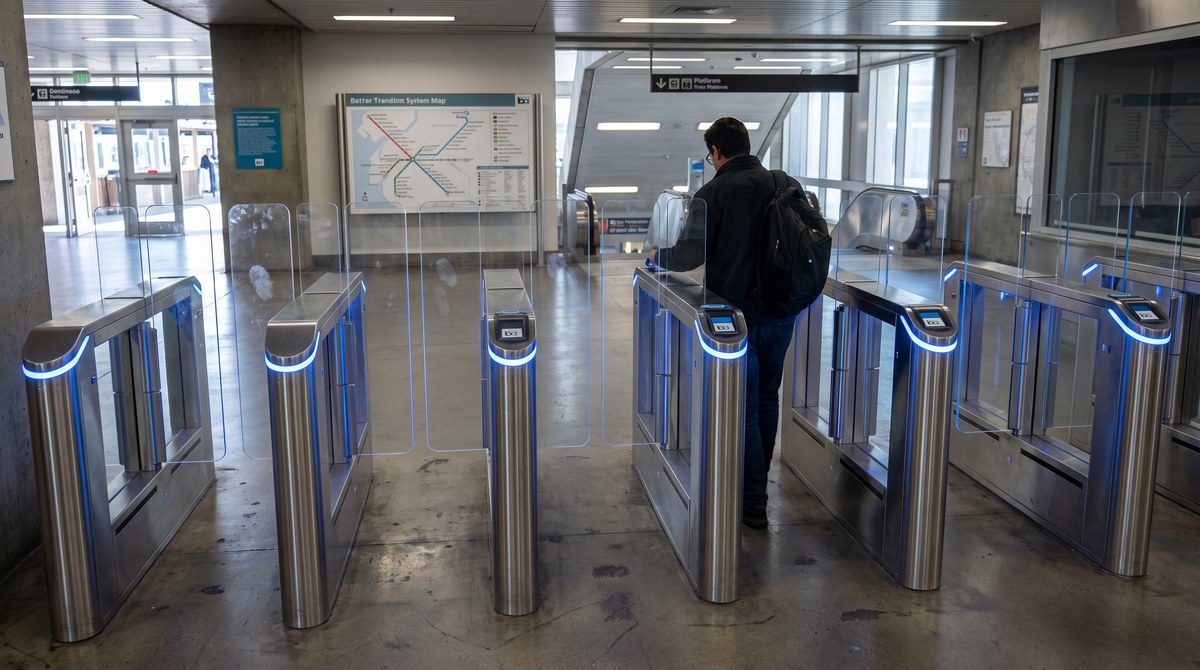
A commuter taps a Clipper card at one of BART’s new fare gates inside a Bay Area station, where BART fare gates have cut evasion and crime. Photo: Houseberry
You have probably seen the clip by now. A woman wedged halfway under one of BART’s new fare gates, stuck, while the internet did what the internet does. It runs about five seconds. It is also the clearest picture yet of why fare evasion on BART has fallen, and why the station at the end of your street might feel a little different than it did two years ago.
BART finished swapping its old 1970s-era gates for taller, tougher ones across all 50 stations last August, four months ahead of schedule. The new fare gates are the reason a would-be jumper now ends up on a phone screen instead of on the platform. For anyone comparing neighborhoods near a BART line, the ripple effects are worth a longer look than the meme gets.
What the new gates actually did
The Next Generation Fare Gate project was a $90 million overhaul, approved by BART’s board in April 2023 and rolled out station by station starting at West Oakland. The old orange fins were easy to push through or hop over. The replacements stand about six feet tall, with clear swing barriers that are genuinely hard to climb, crawl under, or shove past.
The numbers behind them are real. BART says the share of riders who report witnessing fare evasion is down 59 percent over the past year. Fare revenue has grown by about $10 million a year, which BART Director Liz Ames figures could pay off the whole project in a decade or less. Overall crime on the system fell 41 percent in 2025, with violent crime down 31 percent and property crime down 43 percent.
Ames is careful about the cause, and so am I. She credits the gates “in some sense,” not for everything. BART also added police presence over the same stretch, and the Center for Policing Equity has argued the agency overstates what fare enforcement alone accomplishes. Both can be true. The gates clearly helped, and they are not the only reason the platforms feel calmer.
Why a cleaner platform is a neighborhood story
Here is the part that matters if you are house hunting. A BART station is more than a commute tool. It is a piece of the neighborhood, the way a park or a school is. When a station is grimy or feels unsafe, that feeling leaks into the blocks around it. When it is clean and orderly, that leaks out too.
BART says fewer fare evaders has also meant less litter and graffiti to clean up, on top of the drop in crime. That is a small daily upgrade to living near a station, and it is exactly the sort of thing a listing photo will never show you. The way we look at neighborhoods at Houseberry, the station environment belongs on the same checklist as the school rating and the insurance quote, because it shapes how a home actually lives.
Just be honest about what the gate fixes and what it does not. A taller barrier makes the paid platform safer. It does nothing for the three blocks you walk between the turnstile and the front door. That walk is still its own question, and it is where neighborhood-level research earns its keep.
The stations where this changes the math most
Not every station benefits equally. The biggest lift goes to areas where the station itself was the main knock on a neighborhood that was otherwise well located and fairly priced.
Think West Oakland, the first station to get the new gates, one stop from downtown San Francisco on land that has been changing for a decade. Think Fruitvale and Coliseum in East Oakland, where transit access has always been strong and the station’s reputation has not kept up. If you are weighing those areas, it is worth seeing how Oakland neighborhoods rank on safety block by block, because the citywide average hides a lot. The same holds at Richmond, where the station anchors a downtown that has been slowly reinvesting and where neighborhood scores swing widely within a few miles.
Downtown San Francisco stops like 16th Street and 24th Street Mission fit the pattern, and so do the end-of-line suburban stations. BART is now testing even faster gates, trimming the closing time from 800 to 500 milliseconds, at the Concord and Antioch stations, to shut down piggybacking. If you are looking that direction, the top-ranked Concord neighborhoods are a reasonable place to start comparing.
A few honest questions before buying near a station
Does a safer BART station actually lift nearby home values?
Probably a little, slowly, and unevenly. A cleaner, safer station removes a reason buyers used to hesitate, which can widen the pool willing to look. But one good year of BART data will not move prices on its own. Treat it as one input that makes an already-convenient area easier to recommend, not a reason to overpay.
Should I trust a station that used to have a rough reputation?
Reputations lag reality in both directions. The 41 percent crime drop is system-wide, so check the specific station and the specific blocks instead of the old story. A neighborhood can have a much-improved station and still have an uncomfortable three-block walk, or the exact reverse.
What should I check before touring homes near BART?
Walk the route from the station to the house at the hour you would actually use it. Look at the station’s condition with your own eyes. Then compare the area’s safety and overall scores against nearby neighborhoods, so you are judging it on data rather than a viral clip.
Where this goes next
The gates are not foolproof. BART’s own director admits people still piggyback through when someone ahead holds the barrier open, and that viral video is proof the system can be beaten by anyone willing to look ridiculous doing it. But the direction is set, and the faster gates headed to Concord and Antioch say BART plans to keep tightening.
For buyers, the takeaway is not that BART is fixed, so go buy near any station. It is that “walkable to BART” just became a slightly stronger selling point, and one that finally deserves to be checked instead of assumed. Looking hard at the neighborhood before the address is the whole reason we built Houseberry. If you want to see how transit and housing are converging right now, our earlier look at Lafayette’s seven-story BART project pairs well with this one.
Sources
The Houseberry Research Team is Houseberry's reporting team: Bay Area real estate analysts, data specialists and longtime local market watchers. Every day we check the public record: building permits, city council and planning agendas, county recorder filings, state housing bills, police incident data and school results. Then we tie each story to what it means for specific neighborhoods, using Houseberry's own neighborhood data on prices, appreciation, safety, schools and amenities. Questions or corrections: Contact us.
All information provided on this website including but not limited to - school ratings, safety, amenities, user opinions, and property data - is for general informational purposes only. We do not guarantee its reliability, accuracy, or completeness. Users should independently verify information and consult appropriate professionals as needed. By using this website, you agree Houseberry is not responsible for actions, decisions, or consequences arising from reliance on the information provided
houseberry.com - CA DRE# 01847391
 Bay East ©2025. CCAR ©2025. bridgeMLS ©2025. Information Deemed Reliable But Not Guaranteed. This information is being provided by the Bay East MLS, or CCAR MLS, or bridgeMLS. The listings presented here may or may not be listed by the Broker/Agent operating this website. This information is intended for the personal use of consumers and may not be used for any purpose other than to identify prospective properties consumers may be interested in purchasing. Data last updated at October 7, 2026 12:00 AM