Bay Area Home Insurance Is Spreading Past the Hills
California homeowner premiums are up 84% since 2020 and the FAIR Plan is now turning up in low-risk flatland ZIP codes. Here is how Bay Area home insurance is reshaping the real cost of owning, block by block.
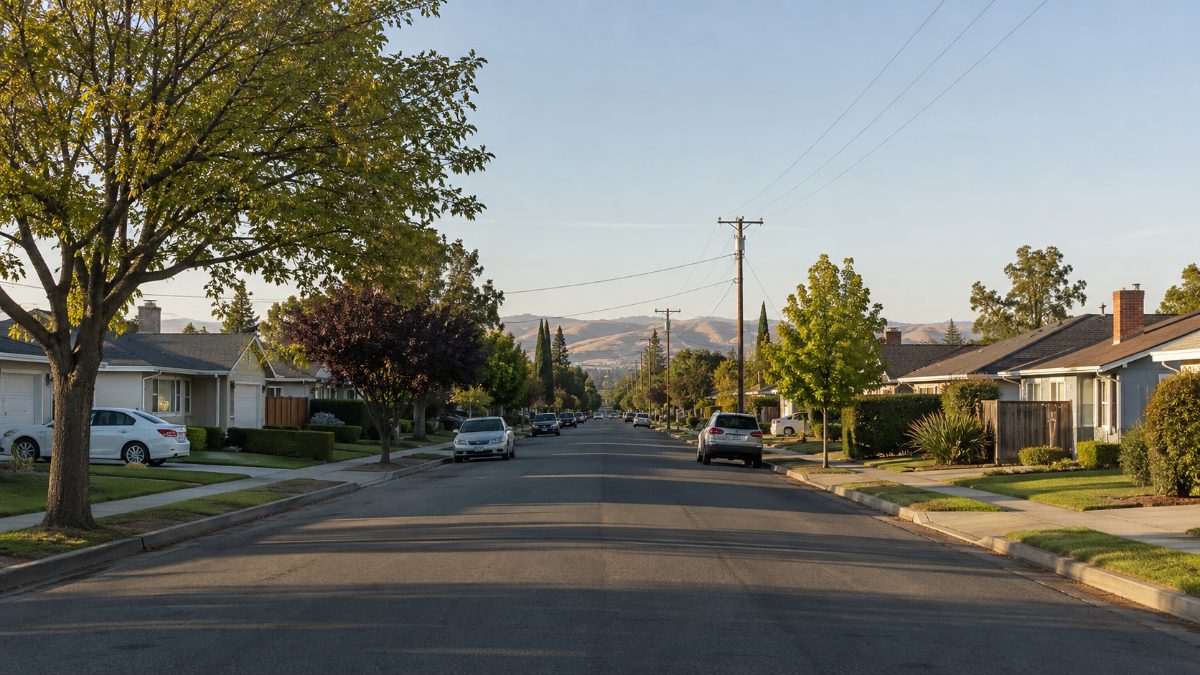
A flat, ordinary Bay Area residential street far from the hills, illustrating how Bay Area home insurance is spreading past wildfire country. Photo: Houseberry
For years, Bay Area home insurance came with a tidy boundary. Buy up in the hills and you paid a wildfire tax. Buy on the flats and you mostly forgot the policy existed. New research out of Stanford says that line is dissolving. Average California homeowner premiums jumped 84 percent between the end of 2020 and March 2026, and the state's insurer of last resort is now showing up in flatland ZIP codes where nothing has ever burned.
That is the part worth sitting with. The crisis used to live in fire country. It is leaking into the rest of the map, and it quietly rewrites what a home costs to own, block by block.
Bay Area home insurance is no longer a hills problem
The new white paper from Stanford's Climate and Energy Policy Program is the first to use loan-level data, and the standout number is not the premium. It is where the FAIR Plan is turning up. As of March 2026 the FAIR Plan covered about 5 percent of California single-family homes, up from 1.5 percent at the end of 2020. But it backed roughly 6 percent of new single-family mortgages. More than one in 17 new home loans in the state is now written with the most limited, most expensive coverage as the only option.
Here is the line that should get Bay Area buyers' attention. Dependence on the FAIR Plan is now showing up in moderate and low wildfire risk ZIP codes at twice the rate of its overall market share. As the report's lead author put it, the problem is bigger than most people think, and it is going to get worse before it gets better.
So how did the flats get pulled in? When seven of the state's twelve largest home insurers reduced or halted new underwriting by 2022, the cost of wildfire risk did not vanish. It got spread across the whole pool. A 1988 law, Proposition 103, still blocks insurers from pricing the actual and projected risk of a fire, so carriers retreated instead of repricing. The bill for that retreat lands on everyone, including the bungalow on a flat street nowhere near a ridgeline.
And the FAIR Plan is not real coverage in the way most people assume. It pays for damage from fire, smoke, lightning, and in-home explosions, and little else. Nearly half of its customers buy a second supplemental policy to patch the gaps. With close to 670,000 homes now on the plan statewide, ‘insured’ increasingly means covered for less, at a higher price, with more paperwork.
The 84 percent is the headline. The deductible is the quiet part.
The premium jump gets the coverage. The deductible deserves equal billing. Over the same stretch, the average California homeowner deductible climbed from $1,813 to $2,553. That is close to a 40 percent jump in what you pay out of pocket before coverage even starts.
For a buyer running carrying costs, those are two different problems. The premium hits the escrow every year whether or not anything happens. The deductible only shows up when a tree comes through the roof, and it shows up bigger than it used to. Both belong in the budget, and only one of them appears on the listing.
What a premium gap looks like across the Bay
Insurance has become a ZIP-level variable, and in the hills it is closer to a street-level one. The averages hide that. So here is a rough map of how premiums stack across Bay Area zones. Treat these as typical ranges for a new buyer, not quotes.
| Bay Area zone | Typical annual premium (est.) | Wildfire risk | FAIR Plan pressure |
|---|---|---|---|
| Dense urban flats (much of San Jose, Fremont, inner SF) | ~$1,300 to $2,000 | Low | Low, but creeping up |
| Inner East Bay flats (Oakland and Berkeley flatlands) | ~$2,000 to $5,000 | Low to moderate | Moderate |
| Wildland-edge hills (Oakland and Berkeley hills, San Jose east foothills, Lamorinda and Walnut Creek borders) | ~$8,000 to $15,000+, or FAIR Plan plus supplemental | High | High |
| Orinda 94563 (FAIR-heavy) | FAIR Plan plus supplemental, rising about 31% on Oct 15 | High | Very high (~2,000 homes on FAIR Plan) |
Estimates and typical ranges for new buyers, not quotes. Premium ranges drawn from Insure.com and Coverage Cat (California and San Jose averages near $1,475 to $1,616) and from Bay Area insurance agencies for hill-zone surplus-lines pricing. FAIR Plan figures from the Stanford CEPP paper and the California FAIR Plan. Orinda increase from KTVU.
Read down that table and the pattern is clear. A flatland home in much of San Jose or Fremont still insures near the California average of about $1,616 a year. Cross into the Oakland or Berkeley flats and the number drifts up. Climb into the hills, along Skyline or the San Jose east foothills or the open-space edges of Lamorinda, and admitted carriers either quote five figures or decline, which pushes owners onto the FAIR Plan. The gap between two homes a mile apart can dwarf the gap in their asking prices. That is exactly why we treat insurance as a neighborhood number, the same way we treat schools or commute, and it shows up when you compare the top-ranked Oakland neighborhoods side by side rather than one listing at a time.
Orinda's 31 percent is a preview, not an outlier
If you want to see where this is heading, watch the fall. The FAIR Plan is raising premiums an average of about 30 percent statewide starting October 15, 2026. The pain is not evenly spread. In Orinda's 94563 ZIP code, where nearly 2,000 homes lean on the FAIR Plan, owners face a 31 percent increase. Some low-risk urban ZIP codes, including parts of San Francisco, will actually see decreases. The map is sorting itself by fire risk in real time.
There is a path off the worst of it, and it is not just hope. The FAIR Plan has added discounts for home hardening, things like fire-resistant roofing and defensible space, and state officials say the admitted market is slowly reopening as new rules let carriers write again. The honest version, which the Stanford authors land on too, is that the only durable fix is to burn down fewer houses. That means real investment in prevention, letting prices reflect genuine risk so carriers come back, and yes, building and retrofitting homes to survive a fire. None of that helps the buyer closing next month, but it is the difference between a crisis that stabilizes and one that keeps creeping toward the flats. If you are weighing a home in a place like Orinda, price the hardening discounts before you assume the FAIR Plan number is fixed.
Put insurance on the comparison sheet
The practical takeaway is small and boring, and it saves people real money. Pull an insurance quote before you write the offer, not after. The mortgage calculator gives you the payment. It does not tell you that the charming place near the ridge carries a permanent surcharge the flat one a mile downhill does not.
This is the whole reason we built Houseberry around the neighborhood instead of the listing. Price, schools, safety, commute, and now insurance are all things the ZIP code decides before you ever tour the house. When you line up options, say where the value actually holds up across San Jose, put the premium and the deductible on the same sheet as price per square foot. The house is the easy part. The block it sits on is the decision.
And keep an eye on October 15. If the FAIR Plan's spread into low-risk ZIP codes keeps widening after this hike, the old hills-versus-flats shorthand is finished, and ‘is it insurable’ becomes a question for every Bay Area buyer, not just the ones with a view.
Sources
Stanford Report: California's home insurance crisis spreads beyond wildfire country
KTVU: Bay Area homeowners face looming 30% FAIR Plan insurance rate hikes
California FAIR Plan: Key Statistics & Data
Insure.com: Best and cheapest homeowners insurance in California for 2026
NerdWallet: The Best Homeowners Insurance in California in 2026
Coverage Cat: Guide to Homeowners Insurance in San Jose, CA (2026)
All information provided on this website including but not limited to - school ratings, safety, amenities, user opinions, and property data - is for general informational purposes only. We do not guarantee its reliability, accuracy, or completeness. Users should independently verify information and consult appropriate professionals as needed. By using this website, you agree Houseberry is not responsible for actions, decisions, or consequences arising from reliance on the information provided
houseberry.com - CA DRE# 01847391
 Bay East ©2025. CCAR ©2025. bridgeMLS ©2025. Information Deemed Reliable But Not Guaranteed. This information is being provided by the Bay East MLS, or CCAR MLS, or bridgeMLS. The listings presented here may or may not be listed by the Broker/Agent operating this website. This information is intended for the personal use of consumers and may not be used for any purpose other than to identify prospective properties consumers may be interested in purchasing. Data last updated at September 26, 2026 12:00 AM