California Housing Ballot Measures: Four Cities Vote Nov 3
Four California cities put local control of housing on the November 3 ballot. Here is what each measure actually does, and why state law probably outranks all of them.
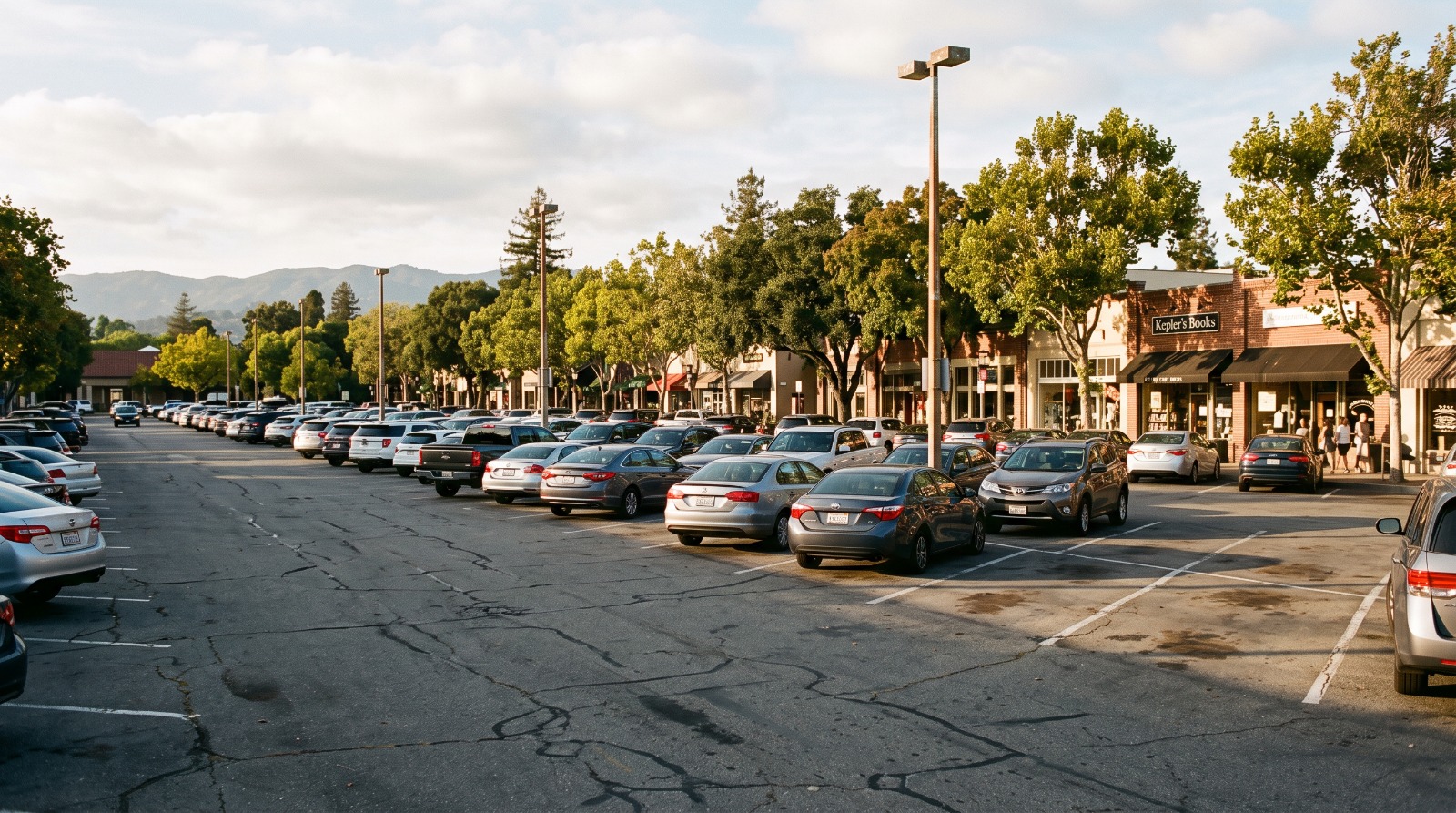
Surface parking lot in downtown Menlo Park, California, the kind of city-owned land at the center of a November 2026 housing ballot measure. Photo: Houseberry
Four California cities vote on November 3 on measures written to take housing decisions back from Sacramento. Three of the four aim at the same asset, which is city-owned land that housing was already planned for. The short answer to what happens if they pass is that state law almost certainly outranks them, and in two of the four cities the state has already put that in writing.
The cities are Menlo Park, Los Altos, Newport Beach and Grover Beach. The Real Deal grouped them this week as a local-control revolt, which is a fair description. Read against the statute, they are also an expensive way to lose.
Three things to hold onto before the arguments start:
- Two of the four measures are about downtown parking lots, in cities that had already flagged those lots as housing sites.
- SB 79 took effect on July 1, 2026, and a local ballot measure is not one of the ways a city can get out from under it.
- The state has already sent warning letters to Grover Beach and Newport Beach, with $10,000 a month in penalties named in both.
What each of the four measures actually does
Only one of the four has a ballot designation so far. Grover Beach voters will see Measure F-26. The other three are still printing as blanks on county documents, so if someone tells you how to vote on a letter in Menlo Park, Los Altos or Newport Beach, they are ahead of the registrar.
| City | What the measure does | Who wrote it | Status |
|---|---|---|---|
| Menlo Park | Requires a citywide election before the city sells, leases or builds housing on city-owned downtown parking lots | Citizen initiative, Save Downtown Menlo | Certified for Nov 3, no letter assigned |
| Los Altos | Requires voter approval before downtown parking plazas are sold, traded or significantly altered, with a carve-out that still allows affordable housing on Plazas 7 and 8 | Citizen initiative, ForLosAltos | Sent to the ballot by council, June 2026, no letter assigned |
| Newport Beach | Cuts rezoned housing capacity from 8,174 units to 2,900 and requires 100 percent of the remainder to be affordable | Citizen initiative, Newport Beach Stewardship Association | Signatures certified, city has sued to keep it off the ballot |
| Grover Beach | Caps commercial buildings at three stories and about 40 feet, caps industrial at 33 feet, and requires at least one third of any mixed-use project to stay commercial | Citizen initiative, Save Grover Beach | Measure F-26, on the Nov 3 ballot |
Notice what is missing from that table. Not one of these measures adds housing capacity anywhere else to replace what it removes. That is the detail the state cares about, and it is the reason two of these cities are already in trouble.
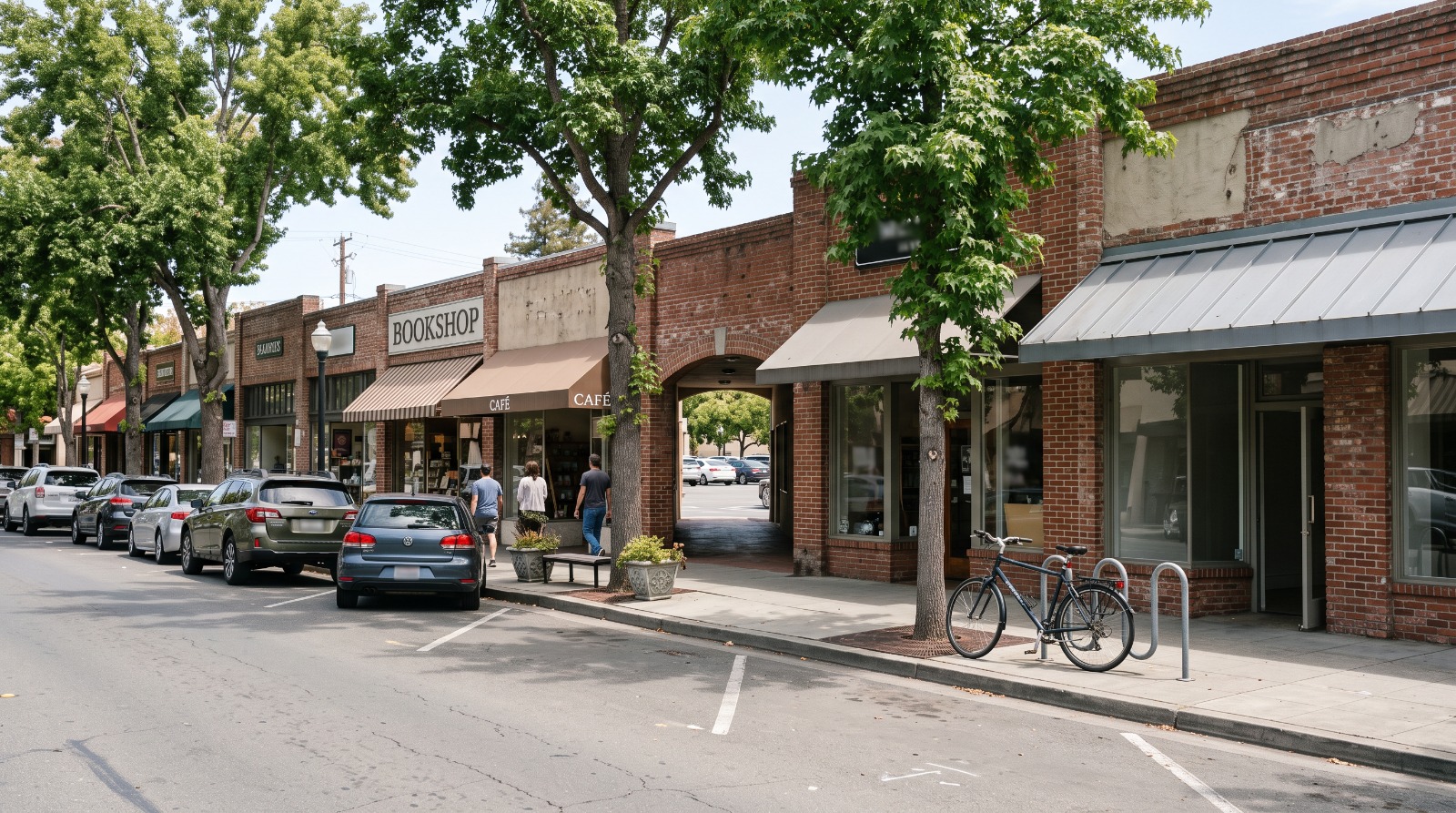
Menlo Park is the one with real projects attached
Everywhere else this is a zoning argument. In Menlo Park there are three actual proposals sitting on a desk.
The city ran a request for proposals on three downtown surface lots and got back three teams in January 2026. Presidio Bay Ventures proposed 347 units at five stories, 140 of them affordable. Alliant Communities proposed 345 units, all affordable. Related California and Alta Housing together proposed 500 units at seven to nine stories, with 346 affordable including 126 for seniors. Those are not placeholder numbers. They are responses to a city solicitation.
If the city has not picked a team, or the chosen developer has not filed a permit application, before November 3, the measure catches the project. A representative for Presidio Bay told the Almanac the company would find it hard to justify more private investment without more certainty that a project can move forward, which is the polite version of what every developer in the state would say.
The context matters. Menlo Park owes 2,946 units under its sixth-cycle housing element, which runs through 2031. Through the end of 2025 it had permitted about 763 above-moderate units, roughly 59 percent of that share, and only about 18.5 percent of its 740 very-low-income units. The market-rate half is on pace. The affordable half is not, and the downtown lots were the plan for fixing that. In June 2026 the ACLU of Northern California came out against the measure, which is not an organization that shows up for parking fights.
Downtown Menlo Park, the neighborhood those lots sit in, scores 4.6 out of 5 on amenities in our 2026 data, the highest in the city. It is the single most walkable place in Menlo Park to put a home. That is not a coincidence, and it is why the lots were on the list.
The state answered this question on July 1
SB 79 took effect statewide on July 1, 2026. It makes qualifying housing an allowed use within a half mile of eligible transit stops in urban transit counties, at heights and densities local zoning cannot undercut. A Tier 1 site within 200 feet of a heavy-rail stop has to allow 95 feet and 160 units per acre. Four Bay Area counties are covered: San Francisco, Alameda, San Mateo and Santa Clara. BART and Caltrain are Tier 1. Muni Metro, VTA light rail and AC Transit Tempo are Tier 2.
Menlo Park is in San Mateo County. Los Altos is in Santa Clara County. Both are inside SB 79 territory.
Here is the part that decides the whole story. A city can get relief from SB 79 in exactly two ways, and neither of them is a vote. It can adopt an exclusion ordinance for specific sites, or it can submit a transit-oriented development alternative plan that preserves equivalent housing capacity across all its TOD zones. Both go to the Department of Housing and Community Development for approval. HCD has already used that power in both directions, rejecting Beverly Hills' alternative plan on May 8, 2026 and approving San Jose's industrial-hub exclusion on June 4.
A measure that says no housing here, full stop, is not an exclusion ordinance and is not an alternative plan. It is a city instructing itself to break state law.
Two of these cities already have letters from Sacramento
This is not speculation about what the state might do. It has already written.
HCD wrote to Grover Beach on July 27, 2026, hours before that night's council meeting, warning that if Measure F-26 passes without offsetting upzoning somewhere else, the action shall be voided. The letter names $10,000 a month in penalties plus attorney fees, loss of state funding eligibility, and exposure to the builder's remedy. It also points out that a housing element update to replace the lost capacity would take at least a year, so there is no way for the city to comply before the election even if it wanted to.
Newport Beach got its letter earlier, on September 18, 2025, and it is blunter. HCD told the city the initiative would put it out of step with its own certified housing element, that the unit cap appears to violate the Housing Crisis Act without a health or safety justification, and that the consequences include the same $10,000 monthly minimum plus the possibility of a court taking local land-use authority away entirely.
Newport Beach is also the one measure that may not make the ballot at all. The city itself sued in June 2026 to block it, arguing the proponents missed Elections Code publication requirements. A judge has to rule by August 28 for ballot printing. So the city council that has to defend the measure is currently in court trying to kill it.
The parking lots are not ordinary city property
Both Peninsula measures share a legal problem their sponsors rarely mention. Los Altos declared Parking Plazas 7 and 8 surplus land in 2024. Menlo Park's downtown lots are city-owned too. Under California's Surplus Land Act, once a city declares land surplus it owes notice and good-faith negotiation to affordable housing developers before it can do much else with the parcel.
A voter-approved rule that adds an election in front of that process does not obviously survive contact with the statute. The Los Altos measure seems to know it, because it carves out an exception letting Plazas 7 and 8 still be developed for affordable housing without a citywide vote. That carve-out is the tell. It concedes the point on the two parcels most likely to draw a lawsuit and leaves the rest of downtown behind a ballot box.
What this fight is worth in dollars
These are not distressed towns making a defensive crouch. They are two of the most expensive small cities in the country, and they are moving in opposite directions.
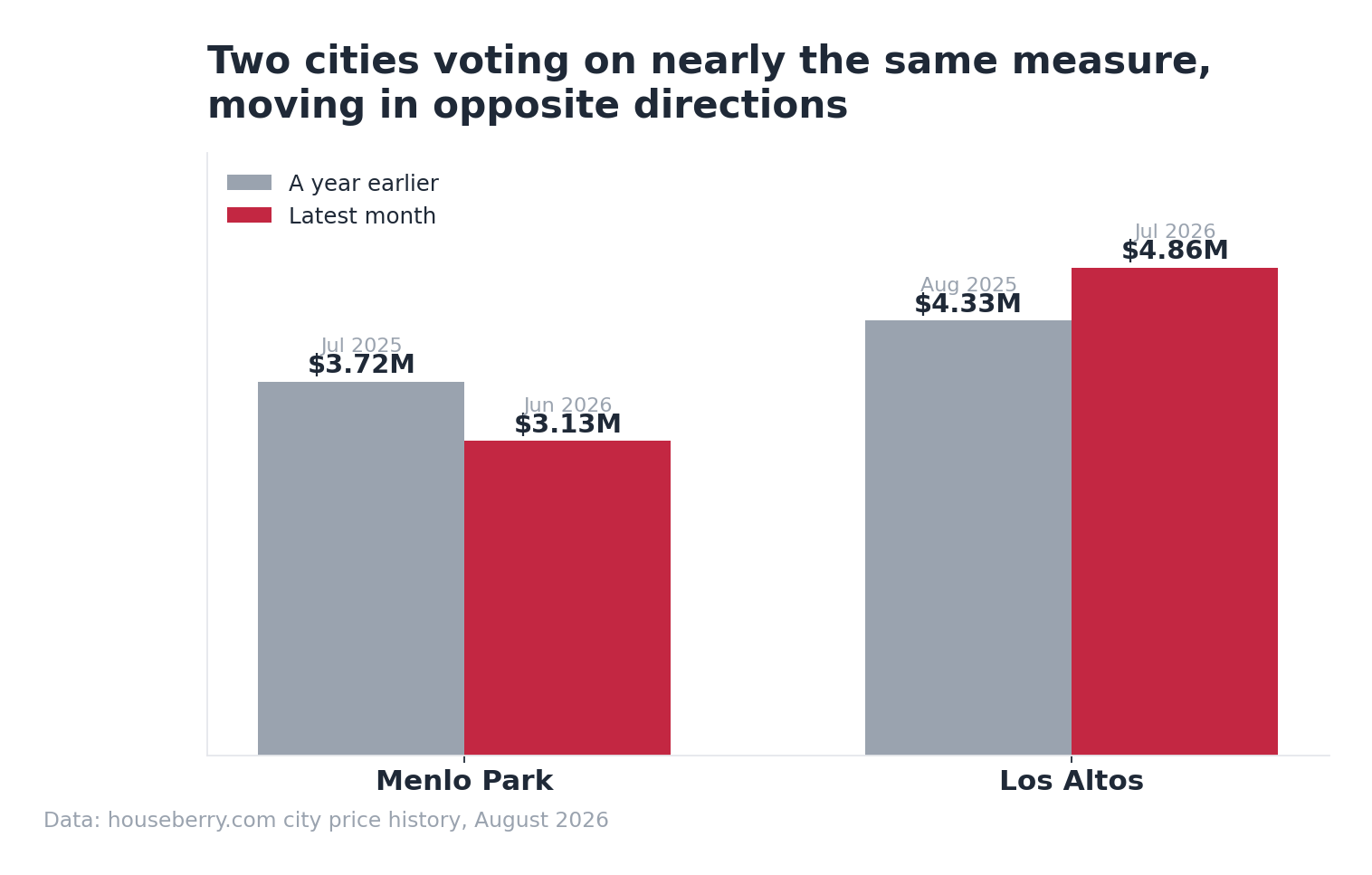
Menlo Park had a citywide median of about $3.13 million in June 2026, down from roughly $3.72 million in July 2025. Los Altos went the other way, from about $4.33 million in August 2025 to $4.86 million in July 2026. Same peninsula, same seven miles apart, nearly the same ballot measure, opposite price trajectories.
The quality signals in both places are exactly what you would expect. Six of the nine Los Altos neighborhoods we score share the top school rating of 5.0 out of 5. In Menlo Park, West Menlo posts the highest safety score in the city at 4.7 out of 15 neighborhoods ranked. Nobody is arguing these are bad places to live. That is the argument. When we look at a neighborhood at Houseberry, high scores plus high prices plus almost no new supply is the exact signature of a place that has stopped building, and both of these are textbook.
The strongest version of the other side
The sponsors are not making things up, and it is worth saying which parts of their case are real.
Downtown merchants in Menlo Park and Los Altos genuinely use those lots. Losing surface parking without a credible replacement is a real cost to a small retail street, and both cities have been vague about the replacement. Citizen initiatives are also a legitimate tool, not a loophole, and the past decade of state preemption has been genuinely heavy-handed in a way that has made a lot of reasonable people feel talked past. If you have sat through a hearing where the answer was effectively that the decision has already been made in Sacramento, the impulse behind these measures is not hard to understand.
What the sponsors have not answered is the arithmetic. Every unit blocked has to go somewhere else in the same city, because the housing element obligation does not shrink when the zoning does. And if a city falls out of compliance, the builder's remedy kicks in, which lets developers propose projects that ignore local zoning almost entirely. Sonja Trauss of YIMBY Law called that outcome ironic, and she is right. The likeliest result of a successful anti-housing measure is less local control, not more.
What to watch between now and November 3
Four dates carry the story from here.
- August 28, 2026. A judge must rule by then on whether the Newport Beach measure goes on the ballot at all.
- Measure letter assignments. Santa Clara and San Mateo counties have not assigned letters to the Los Altos or Menlo Park measures yet. Argument and rebuttal deadlines run through mid-August.
- Menlo Park's developer selection. If the city picks a team and that team files a permit application before the election, the measure may not reach the project at all.
- October 27, 2026. The developer behind the 665-unit Willow Park project at the old Sunset Magazine campus has demanded approval by that date, after Attorney General Rob Bonta sent Menlo Park a 10-page letter on July 29 backing the developer's position under AB 2011.
If you are shopping in any of these four cities, none of this changes what a house is worth next month. What it changes is the five-year picture, which is whether the place you are buying into adds homes or freezes. That is the kind of thing worth knowing before you pick a town, which is most of why we built Houseberry around looking at the area first and the address second.
Sources
- The Real Deal, Residents across four CA cities trying to take back control of housing through ballot measures, August 4, 2026
- California HCD, SB 79 transit-oriented development page
- ABAG, SB 79 summary and tier tables
- KCBX, State warns Grover Beach ballot measure could conflict with California housing law, July 28, 2026
- California HCD letter to the City of Newport Beach, September 18, 2025
- Voice of OC, Newport Beach asks judge to block ballot initiative aimed at limiting housing
- The Almanac, Housing proposals arrive as Menlo Park parking lot plan faces ballot measure
- The Almanac, Menlo Park pulls ahead on market-rate housing, lags on affordable units
- ACLU of Northern California opposition statement, June 29, 2026
- City of Los Altos, Citizen Initiative on the Downtown Parking Plazas
- Holland and Knight, Tracking SB 79 implementation
- Houseberry city and neighborhood price histories and 2026 neighborhood scores for Menlo Park and Los Altos.
All information provided on this website including but not limited to - school ratings, safety, amenities, user opinions, and property data - is for general informational purposes only. We do not guarantee its reliability, accuracy, or completeness. Users should independently verify information and consult appropriate professionals as needed. By using this website, you agree Houseberry is not responsible for actions, decisions, or consequences arising from reliance on the information provided
houseberry.com - CA DRE# 01847391
 Bay East ©2025. CCAR ©2025. bridgeMLS ©2025. Information Deemed Reliable But Not Guaranteed. This information is being provided by the Bay East MLS, or CCAR MLS, or bridgeMLS. The listings presented here may or may not be listed by the Broker/Agent operating this website. This information is intended for the personal use of consumers and may not be used for any purpose other than to identify prospective properties consumers may be interested in purchasing. Data last updated at September 21, 2026 12:00 AM