Downtown San Mateo: 94 Homes and a 35-Day Legal Window
San Mateo quietly recorded a CEQA exemption for an eight-story, 94-unit building on South B Street. The filing cut the window to challenge it from six months to about five weeks.

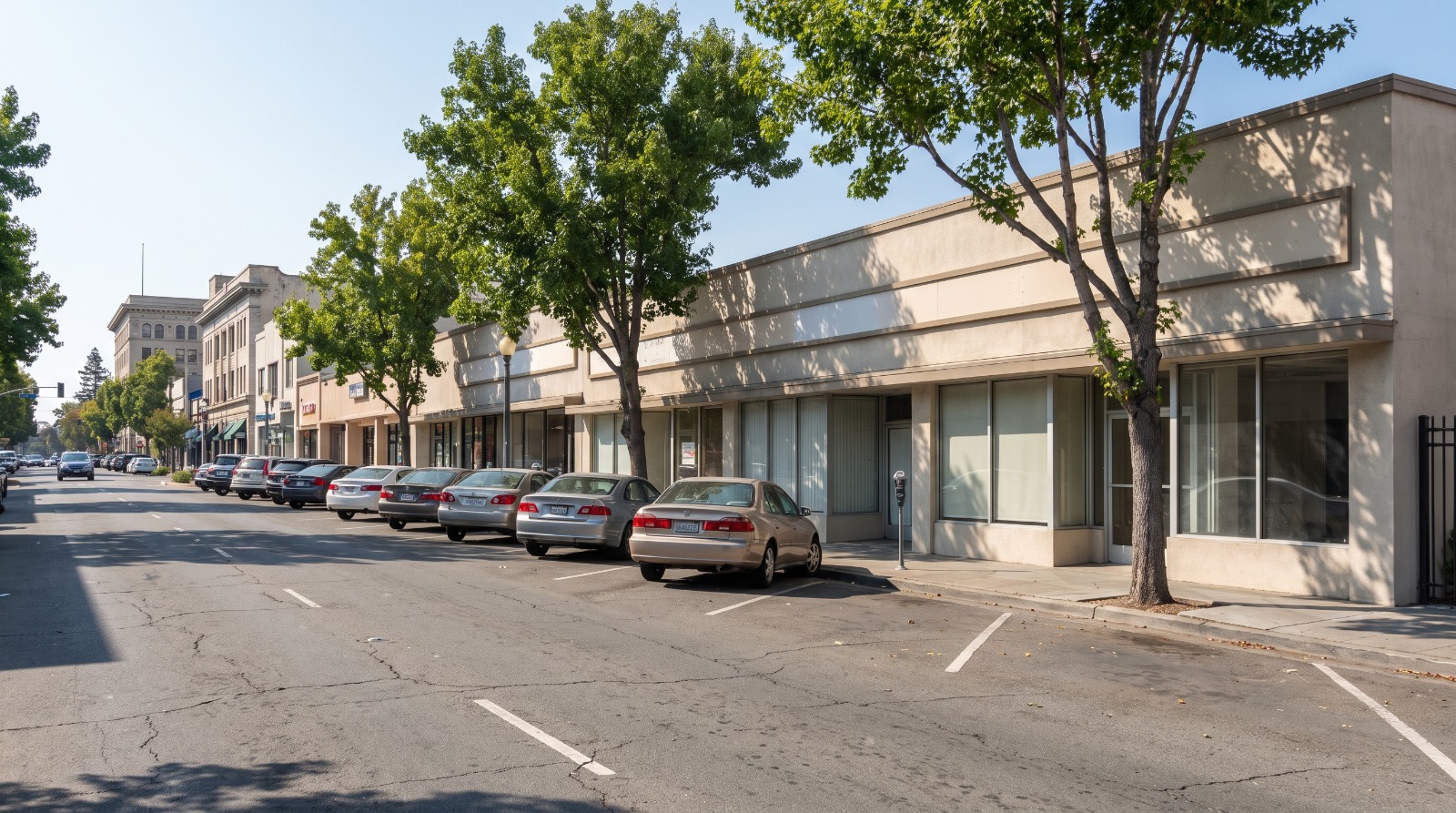
The low-rise commercial block of South B Street in downtown San Mateo where an eight-story, 94-unit building has been approved Photo: Houseberry
On August 20 a two-page form went across the counter at the San Mateo County Clerk's office, and it did more to settle the future of downtown San Mateo than any hearing this year. It is a Notice of Exemption for an eight-story, 94-unit building at 616 South B Street, and the day it was stamped, the window to challenge the project under California's environmental law shrank from 180 days to 35.
That window closes in late September. As far as we can tell, nobody has reported the filing, and the city's own project page still describes the application as under review by staff.
The applicant of record is the architect, Arc Tec. The entity carrying out the project is Nazareth Vista LLC, tied to Nazareth Enterprises, a San Mateo company that bought the parcel for $7.3 million in early 2021 with redevelopment in mind. The name is corporate, not ecclesiastical, which is worth saying because the assumption is easy to make.
One number tells you how much this project grew. In December 2023 the planning commission approved a 48-unit, five-story building on the same lot. The version that just cleared CEQA is nearly twice the homes and three stories taller. Reading the 2023 and 2026 filings side by side is the only way to see it, and nobody has.
Why a paint store site qualifies for an infill exemption
The city used a Class 32 categorical exemption, CEQA Guidelines section 15332, which covers infill development. It has five conditions and a project has to satisfy all of them: consistency with the general plan and zoning, a site under five acres within city limits and substantially surrounded by urban uses, no habitat value for endangered or rare species, no significant traffic, noise, air quality or water quality effects, and adequate utilities and services.
Look at condition two against this site. The ceiling is five acres. The lot is 0.64 acres, about an eighth of the maximum, surrounded on every side by a downtown that has been built out for a century. If there is a textbook Class 32 parcel on the Peninsula, it is a closed paint store six blocks from a Caltrain platform.
That is the fair case for the exemption, and it is a strong one. The site is a two-minute walk from the Laurel Avenue edge of Central Park and about half a mile up B Street from the San Mateo station. Building 94 homes there instead of somewhere with a commute attached is the whole point of the streamlining laws.
What the 35-day clock actually is
This is the part that decides whether the project is real, and it is genuinely counterintuitive.
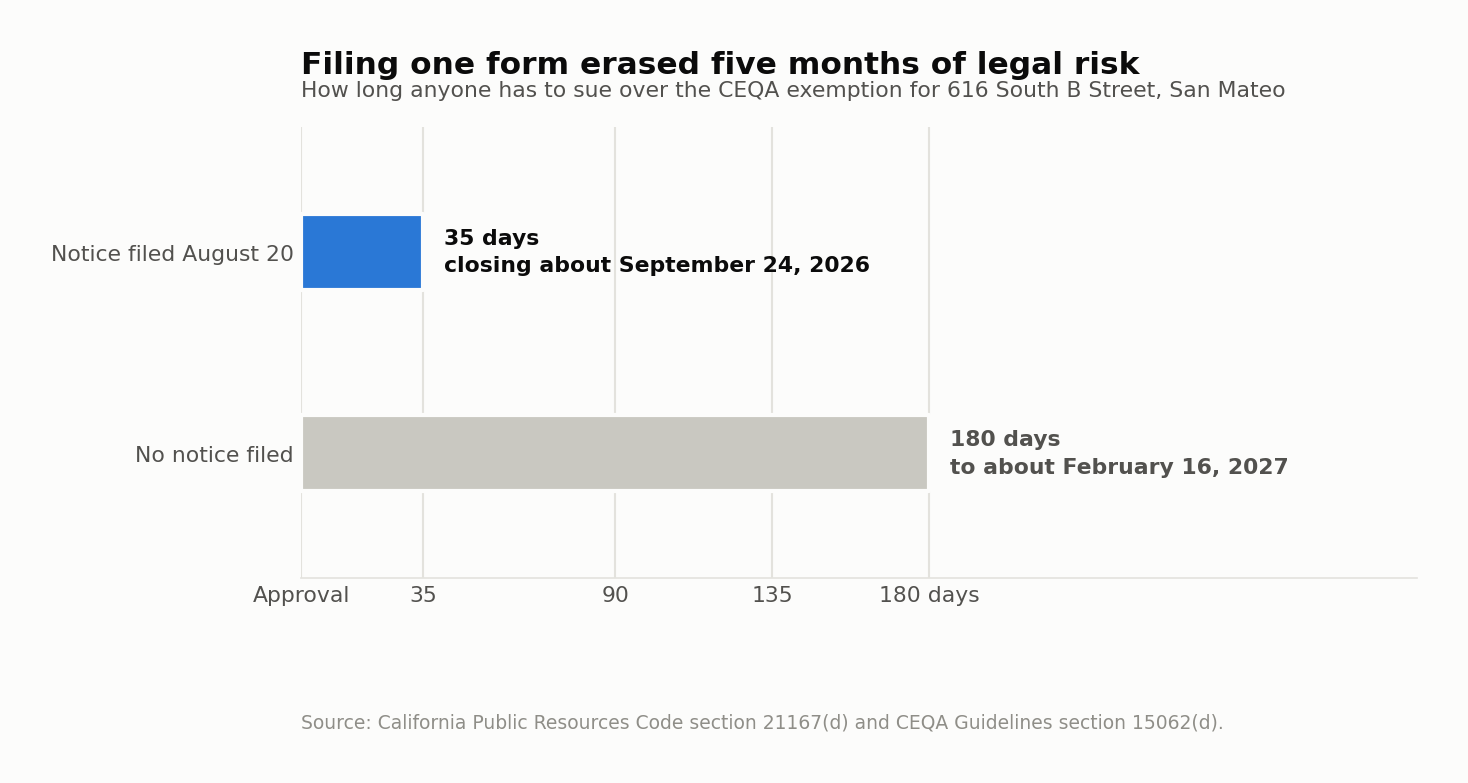
Under Public Resources Code section 21167, a lawsuit claiming an agency wrongly declared a project exempt must be filed within 35 days of the agency filing the notice. If the agency never files one, the deadline is 180 days from the decision. The state's own guidelines say the same thing in plainer words: filing the notice and posting it start a 35-day statute of limitations, and skipping it leaves you exposed for six months.
So the notice is not a formality. It is a shield, and filing it is the cheapest legal move an agency ever makes. San Mateo stamped it with the county clerk on August 20 and it posted to the state database on August 21. Count 35 days and the CEQA challenge lane closes in the last week of September, rather than somewhere around mid-February 2027.
Two honest caveats. The 35 days bars the CEQA exemption claim specifically, not every possible lawsuit, and claims under the Housing Accountability Act or the Subdivision Map Act run on their own clocks. And an exemption is not bulletproof: section 15300.2 carves out exceptions a challenger can still argue inside the window, chiefly unusual circumstances, cumulative impact from successive projects in the same place, a historical resource, or a site on the state's hazardous waste list. That last one is not nothing on a parcel that sold paint for decades, and the notice does not address it either way.
San Mateo has found its gear
The more interesting story is that this filing is not unusual for San Mateo anymore. The city is now running three different streamlining tools at once, and clearing housing without a single environmental impact report.
| Project | Homes | How it cleared review | Date |
|---|---|---|---|
| 616 S. B Street (Nazareth Vista) | 94 | Class 32 infill exemption | Filed Aug 20, 2026 |
| 230 S. El Camino Real | 28 | Class 32 infill exemption | Posted Mar 12, 2026 |
| 668 E. 3rd Avenue | 128 | Statutory exemption under AB 130 | Posted Mar 4, 2026 |
| 220 W. 20th Avenue | 232 | SB 330 streamlining, CEQA exempt | Approved Jun 18, 2026 |
| 690 Concar Drive | 847 | Updated zoning permits | Approved Jul 30, 2026 |
The bottom two sit outside downtown, and 690 Concar is a category of its own. We covered that one when it landed: 847 homes on a 14.5-acre shopping center site, 186 of them affordable. Set it next to Nazareth Vista and you get the two ends of the infill spectrum in one city. A 14.5-acre suburban teardown and a 0.64-acre downtown lot, both cleared without an EIR, three weeks apart.
The context that makes it matter: San Mateo owes the state 7,015 homes between 2023 and 2031, and it has permitted under 5 percent of its very-low-income share so far. Ninety-four units with ten very-low-income apartments does not close that. Doing it eight more times might start to.
What 94 studios do to downtown San Mateo
Downtown San Mateo is the most lopsided neighborhood in the city on Houseberry's numbers, and that lopsidedness is the whole point here. It ranks 23rd of 23 San Mateo neighborhoods on our overall score, at 2.7, dragged down by 2.2 for safety and 2.3 for schools. It also scores 4.3 for amenities with a 4.7 for nearby merchants, which is the highest tier in the city. Its median sale price was about $1.4 million in July 2026, against a citywide median of about $2.21 million in June. Roughly 39 percent below the city as a whole.
Now look at the unit mix again. Forty-two studios and forty-one one-bedrooms, ninety-three of ninety-four homes at one bedroom or less, on a lot two blocks from a park and six from a train. That building is aimed almost perfectly at the household that reads this neighborhood's scorecard and cares about the 4.7 merchants score rather than the 2.3 schools score. Whether that was deliberate market research or just what pencils out at eight stories, it is well calibrated.
The trade-off is the one downtown San Mateo keeps making. A block of eleven two-bedrooms is not going to hold a family, and a downtown that adds only studios gets more crowded without getting more rooted. Hayward Park next door, wrapped around Central Park at a $2.42 million median, is where those families end up instead, and the gap between the two neighborhoods keeps widening. More homes is still the right answer. It is just not a complete one.
The date
Late September. If nobody files by then, the CEQA question on 616 South B Street is closed and the next milestone is a demolition permit on a boarded-up paint store. If someone does file, the argument will be about unusual circumstances or that hazardous waste list, not about height or parking, because those arguments ended the moment the city picked Class 32.
In the meantime, somebody at the city should update the project page. The state's record and San Mateo's own website currently disagree about whether this building has been approved, and the state's record is the one that starts clocks.
Sources
CEQAnet: Notice of Exemption, SCH 2026080771, 616 S. B Street Mixed-Use Development
CEQA Guidelines section 15332, Class 32 in-fill development
CEQA Guidelines section 15062, Notice of Exemption and the 35-day limitations period
Public Resources Code section 21167
CEQA Guidelines section 15300.2, exceptions to categorical exemptions
City of San Mateo: 616 S. B Street mixed-use development project page
SF YIMBY: Planning commission recommends approval for 616 South B Street
The Houseberry Research Team is Houseberry's reporting team: Bay Area real estate analysts, data specialists and longtime local market watchers. Every day we check the public record: building permits, city council and planning agendas, county recorder filings, state housing bills, police incident data and school results. Then we tie each story to what it means for specific neighborhoods, using Houseberry's own neighborhood data on prices, appreciation, safety, schools and amenities. Questions or corrections: Contact us.
All information provided on this website including but not limited to - school ratings, safety, amenities, user opinions, and property data - is for general informational purposes only. We do not guarantee its reliability, accuracy, or completeness. Users should independently verify information and consult appropriate professionals as needed. By using this website, you agree Houseberry is not responsible for actions, decisions, or consequences arising from reliance on the information provided
houseberry.com - CA DRE# 01847391
 Bay East ©2025. CCAR ©2025. bridgeMLS ©2025. Information Deemed Reliable But Not Guaranteed. This information is being provided by the Bay East MLS, or CCAR MLS, or bridgeMLS. The listings presented here may or may not be listed by the Broker/Agent operating this website. This information is intended for the personal use of consumers and may not be used for any purpose other than to identify prospective properties consumers may be interested in purchasing. Data last updated at October 9, 2026 12:00 AM