San Francisco files a $15.4M fix for the Mission Cultural Center
The city filed a $15.37 million seismic retrofit permit for 2868 Mission Street, the shuttered Mission Cultural Center for Latino Arts. Here is what the work covers, the timeline and what Inner Mission homes cost.

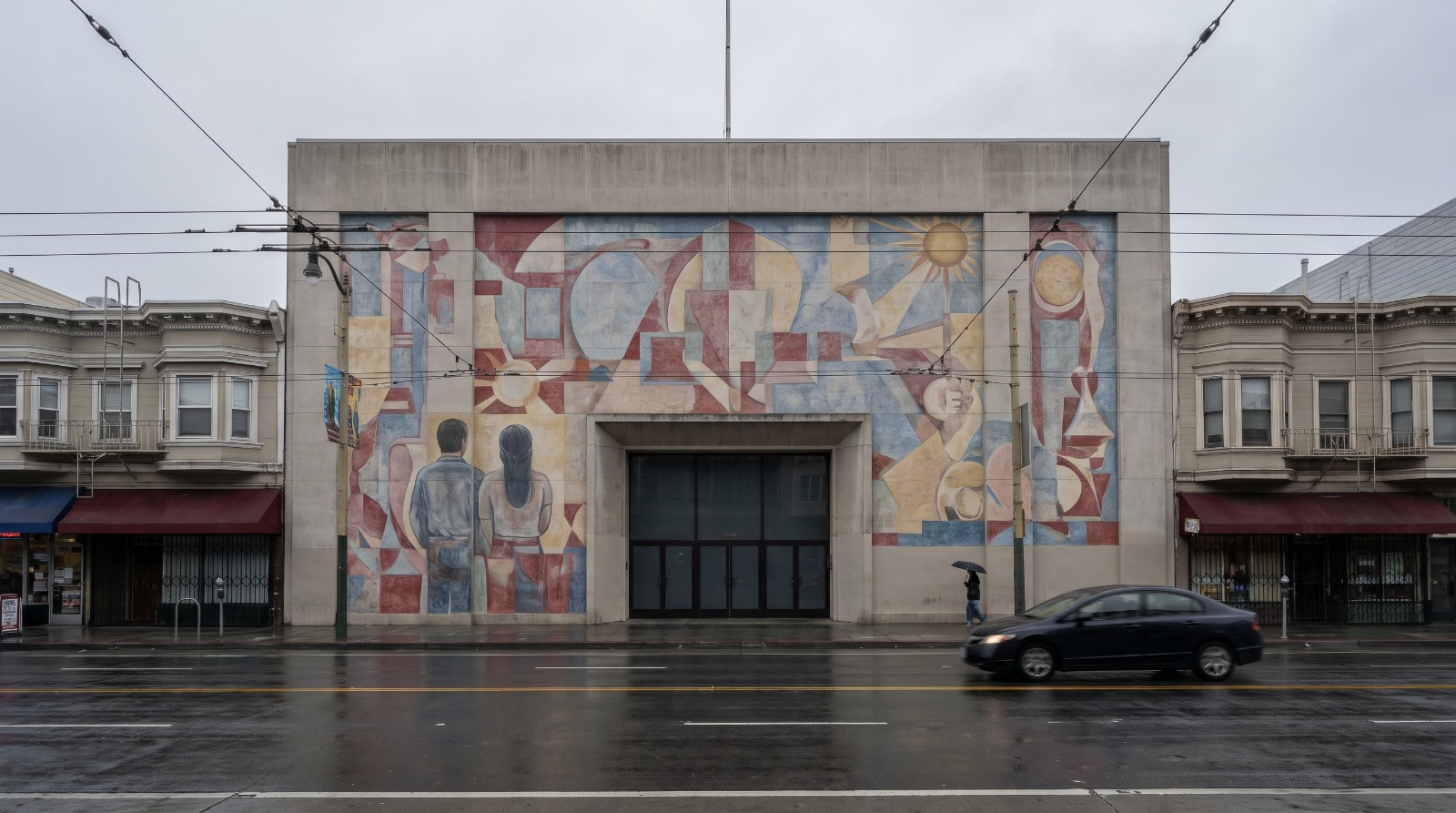
AI-generated view of a mural-covered four-story building on Mission Street in San Francisco's Mission District after rain Photo: Houseberry
The mural is still there. The doors at 2868 Mission Street, between 24th and 25th, have been shut since the Mission Cultural Center for Latino Arts ran out of staff in January. On Nov. 17, the city filed the permit that decides what happens to the building next: a $15.37 million seismic retrofit.
The permit, number 202611170860, covers a voluntary seismic retrofit, soft-story work, a new roof, wall anchorage and floor diaphragm work, new storefronts, entries and windows, and new mechanical systems. It keeps the building at four stories and in office and cultural use. This is the first dollar figure attached to a promise the city has been making all year.
It lands in one of the most expensive stretches of the Mission. Houseberry data puts the typical Inner Mission home at about $1.19 million in September 2026, up about 7 percent from October 2025.
Why the building had to be emptied
The 1947 building has been on the city's seismic list for years. In March 2025, Public Works awarded one design-build contract for two Arts Commission buildings, this one and the African American Art and Culture Complex in the Western Addition. Both centers were told to move out before work began.
For the Mission Cultural Center, that move was the breaking point. The nonprofit said in 2025 it needed about $4 million to relocate and pay market rent in the meantime. It declared bankruptcy and has had no staff since late January 2026. Mission Local reported in October that the city still holds $743,000 it meant for Mission arts programming and is deciding who gets it.
In February, the Board of Supervisors passed Resolution 67-26, introduced by Supervisor Jackie Fielder, committing the city to keep 2868 Mission a center for Latino arts and culture during and after the retrofit. Mayor Daniel Lurie's office has said the same. City leaders were careful to separate that commitment from the nonprofit's money troubles.
The landmark ordinance that protects the building also shapes the work. It allows a seismic retrofit as long as the exterior work follows the city's design guide for unreinforced masonry, which is why the permit spends so many words on storefronts, entries and windows.
A dark corner at 24th and Mission
This block sits at the heart of the Calle 24 Latino Cultural District, with the 24th Street BART plaza a block away. A dark, fenced building at that spot for three years is a real hole in the street.
Houseberry scores the Inner Mission 2.1 out of 5 overall, with 3.3 for amenities and 2.0 for safety, on its San Francisco rankings. Prices have not cared much, according to Houseberry. The typical Inner Mission home gained about 7 percent in eleven months, and neighboring Mission Dolores gained about 8 percent to roughly $1.45 million.
| Neighborhood | Overall | Safety | Amenities | Typical price, Sept. 2026 | Change since Oct. 2025 |
|---|---|---|---|---|---|
| Inner Mission | 2.1 | 2.0 | 3.3 | $1.19M | +7.0% |
| Mission Dolores | 2.7 | 3.8 | 3.6 | $1.45M | +7.7% |
Our view
We think the city is right to fix the building first and argue about the operator second. A landmark holding decades of the neighborhood's prints and posters has to stand up in an earthquake before anything else can happen inside it.
But a permit is not a plan. The city has three years and $15 million of construction to pick who runs 2868 Mission when the scaffolding comes down, and it should pick before the work is half done, not after. Empty cultural buildings in San Francisco have a way of staying empty.
The next marker is the permit actually issuing. Until then, the San Francisco price ranking shows where the Mission sits against the rest of the city.
Sources
- DBI building permit 202611170860, DataSF, filed Nov. 17, 2026
- Resolution 67-26, Protecting the long-term future for a center for Latino arts and culture at 2868 Mission Street, Board of Supervisors
- Latino Arts Center at 2868 Mission to remain cultural space after seismic retrofit, El Reportero, March 2026
- Who will get the Mission's $743,000 in arts funding, Mission Local, October 2026
- Landmark designation, Ordinance 87-22, Board of Supervisors
The Houseberry Research Team is Houseberry's reporting team: Bay Area real estate analysts, data specialists and longtime local market watchers. Every day we check the public record: building permits, city council and planning agendas, county recorder filings, state housing bills, police incident data and school results. Then we tie each story to what it means for specific neighborhoods, using Houseberry's own neighborhood data on prices, appreciation, safety, schools and amenities. Questions or corrections: Contact us.
Map of San Francisco Neighborhoods
Loading map...
View Full Map
Top Neighborhoods in San Francisco, CA





All information provided on this website including but not limited to - school ratings, safety, amenities, user opinions, and property data - is for general informational purposes only. We do not guarantee its reliability, accuracy, or completeness. Users should independently verify information and consult appropriate professionals as needed. By using this website, you agree Houseberry is not responsible for actions, decisions, or consequences arising from reliance on the information provided
houseberry.com - CA DRE# 01847391
 Bay East ©2025. CCAR ©2025. bridgeMLS ©2025. Information Deemed Reliable But Not Guaranteed. This information is being provided by the Bay East MLS, or CCAR MLS, or bridgeMLS. The listings presented here may or may not be listed by the Broker/Agent operating this website. This information is intended for the personal use of consumers and may not be used for any purpose other than to identify prospective properties consumers may be interested in purchasing. Data last updated at November 19, 2026 12:00 AM