Oakland Rent Control in 2026: The 1983 Line Is in Court
Oakland caps covered rent increases at 2.3 percent through July 2027. Whether your building is covered comes down to 1983, and a federal case could move that line.
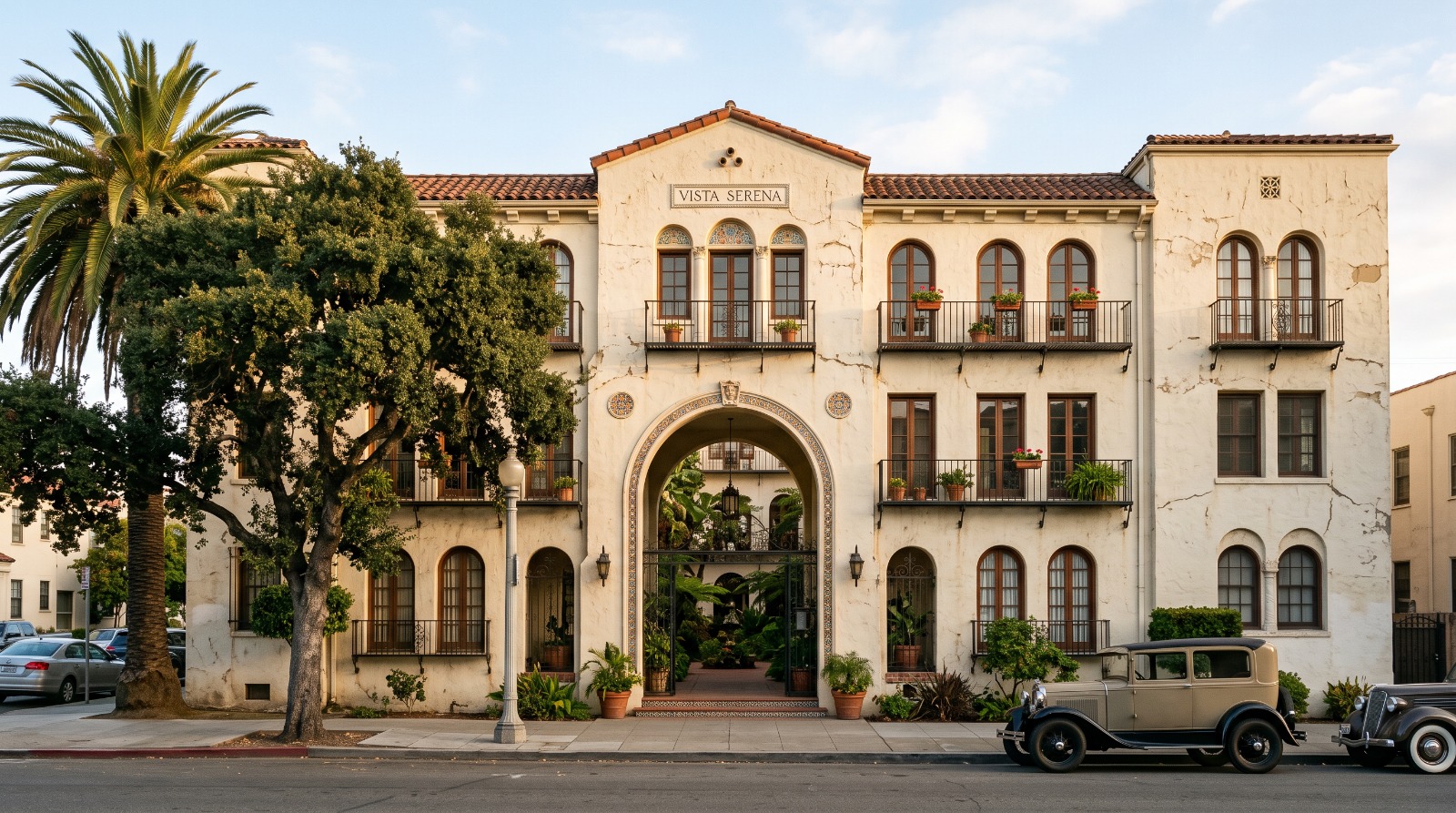
A 1920s stucco courtyard apartment building in Adams Point, Oakland, the kind of pre-1983 building covered by the city rent program. Photo: Houseberry
On August 1 Oakland's allowable annual rent increase went from 0.8 percent to 2.3 percent, where it stays through July 31, 2027. If your building went up before January 1, 1983, that is your number. If it went up after, your landlord is working off a different one, and this year that number is 8.8 percent.
Same city, same block, four times the increase, decided by a date nobody in Oakland chose and the city cannot change. That line is now in front of a federal judge.
The short version:
- 2.3 percent is the Oakland cap for covered units, August 1, 2026 through July 31, 2027.
- 8.8 percent is the state AB 1482 cap for the San Francisco-Oakland-Hayward region over the same period, which is what applies when the local ordinance does not.
- January 1, 1983 is the coverage line, and it is frozen there by a 1995 state law, not by Oakland.
- 93 to 100 percent of Oakland's rent-controlled units were found inaccessible to renters with mobility disabilities in a federal ruling last August, which is the finding driving the case.
Two numbers, and which one lands on you
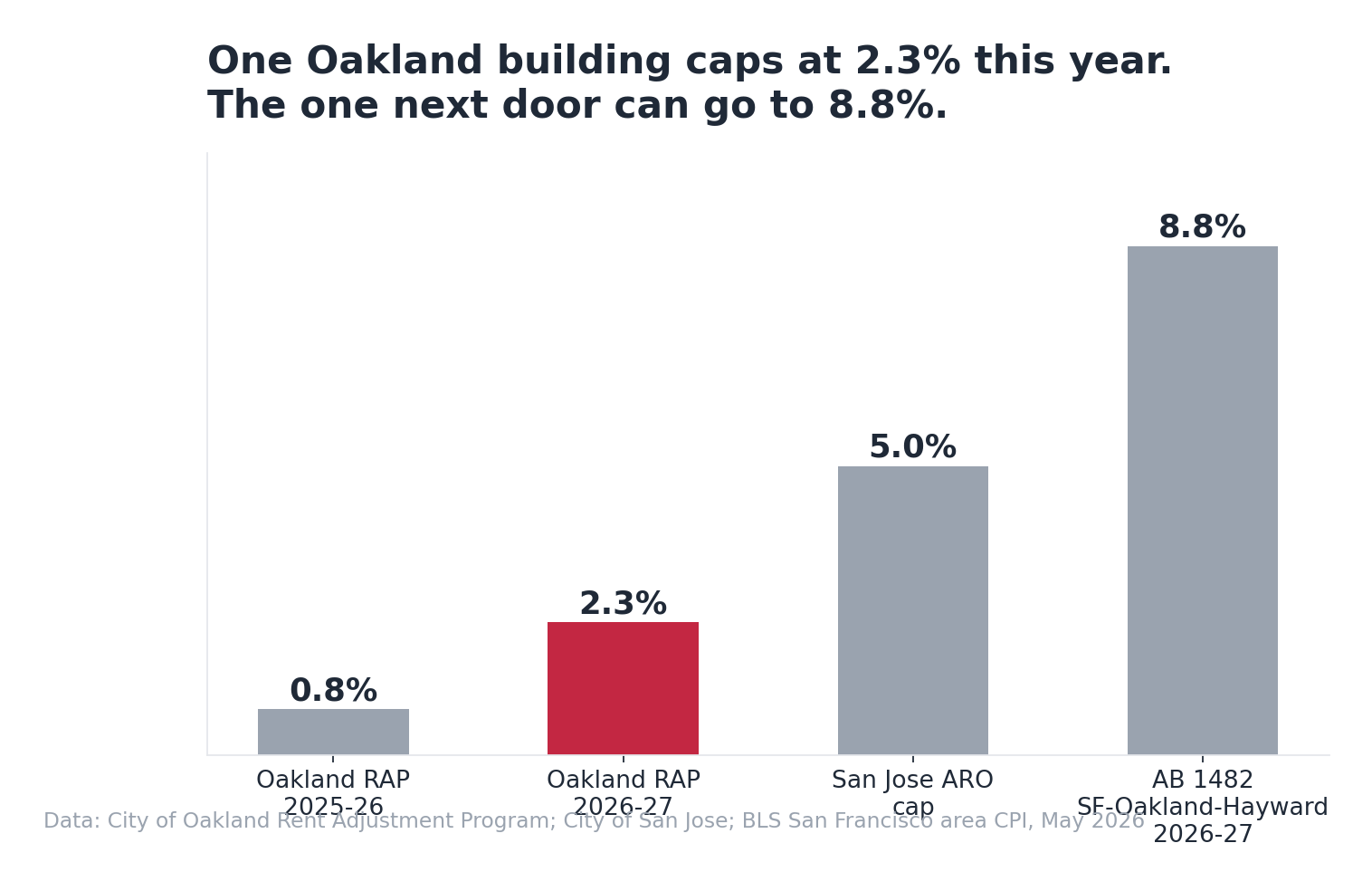
Oakland's Rent Adjustment Program rate resets every August 1 and tracks regional inflation. It was 0.8 percent last year. It is 2.3 percent now. Oakland also caps any single increase at 10 percent regardless of what the formula produces, and allows one increase per twelve-month period.
AB 1482, the statewide Tenant Protection Act, works differently. Its formula is 5 percent plus regional CPI, capped at 10 percent. Bay Area CPI ran 3.8 percent for the twelve months ending April 2026, so the regional cap is 8.8 percent through July 2027. AB 1482 covers most rentals older than 15 years on a rolling basis, which means a 2009 building is inside it now and was not in 2020.
When both apply, the stricter one wins. In practice that means an Oakland renter is either in a pre-1983 multifamily building on 2.3 percent, or they are on 8.8 percent, or in a small set of cases they are on neither. The difference on a $2,400 rent is about $36 a month against $211.
Why 1983, and why Oakland cannot touch it
The date is not a policy choice Oakland is defending. It is a fossil.
The Costa-Hawkins Rental Housing Act passed in 1995 and did three things. It barred cities from imposing rent ceilings on units built after February 1, 1995. It exempted single-family homes and condominiums outright. And it required vacancy decontrol, so a landlord can reset to market rent when a tenant leaves voluntarily, fully in effect since January 1, 1999.
The piece that matters here is a wrinkle in the first item. Cities that already exempted newer construction as of 1995 keep their own earlier cutoff, frozen in place. Oakland's ordinance had a 1983 line. San Francisco's had 1979. Those dates were locked at that moment, and no city council vote can move them forward. Oakland could not extend rent control to 1990 buildings if every member of the council wanted to.
Voters have been asked to undo this three times. Proposition 10 in 2018 would have repealed Costa-Hawkins outright. Proposition 21 in 2020 would have let cities cover buildings 15 years and older. Proposition 33 in 2024 tried repeal again. All three lost.
The cutoff is a different date in every city
If you are comparing East Bay and Peninsula rentals, do not assume the rules travel with you. They do not.
| City | Ordinance | Rent-ceiling cutoff |
|---|---|---|
| San Francisco | Residential Rent Ordinance, 1979 | Certificate of occupancy on or before June 13, 1979 |
| Hayward | Residential Rent Stabilization Ordinance | July 1, 1979 |
| San Jose | Apartment Rent Ordinance, 1979 | Buildings of 3+ units built and occupied before September 7, 1979 |
| Berkeley | Rent Stabilization Ordinance, 1980 | Certificate of occupancy on or before June 1980 |
| Oakland | Rent Adjustment Program, 1980 | Most multifamily built before January 1, 1983 |
| Mountain View | CSFRA, Measure V, 2016 | Buildings of 3+ units, February 1, 1995 |
Mountain View is the instructive one. It passed its ordinance in 2016, twenty-one years after Costa-Hawkins, so it got the statutory 1995 line rather than a frozen local one. Any Bay Area city that adopts rent control tomorrow gets 1995 too. That is the ceiling every new ordinance in California runs into.
Fremont, for the record, has no rent control ordinance at all. AB 1482 is the whole rulebook there.
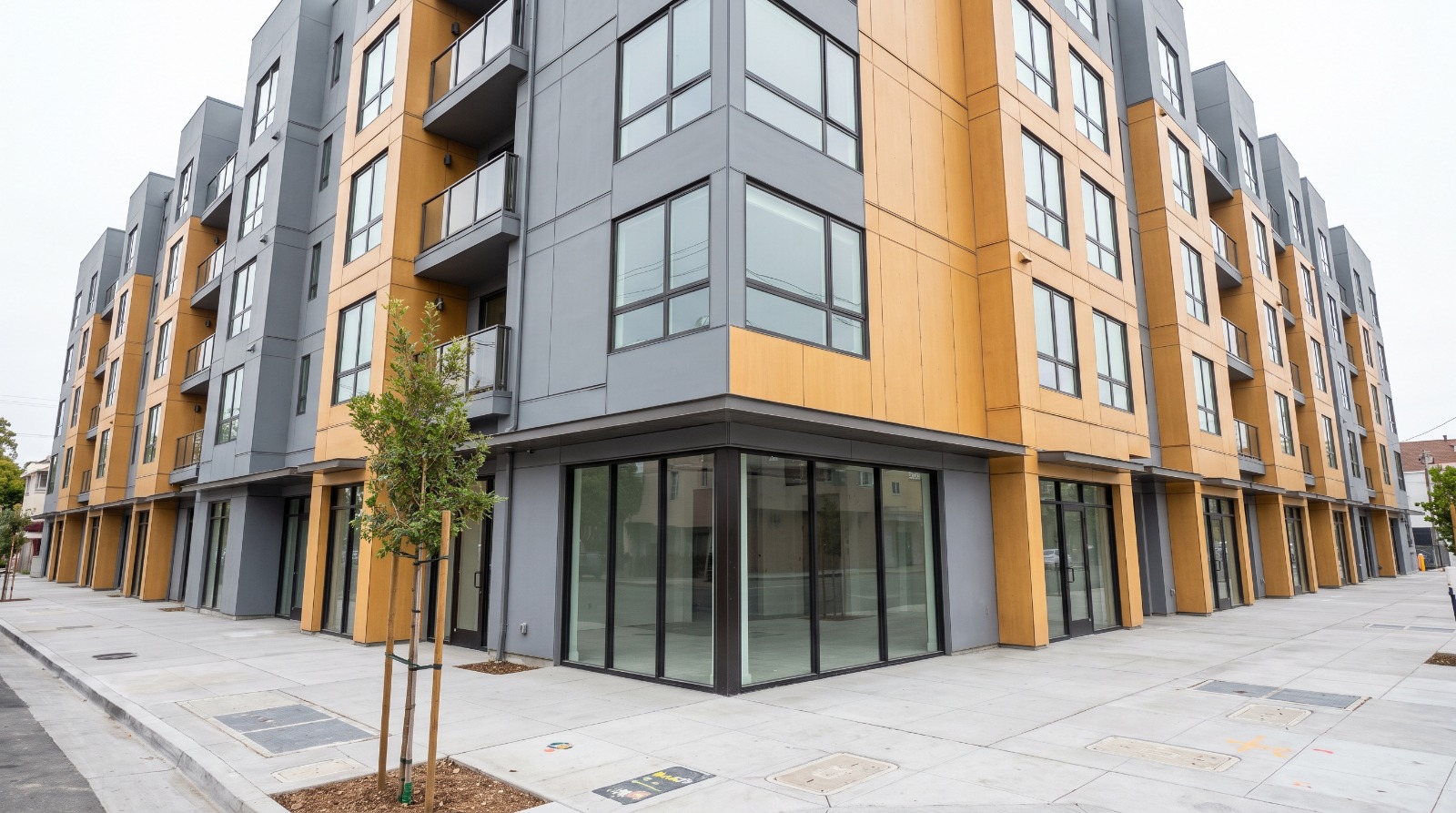
What is actually in front of the judge
The case is Smith v. City of Oakland, No. 4:19-cv-05398, in the Northern District of California before Judge Jon S. Tigar. It was filed in August 2019 by Disability Rights Advocates and the Public Interest Law Project on behalf of three wheelchair users, and it was certified as a class action in January 2021.
The argument is not that Oakland intended to discriminate. It is that federal accessibility requirements for new multifamily construction largely postdate 1983. The Fair Housing Act design and construction rules apply to buildings first occupied after March 13, 1991. So nearly every physically accessible rental unit in Oakland sits on the exempt side of the line, and a facially neutral date ends up sorting renters by disability. Under Title II of the ADA, plaintiffs say the city owes a reasonable modification of its own program.
In August 2025 the court granted plaintiffs partial summary judgment on the liability elements, finding evidence that between roughly 93 and 100 percent of RAP-covered units are inaccessible. It did not decide a remedy. It stayed the case to certify the Costa-Hawkins preemption question to the California Attorney General. A further summary judgment hearing was held on May 28, 2026 and no ruling has issued.
the California Apartment Association, a landlord trade group, wrote about this case again on August 6 and described itself as a friend of the court. Two things about that framing are worth flagging. It has also moved to intervene, which is a party role, not an observer role. And its piece leaves out the August 2025 ruling entirely, which makes the case read as speculative when the liability half is largely decided.
What a ruling would and would not do
This is where most coverage will get out over its skis, so here is the scope, plainly.
Even the most aggressive plausible outcome is a district court order, binding on Oakland only, limited to accessible units, and immediately appealable to the Ninth Circuit. It would not repeal Costa-Hawkins. It would not extend rent control to all post-1983 housing. It would not automatically reach San Francisco, Berkeley or San Jose.
The likelier outcomes are narrower still. Courts facing this shape of problem often land on a targeted program rather than a coverage mandate, something like an accessible-housing subsidy or priority placement, which addresses the harm without touching the state statute. Oakland and the landlord side will also press the ADA's own limits, arguing that rewriting the coverage line is not a modification of the program but a replacement of it, and that no city can be ordered to exceed authority state law never gave it. That is a real defense, not a stalling tactic.
So if you are a renter in a 2015 Oakland building, nothing about this case should change what you expect next year. If you are an owner of one, the same. The precedential risk is genuine and it is several years and one appellate court away.
How to tell whether your own unit is covered
Is my Oakland apartment rent controlled?
If it is in a multifamily building that got its certificate of occupancy before January 1, 1983, and it is not subsidized housing, it is very likely covered by the rent ceiling. Oakland's Rent Adjustment Program page is the place to confirm, and your landlord is required to serve you a RAP notice.
What about single-family homes and condos?
Exempt from the rent ceiling, regardless of age, because Costa-Hawkins says so statewide. A 1912 bungalow in Temescal rented as a house is not rent controlled. The unit above the garage behind it might be a different story depending on how it was created.
Is eviction protection the same as rent control?
No, and this is the single most common mistake. Costa-Hawkins limits rent ceilings. It does not limit just-cause eviction rules. Oakland has used that gap repeatedly: Measure EE in 2002, then Measure JJ in 2016, Measure Y in 2018, and Measure V in 2022, which extended just cause to essentially every rental including ADUs and RVs after its first ten years. So a 2019 building has no rent cap under the local ordinance and will have full eviction protection in 2029.
My building is new. Does anything protect me?
AB 1482 once the building is 15 years old, and Oakland's just-cause rules once it is 10. Before that, mostly your lease. Those two clocks roll forward every year, unlike the 1983 date, which never moves.
Where the old stock actually is
Rent control in Oakland is not evenly distributed, because the housing is not. The median year of construction for Oakland rental housing is 1957. About 32 percent of the city's rental units went up before 1940, and more than 60 percent of Alameda County's pre-1940 rental stock sits inside Oakland.
That geography maps onto price in a way worth seeing.
| Neighborhood | Median home price | Month | Overall score | Rank of 130 |
|---|---|---|---|---|
| Piedmont, Oakland | $3.02M | July 2026 | 4.4 | 1st |
| Rockridge, Oakland | $2.28M | June 2026 | 3.8 | 15th |
| Adams Point, Oakland | $1.44M | July 2026 | 3.0 | 28th |
| Temescal, Oakland | $1.15M | June 2026 | 2.7 | 56th |
| Oakland citywide | $977,450 | May 2026 | 2.6 | n/a |
Rockridge and Adams Point are where the pre-1983 stock is densest, and they sit at opposite ends of a $840,000 spread. Rockridge is mostly early-1900s Craftsman houses, which means much of it is exempt as single-family anyway. Adams Point is the courtyard-apartment belt around Lake Merritt, which is the most rent-controlled square mile in the city. Temescal sits between them at $1.15 million as of June 2026, with a 2.2 safety score that explains a lot of the discount.
For a buyer, the practical read is not complicated. If you are buying a small multifamily building in Adams Point or the Grand Lake area, assume 2.3 percent and a rent roll you cannot reset except on turnover. If you are buying anywhere in the 130 Oakland neighborhoods we rank and the building is newer than 1983, price it on AB 1482 instead. The citywide median of $977,450 in May 2026 blends both worlds and tells you nothing about which one you are buying into.
What to watch
Judge Tigar could rule at any time. The Costa-Hawkins certification to the Attorney General is the thing to watch, because how that question comes back will shape the remedy more than anything either side argues. The next scheduled reset of Oakland's rate is August 1, 2027.
Everything above is our reading of public records and city documents, not legal advice, and a rent question about a specific unit belongs with the Rent Adjustment Program or a tenant attorney. What we can help with is the part before that, which is knowing what kind of housing stock a neighborhood actually holds before you sign anything. That is the habit Houseberry is built around.
Sources
- City of Oakland, allowable annual rent increases
- City of Oakland, Just Cause for Eviction Ordinance
- Bureau of Labor Statistics, San Francisco area Consumer Price Index, May 12, 2026
- Disability Rights Advocates, Smith v. City of Oakland case page
- Justia, Smith et al v. City of Oakland, No. 4:19-cv-05398, N.D. Cal.
- Western Center on Law and Poverty, Housing Update No. 108
- California Apartment Association, In the courts, August 6, 2026 (landlord trade association)
- Berkeley Rent Board, is your unit covered by rent control
- City of San Jose, Apartment Rent Ordinance
- Housing Initiative at Penn, Housing Vulnerability in Oakland
- Houseberry city and neighborhood price histories and 2026 neighborhood scores for Oakland.
All information provided on this website including but not limited to - school ratings, safety, amenities, user opinions, and property data - is for general informational purposes only. We do not guarantee its reliability, accuracy, or completeness. Users should independently verify information and consult appropriate professionals as needed. By using this website, you agree Houseberry is not responsible for actions, decisions, or consequences arising from reliance on the information provided
houseberry.com - CA DRE# 01847391
 Bay East ©2025. CCAR ©2025. bridgeMLS ©2025. Information Deemed Reliable But Not Guaranteed. This information is being provided by the Bay East MLS, or CCAR MLS, or bridgeMLS. The listings presented here may or may not be listed by the Broker/Agent operating this website. This information is intended for the personal use of consumers and may not be used for any purpose other than to identify prospective properties consumers may be interested in purchasing. Data last updated at September 21, 2026 12:00 AM