Peninsula Housing Slowdown Keeps Home Prices Sticky
New housing on the Peninsula has cratered, with San Mateo down to 39 finished homes at mid-2026 and Foster City to one. Here is why so few new units keep prices sticky, and where the handful that get built are landing.
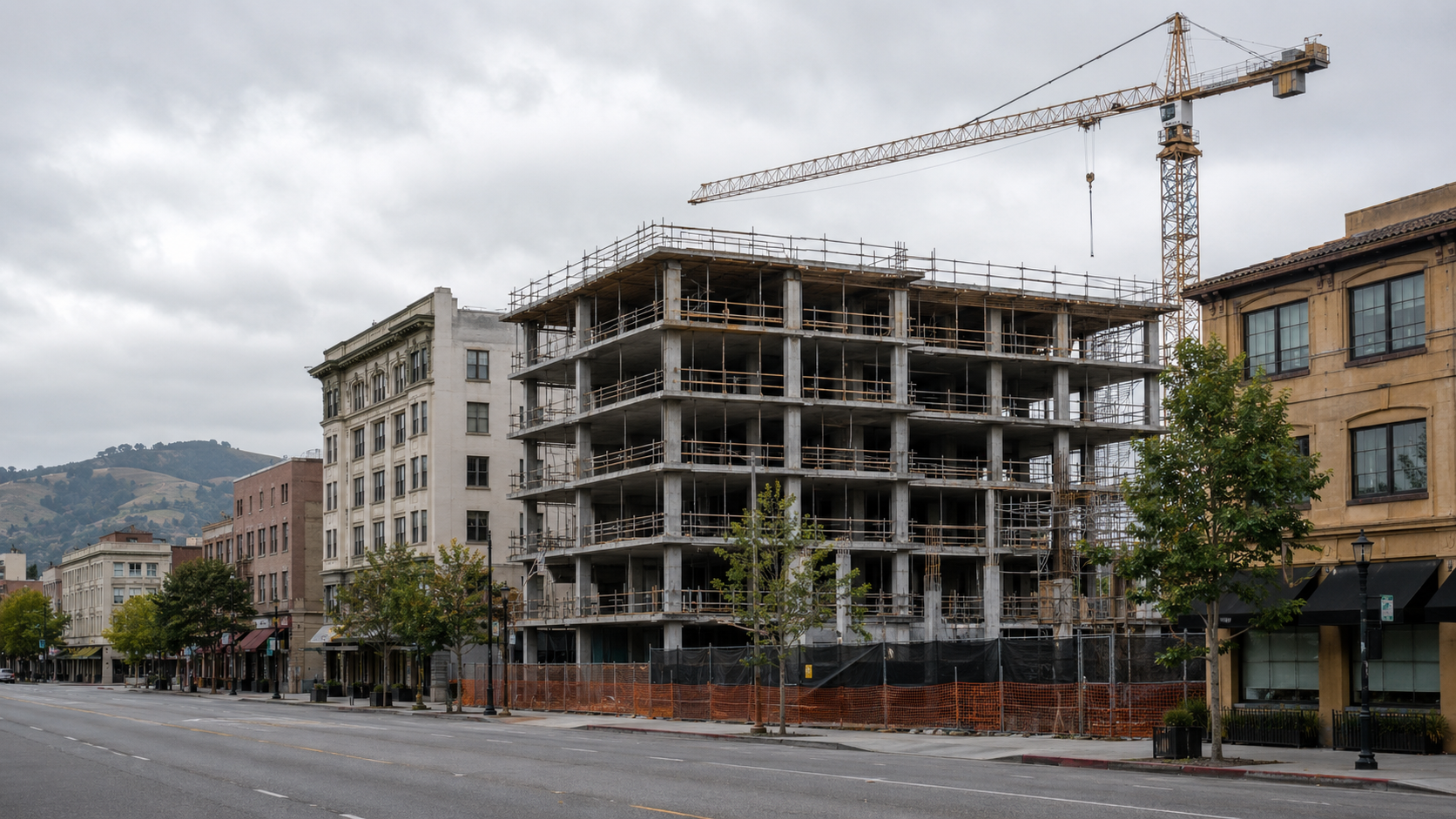
A paused mid-rise construction site on a downtown Peninsula street illustrating the Peninsula housing slowdown. Photo: Houseberry
Block 21, one of downtown San Mateo's most anticipated apartment projects, just picked up its second two-year extension. The developer cited tough lending conditions. That one approval tells you most of what you need to know about the Peninsula housing slowdown right now. The entitlements exist, the plans are drawn, and almost nothing is getting built.
The numbers are blunt. San Mateo averaged 254 completed homes a year from 2022 through 2024. In 2025 that dropped to 116. Halfway through 2026, only 39 units have been finished, according to the San Mateo Daily Journal. Foster City is the sharper version of the same story: 100 completed homes in 2021, 66 in 2022, five last year, and exactly one so far in 2026. Redwood City and South San Francisco are down over the same stretch too.
The pipeline is full. The cranes are not.
This is the part worth getting right, because it is easy to misread. The Peninsula is not stuck because cities stopped approving housing. After six years of state laws that pushed up height and density limits and forced faster approvals, most of these jurisdictions have healthy pipelines and are issuing permits. The bottleneck is the step after the permit. Projects are not breaking ground or reaching completion.
“No one wants to do ground-up multifamily right now,” Stephen Couig, founder of Center Street Lending, told the Daily Journal. His colleague in the same piece, San Mateo developer Mounir Kardosh, put the cause plainly: “It's pure economics. The cost to build has completely outrun what it will bear in rent and what it will bear in sales.”
What is actually stuck
A few local moves from the last year show how cities are trying to unglue projects one at a time:
- Block 21 in downtown San Mateo took its second two-year extension after the developer pointed to lending conditions.
- South San Francisco's council voted to waive several million dollars in impact fees on the affordable portion of a development that has been stalled since 2019, contingent on other financing.
- Foster City has weighed expanding eligibility for development extensions, effectively buying stalled projects more time.
- Redwood City has revisited its impact fee policies to try to spur construction.
None of these are groundbreakings. They are cities keeping approvals alive and shaving costs at the margins while developers wait for the financing math to turn.
Completed homes have collapsed across the Peninsula
Here is the drop in finished homes for the two cities with the clearest numbers. These are completions, not approvals, which is exactly the gap this story is about.
| City | Earlier baseline | 2025 | 2026 so far (mid-year) |
|---|---|---|---|
| San Mateo | 254 / yr avg (2022-24) | 116 | 39 |
| Foster City | 100 (2021), 66 (2022) | 5 | 1 |
Source: San Mateo Daily Journal analysis of city completion data. 2026 figures are through mid-year.
Why the math stopped working
Rents have not risen fast enough to rescue the spreadsheet. Countywide rents grew about 6% between May 2025 and May 2026, to $3,368 across all unit types, per Zumper and Apartment List data cited by the Daily Journal. That is real, but it is nowhere near enough to offset financing costs that jumped after 2022 and construction costs that keep climbing.
The policy layer makes it worse here than almost anywhere. A San Francisco Controller report from April 2026 found that under current conditions no market-rate model pencils out if it also has to carry the city's inclusionary affordable requirements, rules that also apply across the Peninsula. The report's uncomfortable finding was that the maximum economically feasible inclusionary requirement right now is zero percent, and every model looked worse than the same one in 2023.
Zoom out and California's cost problem is structural. A 2025 RAND report found the state is the most expensive place in the country to build multifamily housing, roughly 2.3 times the cost in Texas, with development timelines more than 22 months longer and impact fees averaging about $29,000 per unit versus around $1,000 in Texas. As Kardosh asked in the article, from a bank's point of view, why lend here when it could lend in Waco instead.
Thin supply is what keeps Peninsula prices sticky
Here is where the neighborhood-first way we look at things at Houseberry actually matters. New construction is the release valve on a tight market. When completions fall to a trickle, the existing housing stock absorbs all the demand, and prices stay stubborn even when rates wobble. San Mateo County's single-family median hit about $2.18 million in March 2026, up 6% year over year. A handful of finished condos in a year does very little to loosen that.
For buyers, the practical takeaway is not to wait for a wave of new inventory that is not coming soon. It is to get sharper about where value actually sits inside a market this tight. When we score neighborhoods, some of the more interesting pockets are the ones our data flags as undervalued relative to the rest of the city. In Redwood City, for example, our rankings put areas like Woodside Plaza and Roosevelt on the undervalued side even as citywide prices sit well above two million. You can see how Redwood City neighborhoods rank and which San Mateo neighborhoods score best on value to see where the same dollar stretches further.
Where the few new units are landing
The homes that do get finished tend to be projects that were already deep in the pipeline before financing tightened, clustered in downtown and transit-adjacent parcels rather than spread across neighborhoods. That concentration matters if you are comparing areas. A single new mid-rise can change the feel, parking, and school demand of one downtown pocket while the quiet residential neighborhoods a mile away see essentially no new supply at all. It is the kind of block-by-block difference that a citywide median completely hides, and the reason we lean on neighborhood-level rankings for places like San Mateo, Foster City, and the Peninsula as a whole instead of a single headline number.
What could actually change this
Three things are worth watching over the next several months. First, whether San Francisco follows its Controller's advice and cuts inclusionary requirements, a move that would put pressure on Peninsula cities with similar rules to do the same. Second, whether more cities copy South San Francisco and Redwood City and start trimming impact fees, since that is one of the few levers local governments actually control. Third, the cost of money. Nothing on the Peninsula pencils again in volume until financing gets cheaper.
Until then, expect the pattern to hold: full pipelines, extended entitlements, and very few finished homes. If you are house hunting through a stretch like this, the smartest move is the one we built Houseberry around, studying the neighborhood as carefully as the listing, because in a market with almost no new supply, the area you choose is doing most of the work.
A few quick questions on the slowdown
Will the Peninsula housing slowdown push home prices down?
Not on its own. Fewer completed homes means less new supply, which tends to keep prices firm rather than soften them. Prices move more on interest rates and demand than on the small number of units finishing right now.
Are cities on the Peninsula blocking new housing?
Mostly no. Most are approving projects and have full pipelines thanks to state housing laws. The holdup is financing and construction cost, which stop approved projects from breaking ground and reaching completion.
What should a buyer check in a low-construction market?
Focus on neighborhood-level value rather than waiting for new inventory. Compare schools, safety, amenities, and price across nearby areas, and look for pockets that score as undervalued, like the ones flagged in our Peninsula rankings.
Sources
- San Mateo Daily Journal: New housing on the Peninsula has plummeted
- SPUR: Report highlights the math that keeps housing from being built in San Francisco (SF Controller, April 2026)
- RAND: The High Cost of Multifamily Housing Production in California (2025)
- Redfin: San Mateo County housing market data
- Houseberry: Top neighborhoods on the Peninsula
All information provided on this website including but not limited to - school ratings, safety, amenities, user opinions, and property data - is for general informational purposes only. We do not guarantee its reliability, accuracy, or completeness. Users should independently verify information and consult appropriate professionals as needed. By using this website, you agree Houseberry is not responsible for actions, decisions, or consequences arising from reliance on the information provided
houseberry.com - CA DRE# 01847391
 Bay East ©2025. CCAR ©2025. bridgeMLS ©2025. Information Deemed Reliable But Not Guaranteed. This information is being provided by the Bay East MLS, or CCAR MLS, or bridgeMLS. The listings presented here may or may not be listed by the Broker/Agent operating this website. This information is intended for the personal use of consumers and may not be used for any purpose other than to identify prospective properties consumers may be interested in purchasing. Data last updated at September 30, 2026 12:00 AM