SF is 22,000 permits short. Bernal and Potrero could be next
San Francisco has about 7,000 of the 29,000 permits its housing plan promised by January. Missing the target forces new rules, and housing advocates want Bernal Heights and Potrero Hill rezoned first.

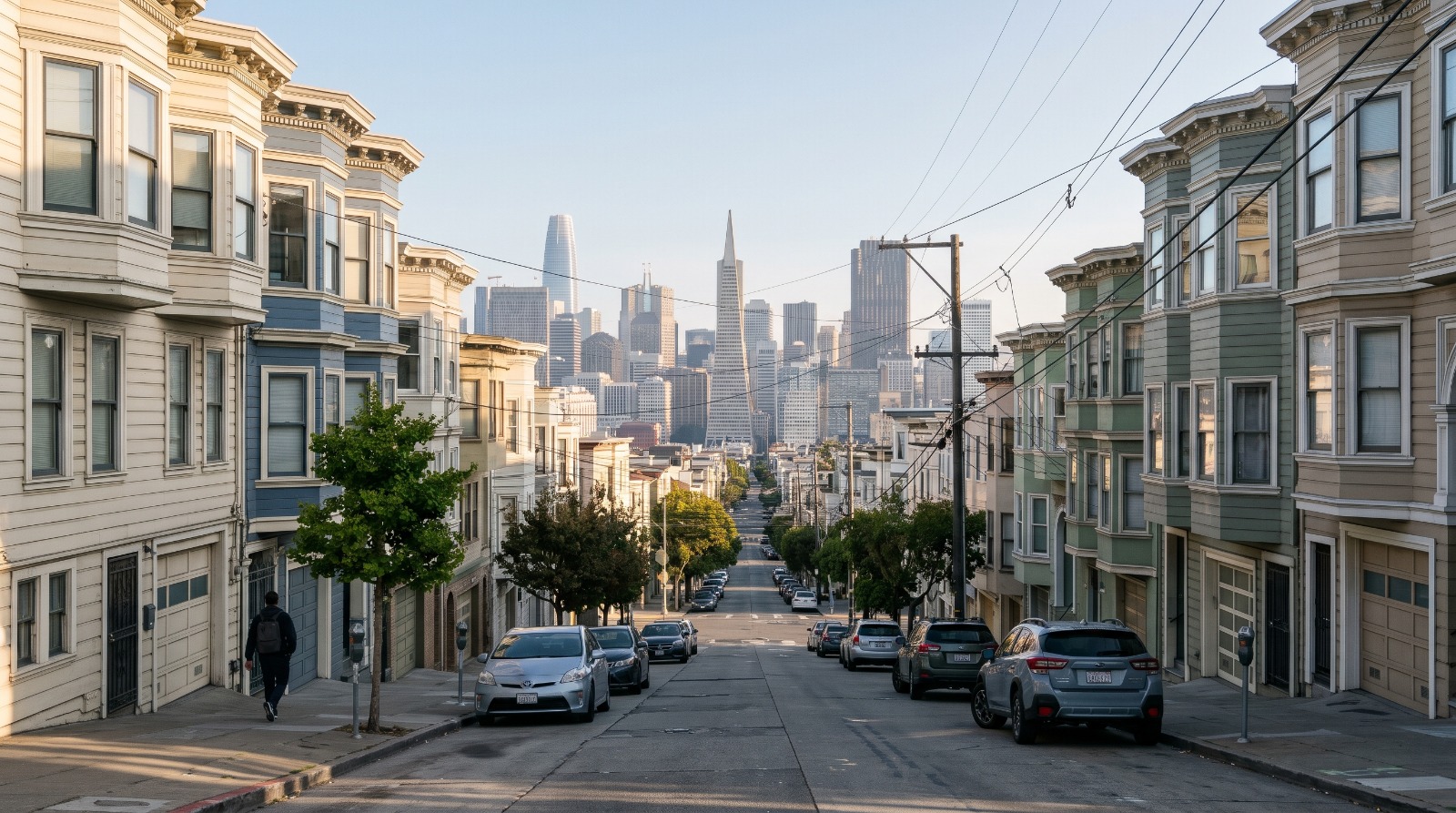
Steep Potrero Hill street of Victorian houses looking north to the San Francisco skyline (AI-generated illustration) Photo: Houseberry
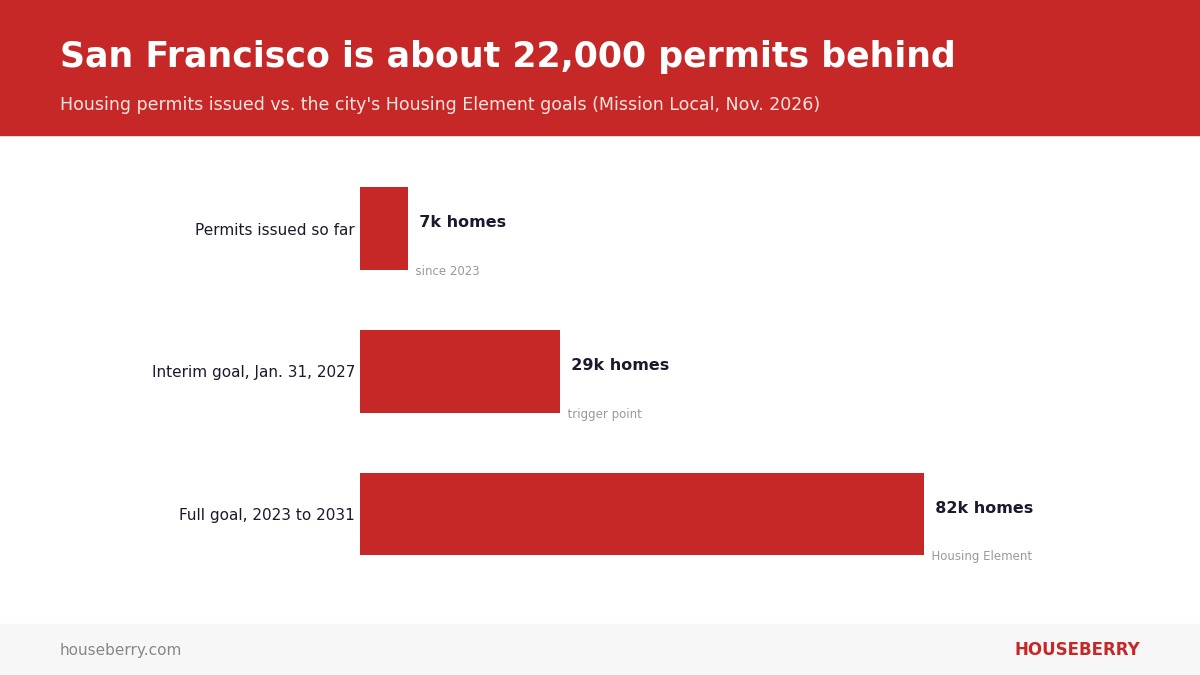
San Francisco has issued about 7,000 building permits toward a goal of 29,000 by Jan. 31, 2027. It will not get there. Missing that interim target sets off a requirement in the city's own housing plan to rewrite its rules until it is on pace again, and housing advocates already have a list of what they want rewritten, starting with taller buildings in Bernal Heights and on Potrero Hill.
Mission Local laid out the numbers on Tuesday. The city is about 22,000 permits behind. Its Housing Element, the state-mandated plan, promises 82,000 new homes between 2023 and 2031. If you own a home in a neighborhood the last rezoning skipped, this is the story that decides whether the next one skips you too.
What the trigger actually does
Think of program 8.1.5 as a circuit breaker the city wrote into its own plan. When permits fall behind, it trips, and San Francisco has to come back with new rules that make building faster or cheaper. It does not say which rules. That is the opening.
The menu is already public. Mayor Daniel Lurie and Supervisor Bilal Mahmood have proposed cutting the transfer tax on real estate sales over $10 million, which developers describe as a barrier to financing. Housing advocates want to drop the requirement that small apartment buildings have two staircases, which raises the cost of every unit. And they want taller buildings allowed on residential streets, not only on commercial corridors.
Robert Fruchtman, an SF YIMBY volunteer, told about 20 people at a session at the Eureka Valley Community Center that the city will probably need drastic measures, and urged them to cite program 8.1.5 by number when they write to supervisors. YIMBY Law, the movement's legal arm, has already sued the city twice this year over upzoning it considered too timid.
Why Bernal and Potrero are on the list
The December 2025 rezoning concentrated on commercial corridors on the west and north sides. It left the hills on the east side untouched. Both are close to transit: Bernal sits between the 24th Street Mission and Glen Park BART stations, and Potrero Hill has the 22nd Street Caltrain station at its foot.
They are also expensive and getting more so. Houseberry data puts the typical Bernal Heights home at about $1.81 million in October 2026, up from about $1.61 million in November 2025. On Potrero Hill, the typical home went from about $1.33 million to about $1.55 million.
| Houseberry data | Typical home, Nov. 2025 | Typical home, Oct. 2026 | Change |
|---|---|---|---|
| Bernal Heights | $1.61M | $1.81M | +12.4% |
| Potrero Hill | $1.33M | $1.55M | +16.5% |
| San Francisco citywide | $1.89M | $2.20M | +16.4% |
Potrero Hill kept pace with the citywide gain on Houseberry's San Francisco city page, and Bernal trailed it by about four points. On Houseberry's scores they sit in the middle of the pack: Potrero Hill at 3.1 out of 5 overall and Bernal at 2.8, with amenities at 3.4 and 3.5. Our Dogpatch, Potrero Hill and Mission Bay comparison has more on how Potrero stacks up against its flatter neighbors.
The honest trade-off
Upzoning is not building. Developers say San Francisco's construction costs, high interest rates and federal tariffs make most projects lose money right now, and the city cannot fix any of those. A height limit raised to six stories on Cortland Avenue does nothing if nobody can finance the building.
What zoning does is decide where buildings can go once the math works again. Neighbors on the hills will say six-story buildings change the character of streets of two-story houses. They are right that it changes. The question the city has to answer by 2028 is whether neighborhoods this close to BART and Caltrain should be exempt from a housing shortfall the size of 22,000 homes.
San Francisco should put Bernal Heights and Potrero Hill in the next rezoning now, on its own terms, instead of waiting for the state to reject a plan that leaves them out. Pair it with the transfer tax cut and the single-stair change, since those attack the cost problem that zoning alone cannot. The trigger trips in January either way. The only choice is whether the city writes the next rules or has them written for it.
To see where Bernal and Potrero rank against the neighborhoods that were rezoned last time, compare them on Houseberry's San Francisco neighborhood rankings.
Sources
The Houseberry Research Team is Houseberry's reporting team: Bay Area real estate analysts, data specialists and longtime local market watchers. Every day we check the public record: building permits, city council and planning agendas, county recorder filings, state housing bills, police incident data and school results. Then we tie each story to what it means for specific neighborhoods, using Houseberry's own neighborhood data on prices, appreciation, safety, schools and amenities. Questions or corrections: Contact us.
Map of San Francisco Neighborhoods
Loading map...
View Full Map
Top Neighborhoods in San Francisco, CA





All information provided on this website including but not limited to - school ratings, safety, amenities, user opinions, and property data - is for general informational purposes only. We do not guarantee its reliability, accuracy, or completeness. Users should independently verify information and consult appropriate professionals as needed. By using this website, you agree Houseberry is not responsible for actions, decisions, or consequences arising from reliance on the information provided
houseberry.com - CA DRE# 01847391
 Bay East ©2025. CCAR ©2025. bridgeMLS ©2025. Information Deemed Reliable But Not Guaranteed. This information is being provided by the Bay East MLS, or CCAR MLS, or bridgeMLS. The listings presented here may or may not be listed by the Broker/Agent operating this website. This information is intended for the personal use of consumers and may not be used for any purpose other than to identify prospective properties consumers may be interested in purchasing. Data last updated at November 25, 2026 12:00 AM