San Francisco's Housing Pipeline Built Just 400 Homes
San Francisco's housing pipeline holds tens of thousands of units on paper, yet only about 405 homes were finished in the first half of 2026. For buyers waiting on a supply wave to cool prices, here is why the wave is stuck.

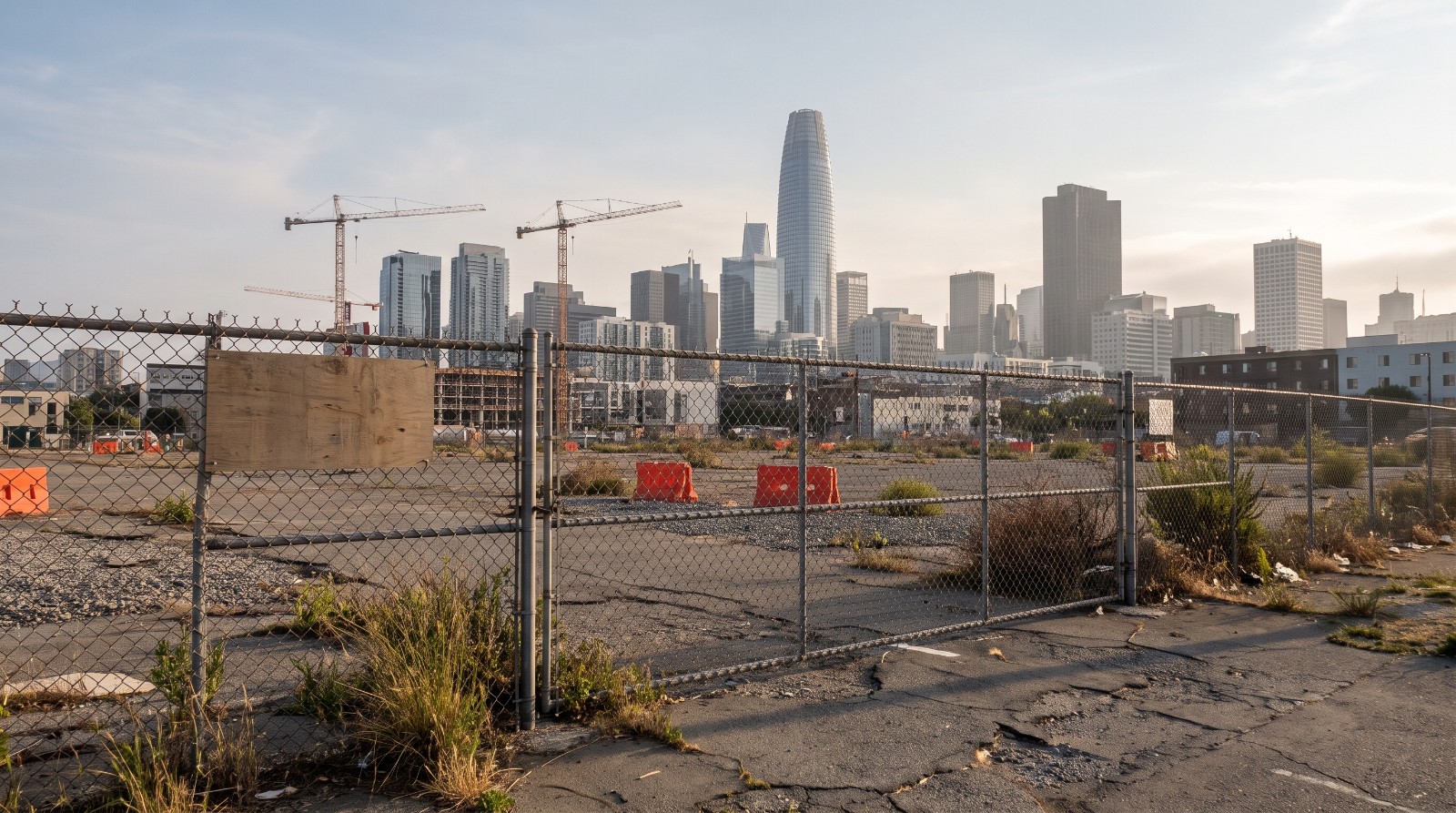
A fenced, empty development lot in San Francisco's South of Market district with the downtown skyline behind it, illustrating the stalled San Francisco housing pipeline. Photo: Houseberry
Start with the number that should end a lot of arguments. In the first half of 2026, San Francisco finished about 405 new homes. Not approved them. Not drew them. Finished them, keys in hand, ready to live in. Over the same stretch, the city's housing pipeline held close to 75,000 units on paper. That gap, between a giant San Francisco housing pipeline and a trickle of actual move-ins, is the whole story. And it is the one thing every buyer waiting for a supply wave to knock down SF prices needs to understand.
Because here is the uncomfortable part. The wave is not coming this year. Maybe not this decade. The pipeline is real, but almost none of it is anywhere near a shovel.
What 74,888 units actually looks like
The San Francisco Planning Department's own pipeline report counts 74,888 housing units as of April 2026. Sounds like a flood. Then you sort those units by how close they are to existing, and the flood turns into a very long line at the DMV.
| Stage in the pipeline | Units | Share of pipeline |
|---|---|---|
| Finished and occupied, first half of 2026 | ~405 | the actual output |
| Under construction | 3,301 | 4% |
| Building permits issued | 1,219 | 2% |
| Building permits approved | 2,422 | 3% |
| Building permits filed | 7,856 | 11% |
| Permits not yet filed | 9,477 | 13% |
| Applications under review | 13,036 | 17% |
| Major multi-phased projects (Treasure Island, Hunters Point) | 37,577 | 50% |
| Total pipeline | 74,888 | 100% |
Source: San Francisco Planning Department Pipeline Report, April 2026. Completions figure via The Frisc.
Read that table from the bottom up. Half the entire pipeline, 37,577 units, sits inside a handful of major multi-phased projects. That is mostly Candlestick Point and the Hunters Point Shipyard, around 9,600 units, plus Treasure Island at roughly 6,300. These are real. They are also 15- and 20-year build-outs on former industrial and military land, tangled in infrastructure, financing, and in places toxic-cleanup timelines. Strip those out and the active pipeline is closer to the 37,000 units The Frisc flagged. Strip out everything that has not even filed a building permit yet, and you are down to a few thousand units that could plausibly break ground soon.
At the very bottom of the funnel sit 3,301 units under construction. Five years ago that number was 4,545. So the part of the pipeline that is actually being built has shrunk by more than a quarter while the paper pipeline swelled. The stage that grew fastest was permits not yet filed, which jumped from 448 units five years ago to 9,477 today. That is not a pipeline filling up. That is a pipeline backing up.
Why nothing moves from approved to built
An entitlement is permission to build. It is not a building. The reason so many SF projects stall in the gap between yes and groundbreaking is boringly financial. Right now the math does not work.
The city controller's May 2026 housing feasibility report found that even market-rate housing in San Francisco does not pencil out at current costs, according to SPUR's read of it. Construction loans are still expensive, and the city's own chief economist, Ted Egan, has said he does not expect rates to fall much over the next year and a half. Add elevated construction costs, developer impact fees, and an inclusionary requirement that has run in the 12 to 15 percent range, and a lot of otherwise-approved towers simply do not get financed. The tell is in the fees. Inclusionary housing revenue that topped $20 million a year before the pandemic has averaged closer to $2 million a year since 2020, because the projects that generate it are not getting built.
This is where I will show my hand, because we are pretty openly pro-housing around here. When a project clears every hearing, survives design review, wins its entitlement, and then sits for three years because the loan will not close, neighborhood character was never the binding constraint. Money was. A city that approves 70,000 units and builds 400 does not have a permission problem anymore. It has a feasibility problem.
The mega-projects are a mirage if you are shopping now
Say this part plainly, because the big pipeline number gets quoted like inventory that is about to hit the market. Treasure Island and the Hunters Point Shipyard are not going to soften what you pay for a two-bedroom in Noe Valley next spring. Those units deliver in phases stretched across the 2030s and beyond, if the financing and infrastructure hold. Counting them as near-term supply is like counting a paycheck you get in 2038.
The near-term supply that does exist clusters in a few places, mostly the eastern side of the city, the SoMa and South Beach high-rise corridor where big residential towers already had momentum. Plenty of neighborhoods, especially on the west side, are getting essentially no new construction at all. So even the trickle is uneven. If you are comparing where in San Francisco to actually buy, new supply is coming is true in about three zip codes and basically fiction in the rest.
What a stuck pipeline means if you are waiting out SF prices
Here is the practical takeaway, and it runs opposite to what the headline pipeline number implies. If your plan is to wait for a supply glut to crater San Francisco prices, you are betting on something the construction data says is not happening. About 400 finished homes a year, in a city this size with this much pent-up demand, does not push prices down. Demand is doing the heavy lifting in this market, which is exactly why SF homes still routinely sell over asking.
The way we look at it when we compare neighborhoods, this is an argument for researching the specific area rather than waiting on a citywide reset that is not scheduled to arrive. Two San Francisco neighborhoods a mile apart can have completely different supply stories, price trajectories, and school and transit access, and the pipeline report will not tell you which is which. That block-by-block picture, schools, safety, value, and what is actually being built nearby, is the whole reason we built Houseberry. If you want the lay of the land, our San Francisco city guide and the individual neighborhood pages are a better starting point than a 75,000-unit number that mostly lives on paper.
None of this is an argument against building. It is the case for it. The region needs far more homes than it is producing, and the fastest way to actually get them is to make the ones already approved financially buildable.
The fixes on the table, and the November vote
City Hall has finally noticed the gap. A November 2026 ballot measure would cap the on-site inclusionary requirement at 5 percent, down from the low teens, with the stated goal of getting stalled projects to pencil. SPUR and the city's technical advisory committee have also floated cutting impact fees by roughly two-thirds and dropping affordability requirements entirely for projects under 25 units. To offset a lower inclusionary rate, Mayor Daniel Lurie and Supervisor Myrna Melgar have proposed roughly doubling the city's affordable housing trust fund to around $125 million a year. There is even talk of merging the Planning Department and the Department of Building Inspection to speed approvals.
Will it work? Cutting fees and inclusionary rates should help projects pencil, but it does not touch interest rates or construction costs, which are the bigger anchors right now. The realistic read is that SF's numbers improve at the margin over the next couple of years and stay nowhere near its state target of about 82,000 units by 2031, a goal the city is currently roughly 6 percent of the way toward meeting. Worth watching. Not worth waiting on.
San Francisco housing pipeline FAQs
Did San Francisco really only build 400 homes in 2026?
About 405 net new units were finished and ready for occupancy in the first half of 2026, per city figures reported by The Frisc. Even doubling that for a full year lands far below what a city this size needs, and far below the tens of thousands of units sitting in the pipeline.
If there are 74,000 units in the pipeline, why are prices not falling?
Because a pipeline unit is not a finished home. Only about 3,300 of those units are actually under construction, and half the pipeline sits in mega-projects that deliver across the 2030s. Roughly 400 completions a year does not add enough supply to push prices down, so demand keeps setting the price.
Should I wait for new construction to lower San Francisco home prices?
The construction data does not support that bet. Under-construction units have shrunk over five years, not grown, and the economic fixes in play will take time to bite. If you are comparing neighborhoods, it usually makes more sense to research specific areas than to wait on a citywide supply wave that is not scheduled to arrive.
Which San Francisco neighborhoods are actually getting new housing?
Most near-term construction is on the eastern side, in the SoMa and South Beach high-rise corridor, with far less on the west side. Supply is uneven block to block, which is exactly why neighborhood-level research beats a single citywide number.
Sources
- The Frisc: SF Has Built Only 400 Homes This Year. Tens Of Thousands More Are Waiting
- San Francisco Planning Department: Pipeline Report
- SPUR: Realigning Housing Policy With Real-World Economics in San Francisco
- The Real Deal: San Francisco wants to cut affordable housing rule
- Mission Local: SF doubles affordable housing fund to $125M annually
- KALW: Several Bay Area cities off track to meet housing target by 2031
The Houseberry Research Team is Houseberry's reporting team: Bay Area real estate analysts, data specialists and longtime local market watchers. Every day we check the public record: building permits, city council and planning agendas, county recorder filings, state housing bills, police incident data and school results. Then we tie each story to what it means for specific neighborhoods, using Houseberry's own neighborhood data on prices, appreciation, safety, schools and amenities. Questions or corrections: Contact us.
All information provided on this website including but not limited to - school ratings, safety, amenities, user opinions, and property data - is for general informational purposes only. We do not guarantee its reliability, accuracy, or completeness. Users should independently verify information and consult appropriate professionals as needed. By using this website, you agree Houseberry is not responsible for actions, decisions, or consequences arising from reliance on the information provided
houseberry.com - CA DRE# 01847391
 Bay East ©2025. CCAR ©2025. bridgeMLS ©2025. Information Deemed Reliable But Not Guaranteed. This information is being provided by the Bay East MLS, or CCAR MLS, or bridgeMLS. The listings presented here may or may not be listed by the Broker/Agent operating this website. This information is intended for the personal use of consumers and may not be used for any purpose other than to identify prospective properties consumers may be interested in purchasing. Data last updated at October 7, 2026 12:00 AM