The San Francisco Neighborhoods That Work Without a Car
With robotaxis stalling and the rules still being written, the quieter question is which San Francisco neighborhoods actually let you live well without a car. The answer is older than any app.

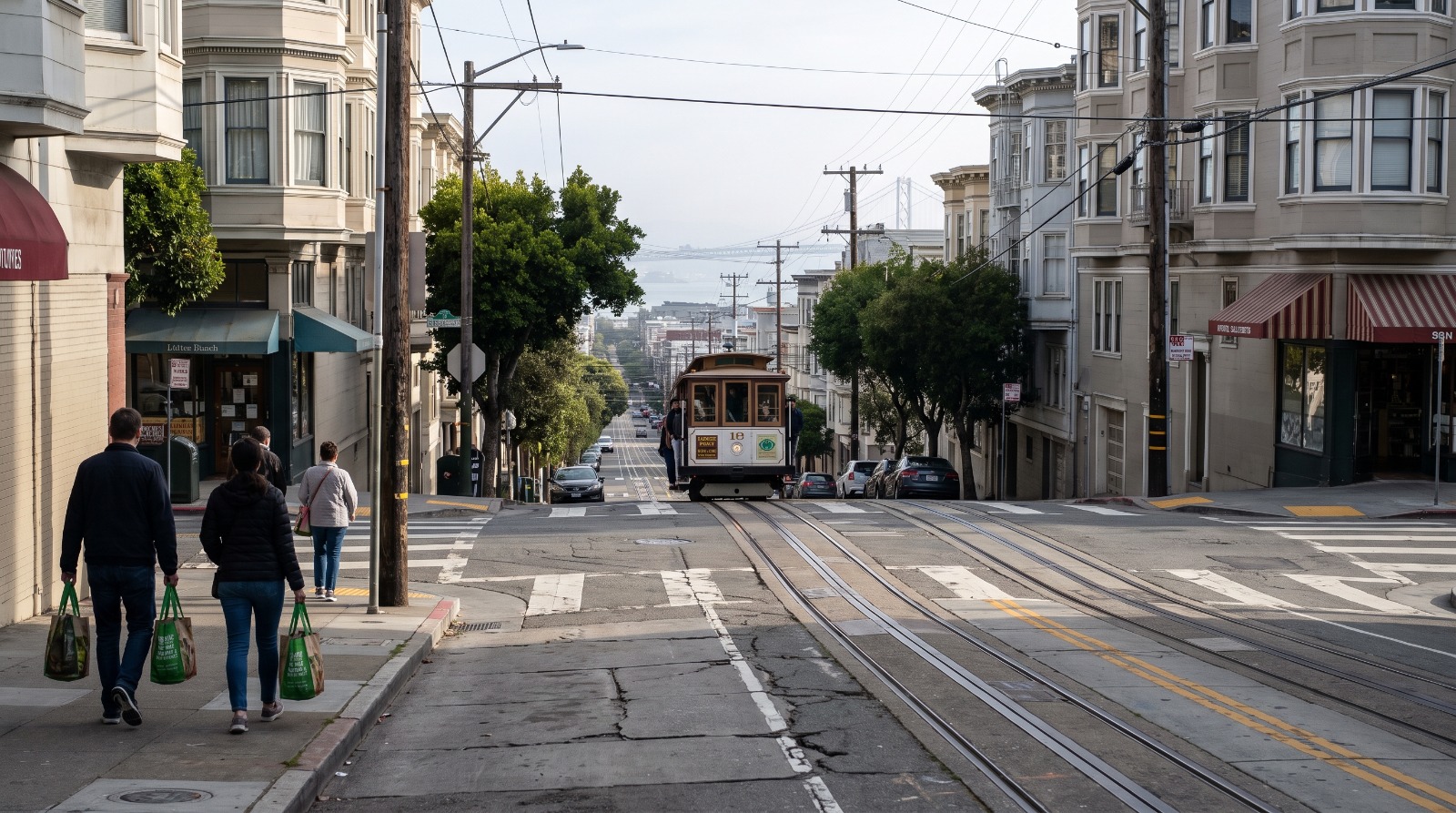
A steep, walkable San Francisco street with a cable car and pedestrians, in one of the neighborhoods that work without a car. Photo: Houseberry
On the Fourth of July, a handful of Waymo robotaxis rolled into the fireworks crowds in the northern part of the city, got boxed in by traffic they did not see coming, and simply stopped. Some sat so long they ran out of charge and had to be towed. Riders were stuck for what felt like forever. It was a very 2026 kind of gridlock, and it made for great video.
It also asked a better question than the one everyone was arguing about. Not whether robotaxis are ready, but the older, more useful one. Which San Francisco neighborhoods let you get through a normal day without a car at all, no app required?
Because that answer does not depend on Waymo, or on Uber’s new self-driving service, or on whichever company is winning the robotaxi race this month. It depends on the neighborhood. And in San Francisco, the most car-free places have been car-free for a hundred years.
The robotaxi drama is a sideshow, the neighborhoods are the story
It has been a rough stretch for the robots. Waymo recalled more than 3,800 vehicles in June after a software problem could send them into closed freeway construction zones, its second recall in about a month. After the July 4 mess, a city supervisor opened an inquiry and the mayor started pushing for tougher rules. Federal regulators have signaled they are done being patient with autonomous cars that cannot handle an emergency scene.
Meanwhile Uber is coming in with its own approach, a service built with Nuro and Lucid that has been quietly testing in the city, with a wider launch planned for later this year. All of that is genuinely interesting if you follow the industry. But if you are choosing where to live, it is noise. A robotaxi is a nice-to-have on top of a neighborhood that already works on foot and on transit. It is not a substitute for one. So the real research question is which neighborhoods already have the bones.
What working without a car actually means here
San Francisco is the most walkable big city in the country, with a citywide Walk Score of 89 and a Transit Score of 77. Roughly a third of San Francisco households do not own a car at all, according to Census figures cited by the SFMTA, and when the city added tens of thousands of new households over the last decade, more than half of them were car-free. This is not a fringe lifestyle here. It is how a large slice of the city already lives.
But the citywide number hides the neighborhoods, which is where it gets practical. A few parts of the city score a perfect 100 for walkability, meaning daily errands need no car at all: Chinatown, the Tenderloin, and Polk Gulch. Just behind them, at 99, sit Nob Hill, North Beach, the Financial District, Civic Center, the Castro, and the Mission. These are the places where a car is closer to a liability than a convenience, once you count the parking and the hills.
The transit backbone is the reason. Muni Metro runs seven light-rail lines that funnel into the Market Street subway, and BART has eight stations inside the city, from Embarcadero down to Balboa Park. Layer the bus network and the cable cars on top, and a resident in the northeast quadrant can reach most of the city, and the wider region, without ever touching a steering wheel.
Walkable is not the same as easy, and it is worth being honest about that
Here is the part a walkability score will not tell you. The most walkable neighborhoods in San Francisco are not automatically the ones most people want to live in, and pretending otherwise does buyers a disservice.
Take Nob Hill. On our own numbers it earns a strong 4.4 out of 5 for amenities, which tracks with its near-perfect walkability, but it scores a 2.7 for safety and lands 61st of 92 city neighborhoods overall. North Beach, the city’s Little Italy, is similar: a 3.8 for amenities, lively and walkable street life, and a 2.1 for safety. The Tenderloin scores a perfect 100 for walkability and is, by most residents’ honest account, a hard place to call home. Walkability measures how much is within reach on foot. It says nothing about whether you want to make that walk after dark.
That is exactly the gap we built Houseberry to close. When we compare neighborhoods, walkability is one input sitting next to safety, schools, amenities, and value, not a trophy that settles the question by itself. The most walkable San Francisco neighborhoods and the overall neighborhood rankings rarely line up perfectly, and the space between those two lists is where most of the real decision lives.
How to actually use this
If getting rid of a car, or never buying one, is the goal, San Francisco makes it more doable than almost anywhere in the country, and the robotaxi turbulence does not change that math. Muni and BART are still the backbone, the cable cars still climb the hills, and the city keeps nudging further car-light, from the new full-time transit lane approved in Chinatown to the car-free stretch of the Upper Great Highway out by the ocean.
Just do not let a perfect Walk Score be the whole decision. Pull the safety and amenities picture for the specific blocks you are considering, walk them at night as well as at noon, and weigh the trade-off honestly. A neighborhood that works without a car is a real asset. A neighborhood that works without a car and that you actually want to come home to is the one worth buying. Sort for both.
The robots will get sorted out, or they will not. The neighborhoods that let you live well without a car were here long before them, and they will be here long after.
Sources
- Waymo cars ran out of charge and blocked roads during SF’s July 4 fireworks (SF Standard)
- Waymo recalls over 3,800 robotaxis that might drive onto closed freeways (Engadget)
- San Francisco mayor pushes for tougher rules after the Waymo traffic fiasco (TechCrunch)
- Uber and Nuro begin testing a premium robotaxi service in San Francisco (TechCrunch)
- San Francisco Walk Score and Transit Score (Walk Score)
- San Francisco is Growing. Driving? Not So Much. (SFMTA)
- Chinatown full-time transit lane approved (Local News Matters)
The Houseberry Research Team is Houseberry's reporting team: Bay Area real estate analysts, data specialists and longtime local market watchers. Every day we check the public record: building permits, city council and planning agendas, county recorder filings, state housing bills, police incident data and school results. Then we tie each story to what it means for specific neighborhoods, using Houseberry's own neighborhood data on prices, appreciation, safety, schools and amenities. Questions or corrections: Contact us.
All information provided on this website including but not limited to - school ratings, safety, amenities, user opinions, and property data - is for general informational purposes only. We do not guarantee its reliability, accuracy, or completeness. Users should independently verify information and consult appropriate professionals as needed. By using this website, you agree Houseberry is not responsible for actions, decisions, or consequences arising from reliance on the information provided
houseberry.com - CA DRE# 01847391
 Bay East ©2025. CCAR ©2025. bridgeMLS ©2025. Information Deemed Reliable But Not Guaranteed. This information is being provided by the Bay East MLS, or CCAR MLS, or bridgeMLS. The listings presented here may or may not be listed by the Broker/Agent operating this website. This information is intended for the personal use of consumers and may not be used for any purpose other than to identify prospective properties consumers may be interested in purchasing. Data last updated at October 21, 2026 12:00 AM