San Jose Diridon Housing: Approved vs Built
A downtown San Jose apartment tower tied to a city land deal was just delayed again. The bigger question for anyone betting on Diridon is how much approved housing is actually rising.

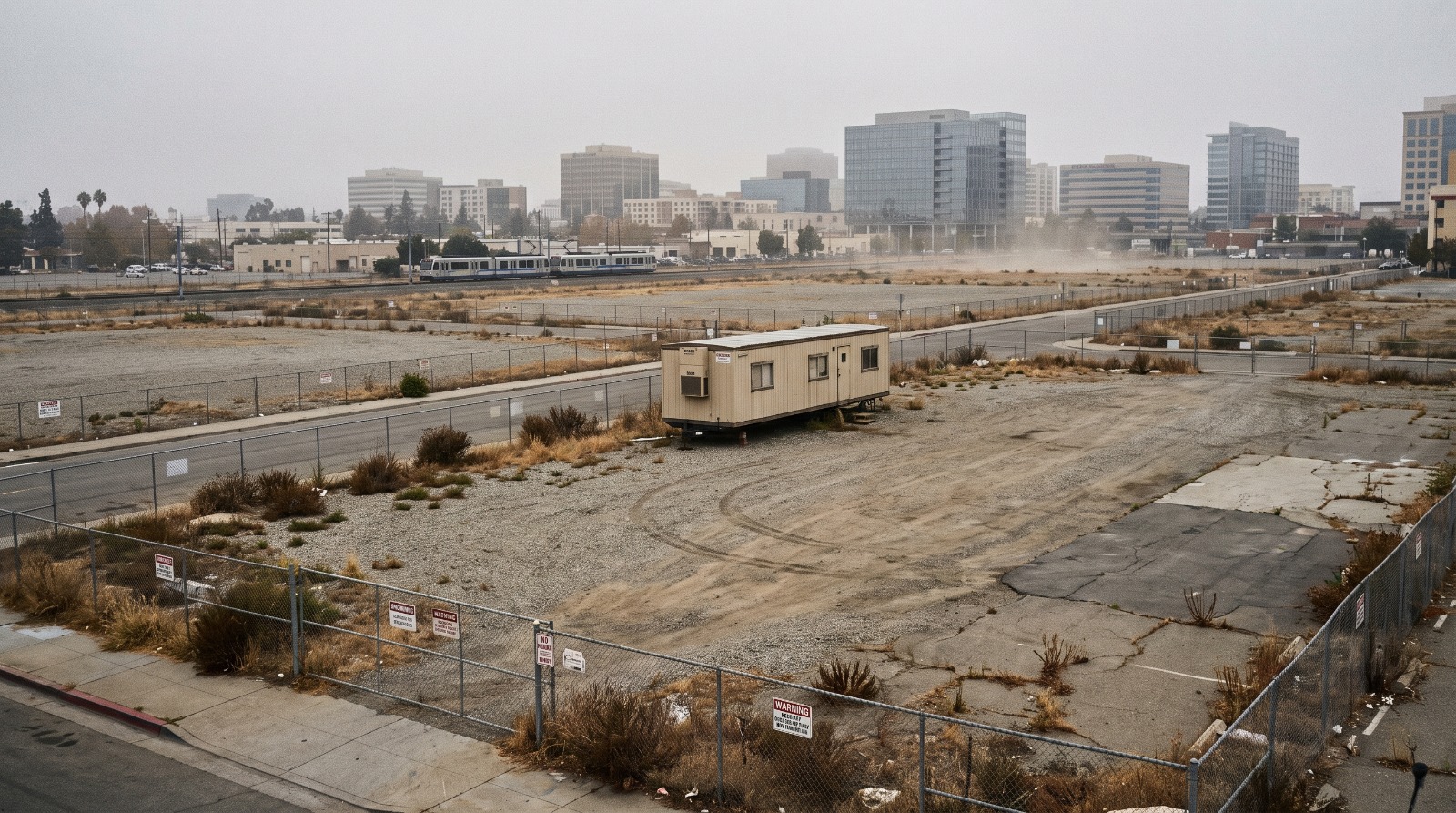
Cleared, fenced vacant lots in the Diridon Station area of downtown San Jose, where approved housing has not yet been built. Photo: Houseberry
Zero. That is how many homes have gone vertical on the 80 acres Google cleared next to Diridon Station. The company spent around a billion dollars assembling that land, demolished what stood there between 2022 and 2024, then paused, and the parcels have sat as gravel and fenced asphalt ever since. Hold that number, because this week another Diridon-area housing project hit a delay, and the gap between approved and built is the entire San Jose Diridon housing story for anyone betting on downtown.
The Gifford is the newest delay
On Wednesday, San Jose planning administrators postponed action on Urban Catalyst's proposed 276-unit, eight-story building at 470 West San Carlos Street, known as The Gifford. It was slated for approval on July 8, has now been delayed twice, and is set for city consideration on July 22, The Real Deal reported, citing the Mercury News.
The pushback is not really a no-to-housing. A residents group, the Stakeholders and Neighborhoods Initiative, argues the eight-story building would rise with no setback along a shared property line with single-family homes, an imposing edge that clashes with downtown design standards near Diridon. As the group's co-president put it, the neighborhood is not opposed to housing and has supported hundreds of affordable and supportive units within two blocks. The fight is about site planning, not density in the abstract.
What makes it more interesting is the side deal. The city has agreed in principle to buy the historic Knox-Goodrich building at 26-36 South First Street from Urban Catalyst for $3.6 million, about 60 percent less than the developer paid, and in exchange Urban Catalyst would start construction on The Gifford next year. City officials insist the two approvals are independent. A council member called the building purchase a slam dunk. Read together, they are a reminder that in downtown San Jose, getting a project to the finish line increasingly takes a bundle of deals, not a single vote.
Approved does not mean built
Step back from any one project and the pattern is the real signal. Downtown San Jose has entitled a lot of housing near Diridon. It has built very little of it. Here is where the marquee pieces actually stand:
| Diridon-area project | Homes | Where it stands (July 2026) |
|---|---|---|
| Google Downtown West (80 acres) | 4,000 to 5,900 planned | Approved 2021, site cleared, paused since 2023, no homes built |
| The Gifford, 470 W. San Carlos | 276 | Pending, delayed twice, city vote set for July 22 |
| Urban Catalyst towers, 147 E. Santa Clara | Two residential towers | Entitled, shifted from senior to market-rate, not started |
Google's Downtown West is the cautionary tale. Approved in 2021 to bring thousands of homes, millions of square feet of offices, and 15 acres of parks, it was paused in 2023 after the company pulled back its timeline and cut ties with key development partners. The site sits fallow. There is even a deadline with teeth: if construction has not started by July 1, 2031, Google owes an extra $54 million to a community fund. Approval was the easy part.
What this does and does not mean for buyers
It does not mean downtown San Jose is dead. The bones of the plan are real. BART's extension to Diridon is advancing, and the Diridon Steering Committee selected a preferred station design in 2025. Over a long enough horizon, this is still one of the most transit-rich redevelopment zones in the state.
What it does mean is that a buyer pricing in towers-next-door-by-2027 should instead price in maybe, eventually. San Jose reached only 33 percent of its state housing target last year and must plan for 62,200 new units by 2031, per The Real Deal, so the pressure to approve is high while the follow-through on building stays slow. The way we look at it when we compare neighborhoods, a promised skyline is a probability, not an amenity. Weigh what is actually on the block today, the schools, the safety, the walk to a train that runs now, and treat the renderings as upside. How San Jose neighborhoods rank is a cleaner read on the present than any pipeline chart, and our earlier piece on the San Jose general plan and zoning overhaul covers the rules shaping what eventually rises.
Questions buyers are asking about Diridon
Is Google still building Downtown West?
Not right now. The project is approved but paused, with the 80-acre site cleared and idle since 2023 and no vertical construction underway. A $54 million penalty kicks in if work has not started by July 2031, which is the clearest sign anyone is still counting on it.
Will The Gifford get approved?
It is pending, with a city vote set for July 22 after two delays. The holdup is a design dispute over height and setbacks next to single-family homes, not organized opposition to housing itself, so approval remains likely even if the building gets reworked.
Does approved housing raise nearby home values?
It can, by adding residents, foot traffic, and eventually retail and transit demand. But timing is everything, and near Diridon the timing has repeatedly slipped. Do not pay today for value that depends on a tower that has not broken ground.
The bottom line for downtown San Jose is simple and a little deflating. The approvals are stacking up. The cranes are not. Until that flips, treat Diridon as a promising place with a long fuse, and buy the neighborhood you can actually use this year.
Sources
The Real Deal: San Jose's deal for Urban Catalyst building faces pushback over resi goals
KQED: Google's once grand vision for Downtown West still on hold
Planetizen: Google razed 80 acres in downtown San Jose, then nothing happened
The Houseberry Research Team is Houseberry's reporting team: Bay Area real estate analysts, data specialists and longtime local market watchers. Every day we check the public record: building permits, city council and planning agendas, county recorder filings, state housing bills, police incident data and school results. Then we tie each story to what it means for specific neighborhoods, using Houseberry's own neighborhood data on prices, appreciation, safety, schools and amenities. Questions or corrections: Contact us.
All information provided on this website including but not limited to - school ratings, safety, amenities, user opinions, and property data - is for general informational purposes only. We do not guarantee its reliability, accuracy, or completeness. Users should independently verify information and consult appropriate professionals as needed. By using this website, you agree Houseberry is not responsible for actions, decisions, or consequences arising from reliance on the information provided
houseberry.com - CA DRE# 01847391
 Bay East ©2025. CCAR ©2025. bridgeMLS ©2025. Information Deemed Reliable But Not Guaranteed. This information is being provided by the Bay East MLS, or CCAR MLS, or bridgeMLS. The listings presented here may or may not be listed by the Broker/Agent operating this website. This information is intended for the personal use of consumers and may not be used for any purpose other than to identify prospective properties consumers may be interested in purchasing. Data last updated at October 13, 2026 12:00 AM