San Jose's General Plan Reset: 4 to 10 Homes Where One Sits Now
San Jose planning staff want to quadruple density limits across most single-family neighborhoods and allow eight stories near Santana Row. Here is which neighborhoods would change most under the General Plan reset, and what it means for buyers betting on quiet R-1 blocks.

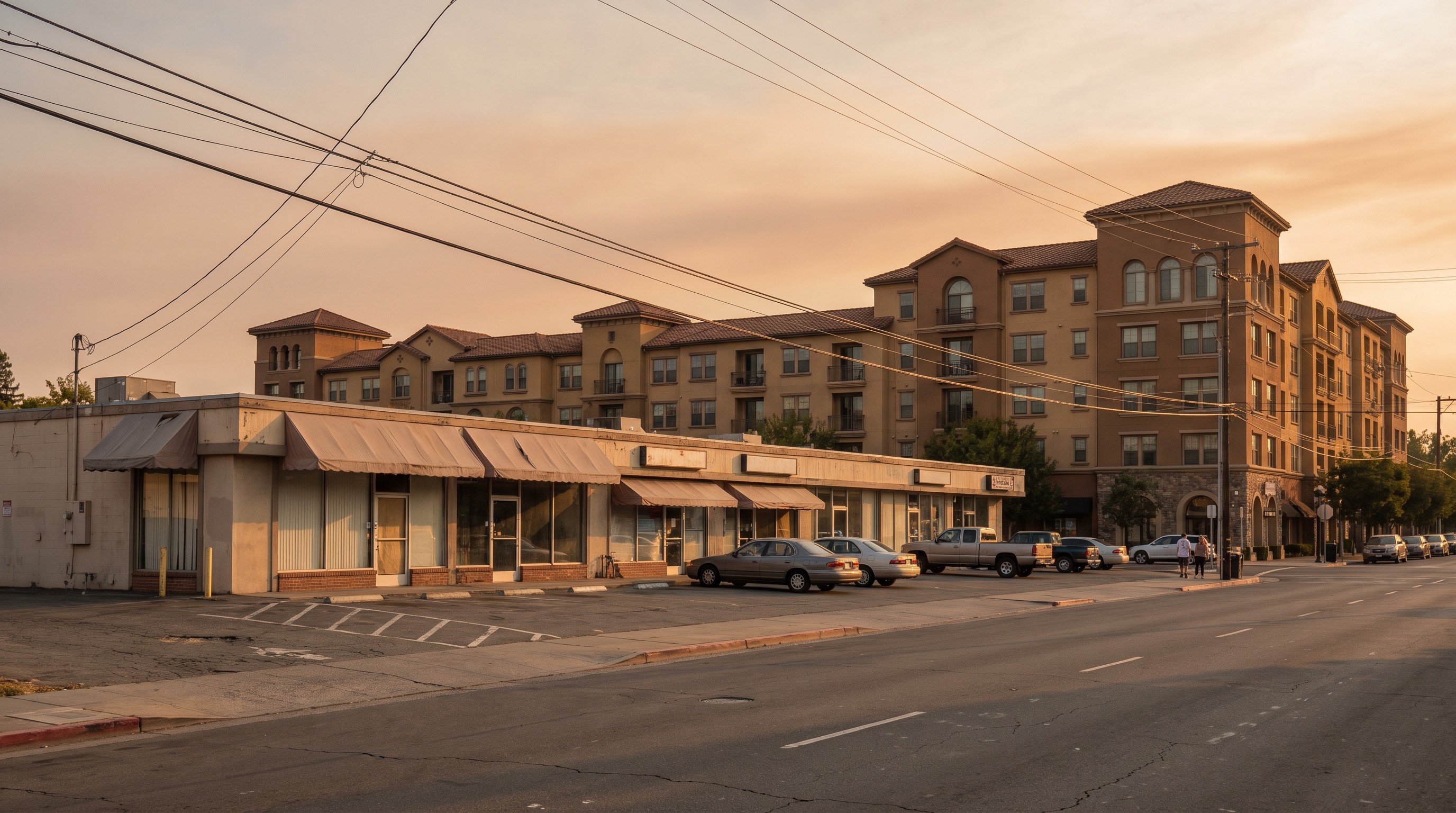
One-story storefronts on Winchester Boulevard near Santana Row, where San Jose General Plan zoning changes could allow eight-story housing. Photo: Houseberry
Quadruple. That is the multiplier San Jose planning staff want to apply to the density limits covering most of the city's single-family neighborhoods, part of the once-every-four-years review of the Envision San Jose 2040 General Plan now headed to the City Council. In practice, lots that hold one house today could hold 4 to 10 homes, depending on lot size. And on Winchester Boulevard near Santana Row, about a dozen low-slung commercial parcels could see height limits jump to eight stories. If you bought, or are about to buy, on a quiet R-1 block because it was a quiet R-1 block, this is the planning document actually worth your time.
What San Jose's General Plan reset puts on the table
The package came out of 10 months of special task force meetings, and on June 24 the Planning Commission voted to advance nearly all of it, as San Jose Spotlight reported. The City Council is expected to take it up August 18. The driver is state math: San Jose has to plan for roughly 62,000 additional homes to satisfy its state-mandated housing targets, and the current map does not get there.
The pieces that matter most:
Missing middle upzoning. Density limits would roughly quadruple across much of residential San Jose, opening historically single-family lots to 4 to 10 homes depending on lot size. Think duplexes, townhomes and small apartment buildings, not towers.
Mid-rise corridors. Certain high-traffic areas would open to mid-rise residential development.
Winchester Boulevard. About a dozen parcels near Santana Row, mostly one- and two-story buildings housing small businesses, would get height limits of eight stories. The commission deadlocked on this one, so it goes to the council with no recommendation.
Public and institutional land. Staff would build a case-by-case framework for converting underused school and congregation land to housing, a live question with enrollment falling and San Jose Unified closing schools.
One thing to hold onto before anyone panics or celebrates: at this stage the recommendations are a framework, not law. By the city's own General Plan review timeline, it will be more than a year before concrete policy changes are actually approved. Nothing about your block changes overnight on August 18.
Winchester is the preview of every fight to come
The fiercest pushback is coming from the Cory neighborhood, the flat grid of postwar homes just east of Winchester. Cory residents are fresh off scuttling a 17-story apartment tower proposed at 826 Winchester Blvd. last year, and they have been showing up in force to the task force meetings. Their worry, as one organizer put it, is that eight-story buildings would rim the neighborhood and squeeze out the small businesses along the corridor. Planning staff counter that proximity to transit, Santana Row and Valley Fair makes these parcels close to the definition of a prime housing location.
Both sides have a point, but not an equal one. The small-business concern is the one worth taking seriously, because corridor upzones really do redevelop the dry cleaner and the taco shop along with the parking lot. The height concern is weaker. A dozen parcels of one- and two-story strip buildings sitting next to one of the South Bay's densest retail and job centers is about as close as zoning gets to a textbook answer for where eight stories belongs. Calling that stretch of Winchester the thing that keeps the neighborhood vital is generous.
What our numbers say about the blocks doing the fighting
Here is the part that jumped out when we pulled our own data. The loudest opposition is not coming from the city's most fragile blocks. It is coming from some of its most location-rich ones. Compare the two flashpoint neighborhoods across the 358 areas we rank in San Jose:
| Houseberry data (July 2026) | Cory | Almaden |
|---|---|---|
| Overall score | 2.4 / 5 (ranked 279th of 358) | 3.2 / 5 (ranked 191st of 358) |
| Safety score | 1.7 / 5 | 3.5 / 5 |
| Amenities score | 2.8 / 5 | 3.3 / 5 |
| Median home price | $1.72M (May 2026) | $1.68M (city-level data) |
On our Cory scorecard, the neighborhood ranks 279th out of 358 in San Jose, with a 1.7 safety score and modest amenities. Its median sale price in May 2026: $1.72 million, up from $1.51 million a year earlier. Nobody is paying $1.7 million for a 2.4 overall score. They are paying for the location, meaning Santana Row, Valley Fair and the freeway network a few minutes away. When the dirt is worth that much more than what sits on it, the pressure to put more homes on each lot is not a policy fashion. It is gravity.
Almaden's objection is a different flavor. The valley scores 3.5 on safety, sits against open space and hillsides, and its whole appeal is the quiet. The now-famous line from a May community meeting, asking how many people want "14-units next door with no parking," captures the fear. But the actual proposal tops out at 4 to 10 homes per lot, which at Almaden lot sizes means townhome scale. The 14-unit building next to a cul-de-sac is not what this framework draws.
Will fourplexes crater single-family values? The housing advocates' own complaint is the tell here. In their letter to the commission, they warned the upzoning still would not produce projects big enough to pencil for developers facing spiraling construction costs. If the projects do not pencil, the fourplex flood does not come. What changes first is the corridors, the Winchester-style sites and the underused institutional land, not the middle of the subdivision.
How to bet on a quiet block now
Read the map, not the headline. For any block you are considering across San Jose, the practical questions are three. Is the block inside or beside one of the proposed change areas or corridors? Is the lot size large enough to make it a candidate for the upper end of that 4-to-10 range? And would a project there actually pencil at today's construction costs? For most deep residential pockets, the honest answers are no, no and no, which is why the ten-year view of an Almaden cul-de-sac looks a lot like the present. Blocks backing onto Winchester, Stevens Creek or an urban village boundary deserve a harder look.
The council takes up the framework August 18, and the real policy fights will run well into 2027. In the meantime, zoning potential is quietly becoming one more data point to check before you fall for a street, right alongside schools, safety and price. Looking hard at the area before zeroing in on the address is the habit we built Houseberry around, and this General Plan reset is exactly the kind of thing that habit is for.
Sources
San Jose Spotlight: Battle lines drawn in San Jose housing plan overhaul
City of San Jose: Envision San Jose 2040 General Plan 4-Year Review
San Jose Spotlight: West San Jose residents fight apartment complex in neighborhood
San Jose Spotlight: San Jose's largest district closes five schools
The Houseberry Research Team is Houseberry's reporting team: Bay Area real estate analysts, data specialists and longtime local market watchers. Every day we check the public record: building permits, city council and planning agendas, county recorder filings, state housing bills, police incident data and school results. Then we tie each story to what it means for specific neighborhoods, using Houseberry's own neighborhood data on prices, appreciation, safety, schools and amenities. Questions or corrections: Contact us.
All information provided on this website including but not limited to - school ratings, safety, amenities, user opinions, and property data - is for general informational purposes only. We do not guarantee its reliability, accuracy, or completeness. Users should independently verify information and consult appropriate professionals as needed. By using this website, you agree Houseberry is not responsible for actions, decisions, or consequences arising from reliance on the information provided
houseberry.com - CA DRE# 01847391
 Bay East ©2025. CCAR ©2025. bridgeMLS ©2025. Information Deemed Reliable But Not Guaranteed. This information is being provided by the Bay East MLS, or CCAR MLS, or bridgeMLS. The listings presented here may or may not be listed by the Broker/Agent operating this website. This information is intended for the personal use of consumers and may not be used for any purpose other than to identify prospective properties consumers may be interested in purchasing. Data last updated at October 9, 2026 12:00 AM