Silicon Valley Is Tearing Down Offices for Apartments
A Dallas developer wants to replace a single-story Menlo Park office with 199 apartments, part of a Peninsula teardown wave remaking old Silicon Valley office parks into housing.

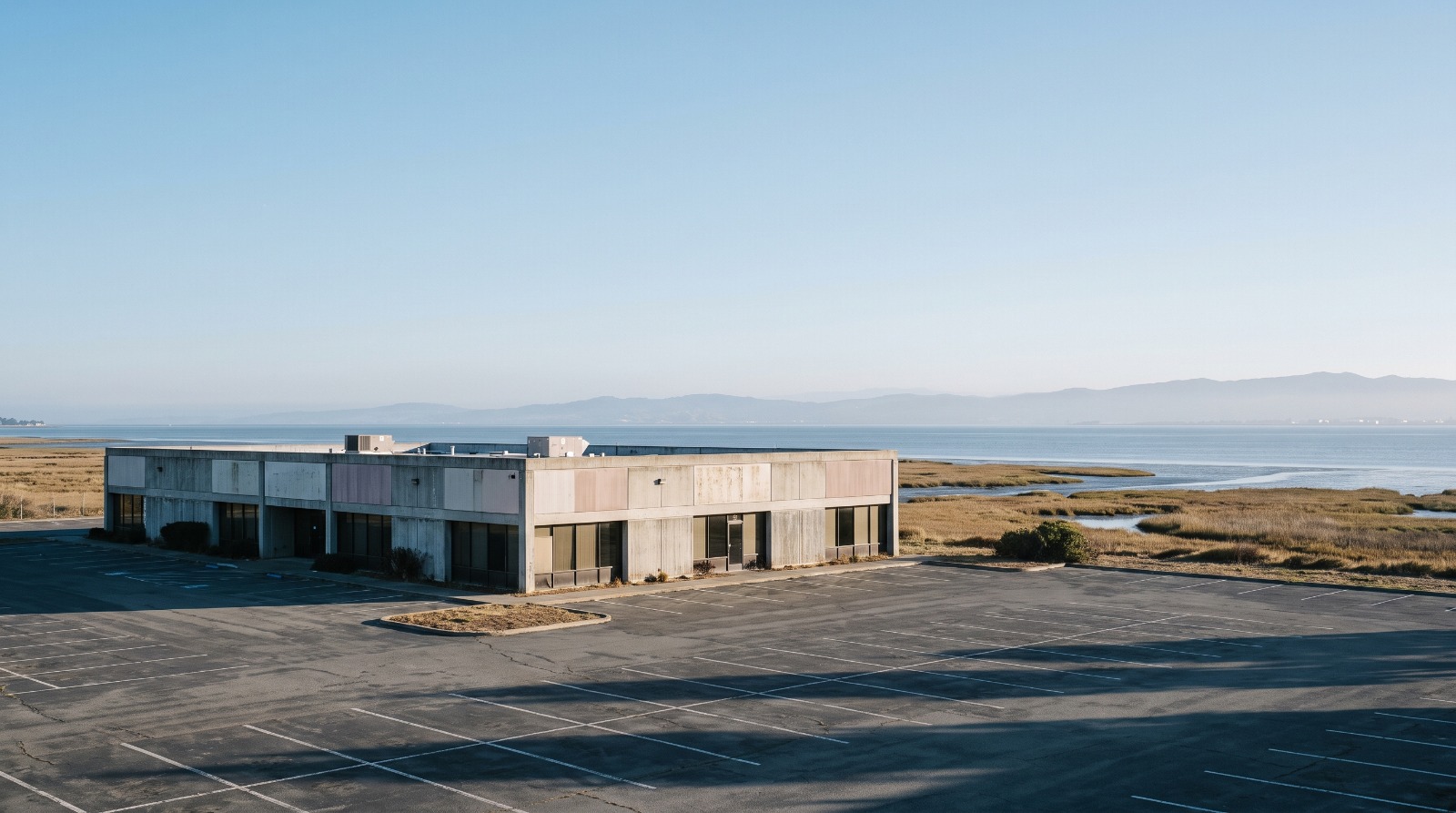
A low single-story Silicon Valley office building and its parking lot on the Menlo Park bayfront, the kind of site being torn down for apartments. Photo: Houseberry
At 155 Jefferson Drive in Menlo Park, the building a Dallas developer wants to knock down is a single-story concrete box of about 32,500 square feet, ringed by surface parking. It is the kind of structure that defined the Peninsula for forty years, and one almost nobody would miss. In its place, Beam Reach has filed plans for an eight-story, 199-unit apartment building. That is the Silicon Valley office teardown story in a single lot. An obsolete tech-era shell comes down so homes can go up.
And Beam Reach is not doing this once. The same firm just won approval for a bigger version of the same idea twelve miles south, at a former Google building in Sunnyvale. Put the two projects next to each other and you get a fair map of where the Peninsula is about to get denser, and why the change is showing up in flat, low-slung office parks rather than on the leafy residential streets people usually fight about.
Neither building is glamorous. Both replace exactly the sort of low-value, single-use parcel that pencils out for housing precisely because the thing standing on it is nearly worthless as office space.
Why knock it down instead of converting it
Office-to-housing conversion gets the headlines in San Francisco. On the Peninsula, developers keep choosing demolition, and the reason is structural, in both senses of the word.
Old R&D and single-story office buildings have deep floor plates, few windows, and low ceilings wrapped in parking. Slicing apartments into that shell is expensive and tends to produce dim units nobody wants to rent. A clean teardown lets a developer build to the light and air a residential building needs. It also lets them build up. You cannot stack seven stories of homes on a building designed to hold one.
The supply of these obsolete boxes is enormous right now. Silicon Valley office vacancy is running around 15%, and in cities like Sunnyvale a chunk of that is former Google space dumped onto the sublease market, part of the 5.6 million square feet the company shed regionally. When that much single-use real estate goes cold at once, the land underneath starts to look more valuable as housing than as offices. Which is roughly what happened at 1215 Bordeaux.
The policy math behind the wave
Two forces are pushing in the same direction. On the demand side, apartments are scarce. South Bay rental vacancy has been running below 3.5%, with rents up more than 4% year over year and San Mateo County rents climbing faster than that. On the supply side, the state has spent five years making it harder for cities to say no.
Menlo Park is on the hook for 2,946 homes this housing cycle, well over half of them affordable, and it is behind on the affordable share. Sunnyvale's target runs close to 12,000. The state density bonus, which is what lets the 155 Jefferson project reach eight stories, trades extra height for those below-market units. SB 79, the new transit-density law, points the same way for sites near rail. None of this forces a specific building. But together it changes the default answer on a dead office parcel from no to probably.
What it means if you are comparing Peninsula neighborhoods
Here is the part that matters if you are weighing where to buy, not just reading the planning news. A teardown like this does not change a neighborhood overnight. It changes what you should be checking.
When several hundred apartments land near Moffett Park or the Menlo Park bayfront, the near-term questions are practical. What happens to traffic on the two or three streets that feed the site. Whether the local elementary school has room. How the new supply nudges rents and, eventually, nearby home values. The honest answer is that more homes near job centers usually helps the region more than it hurts any single block, but the block-level effects are real and worth researching before you commit.
That is the habit we build Houseberry around. Before you fall for a specific address, look hard at the area, because the neighborhood decides how a home actually lives day to day. If you are comparing options, it is worth seeing how Menlo Park neighborhoods rank and how Sunnyvale stacks up on the everyday factors, then watching which pockets are about to add housing. A quiet office park today can be a few hundred new neighbors in three years.
The affordable-housing asterisk
The teardown wave is genuinely good news for supply. It is not a full answer on affordability, and it would be a mistake to pretend otherwise. The 155 Jefferson project reserves 29 of its 199 units as below-market. Bordeaux sets aside 40 of 265. Those are meaningful, and they exist because the density bonus requires them, but they do not close a gap where more than half of a city's mandated homes are supposed to be affordable. Market-rate apartments near transit still help, mostly by taking pressure off the rest of the housing stock over time. Anyone selling them as a cure for the Peninsula's affordability problem is overselling.
The decisions still to come
The Sunnyvale building is approved and will move toward construction. The Menlo Park project is not there yet. It still needs to clear architectural and environmental review, and no hearing date is set, so the 199 units at 155 Jefferson remain a proposal, not a done deal. Watch for that hearing, and watch the pattern around it. Beam Reach is one developer. The teardown-for-apartments model is now showing up all along El Camino Real and around Moffett Park, from a 441-unit project in San Mateo to a string of others in the pipeline. When the buildings coming down are single-story boxes almost nobody loved, that is about as easy a version of the density fight as the Peninsula is going to get.
Peninsula teardown questions, answered
Are these office-to-apartment conversions or full teardowns?
Teardowns. Both Beam Reach projects demolish the existing single-story building and rebuild from the ground up, which is different from the office-to-housing conversions happening inside older high-rises in San Francisco.
Is the Menlo Park project approved yet?
Not yet. Beam Reach filed the 199-unit plan for 155 Jefferson in early 2026 and the public comment window closed in February, but it is still in review with no approval or hearing date set. The Sunnyvale project at 1215 Bordeaux was approved in June 2026.
Will this make Peninsula housing cheaper?
Slowly and indirectly, if at all. More apartments near jobs and transit ease pressure across the market over time, but each project includes only a limited number of below-market units, so do not expect a single building to move prices on its own.
How does new density nearby affect my home value?
It depends on the specifics. A few hundred new apartments can add traffic and school demand near the site while also signaling that a corridor is growing. The practical move is to research the exact area, using something like Menlo Park's neighborhood rankings, rather than assuming the effect is all good or all bad.
Sources
- The Almanac, eight-story housing project in Menlo Park's Bayfront
- City of Menlo Park, 155 Jefferson Drive application
- SF YIMBY, final approval for 1215 Bordeaux Drive, Sunnyvale
- The Real Deal, former Google Sunnyvale offices poised to become housing
- Allwork.Space, office buildings are coming down across Silicon Valley
- The Almanac, Menlo Park lags on affordable units
The Houseberry Research Team is Houseberry's reporting team: Bay Area real estate analysts, data specialists and longtime local market watchers. Every day we check the public record: building permits, city council and planning agendas, county recorder filings, state housing bills, police incident data and school results. Then we tie each story to what it means for specific neighborhoods, using Houseberry's own neighborhood data on prices, appreciation, safety, schools and amenities. Questions or corrections: Contact us.
All information provided on this website including but not limited to - school ratings, safety, amenities, user opinions, and property data - is for general informational purposes only. We do not guarantee its reliability, accuracy, or completeness. Users should independently verify information and consult appropriate professionals as needed. By using this website, you agree Houseberry is not responsible for actions, decisions, or consequences arising from reliance on the information provided
houseberry.com - CA DRE# 01847391
 Bay East ©2025. CCAR ©2025. bridgeMLS ©2025. Information Deemed Reliable But Not Guaranteed. This information is being provided by the Bay East MLS, or CCAR MLS, or bridgeMLS. The listings presented here may or may not be listed by the Broker/Agent operating this website. This information is intended for the personal use of consumers and may not be used for any purpose other than to identify prospective properties consumers may be interested in purchasing. Data last updated at October 21, 2026 12:00 AM