A 500,000 Sq Ft Data Center Is Proposed Next to Silver Creek
Prologis has filed plans for a 516,000-square-foot, 99-megawatt data center at 5977 Silver Creek Valley Road in San Jose. Here is what the proposal actually says, and what it could mean for the neighborhoods uphill.

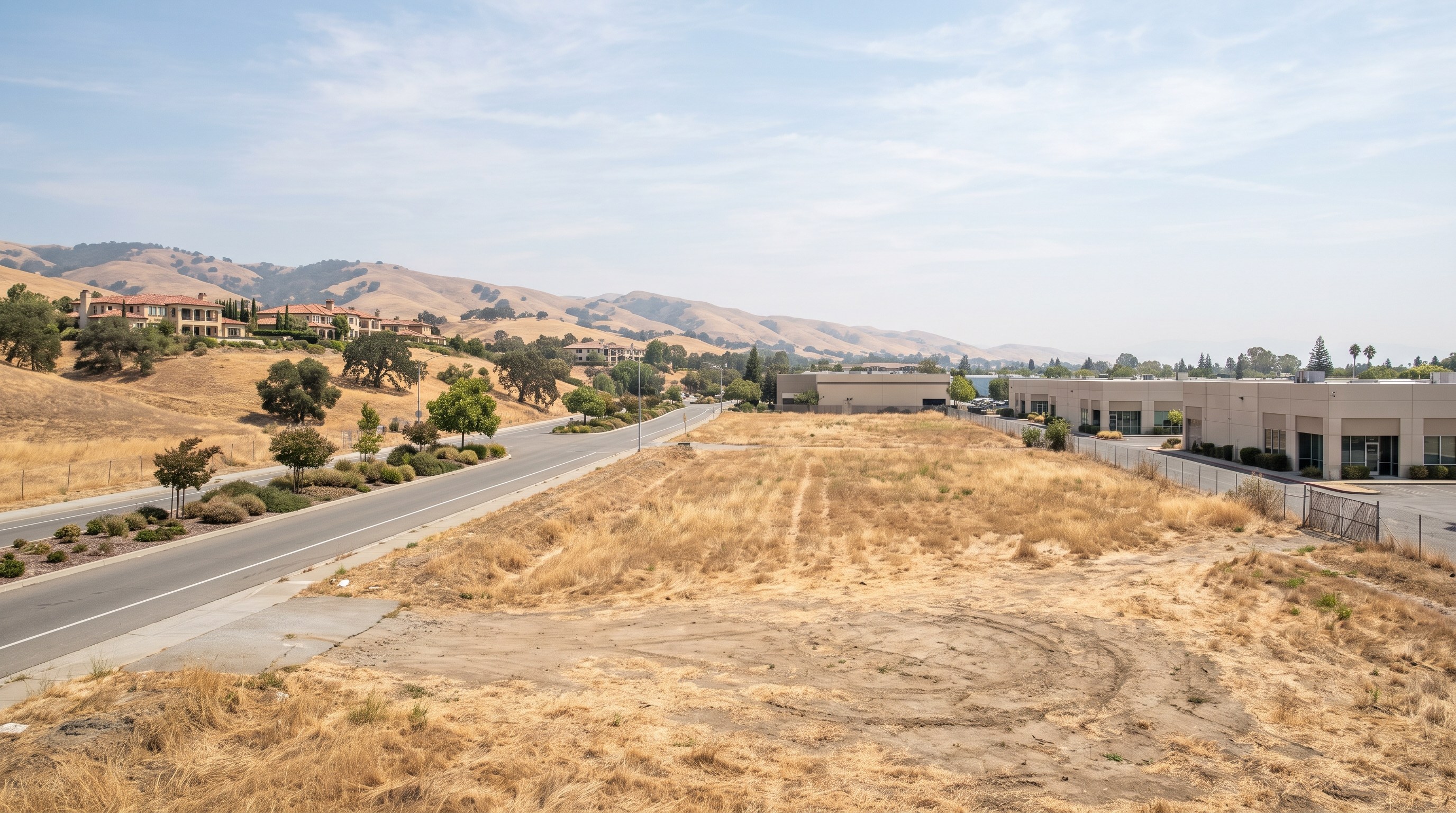
Vacant land along Silver Creek Valley Road in San Jose, the proposed site of a large Prologis data center below the Silver Creek hills. Photo: Houseberry
The 15 acres at 5977 Silver Creek Valley Road have sat empty for years, a flat stretch of dry grass on the corporate-park side of the road that climbs from US 101 toward the Silver Creek Valley Country Club gates. Prologis wants to fill it with one of the biggest data center proposals San Jose has seen: a three-story, 516,000-square-foot building drawing 99 megawatts of power, according to plans filed with the city this week and first reported by SF YIMBY.
A San Jose data center filing is not news by itself. The city has been courting them. What makes this one worth reading closely is the location. Most Bay Area data centers sit in industrial zones nobody drives through on purpose. This one sits at the foot of some of the most expensive residential hillsides in the city, which means thousands of nearby homeowners are about to learn what living near a data center actually involves. The honest answer is less dramatic than the comment sections suggest, but it is not nothing.
What Prologis actually filed for
The application, submitted to San Jose's planning department, lays out a serious piece of infrastructure. Here is the project in brief, per SF YIMBY and Hoodline's coverage of the filing:
About 516,000 square feet across three stories on a 15-acre site, with roughly 30,000 square feet of office space and the rest housing servers and equipment.
A 99-megawatt total power draw, served by a new on-site substation plus a second, independently routed transmission line that Prologis says it will pay for itself.
A fenced generator yard for backup power, and water use the company pegs at roughly what 40 households consume in a year.
A construction timeline of about two years once approvals and utility work are in place.
The land has its own backstory. An affiliate of Duke Realty paid about $40.2 million for the parcel in October 2021 with a warehouse in mind, per The Real Deal, and the site came to Prologis when it swallowed Duke Realty a year later. So a lot that was once penciled as a logistics warehouse is now penciled as server halls. That is the South Bay land market in 2026 in a single parcel.
Design-wise, the early renderings show what you would expect: a blocky grey-and-white box, function over form, with landscaping and facade detailing doing their best to break up the massing. Nobody builds a pretty data center. The question is whether they build a quiet, well-screened one.
The power math is the real story
Ninety-nine megawatts is an enormous ask, and it explains most of what is in the filing. The site sits within three miles of an existing PG&E substation, and PG&E has already been reinforcing this part of the grid. The utility recently expanded its Santa Teresa substation capacity to 80 megawatts to handle growing South San Jose loads, and state filings show a 100-megawatt battery storage project queued at the same substation, as Hoodline detailed.
Prologis has also said it intends to enroll the facility in San Jose's Total Clean Energy program or a similar option, and to fund its own interconnection work, including that second transmission line. Read cynically, that is a developer pre-buying goodwill. Read practically, developer-funded grid upgrades and a self-supplied substation are exactly what you want from a project like this, because the alternative is everyone else's rates and reliability absorbing the load. The grid hardware will also outlive any single tenant, which is more than you can say for most corporate campuses.
Will you hear it from your backyard?
Noise is the number one question people search when a data center lands nearby, and it deserves a straight answer. The steady sound from a facility like this comes from rooftop and yard cooling equipment, and the loud-but-rare sound comes from backup generators, which run during outages and periodic testing. In some communities around the country, particularly where data centers run on-site generation heavily, residents describe a hum you can hear inside the house. Coverage of the national fight over these facilities, like this Illinois Public Media report, captures how real those complaints are, and how much they vary site by site.
Here the geography does the neighbors some favors. The parcel sits in an established employment corridor, separated from the closest homes by the road and other business-park buildings rather than backing directly onto anyone's fence line. The homes with views of the site are mostly uphill and at a distance. That does not make the question go away. It makes the environmental review's noise study the single most important document a nearby resident can read and comment on when it publishes. If you live in the hills above this corridor, that study, not the rendering, is where your attention should go.
What a data center next door does to home values
The research here is more boring than either side wants it to be. National reporting on recent studies has found no systemic drag on home prices near data centers, per Bisnow, while industry analysts looking at the same question conclude the facilities probably do not boost values either, per Data Center Knowledge. The pattern that shows up consistently is about distance: parcels immediately adjacent carry the industrial-neighbor burden of noise, truck movements, and views, while homes a half mile or more away see little measurable effect and sometimes benefit from the tax base.
Our own numbers put that in local context. The Silver Creek Rd area uphill from this corridor scores 4.3 out of 5 overall on Houseberry, ranks 46th of 358 San Jose neighborhoods, and carries a perfect 5.0 safety score with a median home price around $3.19 million as of May 2026. People pay that premium for hillside quiet and views. Nothing in the filing suggests those fundamentals change, but a buyer touring up there this fall should know the vacant lot at the bottom of the hill has a 516,000-square-foot future, and should price their own tolerance for a two-year construction period into the decision. That is not a reason to cross the area off a list. It is a reason to know exactly where a specific house sits relative to the site before you fall for the kitchen.
Traffic, jobs, and what this project is not
Data centers are famously light employers. Thirty thousand square feet of office space in a half-million-square-foot building tells you the permanent headcount will be modest, likely dozens of jobs rather than hundreds. The real people impact is the two-year construction period, which means truck traffic on Silver Creek Valley Road and a lot of trades work, followed by a very quiet neighbor that pays a very large tax bill.
And to be clear about what this is not: it is not lost housing. This parcel is employment land in an office and industrial corridor, and it was never going to be homes under current plans. The debate worth having is whether a low-headcount use is the best use of employment land, and that is a fair fight. But opposing it as if a meadow or a subdivision were the alternative gets the site wrong. The alternative was a warehouse.
The approval gauntlet starts now
The proposal now sits with San Jose's Planning, Building and Code Enforcement department for permitting and environmental review, a process that includes public notice and comment. Nothing is approved yet. Between review, utility work, and the roughly two-year build, the realistic horizon for a humming facility is several years out, and large projects like this have a habit of evolving between first filing and final approval.
If you own or are shopping in the neighborhoods above this stretch of southeast San Jose, the practical to-do list is short: watch the city's file on 5977 Silver Creek Valley Road, read the noise and traffic studies when they publish, and comment during the public window if something in them looks thin. And if you are comparing this pocket against other options across the city, the full San Jose neighborhood rankings and our San Jose city guide are built for exactly this kind of homework, looking hard at the area around a home before you commit to the address. A quiet vacant lot is never a promise. Better to know what is planned for it than to find out from the construction fence.
Sources
Hoodline: South San Jose Braces For Colossal Prologis Data Center Play
The Real Deal: Duke Realty readies to build warehouse in South San Jose
Bisnow: Reports Find Data Centers Don't Lower Nearby Home Prices
Data Center Knowledge: Do Data Centers Really Boost Property Values? A Closer Look
Illinois Public Media: Will data centers impact property values? Depends on who you ask
The Houseberry Research Team is Houseberry's reporting team: Bay Area real estate analysts, data specialists and longtime local market watchers. Every day we check the public record: building permits, city council and planning agendas, county recorder filings, state housing bills, police incident data and school results. Then we tie each story to what it means for specific neighborhoods, using Houseberry's own neighborhood data on prices, appreciation, safety, schools and amenities. Questions or corrections: Contact us.
Map of San Jose Neighborhoods
Loading map...
View Full Map
Top Neighborhoods in San Jose, CA


All information provided on this website including but not limited to - school ratings, safety, amenities, user opinions, and property data - is for general informational purposes only. We do not guarantee its reliability, accuracy, or completeness. Users should independently verify information and consult appropriate professionals as needed. By using this website, you agree Houseberry is not responsible for actions, decisions, or consequences arising from reliance on the information provided
houseberry.com - CA DRE# 01847391
 Bay East ©2025. CCAR ©2025. bridgeMLS ©2025. Information Deemed Reliable But Not Guaranteed. This information is being provided by the Bay East MLS, or CCAR MLS, or bridgeMLS. The listings presented here may or may not be listed by the Broker/Agent operating this website. This information is intended for the personal use of consumers and may not be used for any purpose other than to identify prospective properties consumers may be interested in purchasing. Data last updated at October 9, 2026 12:00 AM