Affordable Senior Housing in Oakland: The Eliza and the Wait
Oakland is building 97 affordable studios for renters 62 and older at Telegraph and 22nd. What the rents actually are, who qualifies, and why the waitlist math is the hard part.

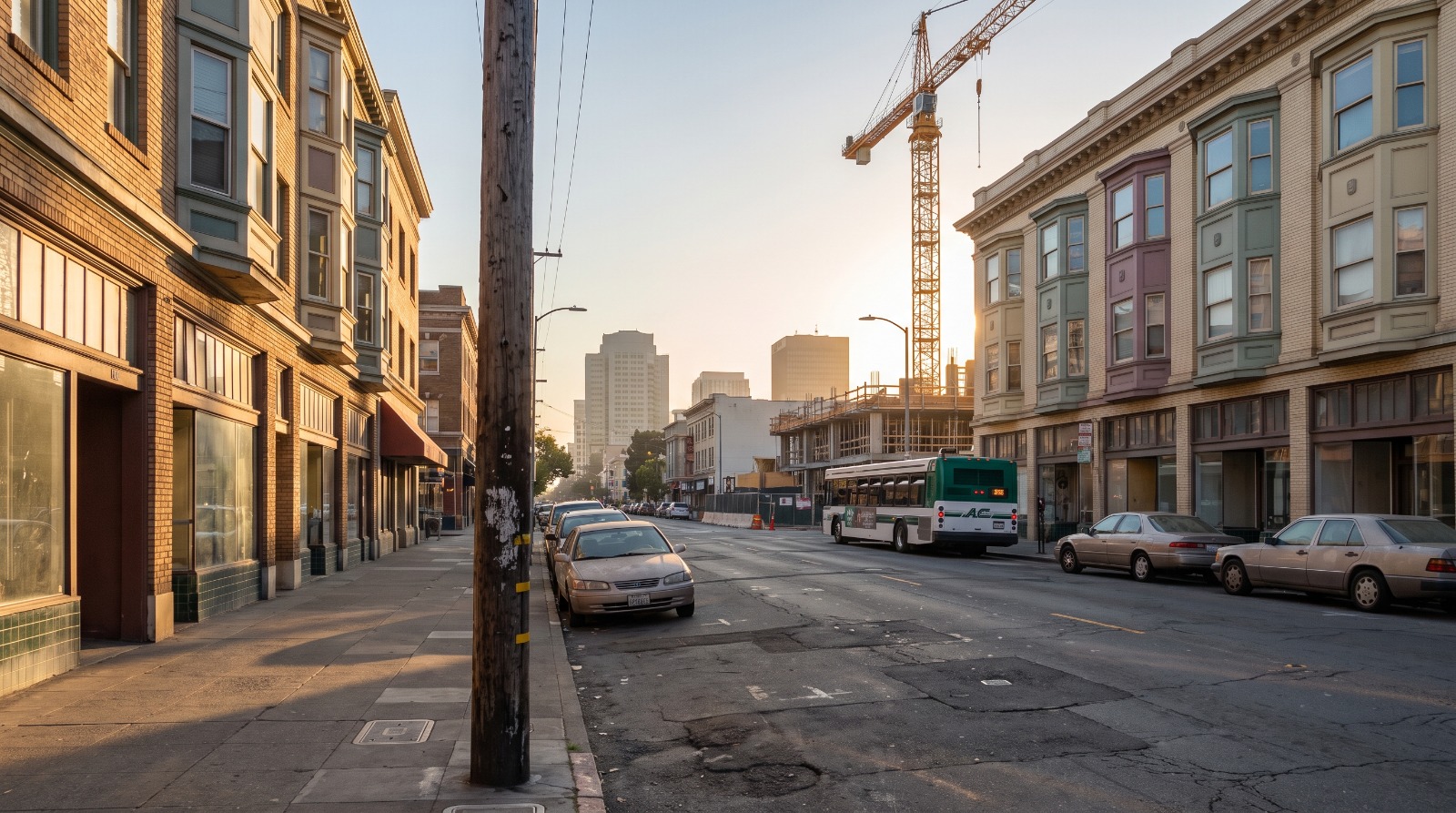
Telegraph Avenue in Uptown Oakland in late afternoon light, with 1920s brick storefronts and a construction crane above a mid-block site where affordable senior housing is rising. Photo: Houseberry
A 68-year-old renter in Oakland who opens a rent increase letter this fall has three options, and two of them are bad. The third is a waitlist. The Eliza, 97 apartments for people 62 and older going up at Telegraph Avenue and 22nd Street, is the largest new piece of affordable senior housing in Oakland's Uptown and downtown core in years. It is fully funded, it topped out in July, and it opens in the fall of 2027. It also will not be close to enough, and the people running it would tell you the same thing.
Three numbers explain more about senior housing in Oakland than any ribbon-cutting will. A studio restricted to 30 percent of area median income rents for at most $891 a month in Alameda County in 2026. A senior living on Supplemental Security Income in California receives $1,233.94 a month. And every one of the Oakland Housing Authority's five waitlists is closed right now. Hold those three together and you have the actual shape of the problem.
What is actually going up at Telegraph and 22nd
The Eliza is a Mercy Housing California project on a former surface parking lot beside the historic Hamilton Apartments, which Mercy also owns. Ninety-six of the 97 apartments are income-restricted studios. The 97th is for an on-site manager. Gensler designed it, Cahill Contractors is building it, and LifeLong Medical Care provides case management on site.
The income split is where it gets specific. Per the state's August 2025 allocation filing, 49 of the studios are restricted to households at 30 percent of area median income and 47 are restricted at 50 percent. Twenty of the 96 are set aside as permanent supportive housing for seniors coming out of homelessness. That is not a rounding detail. It means a fifth of the building is aimed at the hardest housing problem in the city.
Total development cost is $79,702,348, which works out to roughly $830,000 per restricted apartment for a studio on a fifth of an acre. That figure makes people flinch, and it should be said out loud rather than buried. It is what a concrete-and-steel building with an elevator, a services office and 55 years of regulated rent costs in Alameda County in 2026. The stack behind it is ordinary for this kind of project and unreadable to everyone outside it: tax-exempt bonds and low-income housing tax credit equity through JPMorgan Chase, a $20 million permanent loan from the City of Oakland out of its January 2025 funding round, an $11.8 million HUD Section 202 capital advance, and an $8.2 million foundation grant.
A note on where the news came from, because it matters. The piece that ran on August 25 announcing the building was sponsored content, written and paid for by JPMorgan Chase. It is labeled as such and the facts in it hold up. But it is an advertisement, not reporting, and it is close to the only public account of the biggest new senior building in the district. The numbers above come from the state's own funding record instead, which is duller and more reliable.
What affordable means here, in dollars
Affordable is a legal term with a table behind it, and almost nobody publishes the table. Here it is for a one-person household in Alameda County in 2026, using the state income limits revised in June and the tax credit rent caps effective May 1.
| Income tier (one person) | Maximum income, 2026 | Maximum studio rent, 2026 | Homes at The Eliza |
|---|---|---|---|
| Extremely low, 30 percent AMI | $35,650 | $891 | 49 |
| Very low, 50 percent AMI | $59,400 | $1,485 | 47 |
| For comparison: HUD Fair Market Rent, studio | n/a | $2,142 | n/a |
The bottom row is the whole argument. A restricted studio at 50 percent of area median rents for about $657 a month less than what HUD says a plain market studio costs in the Oakland and Fremont area, and one at 30 percent rents for $1,251 less. Over a year that is the difference between a senior who stays in Oakland and one who does not. Those are gross rents, so the tenant's actual check is a little lower after the utility allowance comes out.
The number the rent table does not fix
Here is the part that gets left out of every guide to senior housing in Oakland, and it is the part a 70-year-old on a fixed income needs most. An $891 rent is still out of reach for a senior whose only income is Social Security Supplemental Security Income. California pays a state supplement on top of the federal benefit, and as of January 1, 2026 the combined maximum for an individual living independently is $1,233.94 a month, or $14,807 a year. At the standard measure of 30 percent of income, that senior can afford about $370 in rent. The cheapest legally affordable studio in the county costs more than twice that.
So an income limit is not the same thing as an ability to pay, and this is where a building's financing quietly decides who actually lives in it. The Eliza carries a HUD Section 202 capital advance, the federal program built specifically for very low income seniors, and 202 awards normally come attached to rental assistance that pegs a tenant's payment to 30 percent of whatever they actually earn rather than to a table. The final rent structure has not been published. When it is, that is the line to read, because it is the difference between a building for seniors on modest pensions and a building that also works for seniors on SSI.
The scale of the need is not in dispute. Justice in Aging found in March 2024 that 59 percent of California renters 62 and older were paying more than 30 percent of their income for housing, and that 76 percent of extremely low income renters in that age group were cost burdened. That last group is exactly who the 49 thirty-percent studios are for. Alameda County has roughly 440,000 residents aged 60 and up today and projects about 600,000 by 2040. Against that, 96 studios is a good week, not a plan.
The block itself, and what the scores are telling you
Uptown is the arts and entertainment stretch of downtown Oakland, running along Telegraph and Broadway roughly between 17th and 27th, and The Eliza sits two blocks from the 19th Street BART station. For an older renter without a car, that location is close to the best in the county. Houseberry ranks Uptown 25th of 130 Oakland neighborhoods for amenities at 3.7 out of 5, with a perfect 5.0 for nearby merchants. Groceries, a pharmacy, a clinic and a train are all inside a walk that a 75-year-old can make.
The same page scores Uptown 1.4 out of 5 on safety, 123rd of 130. That is the trade-off, and flattening it in either direction would be dishonest. It does not mean the block is dangerous for a resident of a staffed building with a locked lobby, and downtown safety scores across every American city are dragged down by daytime property crime in commercial districts where far more people pass through than live. It does mean that a senior comparing this to, say, Adams Point over by Lake Merritt, which scores 3.2 overall and 4.1 on amenities, is making a real choice and should walk both at eight in the evening before deciding. The catch is that Adams Point has no subsidized senior building opening in 2027 and Uptown does.
The on-site services coordinator and the LifeLong case management are the building's answer to that gap, and they are the reason a supportive building on a hard block works when a plain apartment on the same block does not. Staffing is a program, and programs get renewed or they do not. Ask about it in 2032.
What to do if you are 62 and renting in Oakland right now
The Eliza does not open for another year, so the practical answer is not to wait for it. Applications for a tax credit building normally open a few months before occupancy, which points to sometime in 2027, and Mercy has not announced a date. The 20 supportive apartments will not be filled by application at all. Those go through Alameda County's coordinated entry system, which is the single door into supportive housing countywide and which a person has to already be in.
Meanwhile the Oakland Housing Authority's waitlists are all closed. Its most recent public housing opening ran for two weeks in March 2026 and lotteried 450 slots across two developments, neither of them senior-designated. That is the reality every listing site leaves out when it shows you 64 income-restricted senior communities in Oakland with no note about whether any of them are open.
What actually works is unglamorous. Apply directly to individual buildings rather than waiting on the housing authority, because each property runs its own list and the lists open at different times. Get on more than one. Check the city's affordable housing listings monthly rather than annually. And if the risk is immediate rather than theoretical, coordinated entry is the door, and going through it early matters more than anything else on this page.
How to hold both facts at once
The Eliza is genuinely good news, and it is also evidence of how far behind the city is. Oakland had 486 affordable homes under construction citywide as of December 2025 and has committed $289.4 million to new construction since 2023, which is a serious effort by any measure, and it is still producing a few hundred homes a year against a population aging by tens of thousands. Adults 55 and older were 25.2 percent of Oakland's homeless population in the January 2024 count. The countywide count did fall 13 percent in January 2026, which is real progress and worth saying.
The way we look at it when we compare neighborhoods, a building is a fact about a block and a waitlist is a fact about a city, and you need both to make a decision. If you are helping a parent figure out where they can afford to grow old in Oakland, start with how the neighborhoods actually compare on the things that matter at 75, which is a walkable pharmacy and a train more than it is a school rating, and then work down to the buildings. Oakland's citywide median sale price was $974,220 in July 2026, essentially flat against a year earlier, and none of that number is available to a renter on $1,233 a month. Ninety-six studios are.
Sources
California Debt Limit Allocation Committee, staff report CA-25-617, August 2025
Mercy Housing California, groundbreaking announcement, February 2026
The Oaklandside, sponsored feature on The Eliza, August 25, 2026
California HCD, revised 2026 State Income Limits, June 23, 2026
California Tax Credit Allocation Committee, 2026 rent limits effective May 1, 2026
HUD, FY2026 Fair Market Rent schedule
California DHCS, SSI and SSP payment standards effective January 1, 2026
Justice in Aging, California older renters policy brief, March 2024
City of Oakland, affordable housing funding awards, December 10, 2025
Oakland Housing Authority, waitlist status
Alameda County 2024 Oakland Point-in-Time count
The Houseberry Research Team is Houseberry's reporting team: Bay Area real estate analysts, data specialists and longtime local market watchers. Every day we check the public record: building permits, city council and planning agendas, county recorder filings, state housing bills, police incident data and school results. Then we tie each story to what it means for specific neighborhoods, using Houseberry's own neighborhood data on prices, appreciation, safety, schools and amenities. Questions or corrections: Contact us.
All information provided on this website including but not limited to - school ratings, safety, amenities, user opinions, and property data - is for general informational purposes only. We do not guarantee its reliability, accuracy, or completeness. Users should independently verify information and consult appropriate professionals as needed. By using this website, you agree Houseberry is not responsible for actions, decisions, or consequences arising from reliance on the information provided
houseberry.com - CA DRE# 01847391
 Bay East ©2025. CCAR ©2025. bridgeMLS ©2025. Information Deemed Reliable But Not Guaranteed. This information is being provided by the Bay East MLS, or CCAR MLS, or bridgeMLS. The listings presented here may or may not be listed by the Broker/Agent operating this website. This information is intended for the personal use of consumers and may not be used for any purpose other than to identify prospective properties consumers may be interested in purchasing. Data last updated at October 11, 2026 12:00 AM