Berkeley Takes On Its Stalled Construction Sites
Berkeley is weighing rules that would require murals, landscaping and temporary uses at stalled construction sites, and could add long vacancy to the list of things that make a property legally blighted.
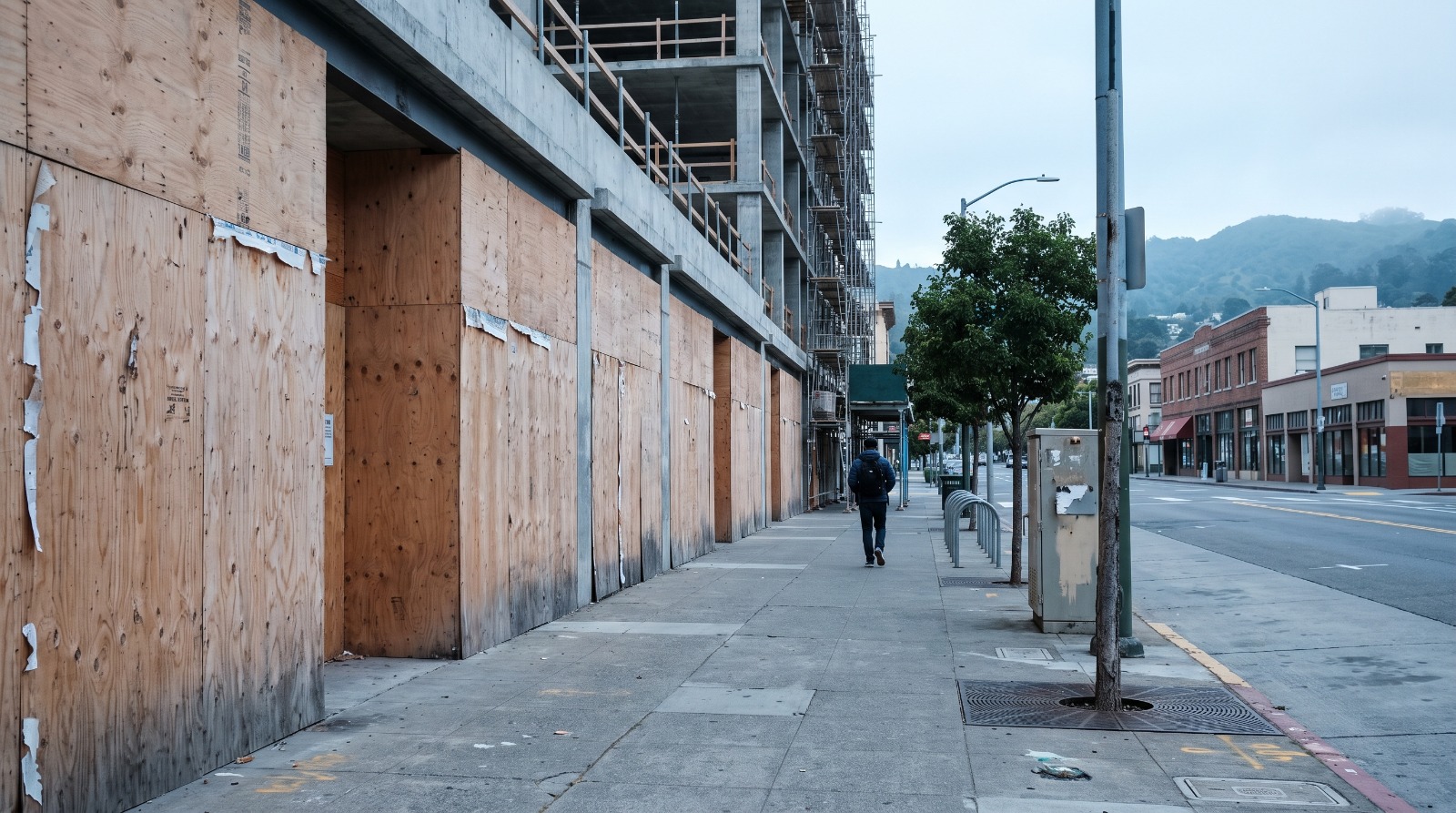
Boarded-up ground-floor storefronts on Center Street in Downtown Berkeley, one of the stalled construction sites the city's new blight standards would cover. Photo: Houseberry
Walk the block of Center Street between Shattuck and Milvia and you pass more than two thousand square feet of papered-over storefront. Not empty the ordinary way a shop is empty between tenants. Empty because the building behind it is waiting on a construction schedule that keeps slipping.
Berkeley's stalled construction sites have become one of the most visible things a person notices downtown, and on July 28 the City Council took up a proposal to do something about how they look while everyone waits.
Item 24 is a referral, not a rule
The proposal carries the acronym RENAISSANCE and sits on the July 28 council agenda as Item 24, sponsored by District 4 Councilmember Igor Tregub with Mayor Adena Ishii and Councilmembers Blackaby and O'Keefe. It asks the city manager to come back with performance standards for commercial districts. On sites that have been demolished or partly built and then stopped, it contemplates requiring temporary landscaping, murals, green walls, what the item calls "creative and dynamic fencing," or temporary creative use of the space. It would add unmitigated prolonged commercial vacancy to the list of factors that let the city declare a property blighted. And it asks staff to look at a streamlined process for revoking land use permits when an owner does not comply.
That last one is the part with teeth, and it is the part that made people in the room uneasy.
A referral is an instruction to staff, not an ordinance. Whatever happened Tuesday night, nothing about a stalled block changes tomorrow. The actual rules, if they arrive, come back later as Part 2. The agenda that evening also carried the Hopkins bike lane decision, which ran long enough to swallow most of the local coverage, and the city had not posted an annotated agenda showing the outcome of Item 24 as of this writing. Treat the policy as live and unfinished rather than settled.
Tregub's framing is worth quoting, because it is the honest case for the whole thing. "When storefronts are active, streets feel and are more welcoming, walkable, and safe," he told The Daily Californian. The word doing the heavy lifting there is feel, and it deserves more credit than it usually gets.
A boarded block reads worse than the numbers say it should
This is the part that matters if you are shopping in Berkeley, and it is a gap we run into constantly when we score neighborhoods. Downtown Berkeley rates 4.0 out of 5 for amenities on Houseberry, level with South Berkeley and not far off Elmwood's 4.4. By the honest measure of what is within a short walk, downtown is one of the best-supplied places in the city. It has a BART portal, a repertory theater, a farmers market, more restaurants than anyone could work through in a season. Its overall score is 3.6, eleventh of eighteen Berkeley neighborhoods, and its median was about $1.27 million in June 2026.
Amenity count and curb appeal are not the same measurement, and buyers feel the second one first. A block can have everything on that list and still read as somewhere you would not linger after dark, because two hundred feet of plywood is what your eye lands on. That is the gap a proposal like this is aimed at. Not the supply of things to do, but the impression the street makes on the ten-second walk from the car.
You can see it in the scores too. Downtown Berkeley's softest number is safety at 3.0, and South Berkeley sits at 2.1 despite the same 4.0 amenities rating and a median around $1.19 million. Neither of those numbers is caused by a stalled construction site, and it would be dishonest to suggest a mural fixes them. But an empty, unlit, boarded frontage is a real ingredient in how a block reads, and the block is what people judge.
Where the vacancies actually are
Tregub's district, which covers downtown, carries a commercial vacancy rate of 9.68 percent. South Berkeley runs 6.76 percent. He has counted seventeen stalled projects contributing to the problem. The reasons are not mysterious and mostly are not Berkeley's doing: construction financing got expensive after 2022 and stayed expensive, tariff uncertainty pushed material costs around, and retail kept moving online. A lot of these sites are approved. The money simply is not there yet.
Which is the part worth holding onto. A stalled site in Berkeley is usually a building that cleared the hardest part of the process and then hit the capital markets. That is a very different thing from a neighborhood in decline, even though it looks worse day to day.
The city has already run the pilot version of this idea. Last August the Downtown Berkeley Association organized a mural on Center Street by artist Ferran Torras, more than 2,000 square feet across frontage left blank by a stalled Core Spaces project, funded by Core Spaces itself and the UC Berkeley Chancellor's Community Partnership Fund. It worked, in the modest sense that a wall of art beats a wall of plywood. RENAISSANCE is essentially the question of whether that should be voluntary.
Downtown Berkeley Association CEO John Caner put the pragmatic case simply: "Yes, we want to fill all storefronts, but if we can't fill all of them, we can at least make them look nice." Liz Lisle, co-chair of the Lorin Business Association in South Berkeley, raised the obvious worry. "When I read things like revocation of permits, I start to think, OK, what is this exactly?" That is a fair question and the standards should answer it. Landscaping is cheap. Losing an entitlement is not, and the small property owners along the Adeline corridor are not the people who stalled a high-rise.
How to read a stalled block if you are shopping in Berkeley
The question we get is whether a boarded site next door hurts what a nearby home is worth. The honest answer is that nobody should give you a confident number on that, and anyone who does is selling something. What we would actually do is find out what the site is. Berkeley's permit records will tell you whether a parcel is entitled, who owns it, and how long it has sat. An approved project waiting on financing is a building in your future. A cleared lot with nothing filed is a longer, vaguer wait.
It is also worth knowing that this is a downtown and South Berkeley story more than a citywide one. Elmwood, Northbrae, Thousand Oaks and the hills barely appear in this conversation, and their scores across the Berkeley rankings reflect a completely different set of tradeoffs, mostly price.
So here is the useful way to hold it. A boarded storefront is telling you about a financing market, not about a neighborhood. Look at what is genuinely around the block, then look at what is approved to be built on it, then decide what the street will be in three years rather than what it is on a Tuesday morning. Comparing the area before you fall for the address is the habit we built Houseberry around, and downtown Berkeley is a good argument for it, because the block you are standing on and the neighborhood you would be buying into are not always telling you the same story.
Sources
- The Daily Californian: Berkeley to weigh beautification standards for stalled developments
- City of Berkeley: City Council regular meeting agenda, July 28, 2026
- The Daily Californian: Center Street mural to beautify downtown Berkeley vacancies
- Houseberry: Downtown Berkeley neighborhood scores and median price
- Houseberry: Berkeley neighborhoods ranked by amenities
All information provided on this website including but not limited to - school ratings, safety, amenities, user opinions, and property data - is for general informational purposes only. We do not guarantee its reliability, accuracy, or completeness. Users should independently verify information and consult appropriate professionals as needed. By using this website, you agree Houseberry is not responsible for actions, decisions, or consequences arising from reliance on the information provided
houseberry.com - CA DRE# 01847391
 Bay East ©2025. CCAR ©2025. bridgeMLS ©2025. Information Deemed Reliable But Not Guaranteed. This information is being provided by the Bay East MLS, or CCAR MLS, or bridgeMLS. The listings presented here may or may not be listed by the Broker/Agent operating this website. This information is intended for the personal use of consumers and may not be used for any purpose other than to identify prospective properties consumers may be interested in purchasing. Data last updated at September 14, 2026 12:00 AM