San Francisco Centre Redevelopment: The Basketball Bid
Urban Land Development and TMG Partners want to fill the San Francisco Centre with basketball courts and a sports high school. Here is what the bid contains, why the mall is suddenly cheap, and what the blocks around Fifth and Market score before any of it happens.
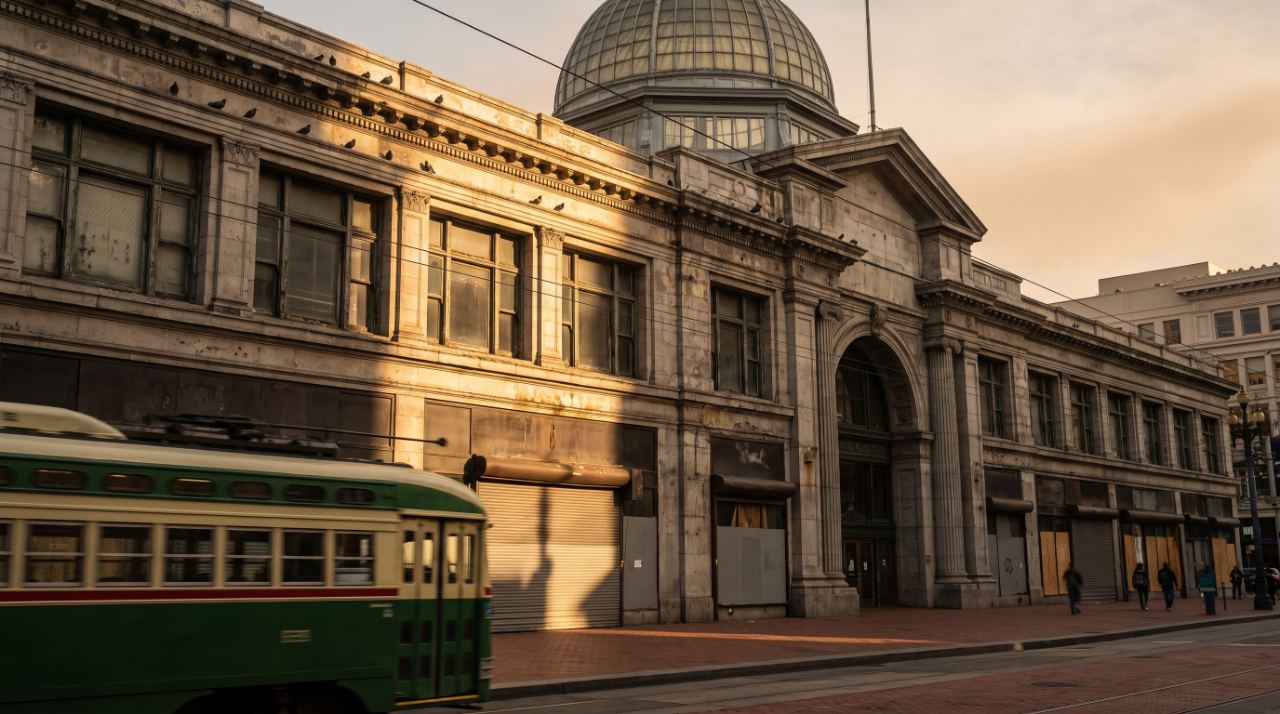
The San Francisco Centre at 865 Market Street, the shuttered mall at the center of a redevelopment bid to turn it into a sports complex. Photo: Houseberry
The call for offers on 865 Market Street closed on Wednesday, September 9, and the bid everyone downtown is talking about wants six hardwood basketball courts on the fourth floor of a mall that has been dark since January. Urban Land Development, with TMG Partners expected to put up most of the money, has pitched the bondholders on turning the San Francisco Centre into a sports complex, The San Francisco Standard reported on September 13.
Here is the short answer to what it means: this is the first San Francisco Centre redevelopment plan that treats the building as somewhere people go on a Tuesday night rather than somewhere they shop. For the condo blocks around Fifth and Market, that distinction matters more than whatever price the bondholders finally accept.
What Urban Land Development and TMG actually put in the bid
The plan stacks a members-only sports program on top of a public retail base and keeps the dome, according to the Standard's account of the bid. Urban Land Development is run by Jon Mayeda, who coaches high school and AAU basketball on the side, and the training-camp piece is led by Phil Handy, the Bay Area native on the Philadelphia 76ers coaching staff.
The floor-by-floor breakdown, as reported:
- Basement: a food court, below grade, where the old one sat next to the Powell Street BART concourse.
- Floors one and two: retail, open to the public.
- Floor three: an entertainment zone built around basketball, including a restaurant and sports bar with dozens of hoops, run by a company launched by former Green Bay Packers receiver Derrick Mayes.
- Floor four: six hardwood courts for private training camps.
- Floor five: eight volleyball courts.
- Top floor: a sports-focused high school.
- The Emporium dome, the one piece of the original building the 2006 remodel kept, stays.
TMG is the credible half of the pairing. It already owns the Metreon across the street and 149 New Montgomery a few blocks east, so a sports anchor at Fifth and Market would sit inside a portfolio it controls. The less comfortable detail, which the Standard also reported, is that Urban Land Development defaulted on two properties, one near Union Square and one in SoMa, between 2024 and 2026.
Why the San Francisco Centre redevelopment pencils at $130 million
The reason a sports complex is even on the table is that the San Francisco Centre has been repriced by roughly 90 percent. The bondholders took the property with a $133 million credit bid in November 2025 after Westfield and Brookfield stopped paying on a loan that had valued it above $1.2 billion in 2016. The Real Deal reported on September 9 that CBRE expects the relaunched sale to land below $130 million.
Westfield's other Market Street footprint tells the same story at a smaller scale. On September 10, the Standard reported that Unibail-Rodamco-Westfield sold 814 and 818 Mission Street, the six-story Bulletin Building and its five-story neighbor, to two LLCs tied to New York-based Seven Equity Group for about $15.5 million combined. Westfield paid $42 million for the pair around 2007. That is a 63 percent haircut before inflation and 76 percent after it.
Put the numbers side by side and the logic of the basketball bid gets clearer.
| What | Number | When |
|---|---|---|
| Loan valuation of the San Francisco Centre | More than $1.2 billion | 2016 |
| Debt owed when Westfield walked | $558 million | June 2023 |
| Bondholders' credit bid to take the mall | $133 million | November 2025 |
| Expected sale price this round | Under $130 million | September 2026 |
| 814 and 818 Mission St, Westfield purchase | $42 million | About 2007 |
| 814 and 818 Mission St, sale to Seven Equity | About $15.5 million | September 2026 |
At a $1.2 billion valuation, about $1,000 a square foot, the only use that could carry the debt was luxury retail, and luxury retail left when Nordstrom did in August 2023. At roughly $100 a square foot, a buyer can afford uses that pay modest rent but fill the building on weeknights. Volleyball courts and an AAU tournament circuit are that kind of use. It is the same write-down that finally makes office-to-housing conversions work down the street.
The ground lease that sank the last deal is fixed, mostly
The last buyers walked in July partly because a school district owns the dirt under the old Nordstrom, and that problem has since been patched. The San Francisco Unified School District holds a 75,675 square foot parcel at the Fifth Street end of the mall and has collected about $3.2 million a year on it since 1983 under a lease that ran to 2043, the Standard reported in July. In August, the district extended the lease options to 2082, which is the difference between a 17-year runway and a 56-year one for anyone financing a rebuild.
The other structural problem has not gone away. The $558 million loan was sliced into commercial mortgage-backed securities, so the seller is not one owner but a stack of bondholders paid in order of risk, represented by the special servicer Midland Loan Services. Presidio Bay and Prado Group, the local pair that agreed to buy the mall in March, announced in early July that they were not moving forward after months of diligence. We covered what that collapse said about the downtown market in our July piece on the failed mall sale. This is the next chapter: the ground lease got fixed, the price came down again and the bidders changed.
What the blocks around Fifth and Market score before anything reopens
Our own numbers say the neighborhoods around the mall have an amenities problem that is not really about amenities. South of Market, the wide district south of Market Street from the Embarcadero to roughly Division, scores 2.1 out of 5 overall on our South of Market page in September 2026, with a safety score of 1.9 and an amenities score of 3.2. Yerba Buena, the museum-and-convention pocket roughly bounded by Market, Third, Fifth and Harrison that touches the mall's back door, scores 2.6 overall on its Houseberry page, with amenities at 3.8 and safety at 2.2.
The pattern holds across the neighborhoods within a ten-minute walk of the dome. On our San Francisco amenities ranking, Yerba Buena sits 18th of 92 neighborhoods and South Beach 17th, while South of Market lands 59th. Their overall ranks are far worse, because safety and schools drag them down.
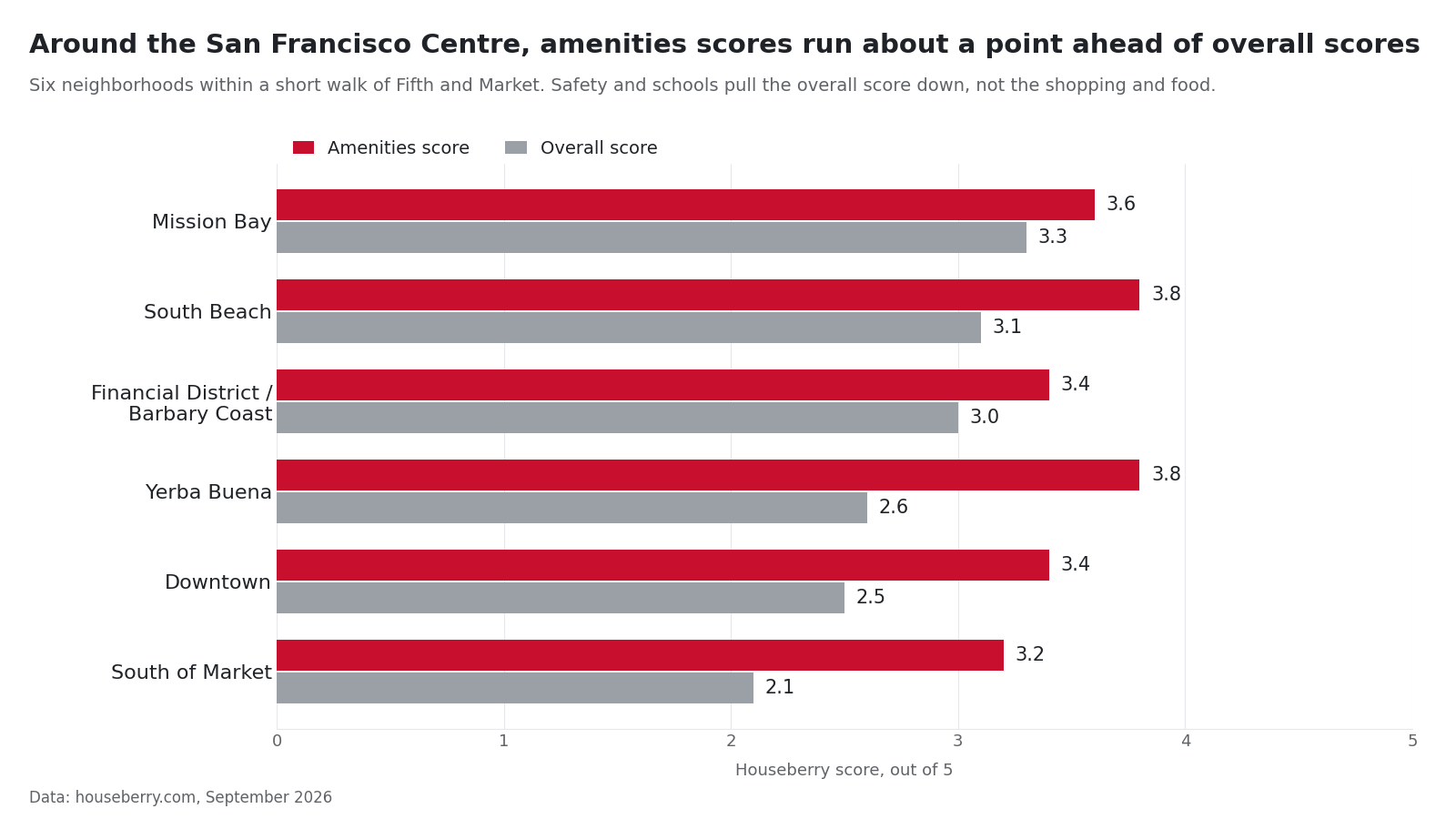
Read that chart as a before picture. A reopened mall adds a food court, two retail floors and a reason to be at Fifth and Market after dark, all of which feed the amenities score. None of it directly moves the safety score, which is the column doing the damage in SoMa and Yerba Buena. If the sports plan works, the honest expectation is a higher amenities number and a slower, secondhand improvement in how the corridor feels at 9 p.m., not a jump in the overall score.
Would a sports mall change SoMa condo prices?
Not on its own, and not soon, but it would change what a buyer is pricing in. The median sale in South of Market came in at about $860,000 in August 2026 on our SoMa price history, down from about $1.7 million in July, a swing that says more about how few sales close in a condo-heavy district in any one month than about a crash. Citywide, San Francisco's median was about $2.2 million in August 2026. The gap between those two figures is the downtown condo discount we wrote about in July, and it has not closed.
What a basketball mall changes is foot traffic on the specific blocks where that discount lives. A condo on Mission Street between Fourth and Fifth is priced against an empty 1.2 million square foot building and a Denny's that closed in late 2024 and never re-let, as the Standard noted. Swap in six courts of youth tournaments every weekend and the block reads differently to a buyer touring at 6 p.m., even before any score moves.
Mission Bay is the useful comparison. It has an arena, a 3.9 safety score and a 3.6 amenities score, and it has a residential neighborhood built around the arena. That is the piece the sports plan lacks. Hudson Pacific's 136-home conversion at 901 Market, two blocks west, is the kind of project that has to happen alongside the mall for the corridor to get residents rather than visitors.
The downside nobody in the bid is talking about
A members-only fourth and fifth floor plus a private high school means most of the building is closed to the public most of the time. The plan's public face is two retail floors and a food court, which is a smaller version of what already failed. Union Square retail is genuinely recovering, with Uniqlo and Zara flagships opening this fall, but two floors of shops at Fifth and Market still have to lease in a submarket that emptied a Nordstrom.
The building is also expensive to hold. Propmodo reported on September 8 that the property is 93 percent vacant and burning millions of dollars a year in maintenance while it sits closed. Whoever wins inherits that carry cost from day one, plus a landmark dome, a parcel owned by a school district and a former Bloomingdale's box that Macy's Inc. still owns. That is a lot of moving parts for a group whose lead partner has two recent defaults.
Questions people are asking about the San Francisco Centre
Who owns the San Francisco Centre now?
A group of commercial mortgage-backed securities bondholders, represented by special servicer Midland Loan Services. They took title through a $133 million credit bid in November 2025 after Westfield and Brookfield handed the keys back in June 2023. CBRE is running the sale on their behalf.
Is the San Francisco Centre going to become housing?
Not under the bid reported so far. The Urban Land Development and TMG plan is sports, school, retail and food. Deep, windowless mall floor plates are a poor fit for apartments, which is why the earlier Presidio Bay and Prado plan leaned on office and retail. The housing on this stretch of Market is coming from conversions like 901 Market, not from the mall.
When could the mall reopen?
Nobody has said. The bondholders are expected to pick a buyer in the coming weeks, and the winner then needs financing, a closing and permits for a change of use in a landmark building. A 2027 opening would be fast.
The next real decision point is the bondholders' award. If it goes to the sports group, watch for two things: whether TMG's capital is actually committed, and whether the retail floors sign tenants before the courts open. We will keep the scores for South of Market, Yerba Buena and Downtown on file as of September 2026 and check them again once there is something at 865 Market to walk past.
Sources
- The San Francisco Standard, Urban Land Development and TMG pitch sports complex at SF Centre mall, September 13, 2026
- The San Francisco Standard, Westfield sells 814 and 818 Mission Street at a steep discount, September 10, 2026
- The Real Deal, SF Centre mall back on market, expected to fetch less than $130M, September 9, 2026
- The Real Deal, San Francisco Centre extends ground lease that helped blow up previous deal, August 7, 2026
- Propmodo, Downtown San Francisco's shuttered megamall tests adaptive reuse limits, September 8, 2026
- The San Francisco Standard, Why the SF Centre mall sale keeps falling apart, July 12, 2026
- The San Francisco Standard, SF Centre deal falls apart, dead mall back on market, July 8, 2026
- Wikipedia, San Francisco Centre
- Houseberry, South of Market neighborhood page
- Houseberry, Yerba Buena neighborhood page
- Houseberry, best amenities neighborhoods in San Francisco
Map of San Francisco Neighborhoods
Loading map...
View Full Map
Top Neighborhoods in San Francisco, CA





All information provided on this website including but not limited to - school ratings, safety, amenities, user opinions, and property data - is for general informational purposes only. We do not guarantee its reliability, accuracy, or completeness. Users should independently verify information and consult appropriate professionals as needed. By using this website, you agree Houseberry is not responsible for actions, decisions, or consequences arising from reliance on the information provided
houseberry.com - CA DRE# 01847391
 Bay East ©2025. CCAR ©2025. bridgeMLS ©2025. Information Deemed Reliable But Not Guaranteed. This information is being provided by the Bay East MLS, or CCAR MLS, or bridgeMLS. The listings presented here may or may not be listed by the Broker/Agent operating this website. This information is intended for the personal use of consumers and may not be used for any purpose other than to identify prospective properties consumers may be interested in purchasing. Data last updated at September 14, 2026 12:00 AM