Affordable Housing Insurance Costs and What SB 1388 Would Do
Some California affordable housing owners told the Legislature their insurance costs rose as much as 500 percent. SB 1388 sits on the Governor's desk until September 30, and what it actually does is a lot smaller than that number.
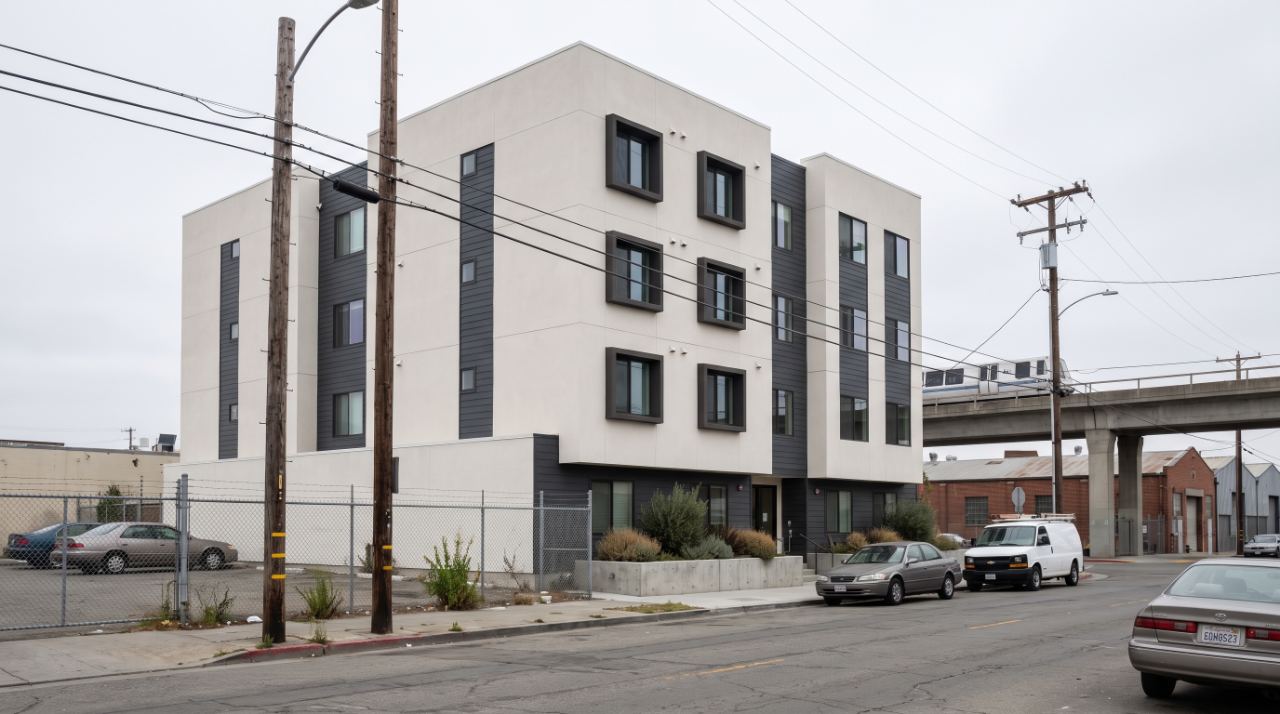
Six-story affordable apartment building near the Coliseum BART station in East Oakland on an overcast morning Photo: Houseberry
Five hundred percent. That is the top of the range California affordable housing providers reported to the Legislature, and it is now printed in the findings of a bill sitting on Governor Newsom's desk. SB 1388 was enrolled on August 31 and he has until September 30 to sign it or veto it.
Read the number slowly. The Legislature wrote that some providers face increases as high as 500 percent across property, liability and builder's risk coverage. Some. That is not a statewide average, and it is not your homeowner premium. Affordable housing insurance costs sit in a different market entirely, the policies on apartment buildings nonprofits build and operate, and when they move the damage shows up as homes that never get built.
Where the 500 percent number actually comes from
The figure is a legislative finding, not a rate filing. Section 1 of the enrolled text says affordable housing providers statewide confront limited availability of coverage and significant premium and deductible increases, with some facing price increases as high as 500 percent. Senator Durazo repeated it as up to 500 percent in her statement to the Assembly Housing Committee on July 1.
An independent check gets close. Enterprise Community Partners, in a February 2026 report on multifamily insurance, found California providers reported a 56 percent cost increase from 2020 to 2022 and increases between 50 and 500 percent in 2024, and that 29 percent of providers nationally saw premiums rise 25 percent or more in 2023.
So the ceiling is documented. The median is nowhere near it, and anyone quoting 500 percent as the statewide rate is reading it wrong. What the top of the range tells you is how wide the spread has gotten. Nobody underwrites a 55-year covenant against a line that might move 20 percent or 500.
What the bill does, and what Appropriations took out of it
SB 1388 creates a technical assistance program. That is the whole thing. Section 50899.15 of the Health and Safety Code would establish the Affordable Housing Risk Reduction Program at HCD, and Section 50899.16 tells the department to analyze risk, help providers put mitigation measures in place, and walk them into what the bill calls alternative risk financing entities, defined as captives, risk retention groups and joint powers authorities.
The version that cleared the Assembly Housing Committee in July was bigger. It let HCD make loans or grants to cover mitigation work and the upfront cost of joining one of those entities. The Assembly Appropriations suspense file results of August 13 record the amendment in one line: do pass as amended to delete the loan and grant process. What reached the Governor is a majority-vote measure with no appropriation.
| The piece | Status in the enrolled SB 1388 |
|---|---|
| Affordable Housing Risk Reduction Program at HCD | Created, Health and Safety Code Section 50899.15 |
| Risk analysis and help joining a captive, risk retention group or joint powers authority | Required, Section 50899.16 |
| Third-party consultants and broadly available training guides | Authorized, Section 50899.16 |
| Loans or grants for mitigation work and entry costs | Deleted in Assembly Appropriations, August 13, 2026 |
| Funding attached to the program | None. The bill carries no appropriation |
| Any cap, rate rule or subsidy on an insurance premium | Nothing. SB 1388 does not touch pricing |
Read the right-hand column twice. Helping twenty nonprofits pool into a joint powers authority is useful work. It will not move a single premium this fiscal year.
Insurance now eats a tenth of an affordable building's operating budget
The per-unit numbers are less dramatic than 500 percent and more useful. Novogradac's analysis of roughly 175,000 tax credit apartments put median property insurance at a record $697 per unit in 2023, a 22.2 percent jump in twelve months and 143.7 percent above 2016. Insurance took 10.1 percent of the $6,932 median operating expense, against 6.4 percent in 2016.
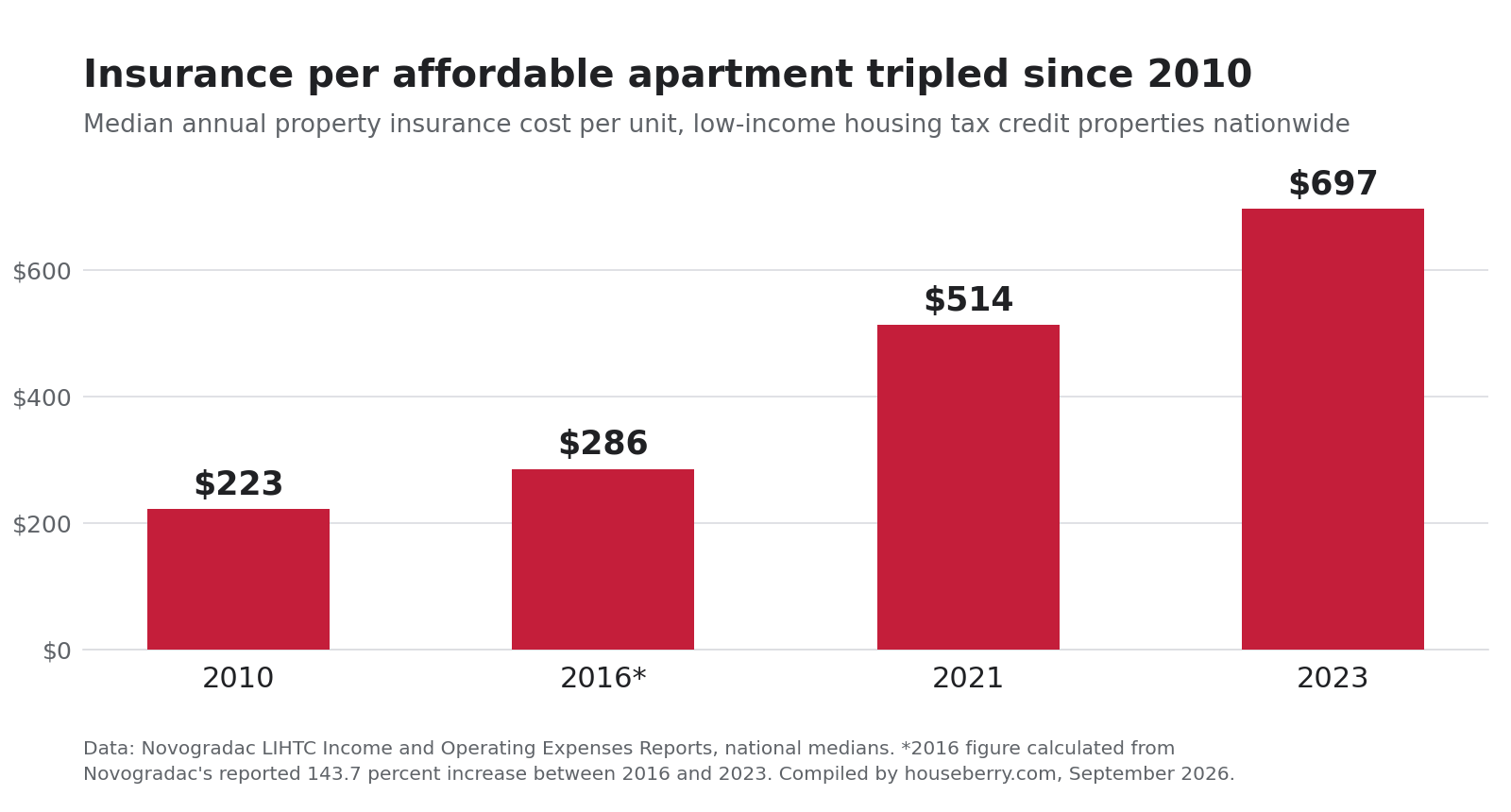
Here is the honest complication. In that same data the West posted the lowest regional median in the country at $522 per unit, below the Northeast at $1,000 and the South at $862. California is not the priciest place in America to insure an apartment building. It is one of the least predictable, and for a lender sizing a 30-year loan, volatility does more damage than a high but stable number.
Coliseum Place is the version of this you can walk to
Take a real building. Coliseum Place is 59 apartments at 7120 Hawley Street in East Oakland, a six-story project by Resources for Community Development and the John Stewart Company, finished in December 2021 and fully leased by July 2022, serving households earning 20 to 50 percent of area median income a short walk from the Coliseum BART station.
The neighborhood around it is Coliseum, the East Oakland district squeezed between International Boulevard and the rail lines, which scores 2.3 out of 5 overall on Houseberry and had a median sale price of about $393,900 in August 2026 against $974,200 citywide for Oakland in the same month. This is where new affordable homes actually get built.
Run the arithmetic. At the 2023 national median, 59 units carry roughly $41,000 of property insurance a year. Triple that and the building is down about $82,000 annually. Rents here are capped by regulation, so none of it passes through to tenants. It comes out of net operating income, which is what the permanent lender sizes the loan against. Every dollar of insurance is a dollar less of private debt the deal can carry.
The other side of the ledger is enormous. The Terner Center's January 2026 analysis of 691 California tax credit projects put average development cost at $660,514 per unit for 4 percent deals in 2024 dollars, and San Francisco's Budget and Legislative Analyst put the city's average at $954,127 per unit as of 2024, the figure behind our look at who qualifies for those homes. Against that, $82,000 sounds trivial. It is annual, and it hits the one line the capital stack cannot flex.
Why affordable housing insurance costs are not the FAIR Plan story
Different market, different fix. Our June piece on home insurance spreading past the hills was about residential policies and the FAIR Plan turning up in flatland ZIP codes. AB 1680, the Make It FAIR Act announced on February 2, 2026 by Commissioner Ricardo Lara and Assemblymember Lisa Calderon, would rebuild that residential side. It is one of the eleven housing bills we tracked to the same desk this month.
SB 1388 touches none of that. No rate rule, no FAIR Plan change, no help for a single homeowner. It aims at the commercial habitational market, where a nonprofit shops a portfolio policy, not a house.
What September 30 actually decides
Under the state constitution, a bill in the Governor's possession on or after September 1 becomes law unless he vetoes it by September 30. A signature costs almost nothing, which is why it is not the interesting part. The interesting part is whether the January budget puts a number next to a program the Legislature just voted to create without one.
Insurance is a strange place for the housing fight to end up. Nobody marches about deductibles. But a state that spends $660,000 a door and then loses deals over an operating line nobody models is not building its way out of anything.
For anyone comparing places to live, the read is smaller and more useful. The affordable pipeline near a BART station is part of what a neighborhood looks like in five years, and it now turns on an insurance market buyers never see. Studying the area before you fall for the address is the habit we built Houseberry around. September 30 is the next date on the calendar. The budget line in January is the one that decides anything.
Sources
- California Legislature, SB 1388 (Durazo), Affordable Housing Risk Reduction Program, enrolled text https://leginfo.legislature.ca.gov/faces/billTextClient.xhtml?bill_id=202520260SB1388
- Assembly Committee on Housing and Community Development, agenda and bill analyses, July 1, 2026 https://ahcd.assembly.ca.gov/system/files/2026-06/agenda-and-bill-analyses-for-7.1.26.pdf
- Assembly Appropriations Committee, suspense file results, August 13, 2026 https://apro.assembly.ca.gov/system/files/2026-08/unofficial-suspense-results-08.13.2026.pdf
- Enterprise Community Partners, Curbing the Insurance Spiral, February 2026 https://enterprisecommunity.org/sites/default/files/2026-02/Curbing-the-Insurance-Spiral.pdf
- Novogradac, Property Insurance Sees Another Big Increase in 2023 LIHTC Data, January 2025 https://www.novoco.com/notes-from-novogradac/property-insurance-sees-another-big-increase-in-2023-novogradac-lihtc-data
- Terner Center for Housing Innovation, impact fees and LIHTC development costs, January 2026 https://ternercenter.berkeley.edu/wp-content/uploads/2026/01/LIHTCImpactFees2026.pdf
- San Francisco Budget and Legislative Analyst, Financing Affordable Housing, June 5, 2026 https://media.api.sf.gov/documents/BLA_Financing_Affordable_Housing_060526.pdf
- Resources for Community Development, Coliseum Place https://rcdhousing.org/coliseum-place/
- California Department of Insurance, Make It FAIR Act announcement, February 2, 2026 https://www.insurance.ca.gov/0400-news/0100-press-releases/2026/release005-2026.cfm
- Houseberry neighborhood and city data for Coliseum and Oakland, accessed September 2026 https://www.houseberry.com/City/Oakland-CA/
All information provided on this website including but not limited to - school ratings, safety, amenities, user opinions, and property data - is for general informational purposes only. We do not guarantee its reliability, accuracy, or completeness. Users should independently verify information and consult appropriate professionals as needed. By using this website, you agree Houseberry is not responsible for actions, decisions, or consequences arising from reliance on the information provided
houseberry.com - CA DRE# 01847391
 Bay East ©2025. CCAR ©2025. bridgeMLS ©2025. Information Deemed Reliable But Not Guaranteed. This information is being provided by the Bay East MLS, or CCAR MLS, or bridgeMLS. The listings presented here may or may not be listed by the Broker/Agent operating this website. This information is intended for the personal use of consumers and may not be used for any purpose other than to identify prospective properties consumers may be interested in purchasing. Data last updated at September 13, 2026 12:00 AM