Palo Alto's School Budget Crisis and What It Does to Home Values
Palo Alto Unified is planning about $33 million in cuts after Measure B failed. Here is what a district budget fight actually does to school scores and Palo Alto home values, and how long it takes to show up.
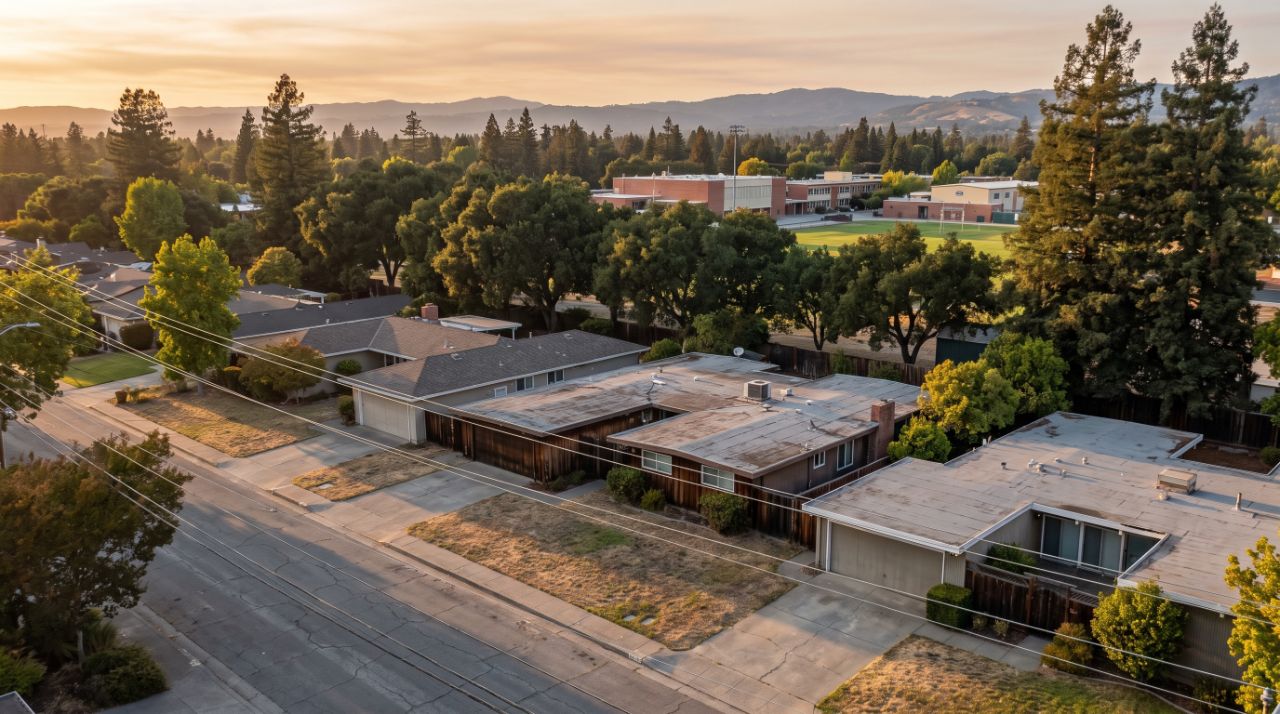
Elevated golden-hour view over single-story Palo Alto homes toward the Palo Alto High School campus and its playing fields. Photo: Houseberry
If Palo Alto Unified has to cut $33 million, do the schools get worse, and does the house I just bid $4 million on lose value? I have been asked some version of that four times in the past two weeks. The honest answer is no, not on the timeline people are worried about. The school scores buyers actually shop on are built from state testing data, and the first results that could reflect a cut made this year will not publish until roughly October 2028.
What does change sooner is smaller, more specific, and worth knowing before an offer goes in.
Two decisions, fourteen days apart, made this whole thing
The shortfall is not one event. It is a tax that failed and a contract that passed, and they happened inside of two weeks.
On June 2, voters rejected Measure B. Per the county's notice of election, it would have charged $800 per parcel for four years and raised roughly $15 million a year, replacing the current tax of $904.92 that the district's own renewal page says expires in 2027. It got 62.4 percent. It needed 66.7. Palo Alto was not alone: EdSource counted seven of fifteen California school parcel taxes failing in June 2026, a 53 percent pass rate and 12 points below the average since 2002.
On June 16, the board approved retroactive labor contracts: a 5 percent raise for 2025-26, 5.4 percent for this year, and two $5,000 bonuses. Cost, with benefits, about $35.4 million. The budget the board had just adopted was $369 million and did not include any of it.
By the August 18 board meeting the arithmetic had caught up. Palo Alto Online reported total projected spending at $404.6 million against $357.4 million of revenue. Chief Business Officer Charen Yu put it plainly: "The district is running a structural deficit and it's not one that improves on its own."
Former board members Todd Collins and Ken Dauber, who campaigned against Measure B, called the result self-inflicted in a September 12 guest opinion. That is opinion, and they are not neutral. But their arithmetic checks against the district's own numbers: $15 million is about 3.7 percent of projected spending, and a $47 million gap is about 13 percent of revenue. The parcel tax was never the whole answer.
Is this a hole that closes, or one that stays open
It stays open, by the district's own account. The gap is in salaries and daily operations, which recur every year, and reserves are a bridge rather than a fix.
The projected ending fund balance falls from $84.6 million to $37.4 million this year. Set that against $404.6 million of spending and you get roughly 9 percent, which is my math, not the district's. Staff have said reserves would drop under the state's 3 percent floor by 2029-30 without a parcel tax and with salaries on their current path. Once a district forecasts that, the Santa Clara County Office of Education requires a sustainable plan.
The Palo Alto Unified budget picture, as of the August 18, 2026 board meeting
| Line item | Figure | What it means |
|---|---|---|
| Adopted 2026-27 budget (June 16, 2026) | $369.0M | Approved before the new labor contracts were priced in |
| Revised 2026-27 spending (Aug. 18, 2026) | $404.6M | Includes about $35.4M of raises and bonuses with benefits |
| Projected 2026-27 revenue | $357.4M | About $35,300 per student across 10,124 students |
| Operating gap this year | About $47.2M | Roughly 13 percent of revenue |
| Ending fund balance | $84.6M to $37.4M | One year of drawdown, about 9 percent of spending |
| Reserve level today | 22.3% | State minimum is 3 percent |
| What Measure B would have raised | About $15M a year | About 3.7 percent of projected spending |
| Cuts the district is planning | About $33M | Over the next few years, per the Aug. 18 forecast |
The number people keep asking me about is the Cubberley money, so let us close that door. The board approved a $65.5 million facilities spending plan in August, contingent on city voters passing Measure J in November. Yu was direct about it at that meeting: "District money is held in legally separate accounts and they are not interchangeable." That money can buy roofs and HVAC. It cannot pay a counselor.
The calendar that actually decides this
Nothing about this school year changes. The $904.92 parcel tax is still being collected and runs through June 30, 2027.
If it is never replaced, the practical effect on a Palo Alto homeowner is that the tax bill falls by about $905 a year starting in 2027-28. On a $4.08 million median that is about two hundredths of one percent of the purchase price. Nobody is buying or selling a house in this city over $905.
The dates worth writing down are the district's first interim report in December and its second in March, which are the checkpoints where the county either accepts the plan or does not. Somewhere in there the board decides whether to go back to the ballot, and at what number. A phased-down tax is on the table. So is a flat one.
Why Palo Alto home prices are upstream of the school budget
Here is the part that surprises people. Palo Alto Unified is a basic aid district, which means it keeps its local property tax revenue instead of being funded by the state's per-student formula. Its budget rises and falls with assessed value in Palo Alto, not with enrollment.
The district booked 4.71 percent property tax growth in 2025-26 and is now assuming a more cautious 3.5 percent going forward. That assumption is doing enormous work in the multi-year projection, and it is essentially a forecast about the local housing market.
So the arrow points the direction most buyers assume it does not. Strong Palo Alto home values fund the schools. Under Proposition 13 a parcel is reassessed when it sells, so every transfer at today's citywide median of about $4.08 million resets a property that may have been carrying a 1990s assessment. That is also why enrollment decline hits Palo Alto differently than it hits districts funded by the state formula, where fewer students means less money. We went through that math for Marin's districts, which lost 3,996 students since 2019, and the mechanics there are not the mechanics here.
What a budget fight does to a school score, and how long it takes
Almost nothing, for at least two years. That is not optimism, it is just how the measurement works.
Our school scores are built from California's state testing data, not from district reputation, spending per student, or how a board meeting went. We laid out that method in August, along with what the premium looks like across the region. The relevant part here is the timing.
The California Department of Education publishes statewide assessment results on October 15. The scores landing next month come from tests students took last spring, months before any of this was decided. Cuts negotiated this winter change staffing in fall 2027. Those classrooms get tested in spring 2028. Those results publish around October 2028. Two full cycles.
What moves faster does not live in a test score at all. It is which special education aides, counselors, and low-enrollment advanced courses survive a reduction list. Collins and Dauber argue those go first, and on historical layoff patterns that is a fair worry. It is also a services question, not a scores question, and it is the one a parent should actually be asking at a board meeting.
The slower risk is who teaches here. Salaries triggered this deficit, and a district that stops paying competitively against Bay Area housing costs eventually has a staffing problem. Staffing does reach the scores. Just not by 2028.
What the Palo Alto premium buys in August 2026 dollars
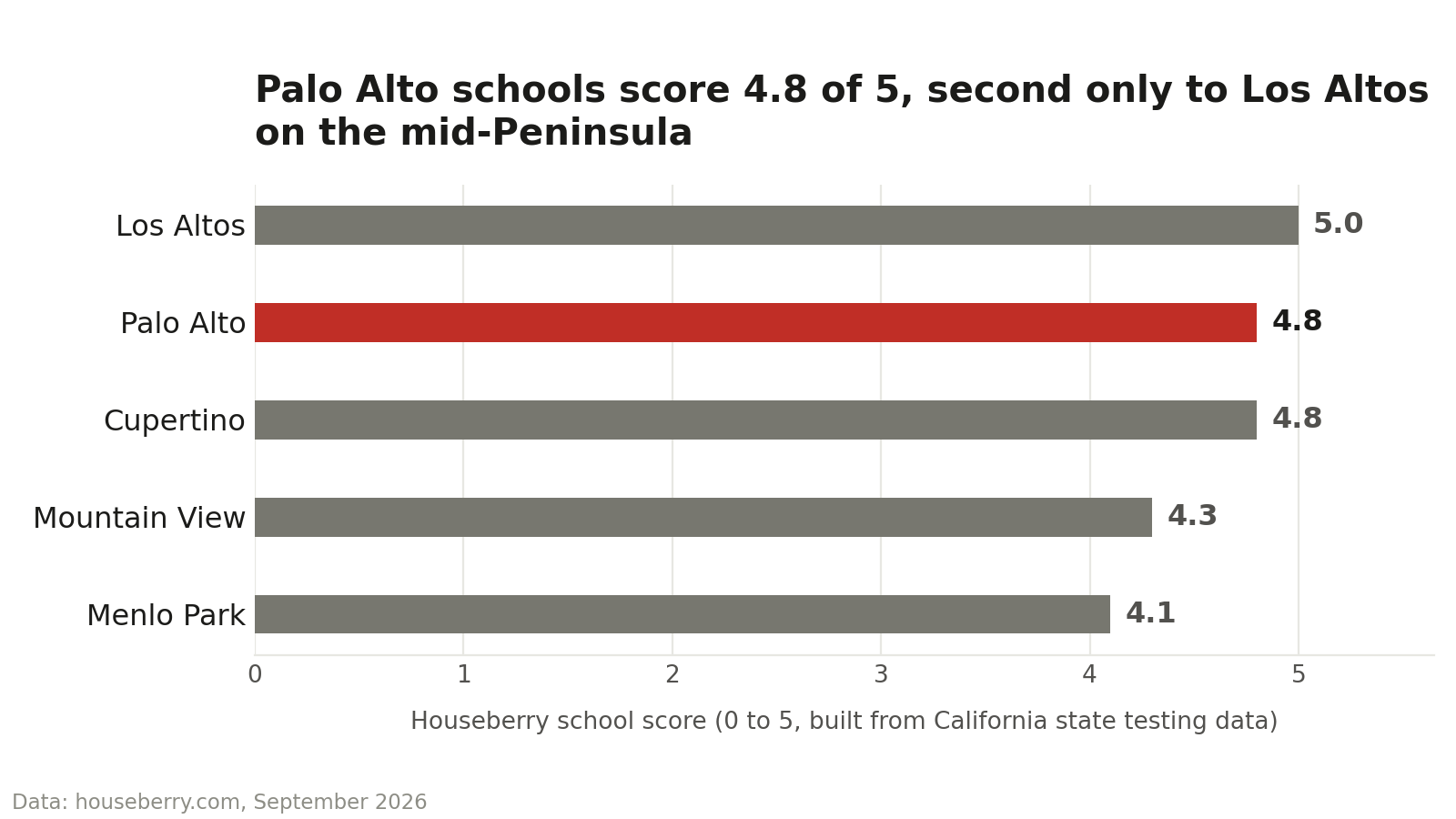
Cupertino matches Palo Alto's school score for roughly $800,000 less. If schools are genuinely the reason someone is shopping Palo Alto, that comparison deserves a real look before the offer goes in.
Palo Alto's median was about $4.08 million in August 2026 with a 4.8 school score. Los Altos was about $4.86 million in July with a 5.0. Cupertino was about $3.26 million in August, also 4.8. Mountain View was about $2.92 million in July at 4.3, and Menlo Park about $3.13 million in June at 4.1. Score for score, Palo Alto is not the cheapest way to buy a 4.8.
Inside the city the spread is narrower than the price spread suggests. Eight of Palo Alto's 27 neighborhoods score a full 5.0 for schools, including Greenmeadow, the Eichler tract off East Charleston Road, which also carries a 5.0 for safety and a median around $4.26 million in August 2026. The lowest school score in the city is 4.6. There is no bad school draw in Palo Alto, which is exactly why the budget story is less of a neighborhood-selection story than it first appears.
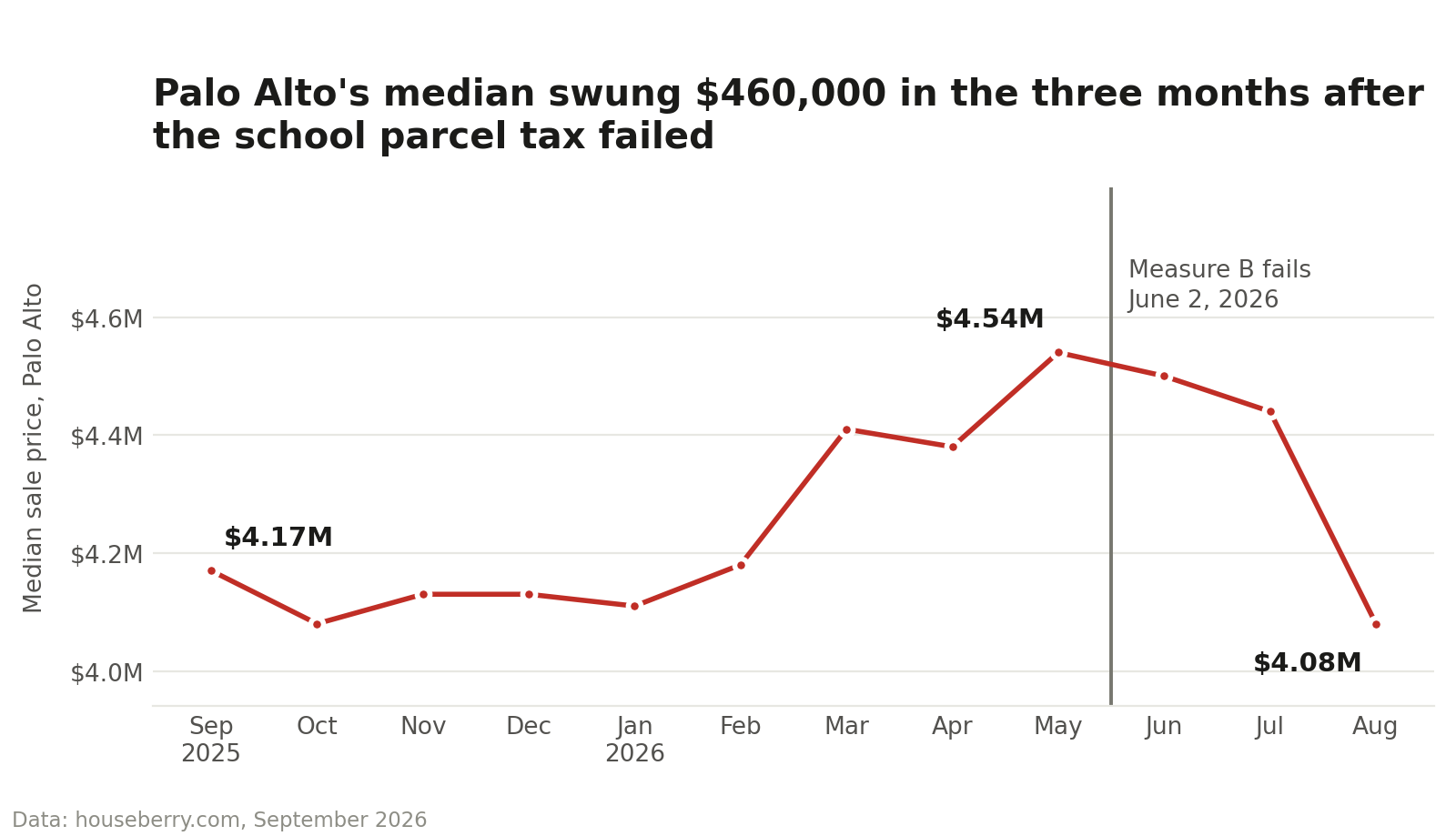
And here is the honest caveat on that chart. Palo Alto closes a small number of very expensive houses each month, so the median jumps around on mix alone. A $460,000 move looks dramatic and usually means three big sales closed in May and did not in August. Do not read policy into a single month of it, in either direction.
What I would watch this fall if I were bidding here
Three things, in order of how much they should change a decision.
The cut list matters most, because it will name specific programs and specific school sites, and that is the only version of this story that can actually differ between one Palo Alto address and another. Superintendent Jason Glass has said those conversations are coming and that they will be uncomfortable. Watch what survives at the elementary sites nearest the house.
Second, the December interim report, which tells you whether the county is satisfied. Third, whether a tax goes back on the ballot and at what number, because a $600 phase-down measure and a $900 flat renewal are different bets on the same electorate that just said no at 62 percent.
None of that is a reason to avoid Palo Alto, and school budget stories get catastrophized fast. This is still one of the best-funded districts in California at roughly $35,300 per student, with a tax base that grows on its own. The way we look at it when we compare neighborhoods, a budget fight is a reason to read the reduction list closely, not a reason to move the school score in your head. That score will not move until October 2028 at the earliest.
Sources
Palo Alto Unified School District, Parcel Tax Renewal 2026
Palo Alto Unified School District, Budget and Fiscal Facts
Santa Clara County Registrar of Voters, Notice of Election, PAUSD parcel tax measure, June 2, 2026
Santa Clara County Registrar of Voters, List of Local Measures, June 2026
Palo Alto Online, "Palo Alto school district braces for budget crunch," Aug. 20, 2026
Palo Alto Online, "School district backs spending plan for sale of Cubberley land," Aug. 26, 2026
Palo Alto Online, Guest Opinion by Todd Collins and Ken Dauber, Sept. 12, 2026
EdSource, "Are California voters signaling tax fatigue toward school bonds and parcel taxes?"
EdSource, "Inequalities grow unchecked in some wealthy counties despite funding formula reforms"
California Department of Education, Aligned Dashboard and Assessment Data Release
Ed-Data, Palo Alto Unified district profile (2025-26 enrollment)
Houseberry, Palo Alto city data and neighborhood rankings, September 2026
Map of Palo Alto Neighborhoods
Loading map...
View Full Map
Top Neighborhoods in Palo Alto, CA





All information provided on this website including but not limited to - school ratings, safety, amenities, user opinions, and property data - is for general informational purposes only. We do not guarantee its reliability, accuracy, or completeness. Users should independently verify information and consult appropriate professionals as needed. By using this website, you agree Houseberry is not responsible for actions, decisions, or consequences arising from reliance on the information provided
houseberry.com - CA DRE# 01847391
 Bay East ©2025. CCAR ©2025. bridgeMLS ©2025. Information Deemed Reliable But Not Guaranteed. This information is being provided by the Bay East MLS, or CCAR MLS, or bridgeMLS. The listings presented here may or may not be listed by the Broker/Agent operating this website. This information is intended for the personal use of consumers and may not be used for any purpose other than to identify prospective properties consumers may be interested in purchasing. Data last updated at September 13, 2026 12:00 AM