San Mateo school bonds V and W hit recent buyers hardest
Measure W charges a flat $29 per $100,000, but Prop 13 means a 2026 buyer pays several times what a longtime neighbor does. We priced both bonds for San Mateo and Foster City homes.

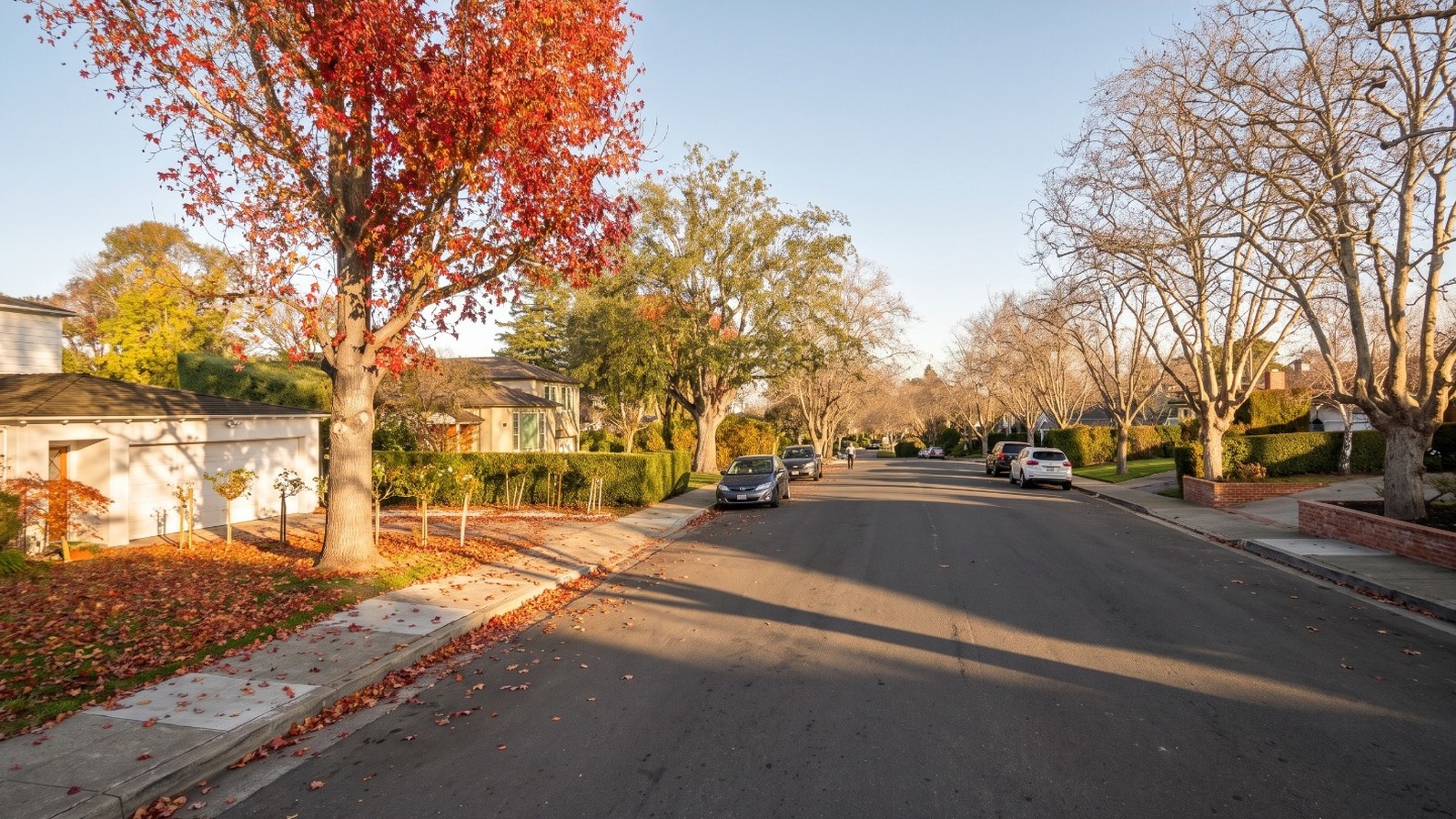
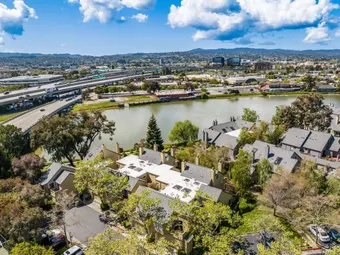
AI-rendered golden-hour view of Parrott Drive in San Mateo's Baywood neighborhood, single-family homes under autumn street trees Photo: Houseberry
Two houses on the same Baywood block can carry very different school bond bills. Measure W, the San Mateo-Foster City School District's $498 million bond on the Nov. 3 ballot, charges $29 for every $100,000 of assessed value. On a home bought this year at San Mateo's typical price of about $2.01 million in September 2026, according to Houseberry data, that is roughly $583 a year. The neighbor who bought in the 1990s may pay a fraction of it.
That gap is the real story of both school measures on San Mateo ballots this fall. The tax is a flat rate. The bill is not, because Prop 13 sets your assessed value at what you paid, then lets it rise no more than 2 percent a year. Below we price out Measure W and the countywide college bond, Measure V, for the homes people are actually buying now.
What Measure W pays for
The district has listed more than $1 billion in repairs across 22 sites and calls $524 million of it immediate, Hoodline reported. Two items stand out. About $84 million would replace or rebuild windowless classrooms. Roughly a fifth of the bond would build about 80 homes for teachers and staff on the old Knolls Elementary campus near 42nd Avenue and Alameda de las Pulgas.
The housing piece has a reason behind it. In a district survey, 96 percent of 608 employees said housing costs were a major problem for hiring and keeping staff, and about 100 employees have left each year on average since 2016.
W stacks on top of two bonds residents already pay. Measure X from 2015 runs $14.80 per $100,000, and Measure T from 2020 runs $30. A district poll briefed to the board on Aug. 28 put support near 57 percent, a thin margin over the 55 percent bar.
Measure V keeps a rate that would otherwise fall
Measure V covers all of San Mateo County. The ballot question opens with "without increasing current tax rates," and that is accurate as far as it goes. The district's own fiscal estimate, printed in the League of Women Voters summary of the measure, puts the highest levy at about $18 per $100,000, or about $75 million a year, with roughly $1.35 billion repaid in all.
What a yes vote does is extend. Older college bonds are being paid down, and without V the college line on your bill would shrink. Opponents led by the Silicon Valley Taxpayers Association make exactly that point: a flat rate held for more years is more total tax. This is the district's fifth bond request since 2001.
A note on the conflicting figures. The Almanac reported $10.50 per $100,000, while the Daily Journal, the Mercury News and the ballot summary use $18. We use $18 because it is the district's stated best estimate of the highest annual rate. Read the $10.50 as a possible early-year rate, not a promise.
What a buyer pays, neighborhood by neighborhood
For anyone who bought in 2026, assessed value sits close to the purchase price. So Houseberry's typical prices are a fair stand-in for a new owner's bill.
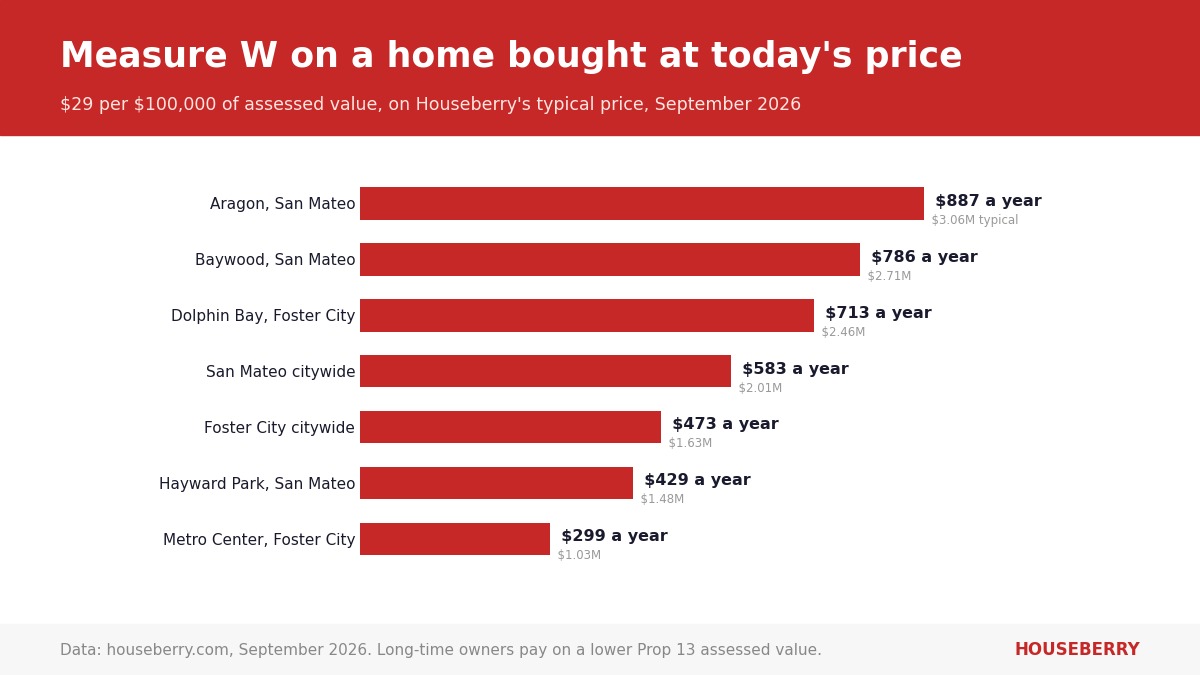
In Aragon, where Houseberry's typical price was $3.06 million in September 2026, W alone comes to about $887 a year. In Foster City's Metro Center, at $1.03 million, it is about $299. Same district, same classrooms, a 3-to-1 spread driven entirely by price.
The longtime owner is the other half of the picture. Here is what each measure adds at four assessed values, from a 2026 purchase to one held since the 1990s.
| Assessed value | Measure W ($29) | Measure V ($18) | All three district bonds after W ($73.80) |
|---|---|---|---|
| $2,010,000 (bought 2026 at San Mateo's typical price) | $583 | $362 | $1,483 |
| $1,630,000 (bought 2026 at Foster City's typical price) | $473 | $293 | $1,203 |
| $1,000,000 | $290 | $180 | $738 |
| $400,000 (a long-held home) | $116 | $72 | $295 |
The Foster City row uses Houseberry's Foster City typical price of $1.63 million. The $400,000 row is the kind of assessed value a family that bought in the 1990s still carries.
Our read: on the tax side, W is mostly a bill on people who bought recently. A household that closed in Baywood this spring would pay several times what the family across the street pays for the same new classrooms. That is how Prop 13 works on every local bond, and it is the number most voters never see.
For scale, the county's 2026-27 assessment roll hit $357.6 billion across 223,003 secured parcels, the Assessor reported in July. That averages about $1.6 million a parcel, commercial land included, or roughly $288 a year for Measure V.
To check your own number, open your secured tax bill. It lists each voter-approved bond by name. Find your assessed value on it, divide by 100,000 and multiply by the rate. Homes on the edges of the district, in parts of Belmont, Hillsborough or the unincorporated Highlands, should confirm which elementary district appears on the bill before doing the math.
The vote is a high bar either way. Contra Costa's $920 million college bond drew 50.5 percent in June and failed. If you are weighing a San Mateo purchase alongside these bills, compare all 23 ranked San Mateo neighborhoods on price, schools and safety, or read our wider Bay Area November ballot guide.
Sources
- Hoodline on Measure W, Oct. 23, 2026
- Hoodline on Measure V, Oct. 2026
- League of Women Voters summary of Measure V
- San Mateo County Assessor, 2026-27 assessment roll
- Houseberry typical home prices and scores, September 2026
The Houseberry Research Team is Houseberry's reporting team: Bay Area real estate analysts, data specialists and longtime local market watchers. Every day we check the public record: building permits, city council and planning agendas, county recorder filings, state housing bills, police incident data and school results. Then we tie each story to what it means for specific neighborhoods, using Houseberry's own neighborhood data on prices, appreciation, safety, schools and amenities. Questions or corrections: Contact us.
Map of San Mateo Neighborhoods
Loading map...
View Full Map
Top Neighborhoods in San Mateo, CA



All information provided on this website including but not limited to - school ratings, safety, amenities, user opinions, and property data - is for general informational purposes only. We do not guarantee its reliability, accuracy, or completeness. Users should independently verify information and consult appropriate professionals as needed. By using this website, you agree Houseberry is not responsible for actions, decisions, or consequences arising from reliance on the information provided
houseberry.com - CA DRE# 01847391
 Bay East ©2025. CCAR ©2025. bridgeMLS ©2025. Information Deemed Reliable But Not Guaranteed. This information is being provided by the Bay East MLS, or CCAR MLS, or bridgeMLS. The listings presented here may or may not be listed by the Broker/Agent operating this website. This information is intended for the personal use of consumers and may not be used for any purpose other than to identify prospective properties consumers may be interested in purchasing. Data last updated at October 27, 2026 12:00 AM