Bay Area Voters Face 25 Housing Measures on November 3
A county by county guide to every housing-related measure on the November 3, 2026 ballot in the Bay Area, from Props 1, 37, 43 and 45 to local rent, zoning and transfer tax votes, with what a yes vote does in each place.


Vote by mail ballot envelope and pen on a kitchen table with Bay Area row houses outside the window Photo: Houseberry
Bay Area voters will decide 25 housing-related measures on November 3, by our count. Four are statewide propositions. The other 21 are local, spread across seven of the region’s nine counties, from rent caps in Berkeley to a 40-home farmworker project in Half Moon Bay.
No single ballot carries all of them. A San Francisco voter will see seven of the Bay Area housing measures on the November 2026 ballot. A voter in Albany or Half Moon Bay will see six. A voter in Santa Rosa or Napa will see only the four statewide ones.
We counted a measure if it changes where or how homes can be built, sets rent rules, decides a specific housing project, funds housing, or changes the transfer tax charged when property sells. School bonds and service parcel taxes are not in this count. This guide describes each measure. It does not recommend a vote. Official arguments for and against each local measure, where any were filed, appear in your county’s voter information guide.
Every Bay Area housing measure on the November 2026 ballot
The table runs statewide first, then by county. The last column names who a yes vote would touch most directly.
| Measure | Where on the ballot | What a yes vote does | Who it most affects in the Bay Area |
|---|---|---|---|
| Prop 1 | Statewide | Authorizes $11.25 billion in bonds for affordable rental housing, homeownership help and veterans’ home loans | Renters and buyers who qualify for income-restricted homes, and affordable housing developers |
| Prop 37 | Statewide | Creates a state second mortgage of up to 17 percent of the price of a newly built home | Middle-income buyers of new construction under the price cap |
| Prop 43 | Statewide | Requires two-thirds approval for voter-proposed local special taxes starting January 1, 2027 | Future citizen-led parcel, transfer and sales tax measures, including ones for housing |
| Prop 45 | Statewide | Sets deadlines for environmental review and narrows CEQA lawsuits for housing and other essential projects | Housing projects that still go through full CEQA review |
| Prop C | San Francisco | Raises city contributions to the Housing Trust Fund to $125 million a year and extends it to 2058 | Affordable housing applicants and down payment assistance users |
| Prop I | San Francisco | Directs half of transfer tax revenue from sales over $10 million to a House SF Fund | Affordable housing programs, and other city services that share the general fund |
| Prop J | San Francisco | Ends the transfer tax exemption for foreclosures on commercial and 5+ unit buildings | Lenders that foreclose on larger properties |
| Measure O | Albany | Lets the council change R-1 zoning through standard hearings instead of a neighborhood vote | Owners and buyers in Albany’s single-family zones |
| Measure S | Albany | Replaces the flat $15 per $1,000 transfer tax with tiers from $10 to $30 | Anyone selling or buying property in Albany |
| Measure X | Berkeley | Caps yearly rent increases on covered units at 10 percent and amends the rent ordinance | Berkeley tenants and landlords |
| Measure FF | Oakland | Ends the transfer tax exemption for foreclosure transfers, with some exceptions | Foreclosing lenders on Oakland property |
| Measure GG | Piedmont | Raises the transfer tax from 1.3 to 1.75 percent of the price | Anyone selling or buying in Piedmont |
| Measure S | San Pablo | Caps rent increases at 3 percent or 60 percent of CPI, whichever is lower, with just cause rules | San Pablo tenants and rental owners |
| Measure U | Walnut Creek | Rezones a 2.4-acre office corner by BART for roughly 225 to 280 homes for residents 55 and older | Downtown Walnut Creek neighbors and older adults seeking housing |
| Measure E | Redwood City | Caps rent increases on older rentals at 5 percent or 60 percent of CPI, whichever is lower | Redwood City tenants and owners of older rentals |
| Measure P | Menlo Park | Requires a citywide vote for changes to downtown parking plazas | Downtown Menlo Park and planned affordable housing on city lots |
| Measure N | Portola Valley | Makes Portola Valley a charter town with a $10 per $1,000 transfer tax | Anyone selling or buying in Portola Valley |
| Measure S | San Bruno | Repeals a 1977 ordinance capping heights at three stories and 50 feet without a vote | Property owners and future projects in San Bruno |
| Measure I | Half Moon Bay | Updates the Downtown Area map used by the city’s Measure D growth limits | Owners near downtown Half Moon Bay |
| Measure Q | Half Moon Bay | Approves the 555 Kelly lease for 40 apartments for farmworkers 55 and older | Older farmworkers and Kelly Avenue neighbors |
| Measure D | Los Altos | Requires a vote to sell, lease or alter the ten downtown parking plazas, except housing on Plazas 7 and 8 | Downtown Los Altos and the city’s housing plan |
| Measure L | Cupertino | Requires two-thirds voter approval to rezone parks or open space for development | Cupertino park land and nearby owners |
| Measure W | San Rafael | Raises the city transfer tax from 0.2 to 1 percent | Anyone selling or buying in San Rafael |
| Measure X | Sausalito | Raises height and density limits in waterfront I and W zones and ends voter approval for most zoning changes outside downtown | Marinship property owners and Sausalito residents |
| Measure Z | Benicia | Creates a city transfer tax, paired with Measure Y’s charter change | Anyone selling property in Benicia |
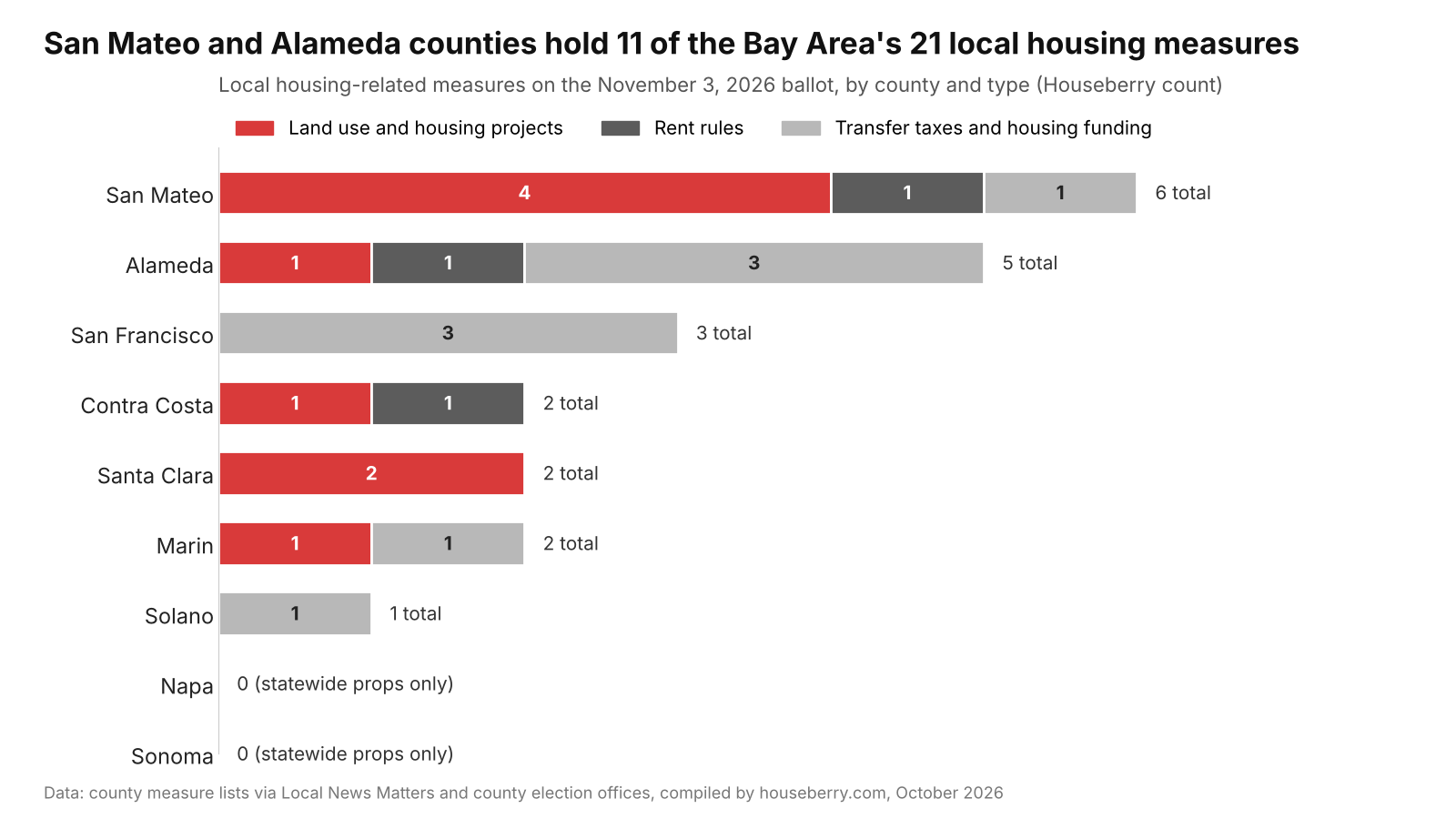
Counted by county, San Mateo and Alameda together hold 11 of the 21 local measures, and San Francisco’s three are all about housing money.
The four statewide propositions that touch housing
Every Bay Area voter sees these four. Positions for and against come from the official arguments in the Secretary of State’s voter guide unless noted, and the mechanics come from the Legislative Analyst’s Office.
Prop 1: an $11.25 billion housing bond
Prop 1 authorizes $10 billion in general obligation bonds for affordable housing programs plus $1.25 billion for CalVet home loans. The LAO puts $7.2 billion toward rental housing and $1.1 billion toward homeownership help, with repayment costing the state $500 million to $600 million a year for about 25 years. Our earlier look at the housing bond covers how the money is divided.
Supporters, including US Vets and Habitat for Humanity California, argue it builds homes for veterans, seniors and essential workers with public oversight and no new taxes. No official argument against was submitted, and CalMatters reports some Republican lawmakers questioned whether bonds address high construction costs.
Prop 37: a second mortgage on newly built homes
Prop 37 lets the California Housing Finance Agency sell up to $25 billion in revenue bonds and lend buyers up to 17 percent of a home’s price. The LAO analysis says the buyer must be the first purchaser of a newly built home, put at least 3 percent down, and earn no more than double the typical income in their area. The official summary puts the price cap at about $1.5 million, and the LAO finds no direct state cost.
For a Bay Area buyer, eligibility turns on the price of new construction nearby and the area income limit. Supporters, including State Treasurer Fiona Ma, argue it offers low-interest mortgages funded by private investors at zero taxpayer cost. No official argument against was submitted.
Prop 43: two-thirds for voter-proposed local special taxes
Since a 2017 California Supreme Court ruling, local special taxes placed on the ballot by voter petition have needed only a majority, while the same taxes placed by a city council need two-thirds. Starting January 1, 2027, Prop 43 would require two-thirds for new, increased or extended special taxes proposed by voters, according to the LAO.
In the Bay Area, the rule would apply to future citizen-led parcel taxes, transfer taxes and sales taxes, including any dedicated to housing. A July transit advocacy analysis lists Alameda County’s 2025 Measure B, Sonoma County’s 2024 Measure H and Santa Clara County’s June 2026 Measure D as voter-proposed taxes that passed by majority and would have fallen short of two-thirds.
Supporters, including the Howard Jarvis Taxpayers Association and the California Taxpayers Association, argue it restores Proposition 13’s two-thirds requirement for earmarked taxes. Opponents, including California Professional Firefighters and the California Federation of Teachers, argue it lets 33.4 percent of voters block what nearly 67 percent want for services such as fire protection, schools and affordable housing.
Prop 45: deadlines for environmental review
Prop 45 amends the California Environmental Quality Act for projects it defines as essential, including housing. The LAO says it sets a 365-business-day deadline to finish an environmental impact report, judges a project against the rules in place when the application was filed, and lets courts halt only the problem part of a project rather than all of it.
Many Bay Area infill projects already skip CEQA review under AB 130, the 2025 law in our Menlo Park 800 Oak Grove story, so Prop 45’s timelines would matter for housing that still goes through review. Supporters, including the California Council for Affordable Housing, argue it cuts delays that raise housing and infrastructure costs while keeping environmental protections. Opponents, including California Environmental Voters, argue it weakens environmental safeguards and will not lower costs for consumers.
Props 40 and 42 are not counted. The LAO says Prop 40’s billionaire tax generally excludes real estate, and Prop 42 covers property other than real estate.
Rent rules: Berkeley, San Pablo and Redwood City
Three cities vote on rent limits, each with a different ceiling. Rent rules follow the unit, so Berkeley’s would reach covered rentals in all 18 neighborhoods on our Berkeley rankings.
Berkeley Measure X would bar raising rent on covered units by more than 10 percent in one year, limit exemptions to units that were exempt when the current tenancy began, and lower the threshold for forming a tenant association from 10 units to 5, according to the city attorney’s impartial analysis.
San Pablo Measure S, a citizen petition, would cap increases at 3 percent or 60 percent of CPI, whichever is lower, add just cause eviction rules, and fund a rent board through owner fees estimated at $1.08 million to $2.36 million a year, per the county’s measure page. Supporters argue it stabilizes communities and still allows owners a fair return. Opponents argue it creates a costly bureaucracy, builds no housing and burdens small housing providers.
Redwood City Measure E, a voter initiative, would cap increases on older rental properties at 5 percent or 60 percent of CPI, whichever is lower, and add protections for tenants 62 and older. ABC7 reports a city estimate of about $11 million a year to run it. Supporters, including Councilmember Chris Sturken, argue it gives relief to tenants facing 8 to 10 percent yearly increases. Opponents, including Mayor Elmer Martínez Saballos, argue it could undermine existing tenant protections and affordable housing projects.
Where homes can go: nine land use votes
Two of these are projects with addresses. Seven change who decides zoning.
Walnut Creek Measure U would rezone the 2.4-acre office corner at North California Boulevard and Ygnacio Valley Road, across from BART, for roughly 225 to 280 homes for residents 55 and older. Downtown Walnut Creek scores 3.3 out of 5 overall on our Walnut Creek rankings, and our Measure U explainer has the site details.
Half Moon Bay Measure Q is a referendum on the city’s lease with Mercy Housing for 40 income-restricted apartments for agricultural workers 55 and older at 555 Kelly Avenue. A yes vote approves the lease, and a no vote rejects it and bars the council from re-adopting it for a year, according to the city’s Measure Q page. The same ballot carries Measure I, which would update the 1998 Downtown Area map that the city’s Measure D growth limits rely on.
Menlo Park Measure P and Los Altos Measure D both require a citywide vote before downtown parking lots change. Los Altos’s Measure D page says the ten plazas are credited with 124 homes in the city’s housing plan, the measure exempts affordable housing on Plazas 7 and 8, and the state housing department has said the city must amend its housing element if it passes.
Cupertino Measure L would require two-thirds voter approval to rezone parks or open space for residential, commercial or industrial use. San Bruno Measure S would repeal a 1977 ordinance that caps buildings at three stories and 50 feet unless voters approve more. Albany Measure O would let the council change single-family zoning through standard public hearings instead of the neighborhood vote that a 1978 measure requires, per the city’s measure page.
Sausalito Measure X, an initiative, would raise height limits from 32 to 47 feet in the waterfront industrial zone, repeal the Marinship Specific Plan, and let the council change zoning outside the Downtown Historic District without a further public vote, according to the county’s impartial analysis.
Transfer taxes and housing money
Nine measures change what is collected when property sells or where housing dollars go.
San Francisco Prop C would raise yearly contributions to the Housing Trust Fund from about $52 million to $125 million, phased in starting in 2029, and extend the fund to 2058. SF Public Press reports that supporters, including Mayor Daniel Lurie and the full Board of Supervisors, describe it as steadier long-term funding, and the San Francisco Republican Party, the registered opponent, argues the fund spreads resources too thinly. Prop I, a citizen initiative, would send half of the transfer tax revenue from sales over $10 million to a new House SF Fund. Prop J would end the foreclosure exemption for commercial and 5+ unit buildings starting in 2027. Per the League of Women Voters of San Francisco, Prop I supporters say it funds housing without a tax increase and opponents say it reduces flexibility to pay for first responders and parks. Prop J supporters estimate $100 million to $150 million a year, and opponents say no other major California city taxes foreclosures this way.
Oakland Measure FF takes the same approach to foreclosure transfers. The city projects $4 million to $13 million a year, which we broke down in our Oakland foreclosure transfer tax explainer.
Four cities would change the rate on ordinary sales, shown here at each city’s median sale price from Houseberry data.
- San Rafael Measure W: 0.2 to 1 percent. On the San Rafael median of about $1.31 million in September 2026, the city tax goes from $2,620 to $13,100.
- Portola Valley Measure N: a new $10 per $1,000 tax, about $44,300 on the July 2026 median of $4.43 million.
- Albany Measure S: a flat $15 per $1,000 becomes tiers of $10 to $30 per $1,000 based on purchase price. On the August 2026 median of about $1.2 million, the current tax is $18,000, and the new amount would depend on which price tier the sale falls in.
- Piedmont Measure GG: 1.3 to 1.75 percent, or $13,000 to $17,500 per $1 million of price.
Benicia voters will see Measure Y, which would make Benicia a charter city, and Measure Z, which would create a city transfer tax that depends on that change.
What changed since our August guide
Our August 7 overview covered the Menlo Park and Los Altos parking lot measures before they had letters. They are now Measures P and D. The Oakland foreclosure measure is now Measure FF, and the state housing bond is now Prop 1. San Francisco’s Prop G on the Great Highway is a transportation measure and is not counted here.
Dates and quick answers
- October 5: counties mail ballots by this date.
- October 19: last day to register to vote. After that, conditional voter registration lets you register and vote in person through Election Day.
- November 3: Election Day, with polls open 7 a.m. to 8 p.m. Mailed ballots must be postmarked by Election Day and arrive within 7 days.
Does Prop 43 change the vote needed for measures on this ballot? No. It takes effect January 1, 2027, and applies to voter-proposed special taxes after that.
Where do I see my exact ballot? Your county’s sample ballot lists every local measure for your address, including school bonds and parcel taxes. Local News Matters also publishes a list for each Bay Area county.
Sources
- California Secretary of State, Official Voter Information Guide, November 3, 2026
- Legislative Analyst’s Office, November 2026 ballot analyses
- LAO, Proposition 37 analysis
- LAO, Proposition 43 analysis
- LAO, Proposition 45 analysis
- CalMatters, Proposition 1 housing bond
- CalMatters, Proposition 43 tax threshold
- CalMatters, Proposition 45 environmental review
- SeamlessBayArea.org, Prop 43 and transit funding
- Local News Matters, county measure lists for November 3, 2026
- League of Women Voters of San Francisco, Pros and Cons guide
- SF Public Press, Proposition C
- SPUR, six November ballot measures affecting housing
- City of Berkeley, impartial analyses
- Contra Costa County Elections, Measure S
- ABC7, Redwood City Measure E
- City of Half Moon Bay, Measure Q
- City of Los Altos, Measure D
- City of Cupertino, Parks and Open Space Protection Measure
- City of Albany, 2026 ballot measures
- Marin County Elections, Sausalito Measure X
- Local News Matters, San Rafael Measure W
- Alameda County, Piedmont real property tax measure
- The Almanac, Portola Valley Measure N
- Coastside Buzz, Half Moon Bay Measures I and Q
- California Secretary of State, vote by mail and conditional voter registration
- Houseberry neighborhood and city data, October 2026
The Houseberry Research Team is Houseberry's reporting team: Bay Area real estate analysts, data specialists and longtime local market watchers. Every day we check the public record: building permits, city council and planning agendas, county recorder filings, state housing bills, police incident data and school results. Then we tie each story to what it means for specific neighborhoods, using Houseberry's own neighborhood data on prices, appreciation, safety, schools and amenities. Questions or corrections: Contact us.
All information provided on this website including but not limited to - school ratings, safety, amenities, user opinions, and property data - is for general informational purposes only. We do not guarantee its reliability, accuracy, or completeness. Users should independently verify information and consult appropriate professionals as needed. By using this website, you agree Houseberry is not responsible for actions, decisions, or consequences arising from reliance on the information provided
houseberry.com - CA DRE# 01847391
 Bay East ©2025. CCAR ©2025. bridgeMLS ©2025. Information Deemed Reliable But Not Guaranteed. This information is being provided by the Bay East MLS, or CCAR MLS, or bridgeMLS. The listings presented here may or may not be listed by the Broker/Agent operating this website. This information is intended for the personal use of consumers and may not be used for any purpose other than to identify prospective properties consumers may be interested in purchasing. Data last updated at October 3, 2026 12:00 AM