Prop G Would Cost 20 Million. Sunset Prices Rose Anyway
San Francisco's controller put the first official price on reopening the Great Highway to cars. The number that will actually reshape the Sunset is a different one.
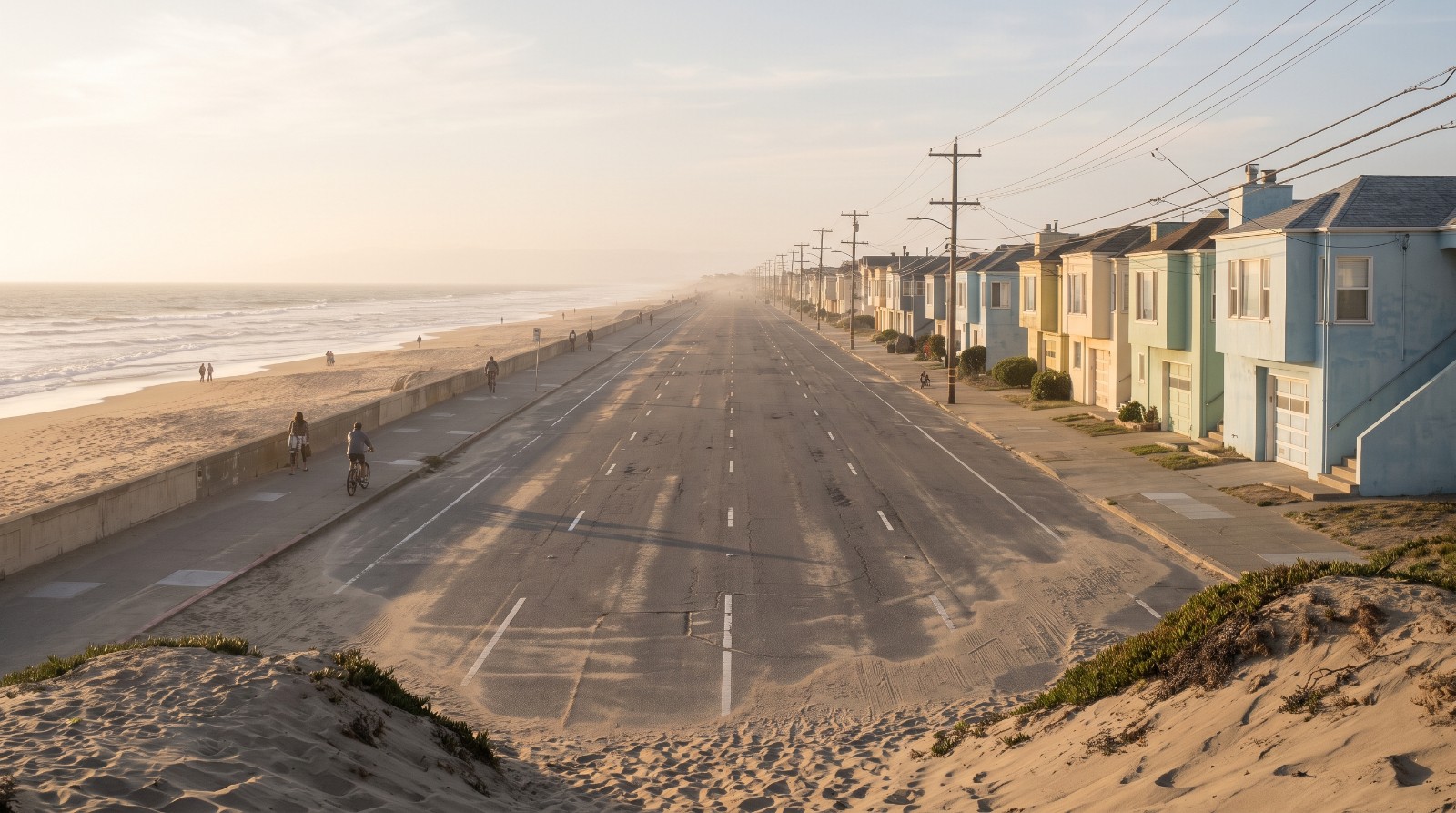
The car-free Great Highway roadway at Sunset Dunes park in San Francisco's Outer Sunset, with Ocean Beach on one side and Sunset row houses on the other. Photo: Houseberry
Deputy Controller ChiaYu Ma's letter is the first official price tag anyone has put on Proposition G, and the number that will get quoted is 9.8 million dollars. That is what it costs to put cars back on the Great Highway on weekdays. Roughly 8.8 million of it is traffic signals at eight intersections. Add five years of upkeep and sand removal and the controller lands close to 20 million. San Franciscans vote on it November 3.
The letter is careful, specific, and it prices exactly one thing: pavement. What it cannot price is the part that decides whether the west side of the city gets more expensive, and on that question the last twelve months have already produced an answer that neither campaign is going to enjoy.
Here is what the controller actually found.
- Traffic signals at eight intersections: about 8.8 million dollars, the bulk of the upfront cost
- Removing park features and restoring the roadway: about 750,000 dollars
- Restriping and signage: 200,000 to 250,000 dollars, depending on which account of the letter you read
- Ongoing annual cost: 500,000 to 1.9 million dollars, mostly signal maintenance and sand
- Offsetting savings: roughly 300,000 dollars a year the city would no longer spend staffing the park
The 8.8 million is a pedestrian safety bill, not a road bill
Almost 90 percent of the upfront cost is signalizing eight intersections, and that is the detail worth sitting with. Reopening a road that already exists should be cheap. Repainting lines is cheap. What is not cheap is the fact that once cars are moving on that stretch again, people crossing to the beach need somewhere protected to do it.
Both sides read the same number and reach opposite conclusions. Measure opponent Lucas Lux calls it charging San Franciscans millions to close a beloved park. Prop G advocate Jamie Hughes calls it the cost of pedestrian safety measures and says voters will consider it a small price to pay. The San Francisco Standard's account of the letter also notes the controller came in about 4 million dollars below what the city's own transportation and parks departments had estimated, which is not the usual direction for a city cost estimate.
One more line item nobody is campaigning on: sand. When the highway was open to cars, San Francisco spent about 860,000 dollars clearing sand in fiscal 2022-23 and about 420,000 in 2023-24, per CBS Bay Area's summary of the estimate. The ocean does not care how the vote goes.
The city has already voted on this road, twice, badly
Proposition K passed in November 2024 with 55 percent citywide, converting the roadway into Sunset Dunes park. The neighborhood that actually lives there voted against it by 64 percent. That gap is the whole political story of the last two years, and it is why District 4 Supervisor Joel Engardio was recalled in 2025.
Prop G is the answer to that gap. Organizers with Great Highway for Everyone, led by Richard Correia and Albert Chow, submitted 15,626 signatures against a requirement of 10,582. Current District 4 Supervisor Alan Wong supports it. Friends of Sunset Dunes, led by Lux, opposes it and sued over the petition language.
So a citywide electorate created a park over the objection of the district, and now the district is going back to the citywide electorate to undo part of it. Whatever you think of the road, that is a genuinely rough way to make land use decisions, and it is worth noticing that the same city struggles to approve eight units of housing through a process that takes eighteen months.
What Prop G would actually change
Cars on weekdays, park on weekends. The measure would reopen the stretch from Lincoln Way to Sloat Boulevard to motor vehicles Monday through Friday and keep it closed to cars from Friday evening through Monday morning, plus holidays. It amends the Park Code rather than repealing Prop K outright.
That split matters for anyone reading this as a property question, because the park's own numbers are lopsided in the same direction. Sunset Dunes draws roughly 14,000 visitors on a weekend day and about 4,000 on a weekday, and it logged 1.7 million visits in its first year. Prop G takes the roadway back on the five days when it is least used as a park and leaves the two days when it is busiest. As compromises go, it is more coherent than the campaign rhetoric on either side suggests.
The west side got more expensive while the road was a park
This is the part the cost letter does not touch. Over the twelve months through July 2026, the two neighborhoods with the most direct exposure to Sunset Dunes both got more expensive, and one of them got much more expensive.
| Neighborhood | Median sale price, Aug 2025 | Median sale price, July 2026 | 12-month change |
|---|---|---|---|
| Outer Sunset | 1.52 million dollars | 1.70 million dollars | up about 11.8 percent |
| Parkside | 1.60 million dollars | 1.99 million dollars | up about 24.4 percent |
Those are our own numbers, pulled from each neighborhood's twelve-month price history rather than a snapshot. And they cut against the simplest version of the pro-park argument. Outer Sunset is the neighborhood that fronts the dunes. Parkside sits behind it, a few blocks inland, with no ocean frontage at all. If the park were the dominant price driver, Outer Sunset should have run away from Parkside. It did the opposite, by more than twelve percentage points.
Parkside also carries the better safety score of the two, 4.6 out of 5 against Outer Sunset's 4.3, which puts it 11th of the 92 San Francisco neighborhoods we score for safety. Outer Sunset wins on amenities, 3.9 to 2.9. Buyers appear to be paying for the quiet grid and the schools, not for the view of the roadway.
None of which proves the park is irrelevant. Agents quoted in the Standard's February piece on the Outer Sunset describe buyers treating Sunset Dunes as an amenity rather than an inconvenience, and oceanfront trades at the top of the market have been extraordinary. But the honest read of a twelve-month price series is that the west side is being repriced by something bigger than a road, and a citywide market that has been unusually hot all year is the obvious candidate.
The number that changes the Sunset is 199, not eight
Eight traffic signals will not change who can afford to live out there. Housing will. There are 199 homes proposed at 1234 Great Highway, and we wrote about that project in July. One approved building on that site does more for the Sunset's next decade than either outcome on November 3.
That is the frustrating thing about this fight. The Sunset is one of the few parts of San Francisco with real room to add homes near a beach, a rapid bus line, and an N Judah stop, and the city has spent two years and one recall arguing about which days cars may use a mile and a half of asphalt. The 20 million dollars is a rounding error next to what the same political energy could have built.
The trade-off worth naming, and Prop G supporters are right about this: a weekday closure genuinely does push traffic somewhere. It lands on Sunset Boulevard, Lower Great Highway, and the residential grid in between, and people who live on those streets are not imagining it. The controller's letter does not price that, and no ballot argument on either side has bothered to measure it.
What to watch before November 3
Three things. First, whether the Department of Elections certification and the Friends of Sunset Dunes lawsuit change the measure's ballot language, because the wording of a park code amendment does a lot of work. Second, whether anyone publishes an actual traffic diversion study, since that is the strongest argument in the Sunset's favor and it currently exists only as an assertion. Third, whether the coastal development permit the measure would require gets priced, because the controller flagged it as an unknown cost.
If you are shopping the west side in the meantime, the practical move is to treat the road question as noise and the fundamentals as signal. Compare the neighborhood-level scores across San Francisco the way you would compare school ratings or an insurance quote, and notice that Parkside and Outer Sunset are genuinely different products at similar prices. That is the habit we built Houseberry around, and it will still be the right habit on November 4, whichever way this goes.
Sources
- Reopening the Great Highway to cars could cost 20M over five years, controller finds, The San Francisco Standard, August 11, 2026
- Reopening San Francisco's Great Highway for cars would cost 10M to start, controller says, CBS Bay Area
- Great Highway measure to reopen San Francisco road set for ballot, Mission Local, July 2026
- Sunset Dunes marks first anniversary with 1.7M visits, Local News Matters, April 13, 2026
- The Outer Sunset's unlikely rise from rugged to red-hot, The San Francisco Standard, February 1, 2026
- Houseberry neighborhood price history, Outer Sunset and Parkside
Prop G Would Cost 20 Million. Sunset Prices Rose Anyway
San Francisco's controller put the first official price on reopening the Great Highway to cars. The number that will actually reshape the Sunset is a different one.
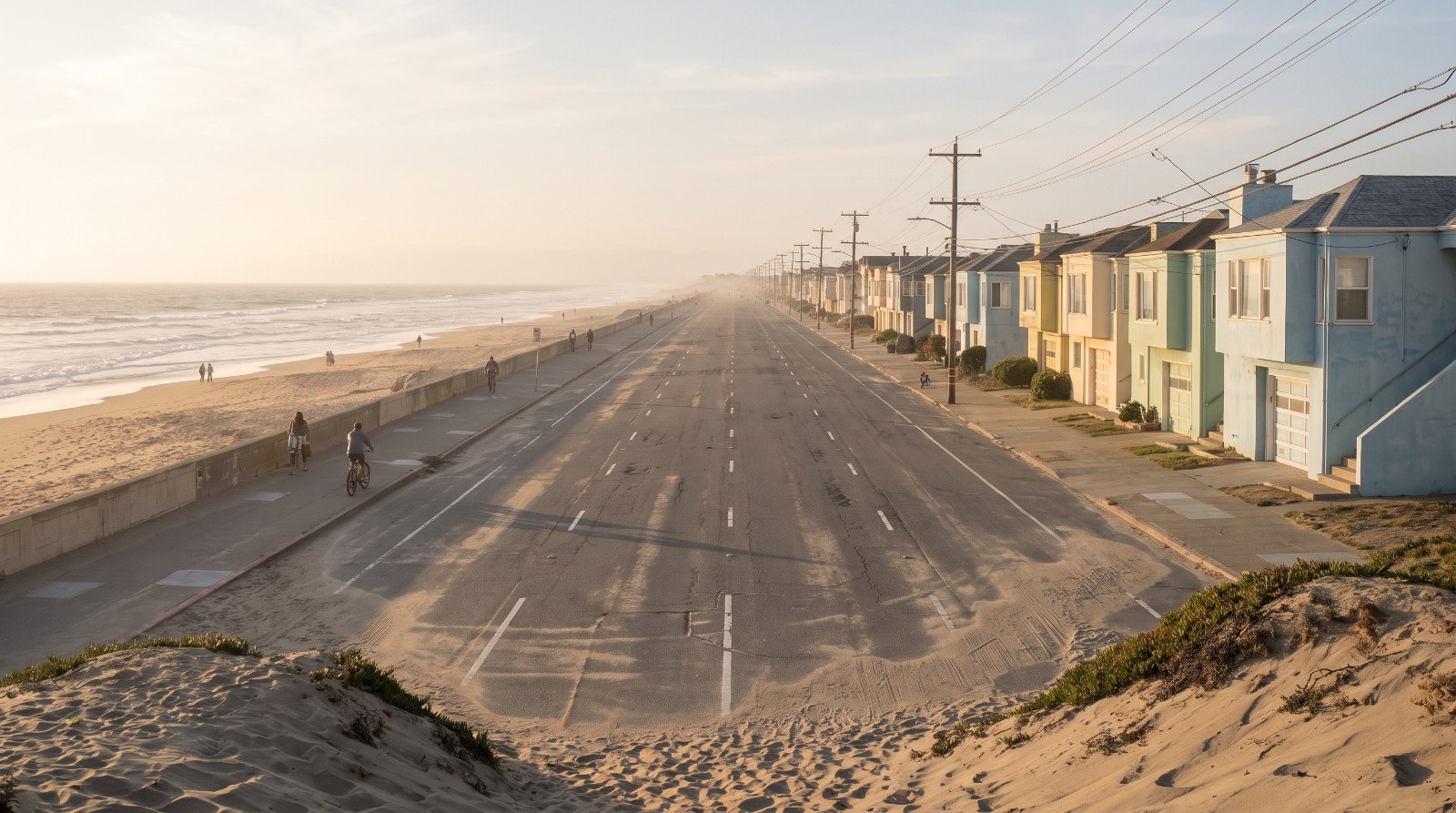
The car-free Great Highway roadway at Sunset Dunes park in San Francisco's Outer Sunset, with Ocean Beach on one side and Sunset row houses on the other. Photo: Houseberry
Deputy Controller ChiaYu Ma's letter is the first official price tag anyone has put on Proposition G, and the number that will get quoted is 9.8 million dollars. That is what it costs to put cars back on the Great Highway on weekdays. Roughly 8.8 million of it is traffic signals at eight intersections. Add five years of upkeep and sand removal and the controller lands close to 20 million. San Franciscans vote on it November 3.
The letter is careful, specific, and it prices exactly one thing: pavement. What it cannot price is the part that decides whether the west side of the city gets more expensive, and on that question the last twelve months have already produced an answer that neither campaign is going to enjoy.
Here is what the controller actually found.
- Traffic signals at eight intersections: about 8.8 million dollars, the bulk of the upfront cost
- Removing park features and restoring the roadway: about 750,000 dollars
- Restriping and signage: 200,000 to 250,000 dollars, depending on which account of the letter you read
- Ongoing annual cost: 500,000 to 1.9 million dollars, mostly signal maintenance and sand
- Offsetting savings: roughly 300,000 dollars a year the city would no longer spend staffing the park
The 8.8 million is a pedestrian safety bill, not a road bill
Almost 90 percent of the upfront cost is signalizing eight intersections, and that is the detail worth sitting with. Reopening a road that already exists should be cheap. Repainting lines is cheap. What is not cheap is the fact that once cars are moving on that stretch again, people crossing to the beach need somewhere protected to do it.
Both sides read the same number and reach opposite conclusions. Measure opponent Lucas Lux calls it charging San Franciscans millions to close a beloved park. Prop G advocate Jamie Hughes calls it the cost of pedestrian safety measures and says voters will consider it a small price to pay. The San Francisco Standard's account of the letter also notes the controller came in about 4 million dollars below what the city's own transportation and parks departments had estimated, which is not the usual direction for a city cost estimate.
One more line item nobody is campaigning on: sand. When the highway was open to cars, San Francisco spent about 860,000 dollars clearing sand in fiscal 2022-23 and about 420,000 in 2023-24, per CBS Bay Area's summary of the estimate. The ocean does not care how the vote goes.
The city has already voted on this road, twice, badly
Proposition K passed in November 2024 with 55 percent citywide, converting the roadway into Sunset Dunes park. The neighborhood that actually lives there voted against it by 64 percent. That gap is the whole political story of the last two years, and it is why District 4 Supervisor Joel Engardio was recalled in 2025.
Prop G is the answer to that gap. Organizers with Great Highway for Everyone, led by Richard Correia and Albert Chow, submitted 15,626 signatures against a requirement of 10,582. Current District 4 Supervisor Alan Wong supports it. Friends of Sunset Dunes, led by Lux, opposes it and sued over the petition language.
So a citywide electorate created a park over the objection of the district, and now the district is going back to the citywide electorate to undo part of it. Whatever you think of the road, that is a genuinely rough way to make land use decisions, and it is worth noticing that the same city struggles to approve eight units of housing through a process that takes eighteen months.
What Prop G would actually change
Cars on weekdays, park on weekends. The measure would reopen the stretch from Lincoln Way to Sloat Boulevard to motor vehicles Monday through Friday and keep it closed to cars from Friday evening through Monday morning, plus holidays. It amends the Park Code rather than repealing Prop K outright.
That split matters for anyone reading this as a property question, because the park's own numbers are lopsided in the same direction. Sunset Dunes draws roughly 14,000 visitors on a weekend day and about 4,000 on a weekday, and it logged 1.7 million visits in its first year. Prop G takes the roadway back on the five days when it is least used as a park and leaves the two days when it is busiest. As compromises go, it is more coherent than the campaign rhetoric on either side suggests.
The west side got more expensive while the road was a park
This is the part the cost letter does not touch. Over the twelve months through July 2026, the two neighborhoods with the most direct exposure to Sunset Dunes both got more expensive, and one of them got much more expensive.
| Neighborhood | Median sale price, Aug 2025 | Median sale price, July 2026 | 12-month change |
|---|---|---|---|
| Outer Sunset | 1.52 million dollars | 1.70 million dollars | up about 11.8 percent |
| Parkside | 1.60 million dollars | 1.99 million dollars | up about 24.4 percent |
Those are our own numbers, pulled from each neighborhood's twelve-month price history rather than a snapshot. And they cut against the simplest version of the pro-park argument. Outer Sunset is the neighborhood that fronts the dunes. Parkside sits behind it, a few blocks inland, with no ocean frontage at all. If the park were the dominant price driver, Outer Sunset should have run away from Parkside. It did the opposite, by more than twelve percentage points.
Parkside also carries the better safety score of the two, 4.6 out of 5 against Outer Sunset's 4.3, which puts it 11th of the 92 San Francisco neighborhoods we score for safety. Outer Sunset wins on amenities, 3.9 to 2.9. Buyers appear to be paying for the quiet grid and the schools, not for the view of the roadway.
None of which proves the park is irrelevant. Agents quoted in the Standard's February piece on the Outer Sunset describe buyers treating Sunset Dunes as an amenity rather than an inconvenience, and oceanfront trades at the top of the market have been extraordinary. But the honest read of a twelve-month price series is that the west side is being repriced by something bigger than a road, and a citywide market that has been unusually hot all year is the obvious candidate.
The number that changes the Sunset is 199, not eight
Eight traffic signals will not change who can afford to live out there. Housing will. There are 199 homes proposed at 1234 Great Highway, and we wrote about that project in July. One approved building on that site does more for the Sunset's next decade than either outcome on November 3.
That is the frustrating thing about this fight. The Sunset is one of the few parts of San Francisco with real room to add homes near a beach, a rapid bus line, and an N Judah stop, and the city has spent two years and one recall arguing about which days cars may use a mile and a half of asphalt. The 20 million dollars is a rounding error next to what the same political energy could have built.
The trade-off worth naming, and Prop G supporters are right about this: a weekday closure genuinely does push traffic somewhere. It lands on Sunset Boulevard, Lower Great Highway, and the residential grid in between, and people who live on those streets are not imagining it. The controller's letter does not price that, and no ballot argument on either side has bothered to measure it.
What to watch before November 3
Three things. First, whether the Department of Elections certification and the Friends of Sunset Dunes lawsuit change the measure's ballot language, because the wording of a park code amendment does a lot of work. Second, whether anyone publishes an actual traffic diversion study, since that is the strongest argument in the Sunset's favor and it currently exists only as an assertion. Third, whether the coastal development permit the measure would require gets priced, because the controller flagged it as an unknown cost.
If you are shopping the west side in the meantime, the practical move is to treat the road question as noise and the fundamentals as signal. Compare the neighborhood-level scores across San Francisco the way you would compare school ratings or an insurance quote, and notice that Parkside and Outer Sunset are genuinely different products at similar prices. That is the habit we built Houseberry around, and it will still be the right habit on November 4, whichever way this goes.
Sources
- Reopening the Great Highway to cars could cost 20M over five years, controller finds, The San Francisco Standard, August 11, 2026
- Reopening San Francisco's Great Highway for cars would cost 10M to start, controller says, CBS Bay Area
- Great Highway measure to reopen San Francisco road set for ballot, Mission Local, July 2026
- Sunset Dunes marks first anniversary with 1.7M visits, Local News Matters, April 13, 2026
- The Outer Sunset's unlikely rise from rugged to red-hot, The San Francisco Standard, February 1, 2026
- Houseberry neighborhood price history, Outer Sunset and Parkside
All information provided on this website including but not limited to - school ratings, safety, amenities, user opinions, and property data - is for general informational purposes only. We do not guarantee its reliability, accuracy, or completeness. Users should independently verify information and consult appropriate professionals as needed. By using this website, you agree Houseberry is not responsible for actions, decisions, or consequences arising from reliance on the information provided
houseberry.com - CA DRE# 01847391
 Bay East ©2025. CCAR ©2025. bridgeMLS ©2025. Information Deemed Reliable But Not Guaranteed. This information is being provided by the Bay East MLS, or CCAR MLS, or bridgeMLS. The listings presented here may or may not be listed by the Broker/Agent operating this website. This information is intended for the personal use of consumers and may not be used for any purpose other than to identify prospective properties consumers may be interested in purchasing. Data last updated at September 26, 2026 12:00 AM