San Francisco Tenant Buyouts Jump 33 Percent, Most Since 2019
San Francisco landlords filed 574 pre-buyout disclosures from January to August 2026, up 33 percent from 2025 and the most since 2019. What a disclosure is, why the rent surge is driving buyout offers, and which neighborhoods are seeing the most.
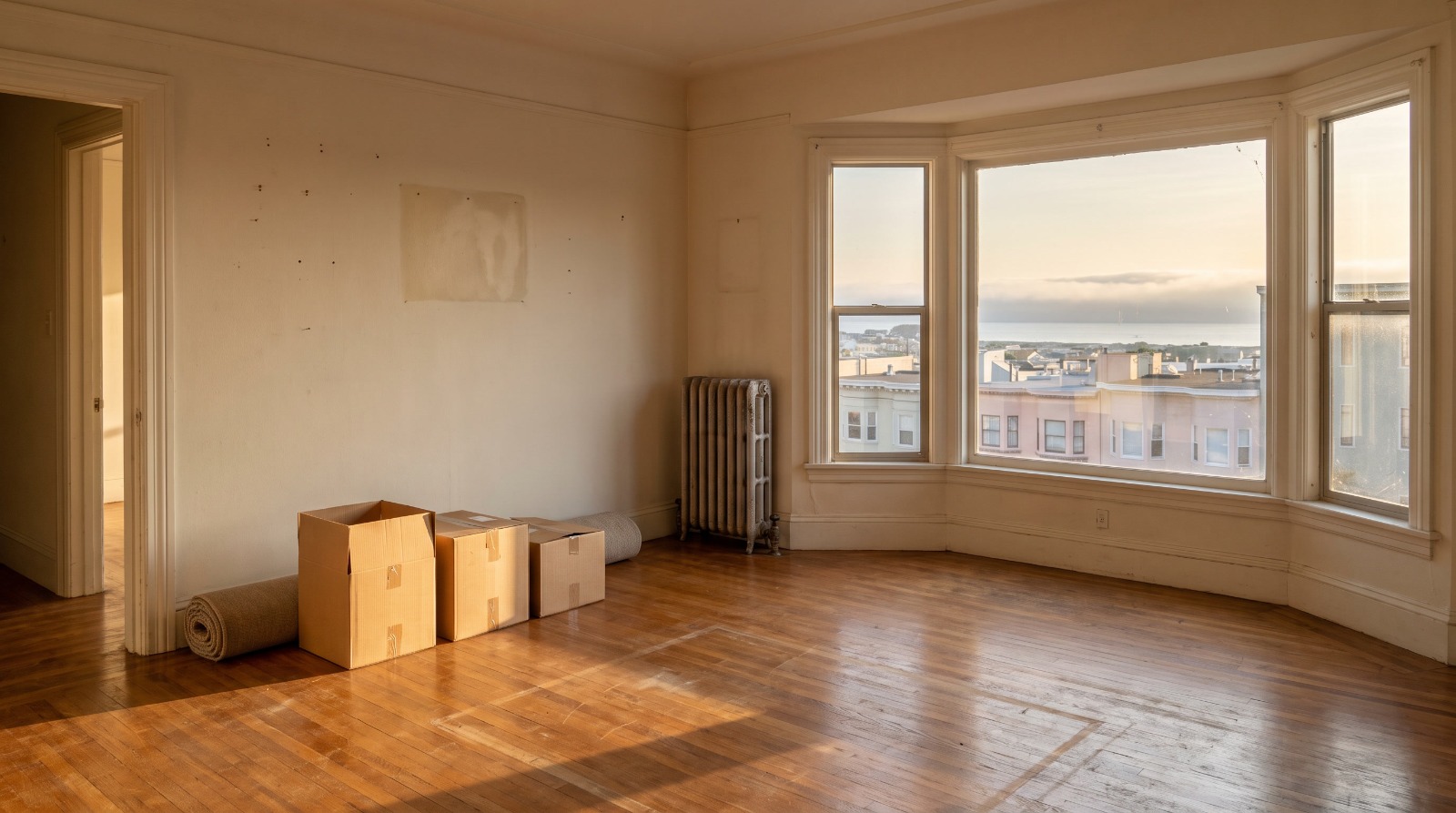
An empty rent-controlled flat in San Francisco's Outer Sunset after a tenant buyout, with moving boxes by the door. Photo: Houseberry
574. That is how many pre-buyout disclosures San Francisco landlords filed with the Rent Board between January 1 and August 31, 2026, according to the city's own buyout dataset. Same eight months last year: 432. The year before: 322.
So San Francisco tenant buyouts, or at least the paperwork that has to come before one, are up 33 percent in a year and running at their highest level since 2019. We have not seen it reported anywhere else. We pulled the Rent Board data ourselves, and the pattern lines up almost exactly with the rent spike.
What a buyout disclosure is, and what it is not
A pre-buyout disclosure is a landlord's sworn notice that it has told a tenant their rights before offering money to move out. Under the Rent Ordinance's buyout section (37.9E), in effect since March 2015, a landlord has to hand the tenant a Rent Board form and file a declaration with the Board before buyout talks begin, as the city's buyout page lays out.
That makes the disclosure count a measure of intent, not outcomes. Some tenants say no. Some negotiate for months. Some offers never get made. If a deal is signed, the tenant gets 45 days to rescind it, and only then does the landlord file the final agreement.
So when I say buyouts are up 33 percent, read it precisely: the number of landlords formally preparing to offer one is up 33 percent. For a leading indicator, that is about as clean as housing data gets.
Why landlords are offering buyouts now
Because the gap between a rent-controlled rent and a market rent just got a lot wider. San Francisco's median rent hit $3,844 in September 2026, up 25.6 percent from a year earlier, per Apartment List, a pace Axios called the fastest of any major U.S. city this year. The allowable increase on a rent-controlled unit is 1.6 percent for March 2026 through February 2027.
Every month that gap persists, a sitting tenant is worth more to the landlord gone than staying. State law lets a vacated unit reset to market rent for the next tenant. And a building delivered empty sells for more than one with long-term tenants, because the buyer is pricing the rent roll.
A buyout is the legal, negotiated route to that vacancy. The alternatives, an owner move-in or an Ellis Act withdrawal from the rental market, come with relocation payments, restrictions, and a lot more friction. Mayor Lurie's September 10 rent emergency package would raise Ellis Act relocation payments by $3,000, which, if anything, makes a negotiated buyout look relatively cheaper.
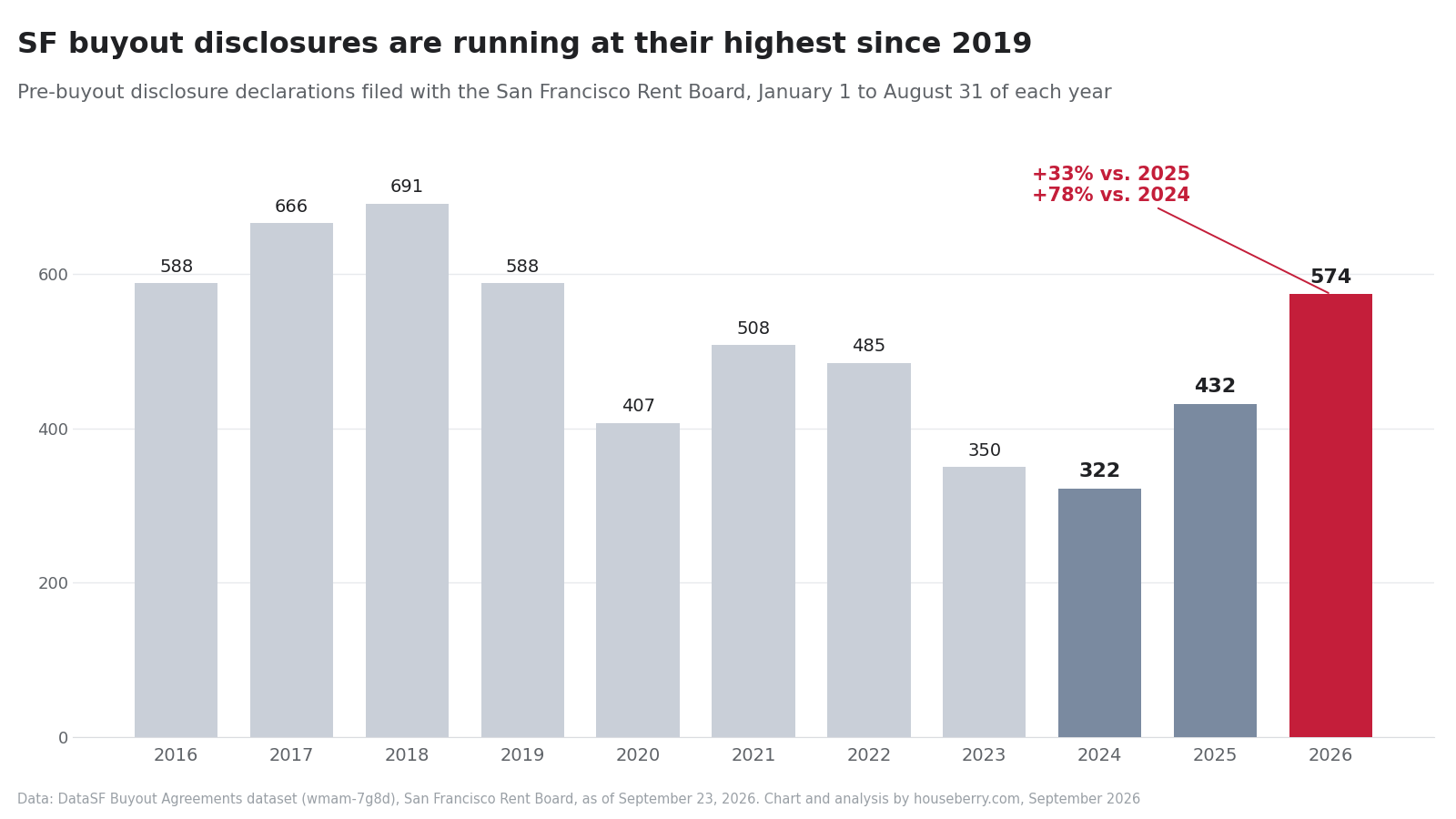
The chart also shows how the cycle works. Filings peaked in 2017 and 2018, the last time rents ran hot, then fell by more than half to 322 by 2024 as the market cooled. They have now climbed back most of the way in two years.
Where San Francisco buyout disclosures are rising fastest
The west side leads, and the jumps are sharpest in neighborhoods with lots of small, older rental buildings. The Sunset/Parkside area, the city's planning district covering the Outer Sunset and Parkside grids west of 19th Avenue, filed 72 disclosures in the first eight months of 2026, up from 57.
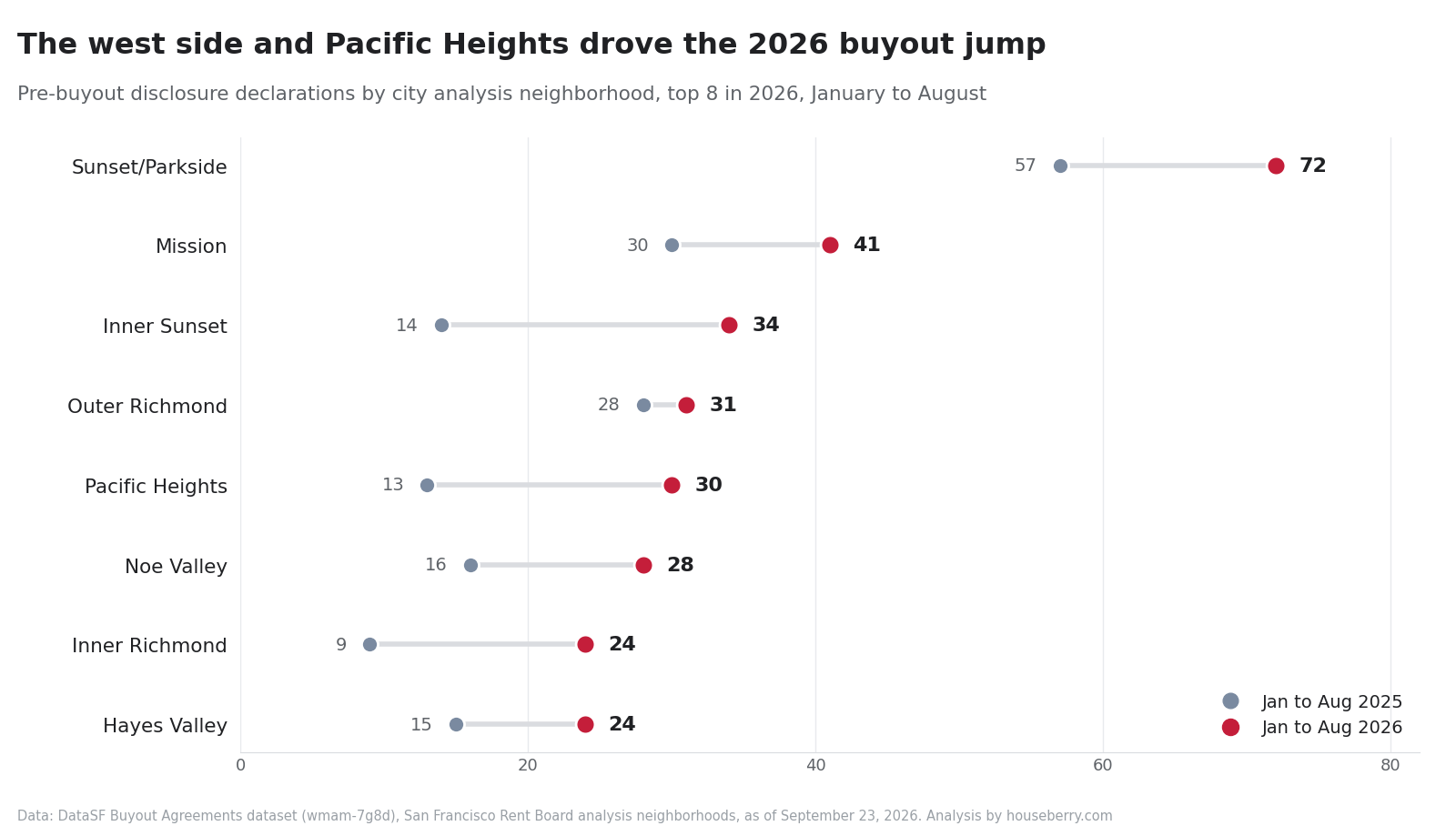
The bigger story is in the percentage moves. The Inner Sunset, the blocks around 9th and Irving near UCSF, went from 14 to 34. The Inner Richmond went from 9 to 24. Pacific Heights more than doubled, 13 to 30, which tells you this is not only a low-rent-neighborhood phenomenon. Some of the city's most expensive flats are being cleared too.
Here is how those filings line up with what homes are selling for, using our own neighborhood price history.
| Area (Rent Board) | Jan to Aug 2025 | Jan to Aug 2026 | Houseberry median sale price |
|---|---|---|---|
| Sunset/Parkside | 57 | 72 | $1.73M (Outer Sunset, Aug 2026) |
| Mission | 30 | 41 | $2.33M (Inner Mission, Aug 2026) |
| Inner Sunset | 14 | 34 | $2.23M (Aug 2026) |
| Outer Richmond | 28 | 31 | $2.01M (Jul 2026) |
| Noe Valley | 16 | 28 | $3.29M (Jul 2026) |
| Inner Richmond | 9 | 24 | $2.61M (Jul 2026) |
| San Francisco citywide | 432 | 574 | $2.20M (Aug 2026) |
Two things jump out. First, the buyout surge is not concentrated where homes are cheapest. The Outer Sunset sold at about $1.73 million in August 2026, below the $2.2 million citywide median, while the Inner Sunset ran $2.23 million and Noe Valley $3.29 million. Second, the west side neighborhoods leading in filings also score well on our numbers. The Outer Sunset ranks second of 92 San Francisco neighborhoods overall, with a 4.5 school score and 4.3 for safety. Strong fundamentals plus a rental surge equals an expensive tenant to keep in place.
A caveat on the match-up. The Rent Board's areas are larger than Houseberry's neighborhoods, so Sunset/Parkside covers more than the Outer Sunset alone. Read the prices as the price level of the area, not as comps for a specific fourplex.
Are more tenants actually taking buyouts?
Not yet, on paper, but the dollars are up sharply. Landlords filed 233 signed buyout agreements dated January to August 2026, against 243 for the same months of 2025. The median payment on those 2026 agreements was $50,000, up from $35,000.
The flat agreement count is mostly a timing artifact. A signed deal cannot be filed until the 45-day rescission window closes, and a disclosure filed in July might not become a signed agreement until winter. If the usual pattern holds, the agreement count should climb through early 2027. The payments are the real signal. A $50,000 median tells you landlords see a lot of value in an empty unit right now.
One limit on the amounts: each agreement can cover more than one tenant in a household, so the median is per agreement, not per person.
What this does and does not mean
It does mean more rent-controlled tenants in San Francisco will get a knock on the door in the coming months, especially on the west side. It also means more of the city's older small buildings will come to market empty and priced accordingly.
It does not mean mass displacement by force. A buyout is voluntary, the tenant can walk away from the offer, and the city's annual buyout reports track every one filed. It also does not prove any single landlord plans to sell. Some are clearing a unit for family, some for a remodel, some to re-rent at market.
For renters with a long tenancy, the practical point is that your below-market rent is now a real asset with a price. The SF Tenants Union and the Rent Board both have guides worth reading before you answer an offer. Buyouts also carry a string for owners: two or more buyouts, or one involving a senior or disabled long-term tenant, can block a condo conversion for 10 years.
For buyers, a vacant pre-1979 two-unit building in the Sunset or Richmond is going to cost more than the same building with tenants, and part of that premium is somebody's buyout check. If you are weighing whether to rent or buy in this market, or watching the banked rent increase cap moving through City Hall, count this in. My read: a buyout boom is what a shortage looks like from inside a rent-controlled building. The fix is still more homes, and until the city permits them, the cheapest apartment in San Francisco will keep being the one somebody already lives in. When we compare neighborhoods at Houseberry, we look past the listing to what the block is actually doing, and our San Francisco neighborhood rankings are the place to start.
Sources
DataSF, Buyout Agreements dataset (wmam-7g8d), San Francisco Rent Board, data as of September 23, 2026 (analysis by Houseberry)
SF.gov, Buyout Agreements, San Francisco Rent Board
SF.gov, Rent Board Annual Buyout Reports, 2016 to 2026
San Francisco Tenants Union, Buyouts
Apartment List, San Francisco, CA Rent Report, September 2026
SF.gov, Learn about rent increases in San Francisco (allowable increase 1.6 percent, March 2026 to February 2027)
Axios San Francisco, Lurie declares San Francisco rent emergency as costs soar, September 10, 2026
Houseberry, San Francisco city guide, neighborhood pages and rankings, retrieved September 23, 2026
Map of San Francisco Neighborhoods
Loading map...
View Full Map
Top Neighborhoods in San Francisco, CA





All information provided on this website including but not limited to - school ratings, safety, amenities, user opinions, and property data - is for general informational purposes only. We do not guarantee its reliability, accuracy, or completeness. Users should independently verify information and consult appropriate professionals as needed. By using this website, you agree Houseberry is not responsible for actions, decisions, or consequences arising from reliance on the information provided
houseberry.com - CA DRE# 01847391
 Bay East ©2025. CCAR ©2025. bridgeMLS ©2025. Information Deemed Reliable But Not Guaranteed. This information is being provided by the Bay East MLS, or CCAR MLS, or bridgeMLS. The listings presented here may or may not be listed by the Broker/Agent operating this website. This information is intended for the personal use of consumers and may not be used for any purpose other than to identify prospective properties consumers may be interested in purchasing. Data last updated at September 25, 2026 12:00 AM