San Francisco Banked Rent Cap: What a 10 Percent Limit Changes
Supervisor Danny Sauter wants to cap banked rent increases in San Francisco's rent-controlled units at 10 percent a year. Here is how banking actually stacks up, what the cap changes for tenants, and how it moves the math on 2 to 4 unit buildings in the Richmond, Sunset and Mission.
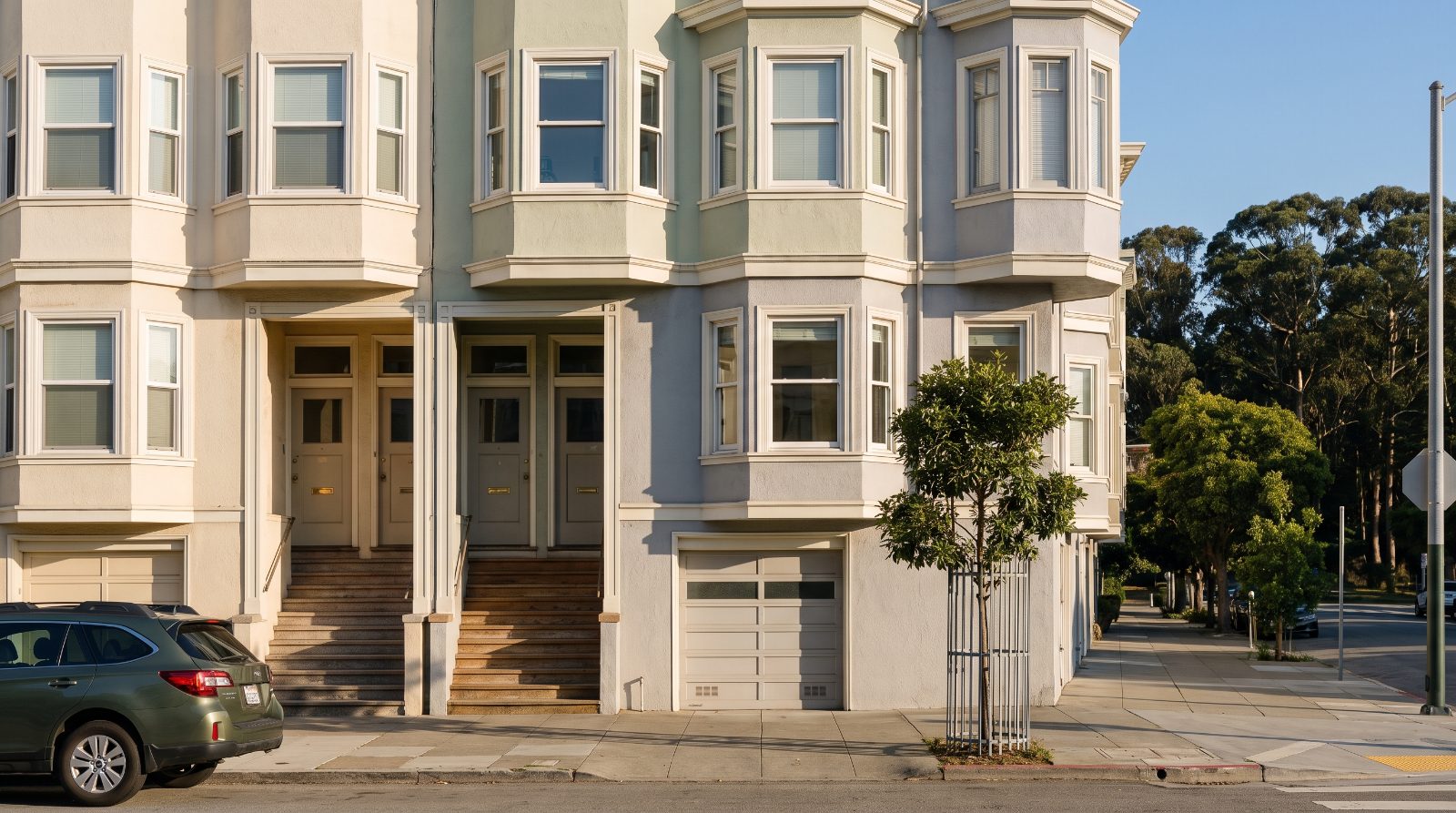
Pre-1979 rent-controlled flats in San Francisco's Inner Richmond, the kind of building a banked rent increase cap would affect. Photo: Houseberry
The idea fits on an index card. Cap banked rent increases in San Francisco's rent-controlled apartments at 10 percent a year, and make landlords remind tenants every year what the limits are. Supervisor Danny Sauter has introduced it, Bay City News reported, as part of the tenant package Mayor Daniel Lurie rolled out on September 10 when he declared a rent emergency.
It does not touch the annual allowable increase, which is 1.6 percent for March 2026 through February 2027. It does not abolish banking. What it changes is the speed. A tenant who has not had a raise since 2015 can legally be handed a 21.1 percent increase today. Under the cap, the same total arrives in three steps.
What banking means under the San Francisco Rent Ordinance
Banking is the right to take an annual increase later instead of now. Each year the Rent Board sets an allowable increase at 60 percent of Bay Area inflation. If a landlord skips it, the skipped amount goes into a bank that the city says has no limit and does not expire during the tenancy.
A few rules shape how the bank behaves, and they matter for the math:
- Banking has been allowed since April 1, 1982. Skips before then do not count.
- Banked percentages add up. They cannot be compounded.
- The bank belongs to the tenancy, not the owner. A new buyer inherits the prior owner's bank, and it disappears when the tenant moves out.
- Any increase over 10 percent in a year already requires 90 days of written notice instead of 30.
Most owners who bank are not scheming. They just never raised rent on a good tenant. The trouble starts at sale, when a new owner finds a decade of unused increases on the rent roll and applies them at once. The San Francisco Public Press documented the pattern back in 2019, and noted that the Rent Board does not track when banks get used.
A tenant since 2015, worked out
Here is the stack for a unit rented in March 2015 at $2,500 where rent was never raised. The allowable increases on each March anniversary, from the Rent Board's historical table and its recent announcements, ran 1.6, 2.2, 1.6, 2.6, 1.8, 0.7, 2.3, 3.6, 1.7, 1.4 and 1.6 percent from 2016 through 2026.
Add them and you get 21.1 percent. Today the owner could raise that $2,500 to about $3,028 in one notice, an extra $527.50 a month. Under a 10 percent annual cap it goes to $2,750, then $3,000 a year later, then $3,028 in year three.
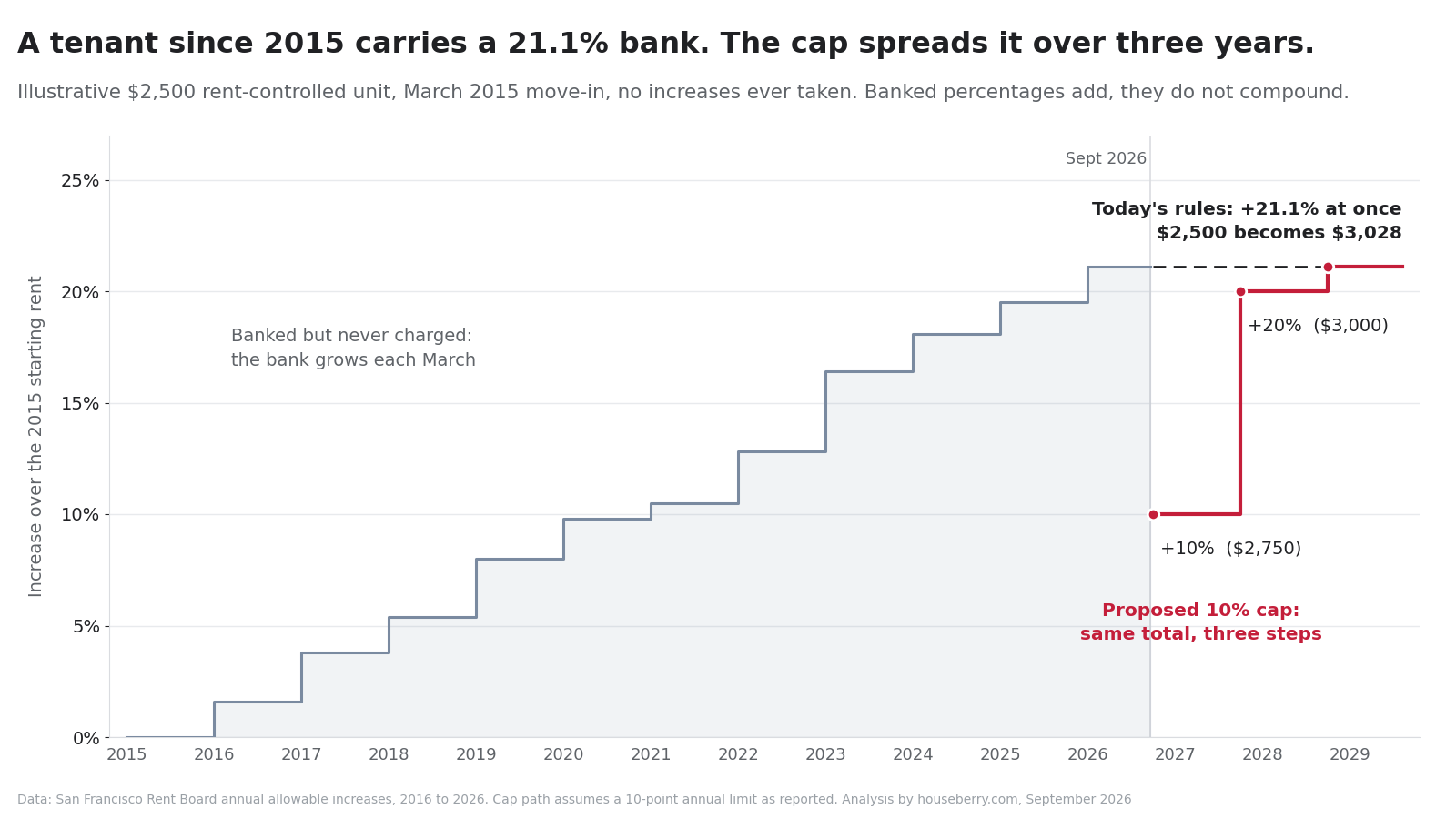
Longer tenancies stretch further, same $2,500 rent, same assumption that no raise was ever taken.
| Tenant moved in (March) | Banked by Sept 2026 | Added to $2,500 rent today | Years to collect at 10% a year |
|---|---|---|---|
| 2021 | 10.6% | $265 | 2 |
| 2018 | 15.7% | $393 | 2 |
| 2015 | 21.1% | $528 | 3 |
| 2010 | 28.3% | $708 | 3 |
| 2000 | 43.9% | $1,098 | 5 |
The cap barely registers for anyone who moved in after about 2020. It bites hardest on tenancies from the 2000s, which is exactly where the scariest stories come from. Think of a 44 percent notice landing on someone who has lived in the same Richmond flat for 26 years.
The ordinance, line by line
This is the reported version. The ordinance text was not public yet when we checked.
- Sponsor: Supervisor Danny Sauter of District 3, with Supervisor Matt Dorsey named on the tenant-notice piece, per SFist and the SF Standard.
- Covers: rent-controlled units under the city's Rent Ordinance, generally pre-1979 multi-unit buildings.
- The cap: banked increases limited to 10 percent in a year. Our three-step math assumes that limit sits on top of the regular annual increase, which the reporting does not yet settle.
- Notices: landlords must tell tenants each year about rent increase limits and their rights.
- Pass-throughs: Mission Local and the Richmond Review report the package also reins in capital improvement charges. Details are not out.
- Unchanged: the 1.6 percent annual rate, banking itself, inheritance of banks by new owners, and vacancy decontrol when a tenant leaves.
Sauter framed it as preventing “devastating surprise rent hikes.” Fair enough. It is a speed limit, not a rent cut.
What changes for buyers of 2 to 4 unit buildings
For buyers, the cap mostly moves income later rather than erasing it. Take a pre-1979 fourplex where two units are near market and two long-term tenants from 2015 each pay $2,500.
Under current rules, a buyer's pro forma can book both banks at close: $527.50 times two units times 12 months, about $12,660 a year in added income. At a 5 percent cap rate, which is our assumption for illustration and not a market quote, that line alone supports roughly $253,000 of value on paper.
With the cap, year one adds $6,000, year two $12,000, year three the full $12,660. The shortfall over the phase-in totals about $7,300. On a building in the low millions, that is a rounding error in the price and a real line in a first-year cash budget.
The bigger underwriting change is quieter. Some buyers count on a big banked notice nudging a long-term tenant out, resetting the unit to market. A 10 percent step is easier to absorb, so fewer will move. If your offer only works because someone moves out, the cap is aimed squarely at your spreadsheet. That is a policy choice, and I think an honest buyer should price it rather than argue with it.
There is a real downside for tenants too. Banking has been an informal courtesy, the landlord who skips raises because the tenant is reliable. Put a speed limit on collecting later and some owners will simply take the 1.6 percent every March.
Richmond, Sunset and Mission: where it lands
The cap matters most where the rent-controlled stock is flats and small apartment buildings. It matters least where it is single-family houses, which state law largely exempts from local rent limits. Our own neighborhood data tracks that split.
The Inner Richmond, the grid of Edwardian flats between Arguello Boulevard and Park Presidio around Clement Street, had a median sale price of about $2.61 million in July 2026. That is well above the $2.2 million San Francisco citywide median for August on Houseberry's price history. Scores are strong, 4.4 out of 5 for both schools and safety, and much of the housing is exactly the two to six unit stock the ordinance targets.
The Outer Richmond, out toward Ocean Beach along Balboa and Geary, ran about $2.01 million in July 2026. Same small pre-1979 buildings, lower entry price.
The Outer Sunset, the Judah and Noriega corridors running down to the Great Highway, sold at about $1.73 million in August 2026 and ranks among the top two of 92 San Francisco neighborhoods on our overall score. Its stock is mostly detached houses, so a banked-rent cap reaches fewer renters here than the headline suggests.
The Inner Mission, the Victorians and walk-ups around Valencia and the 16th and 24th Street BART stations, posted about $2.33 million in August 2026. It scores 2.1 overall on Houseberry, pulled down by school and safety scores, but holds some of the city's densest pre-1979 rental stock and a lot of very long tenancies.
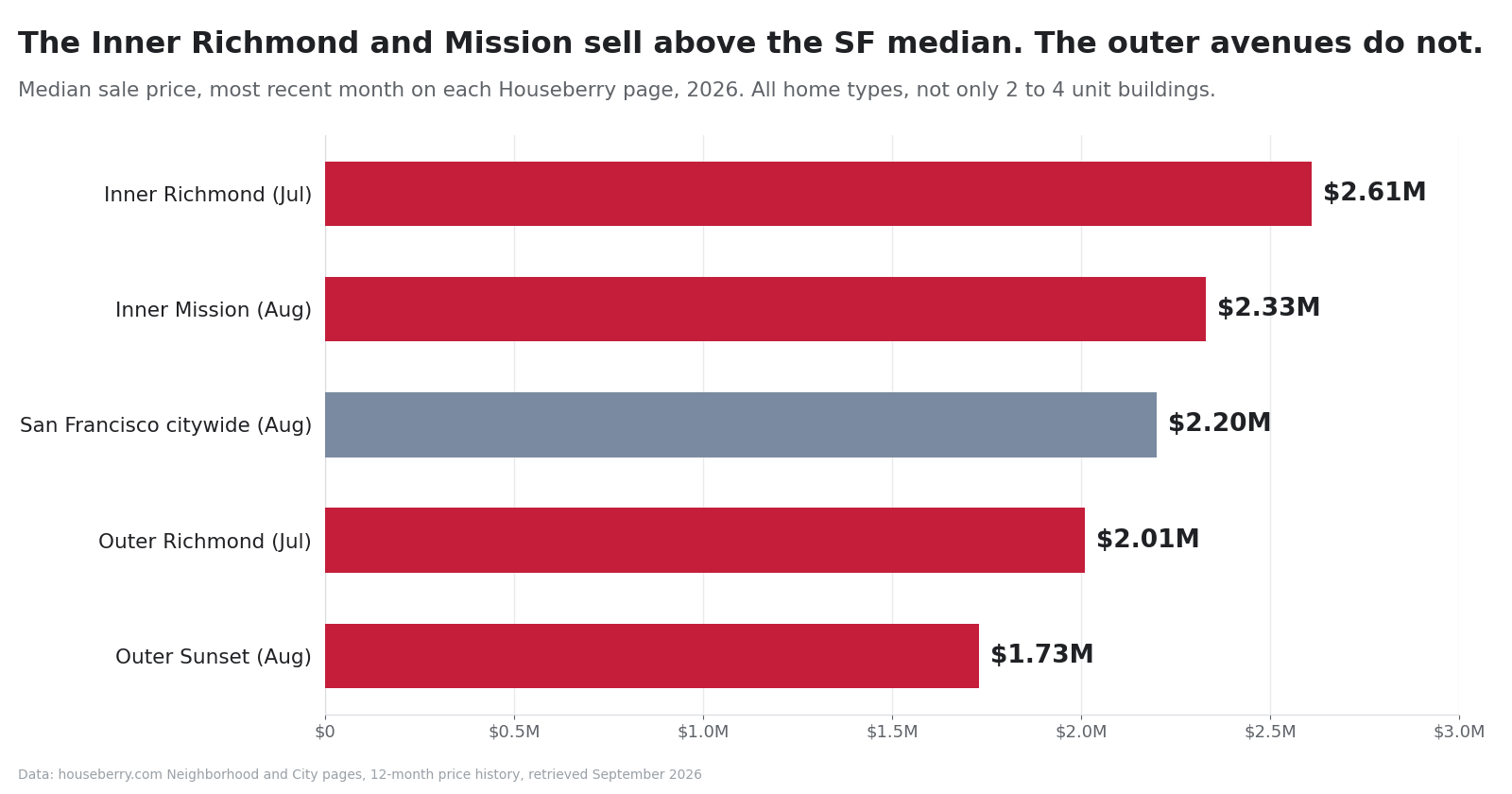
Those medians cover every sale, mostly houses and condos. Read them as price levels, not fourplex comps.
And the cap would not reach the Richmond case that made headlines in June. The 90 percent increase at 6838 Geary Boulevard involved a 1996 building outside local rent control and relied on a state-law exemption. Banking had nothing to do with it.
Who is for it, who is against it
Support is broad, and opposition is aimed elsewhere so far. Gail Gilman of the Eviction Defense Collaborative praised the package, per the Richmond Review. Tenant groups want more: Anastasia Yovanopolous of the SF Tenants Union said it “falls seriously short,” and Meg Heisler of the Anti-Displacement Coalition called it incomplete.
Landlord groups have spent their fire on Supervisor Jackie Fielder's eviction measure. The San Francisco Apartment Association sent the Board a letter against it, the SF Standard reported. We found no formal landlord statement on the banking cap as of September 22.
My view, for what it is worth: a speed limit on banked increases is reasonable, and it will not house one extra person. Rents are up about 25 percent in a year because vacancy fell to 2.2 percent and the city finished only 489 homes this year, per the SF Standard. The fix for that is permits, not notices.
When the Board could take it up
Nothing is scheduled yet. Board rules generally hold a newly introduced ordinance for 30 days before a committee can hear it, so the earliest realistic hearing is late October, most likely at Land Use and Transportation, where Rent Ordinance changes usually go. We will update this post with the hearing date, and our San Francisco neighborhood rankings are there if you are weighing which block to buy or rent on in the meantime.
Sources
Local News Matters / Bay City News, “San Francisco supervisors move to limit steep rent increases landlords can bank,” September 17, 2026
SF Standard, “Lurie declares rent emergency as SF housing costs surge,” September 10, 2026
SFist, “SF Mayor Declares Rent Emergency, Announces Several Tenant Protection Proposals,” September 10, 2026
Mission Local, “Lurie declares ‘rent emergency’ as S.F. rents spike,” September 2026
Richmond Review/Sunset Beacon, “Mayor Unveils Tenant Protection Package as Rents Surge to Record Highs,” September 11, 2026
SF Standard, “SF landlords go on offense against Lurie’s rental emergency declaration,” September 15, 2026
SF.gov, Banked rent increases, and Learn about rent increases in San Francisco, retrieved September 22, 2026
SF.gov, Annual Rent Increase for 3/1/25 to 2/28/26 Announced
San Francisco Rent Board, Allowable Annual Increases table (1982 to 2021), via SF Tenants Union
Elke & Merchant LLP, SF Rent Board announcements of the 0.7 percent (2021 to 2022) and 2.3 percent (2022 to 2023) allowable increases
San Francisco Apartment Association, Rent Increases, Interest and Fees (3.6 percent for 2023 to 2024)
Hoodline, Richmond District 90 percent rent increase at 6838 Geary Boulevard, June 2026
San Francisco Public Press, “Cities Grapple With ‘Banked’ Rent Hikes,” September 16, 2019
Houseberry, San Francisco city guide, neighborhood pages and rankings, retrieved September 22, 2026
Map of San Francisco Neighborhoods
Loading map...
View Full Map
Top Neighborhoods in San Francisco, CA





All information provided on this website including but not limited to - school ratings, safety, amenities, user opinions, and property data - is for general informational purposes only. We do not guarantee its reliability, accuracy, or completeness. Users should independently verify information and consult appropriate professionals as needed. By using this website, you agree Houseberry is not responsible for actions, decisions, or consequences arising from reliance on the information provided
houseberry.com - CA DRE# 01847391
 Bay East ©2025. CCAR ©2025. bridgeMLS ©2025. Information Deemed Reliable But Not Guaranteed. This information is being provided by the Bay East MLS, or CCAR MLS, or bridgeMLS. The listings presented here may or may not be listed by the Broker/Agent operating this website. This information is intended for the personal use of consumers and may not be used for any purpose other than to identify prospective properties consumers may be interested in purchasing. Data last updated at September 22, 2026 12:00 AM