AB 1729 Veto: Where Sacramento State Workers Can Live Now
Newsom vetoed AB 1729, so the four-day return-to-office order stays. Here is what that means for Sacramento commutes, downtown, and which neighborhoods make the week easier.
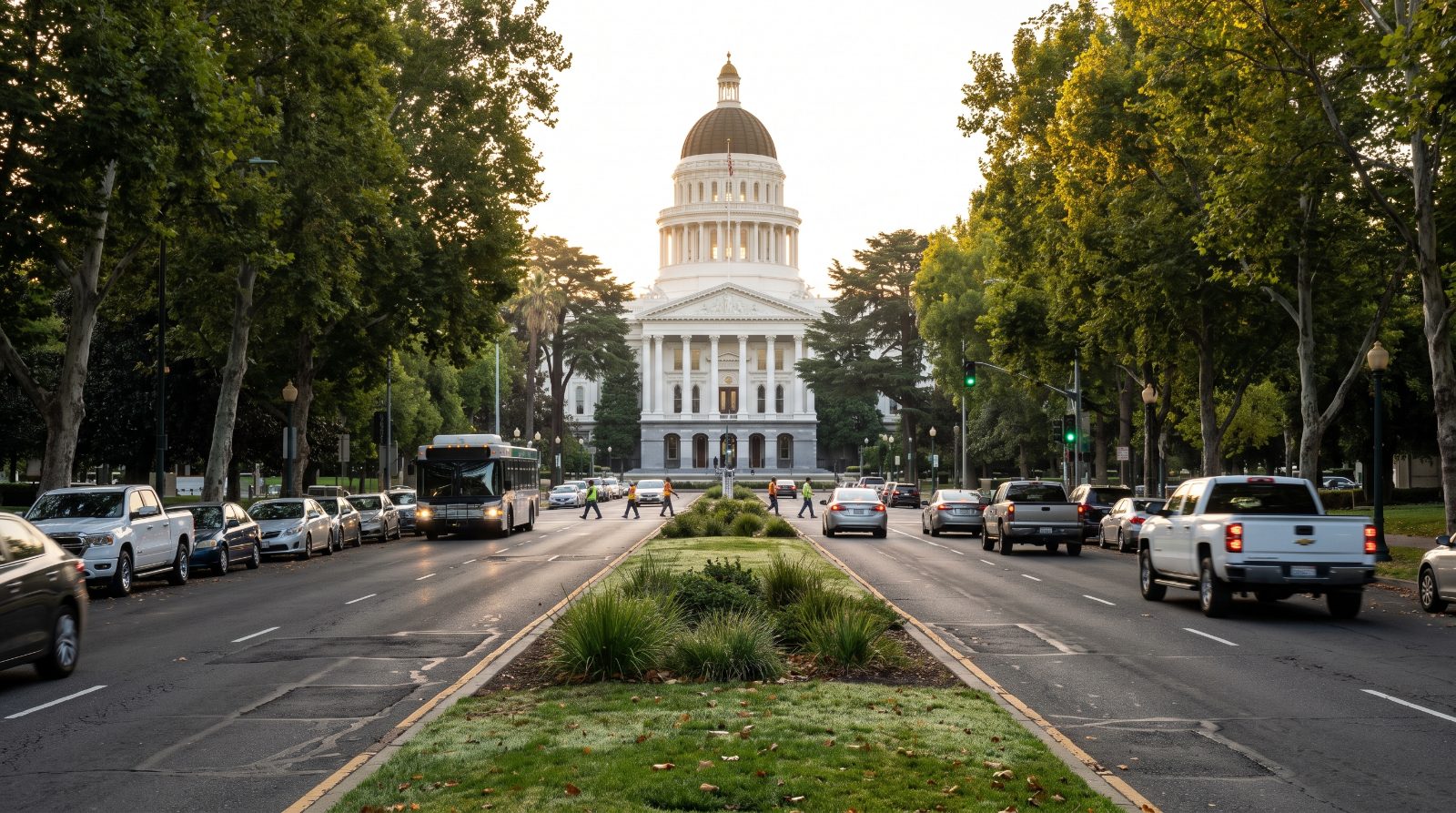
Morning commuter traffic on Capitol Mall heading toward the California State Capitol after the AB 1729 telework veto. Photo: Houseberry
Here is the question a lot of state workers in Elk Grove, Folsom and Natomas are asking this week: do I keep driving in four days a week, or do I finally move closer? Gov. Gavin Newsom answered half of it on Friday, September 18, 2026, when he vetoed AB 1729, the bill that would have loosened work-from-home rules for state employees. The four-day return-to-office order stays in place.
The other half, where to live now that the commute is permanent, is a neighborhood question. That is the part we can help with.
What AB 1729 would have done, and why Newsom said no
AB 1729 would have made each department put in writing why a job needs to be in the office, and it told the Department of General Services to build a public dashboard tracking what telework saves. Assemblymember Alex Lee, a South Bay Democrat, carried it with Folsom Republican Josh Hoover as a co-author, and the engineers’ union PECG sponsored it.
It passed easily, 67 to 7 in the Assembly and 31 to 6 in the Senate. Newsom vetoed it anyway, writing that in-person collaboration is “an essential part of a productive and effective workplace” and objecting that the bill would encourage telework “to be the default work arrangement.” Those margins clear the two-thirds needed for an override, but the Legislature has not overridden a California governor since 1979.
Newsom’s March 3, 2025 order set four office days a week starting July 1, 2025. Then the unions bargained. PECG traded a one-year delay for a raise largely offset by unpaid hours, and SEIU Local 1000 and the scientists’ union CAPS got similar delays. In August 2025 the State Auditor found that telework three days a week could save about $225 million a year and that the order went out without a full look at office space needs or costs. The delay ran out and the four-day week took effect July 1, 2026, covering roughly 108,000 hybrid workers.
The unions are not done. SEIU Local 1000, which represents about 96,000 state workers, is holding a strike authorization vote over pay and telework, and PECG President Brian Simon said in a statement after the veto that telework “should be embraced, not discarded.” For anyone planning a move, though, the working assumption for the next year is four days a week.
Why this is a Sacramento story first
Because the capital region holds about 40 percent of the state civil service. Federal labor data show about 139,600 state government jobs in the Sacramento-Roseville-Folsom metro in August 2026, and CapRadio puts roughly 90,000 state employees in Sacramento County alone. When their week changes, the grid downtown feels it.
And it has, a little. The Downtown Sacramento Partnership, using Placer.ai phone data, counted 12 percent more foot traffic from July 1 to 11, 2026 than in the same days of 2025. The district had about 100,000 workers before the pandemic and was running near 60 percent of that in February 2026. Office vacancy downtown was about 24 percent in early 2025. A 12 percent bump is real for the lunch counters on K Street. It is not a full recovery.
Parking is where the new week gets personal. The state runs more than 20 parking facilities on lotteries and waitlists, added lots at 450 N Street and at the May Lee State Office Complex, the 1.25 million square foot campus on Bannon Street in the River District, and private garages start around $10 a day. Four days a week, that adds up fast.
The Sacramento commute shed, neighborhood by neighborhood
The neighborhoods that make a four-day office week easiest are the ones inside about three miles of the Capitol, and they trade safety scores for walkability. Here is how the main state-worker commute sheds compare on Houseberry scores, with rough driving miles and the rail option each one actually has.
| Neighborhood or city | Rough miles to the Capitol | Rail option | Houseberry overall score |
|---|---|---|---|
| Midtown / Winn Park / Capitol Avenue | 1 | Walk or bike, all three light rail lines | 2.8 of 5 |
| East Sacramento | 3 | Gold Line on Folsom Boulevard | 3.2 of 5 |
| Curtis Park | 3 | Blue Line at City College | 3.1 of 5 |
| Natomas Park | 7 | None, drive I-5 | 3.6 of 5 |
| Elk Grove (top-ranked Elk Grove Blvd / Four Winds) | 16 | Blue Line from Cosumnes River College | 4.1 of 5 |
| Roseville (top-ranked Johnson Ranch) | 19 | One Capitol Corridor round trip a day | 4.0 of 5 |
| Folsom (top-ranked Empire Ranch) | 23 | Gold Line, every 15 minutes on weekdays | 4.0 of 5 |
Midtown, the grid of Victorians and newer apartments between the Capitol and the Business 80 loop, is a bike ride from almost every state office, but it scores 1.6 of 5 on our safety measure. East Sacramento, the older neighborhood of 1920s and 1930s homes around McKinley Park, scores 4.5 on amenities and puts you on the Gold Line at 39th, 48th or 59th Street. Its safety score is 2.7. Curtis Park and Land Park, south of Broadway, sit near 4.3 to 4.5 on amenities with safety in the low to mid 2s. Our Sacramento safety rankings run from 1.1 to 4.8, so context matters more than any single number.
Natomas Park is the interesting outlier. It ranks fifth of 185 Sacramento neighborhoods at 3.6 overall with a 4.4 safety score, but there is no light rail across the American River yet. Every trip downtown is I-5, and the planned Green Line extension to the airport is still unfunded.
The workers who moved out during remote work
The people hit hardest by the veto are the ones who bought on the edge of the region when two office days a week felt permanent. Elk Grove, Folsom and Roseville buy you higher top-end scores. Elk Grove’s best-ranked area scores 4.1, and both Empire Ranch in Folsom and Johnson Ranch in Roseville score 4.0. But you pay in miles.
And in Elk Grove’s case, you also paid more. Houseberry’s city pages put Elk Grove’s median at about $632,000 in August 2026, against about $439,000 for Sacramento citywide. In no month of the past year did the gap narrow below about $170,000.
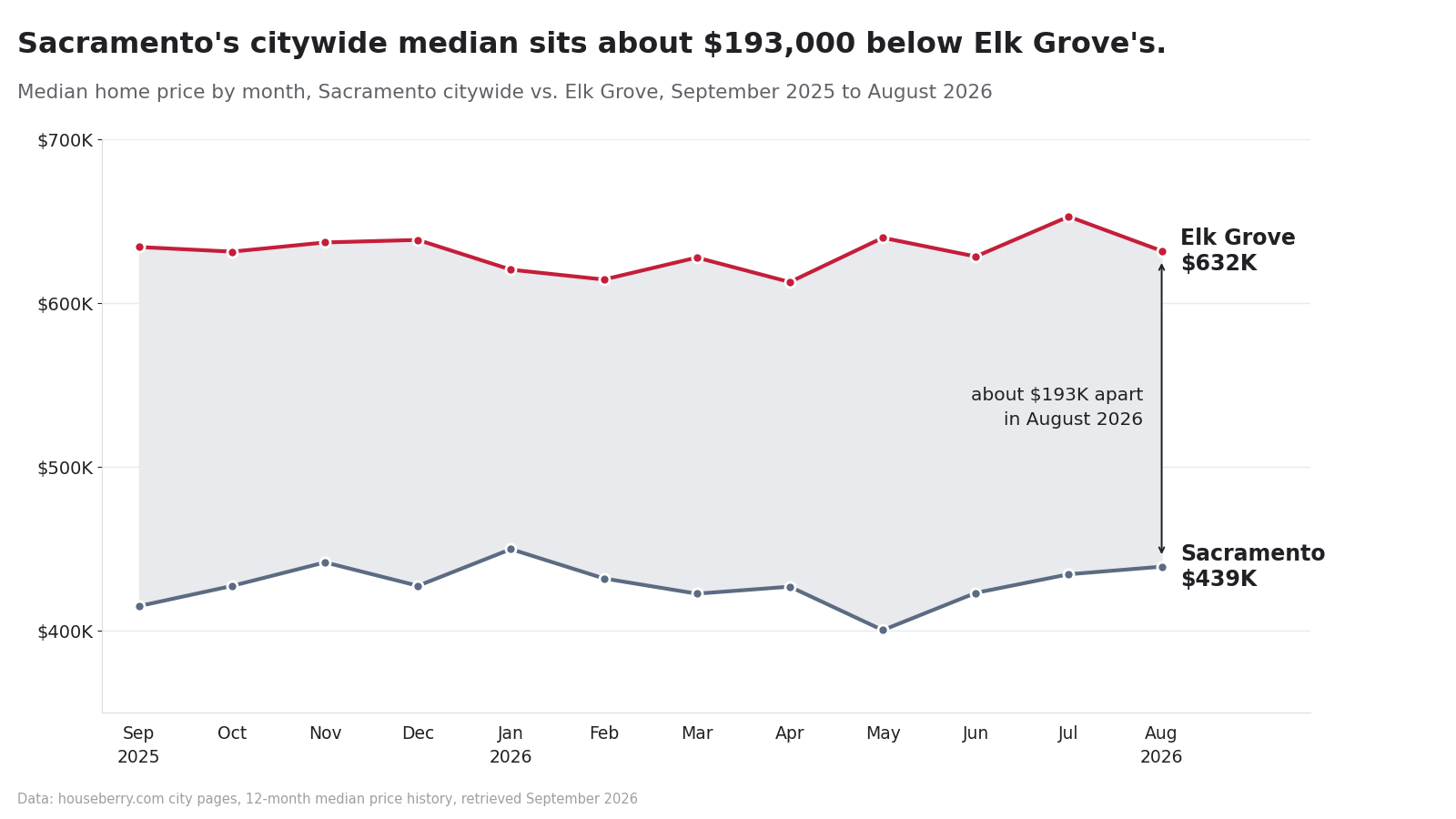
The citywide number hides a wide range, though. East Sacramento and Land Park have long sold well above the city median, so “closer” usually means a smaller or older house, or a condo in Midtown, more than a cheaper one. Davis is its own case, with a median of about $903,000 in August 2026 on Houseberry and a Capitol Corridor station, which makes it a train commute for people who can afford it.
Rail is the pressure valve, and it is uneven. SacRT light rail was running about 75 percent of pre-pandemic ridership heading into July, with Capitol Corridor ridership up 23 percent year over year. Folsom has the best of it now that SacRT runs 15-minute weekday Gold Line service out to the Historic Folsom end. Elk Grove drivers can park at Cosumnes River College and ride the Blue Line in.
One detail worth knowing before you list the house: CalMatters reported that exemptions are available for some workers who live 50 or more miles from their worksite. That mostly helps people who live well outside the region. It does not reach Elk Grove, which sits about 16 road miles from the Capitol.
How to think about a move right now
Treat the four-day week as the plan for at least a year, and pick the commute you can live with about 180 times a year, which is roughly what four office days add up to once holidays and vacation come out.
For some households the answer is a better commute: a Blue Line park and ride, a vanpool, a parking lottery spot. For others it is a smaller place inside the three-mile ring. Both are reasonable. What we would not do is buy on the assumption that the next governor, or the next contract, restores two-day hybrid. It might. It is not a plan.
If you are coming from the Bay Area for a state job, our guide to what money buys moving to Sacramento from the Bay Area covers the price side, and the full Sacramento neighborhood rankings let you sort all 185 neighborhoods by schools, safety and amenities, which is how we would start the shortlist. Downtown also has room for a lot more homes near its light rail stations, and every one that gets built makes this trade a little less painful for the next person.
Sources
CalMatters, “Newsom vetoes bill to loosen work-from-home rules for state workers,” Lynn La, September 18, 2026 (republished by Local News Matters, September 21, 2026)
CBS Sacramento, “Newsom vetoes bill aimed at preserving California state workers’ telework,” September 2026
The Sacramento Bee, “Gov. Gavin Newsom vetoes state worker telework bill in latest battle over RTO,” Corey Schmidt, September 19, 2026
Industry Insider California, “State Worker Telework Bill Clears California Legislature,” August 28, 2026
Office of the Governor, return-to-office announcement, March 3, 2025
CalMatters, “Newsom return-to-office order delayed for one state worker union,” Adam Ashton, June 24, 2025
CapRadio, “Audit finds California can save hundreds of millions if state workers stay remote,” August 14, 2025
CapRadio, “Union-backed bill would require telework options for California state workers,” February 23, 2026
Abridged by PBS KVIE, “Two weeks into return-to-office mandate, Downtown Sacramento sees modest signs of rebound,” July 16, 2026
The Sacramento Bee, “State workers returning to the office. Is Sacramento’s commute about to change?” June 30, 2026, and “Will RTO change downtown Sacramento?” July 1, 2026
CalMatters, “Gavin Newsom’s return-to-office rules are stricter than many states,” Lynn La, July 20, 2026
PECG, statement on the AB 1729 veto, September 21, 2026
U.S. Bureau of Labor Statistics via FRED, state government employment, Sacramento-Roseville-Folsom MSA, August 2026
California Department of General Services, May Lee State Office Complex
SacRT, Folsom 15-minute service
Houseberry, Sacramento, Elk Grove, Roseville, Folsom and Davis rankings and city pages, retrieved September 22, 2026
Map of Sacramento Neighborhoods
Loading map...
View Full Map
Top Neighborhoods in Sacramento, CA



All information provided on this website including but not limited to - school ratings, safety, amenities, user opinions, and property data - is for general informational purposes only. We do not guarantee its reliability, accuracy, or completeness. Users should independently verify information and consult appropriate professionals as needed. By using this website, you agree Houseberry is not responsible for actions, decisions, or consequences arising from reliance on the information provided
houseberry.com - CA DRE# 01847391
 Bay East ©2025. CCAR ©2025. bridgeMLS ©2025. Information Deemed Reliable But Not Guaranteed. This information is being provided by the Bay East MLS, or CCAR MLS, or bridgeMLS. The listings presented here may or may not be listed by the Broker/Agent operating this website. This information is intended for the personal use of consumers and may not be used for any purpose other than to identify prospective properties consumers may be interested in purchasing. Data last updated at September 22, 2026 12:00 AM