PG&E's proposed January power cut reaches one in three homes
PG&E's June notice promised a $10.55 monthly increase. Its October update turned that into a cut, but only for the third of homes that buy power from PG&E.

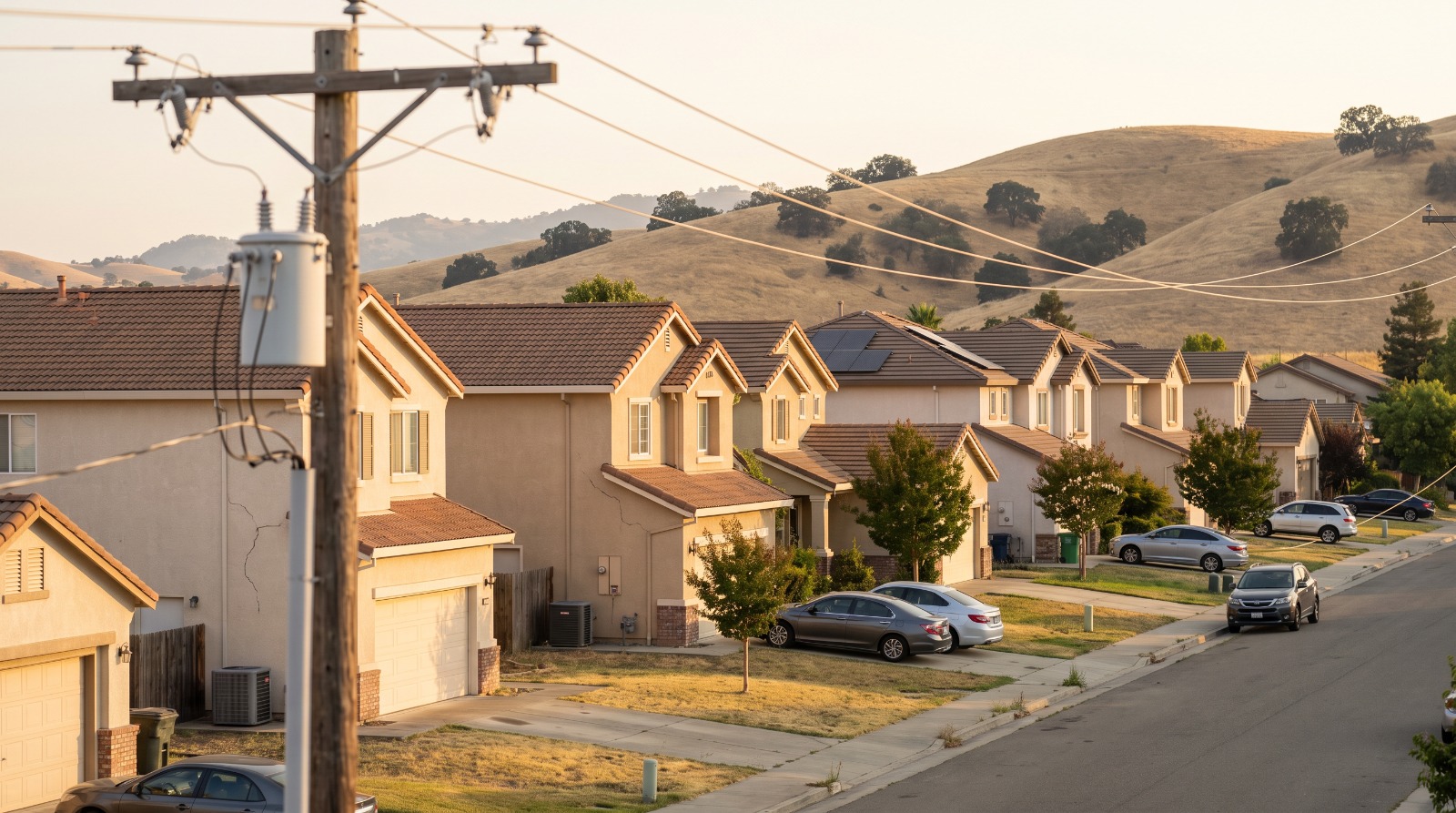
Two-story stucco tract homes, a utility pole and power lines below the golden Vaca Mountains in Vacaville's Browns Valley on a hot afternoon Photo: Houseberry
The PG&E notice tucked into June bills said a typical home would pay about $10.55 more a month for electricity starting in January. That number is already out of date. On October 16, PG&E filed new math in the same case, and for its own residential customers the 4.7 percent increase has turned into a proposed cut of about 2.7 percent. The state Public Utilities Commission still has to approve it, and PG&E wants it in place January 1.
Here is the catch. Only about one in three PG&E households buys its power from PG&E. The rest are signed up with a city or county power agency like CleanPowerSF, Ava Community Energy or MCE, and for them PG&E's share of the bill edges up 0.4 percent instead. In the Bay Area and the Sacramento region, the homes that actually get the cut sit mostly in the towns that never joined one of those agencies, places like Vacaville, where Houseberry's climate data puts the typical July afternoon at 91 degrees.
Why a hike turned into a cut
The case is PG&E's 2027 Energy Resource Recovery Account forecast, A.26-05-007. It covers the fuel and power PG&E buys for customers who get their electricity from PG&E. The May filing asked for $3.18 billion and produced the $10.55 figure in the June bill insert.
Then natural gas got cheaper.
The October 16 Fall Update refreshed forward prices to late August, and PG&E now expects to end 2026 having collected $876 million more than its power cost. That money goes back to customers in 2027 rates. A state benchmark price for renewable power also came in 51 percent below what PG&E had assumed in May. Put together, PG&E says its system average rate for its own customers falls 2.5 percent, to 32.7 cents a kilowatt-hour.
So most of the January cut is a refund. PG&E overcharged for power in 2026, and the 2027 rate gives it back.
| Who you buy power from | Rate now | Proposed Jan. 1 | Change at 500 kWh |
|---|---|---|---|
| PG&E, standard residential | 40.57 cents | 39.50 cents | about $5.39 less |
| PG&E, CARE discount | 21.77 cents | 20.55 cents | about $6.14 less |
| A community power agency (PG&E charges only) | 31.51 cents | 31.63 cents | about $0.61 more |
The figures come from Attachment A of the Fall Update and are averages across all rate plans. Your tier, your baseline region and the fixed monthly charge move your number up or down from there.
One in three homes gets it
The rest of the region left PG&E's power supply years ago. San Francisco has CleanPowerSF. Most of Alameda County buys from Ava. San Mateo County's agency renamed itself WestLight Energy. MCE serves 38 communities across Marin, Napa, Contra Costa and Solano, from San Rafael to Vallejo and Fairfield, according to MCE's own member list.
Those customers still get a PG&E bill, because PG&E still runs the wires and reads the meter. The generation price on that bill comes from the agency, though, and CleanPowerSF, Ava and MCE each set their own 2027 rates on their own schedule.
PG&E's filing puts a number on the split. For 2027 it forecasts 2,016,594 residential households on its own power and 3,482,358 with another provider. That is about 37 percent. By our count of the same filing, residential customers on PG&E power will use about 9.6 billion kilowatt-hours in 2027 against 16.1 billion for everyone else.
Inside the Bay Area, the PG&E holdouts are mostly towns that voted no. Orinda's council closed the door on MCE again in 2022. Vacaville's council rejected MCE 5 to 0, even as neighboring Fairfield and Vallejo joined, and neither city appears on MCE's list today.
The Sacramento side is simpler. Most of Sacramento County buys from SMUD, a public utility with its own elected board, and Roseville runs its own electric department. Neither is in this case at all. Placer and El Dorado counties are served by Pioneer Community Energy, and Davis and Woodland by Valley Clean Energy.
Heat is where the cut matters
A rate cut is worth more to a house that runs the air conditioner all summer. Houseberry keeps 30-year climate averages for every neighborhood we score, and they show how different the PG&E holdouts are.
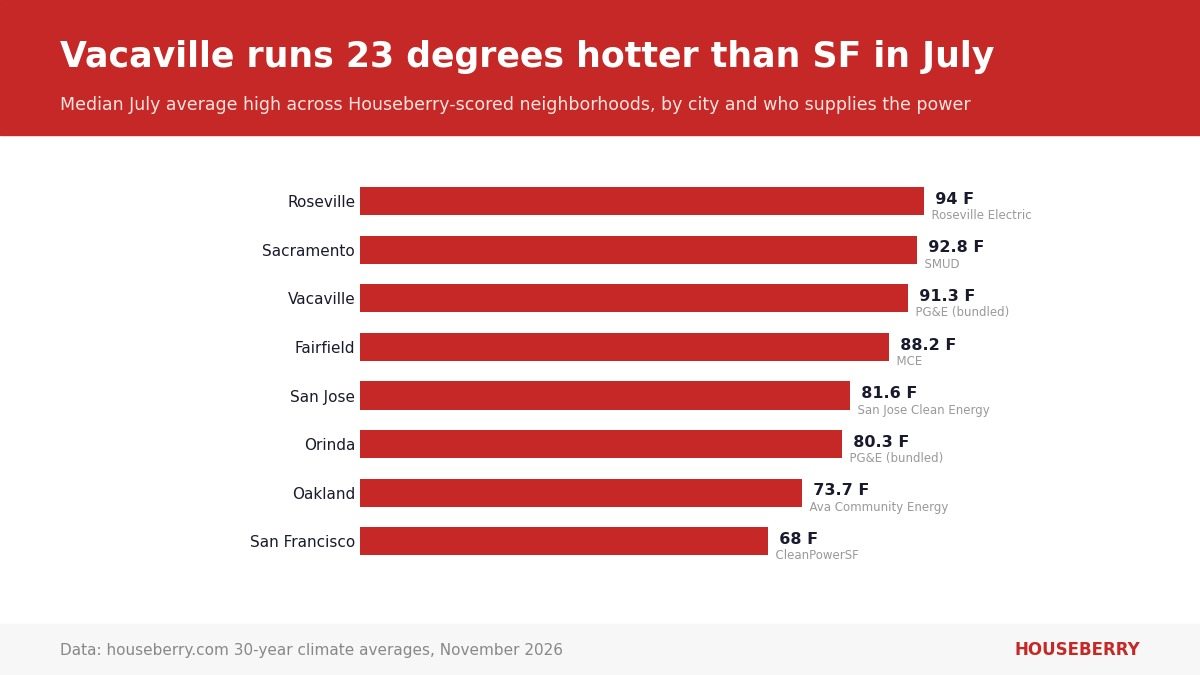
Vacaville is the hottest PG&E-supplied city in that chart. The median July high across its neighborhoods is 91.3 degrees in our data, against 68.0 across 53 San Francisco neighborhoods. That is a 23-degree gap. If a Vacaville house uses 1,000 kWh in a hot month, the new average rate takes about $10.77 off that bill.
It is also an affordable place to own the house running that AC. According to Houseberry data, the typical Vacaville home was worth about $587,100 in October 2026. Browns Valley, the hillside neighborhood at the city's west edge, ranks first of 20 on Houseberry's Vacaville ranking at 3.6 out of 5, with a 4.4 safety score.
Orinda is the other end of the same deal. Its neighborhoods top out around 80 degrees in July in our data, and the typical home was worth about $2.16 million in October 2026, per Houseberry's Orinda page. Same rate cut. Much smaller air conditioning load.
The bigger 2027 number is still coming
We think the $10.55 in the June notice should not be the number anyone budgets around. It was honest in June. For PG&E's 2 million households on its own power, it is wrong now.
It is also the smaller of PG&E's two 2027 cases. The general rate case, which pays for the wires, poles and wildfire work every PG&E customer uses, asks for $16.64 billion in 2027, up 8 percent. The CPUC's fact sheet shows PG&E's own estimate of a typical 500 kWh bill rising from $214.93 in 2025 to $226.11 in 2027, and it expects a decision in May 2027. Unlike the power charge, that one lands on CleanPowerSF and MCE customers too. A September 23 proposed decision granting interim relief in that case would add another $146 million to PG&E's generation costs, which the October figures above do not include.
There is one more small item in the filing. PG&E forecasts each of the two California Climate Credits in 2027 at $42.11, up from $36.18 this year. Every residential customer gets those, whoever supplies the power.
If you are shopping in a PG&E-supplied town, the power bill belongs in the monthly math next to the mortgage. Our San Jose versus Sacramento household bills comparison shows how much the utility line moves the total. The CPUC takes public comment on the power case at A.26-05-007 until it votes, and the Vacaville neighborhood rankings show where the hottest and coolest blocks sit before you sign.
Sources
The Houseberry Research Team is Houseberry's reporting team: Bay Area real estate analysts, data specialists and longtime local market watchers. Every day we check the public record: building permits, city council and planning agendas, county recorder filings, state housing bills, police incident data and school results. Then we tie each story to what it means for specific neighborhoods, using Houseberry's own neighborhood data on prices, appreciation, safety, schools and amenities. Questions or corrections: Contact us.
Map of Vacaville Neighborhoods
Loading map...
View Full Map
Top Neighborhoods in Vacaville, CA





All information provided on this website including but not limited to - school ratings, safety, amenities, user opinions, and property data - is for general informational purposes only. We do not guarantee its reliability, accuracy, or completeness. Users should independently verify information and consult appropriate professionals as needed. By using this website, you agree Houseberry is not responsible for actions, decisions, or consequences arising from reliance on the information provided
houseberry.com - CA DRE# 01847391
 Bay East ©2025. CCAR ©2025. bridgeMLS ©2025. Information Deemed Reliable But Not Guaranteed. This information is being provided by the Bay East MLS, or CCAR MLS, or bridgeMLS. The listings presented here may or may not be listed by the Broker/Agent operating this website. This information is intended for the personal use of consumers and may not be used for any purpose other than to identify prospective properties consumers may be interested in purchasing. Data last updated at November 6, 2026 12:00 AM