Moving to Sacramento From the Bay Area: What Money Buys
Sell the median San Francisco home and you can buy the most expensive real neighborhood in Sacramento with more than a million dollars left over. The 2026 exchange rate, neighborhood by neighborhood.
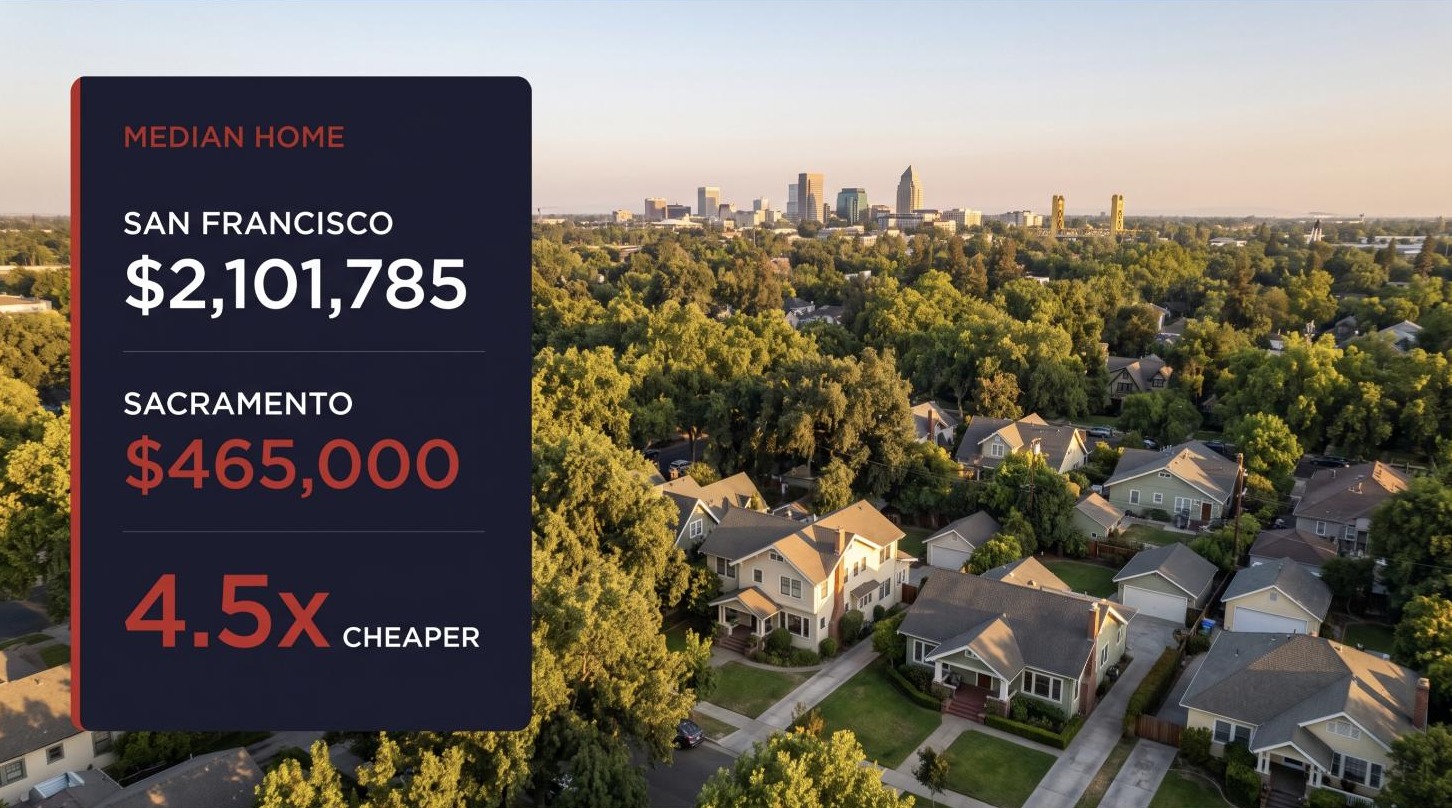
Aerial view of a tree-lined Sacramento neighborhood with the downtown skyline behind it, overlaid with 2026 median home prices showing Sacramento at $465,000 against San Francisco at $2,101,785. Photo: Houseberry
Here is the number that decides most of these moves. The median priced neighborhood in San Francisco costs $2,101,785. The median priced neighborhood in Sacramento costs $465,000. That is a factor of 4.5, and it means the Bay Area to Sacramento move is not really a question of whether you can afford it. It is a question of which tier of the Sacramento market you land in, because for most Bay Area sellers the answer is the top of it.
Every figure below comes from Houseberry’s own August 2026 scores: 147 priced Sacramento neighborhoods from the Sacramento neighborhood rankings, measured against 80 scored Bay Area cities and towns and the neighborhood-level data behind San Francisco and Oakland. The mover guides that dominate this search have none of it.
The exchange rate, plainly
Sacramento’s priced neighborhoods run from $343,000 to $773,000, with a single outlier boundary around the international airport at $1,124,000. That is the whole spread. One city, 147 neighborhoods, and the most expensive real residential one costs less than the cheapest full-sized city in the East Bay.
| Market | Median | Measured across |
|---|---|---|
| San Francisco | $2,101,785 | 88 priced neighborhoods |
| Bay Area cities and towns | $1,422,305 | 80 scored places |
| Oakland | $954,322 | 92 priced neighborhoods |
| Sacramento | $465,000 | 147 priced neighborhoods |
Read the bottom two rows together and the point lands harder than any percentage. Sell the median Oakland home and you clear 146 of Sacramento’s 147 priced neighborhoods outright. Sell the median San Francisco home and you buy East Sacramento at $773,000, the most expensive real neighborhood in the city, with roughly $1.3 million left over.
What the top of Sacramento actually looks like
Bay Area buyers usually arrive expecting to trade down in quality along with price, and the top of Sacramento does not work that way. The five priciest residential neighborhoods are East Sacramento at $773,000, Arden Manor at $763,000, River Park at $762,000, Land Park at $757,000, and Curtis Park at $715,000. These are the grand-street neighborhoods, deep lots, full canopies, Tudors and Craftsmans on 50-foot frontages, and every one of them sits below the price of the cheapest scored city in the entire East Bay.
They also score the way you would hope on the things that make a street pleasant. East Sacramento and Land Park both score 4.5 out of 5 for amenities, the highest in the city, and Sierra Oaks scores 4.4. For context, the highest amenities score among all 80 Bay Area cities is Corte Madera at 4.4, at a $2,550,000 median. On that one factor, Sacramento’s best streets are not trading down at all.
The trade is safety, and it is not where you expect
This is the part the relocation guides never say out loud, and it is the single most useful thing in this article. In Sacramento, the walkable neighborhoods and the high safety scores are almost perfectly opposed.
The amenities leaders score badly for safety. Land Park scores 2.5, East Sacramento 2.7, Curtis Park 2.2, Midtown 1.6, Boulevard Park 1.2. Meanwhile the 16 neighborhoods scoring 4.0 or better for safety are the flat, quiet, mid-century tracts on the city’s southern and northern edges, and their amenities scores run from 1.9 to 3.8.
| Sacramento neighborhood | Safety | Amenities | Median price |
|---|---|---|---|
| Bing Maloney Golf Course | 4.8/5 | 3.0/5 | $445,000 |
| Valleyview Acres | 4.7/5 | 2.8/5 | $572,000 |
| Sacramento City College | 4.5/5 | 3.5/5 | $706,000 |
| Heritage Park | 4.5/5 | 3.6/5 | $572,000 |
| Tahoe Park South | 4.4/5 | 3.3/5 | $450,000 |
| Natomas Park | 4.4/5 | 3.6/5 | $595,000 |
| River Park | 4.3/5 | 3.8/5 | $762,000 |
| Land Park | 2.5/5 | 4.5/5 | $757,000 |
| East Sacramento | 2.7/5 | 4.5/5 | $773,000 |
A Bay Area buyer who chases the version of Sacramento they saw on a weekend visit, which is Midtown and East Sac, is buying the low end of the city’s safety range. The buyer who wants the score is buying a 1960s tract with a two-car garage and a drive to dinner. Both are legitimate. Confusing them is the expensive mistake, and it is the one people make.
Where Sacramento genuinely beats the Bay Area
Seven Sacramento neighborhoods sell under $500,000 and score 4.0 or better for safety: Bing Maloney Golf Course at $445,000 and a 4.8, Sacramento Executive Airport at $445,000 and a 4.2, Tahoe Park South at $450,000 and a 4.4, Morrison Creek at $454,000 and a 4.1, Freeport at $467,000 and a 4.1, Elder Creek at $384,000 and a 4.0, and Florin Fruitridge Industrial Park at $460,000 and a 4.0.
Now put that next to the Bay Area. Across 80 scored Bay Area cities and towns, exactly four sell under $1 million and score 4.0 or better for safety, and the cheapest is $507,782. Sacramento has more sub-$500,000 options at that safety bar than the entire nine-county Bay Area has sub-$1 million options. We ranked the Bay Area side of that comparison in the cheapest Bay Area places that are actually safe. That gap, not the headline price difference, is what makes the move work for families who were priced out of safety rather than out of housing.
The honest costs
Three of them, and none are small. First, most of Sacramento scores mid-table or lower on Houseberry’s composite: 37 of the 147 priced neighborhoods score 3.0 or higher overall, which means roughly three in four score below that. The city has real range and a real bottom, and a $400,000 price tag is often telling you which one you are looking at.
Second, school scores are the weak column citywide. Even the strongest safety performers cluster between 2.7 and 3.4 for schools, and the highest school score in this dataset is Country Creek Estates at 4.5, in a neighborhood with no published median. Bay Area buyers coming from Silicon Valley or the Peninsula, where regional school means run 4.39 and 3.91, will feel that immediately.
Third, appreciation has been flat to slightly negative across most of the city in the current data, with the large majority of neighborhoods showing small declines. Sacramento is a place to buy more house, not a place to assume the house does the earning for you.
Matching a Bay Area life to a Sacramento street
If you are leaving a walkable inner Bay Area neighborhood and the walkability is the non-negotiable, the honest matches are East Sacramento, Land Park, Curtis Park and Sierra Oaks, all between $712,000 and $773,000, all scoring 4.3 to 4.5 for amenities, all scoring between 2.2 and 2.7 for safety. You will pay roughly a third of a San Francisco median and accept a safety score in Sacramento’s lower half.
If you are leaving a quiet suburb and the safety score is the non-negotiable, the matches are Heritage Park, Natomas Park, Valleyview Acres and Tahoe Park South, $450,000 to $595,000, safety 4.4 to 4.7, amenities 2.8 to 3.6. That is the closest thing to a Castro Valley or Clayton trade, at 40 percent of the price.
If you want both and will accept the compromise version of each, River Park at $762,000 is the only neighborhood in the city that scores 4.3 for safety and 3.8 for amenities at the same time. It is a bend of the American River, one way in, one way out, and it is the closest Sacramento comes to having it both ways.
Where this is heading
Two things to watch. Sacramento’s central neighborhoods carry the city’s housing pipeline and its lowest safety scores at the same time, which is the pattern that historically improves as residential density rises, the same mechanism now visible in downtown San Francisco and downtown San Jose. And the price gap itself is the unstable part. A 4.5x ratio between two markets two hours apart is a gap that Bay Area equity keeps arriving to close.
How we did the math
Sacramento figures are neighborhood-level medians and scores from Houseberry’s 185 ranked Sacramento neighborhoods, of which 147 carry a published median, pulled August 5, 2026. Bay Area figures are Houseberry’s city and town scores across five regions, 80 of which carry both a median and a safety score, plus neighborhood-level medians for San Francisco and Oakland. Sacramento County city-level price fields were excluded from this analysis: they are visibly inconsistent with the neighborhood data on the same site and should not be quoted until corrected. Safety scores read reported incident data normalized by population, so dense entertainment districts score lower than their streets may feel. Regional and county context is published by SACOG.
Quick answers
Is Sacramento really cheaper than the Bay Area? Yes, by roughly a factor of three at the city level and 4.5 against San Francisco. Sacramento’s median priced neighborhood is $465,000 against $1,422,305 across scored Bay Area cities and $2,101,785 across San Francisco neighborhoods, per Houseberry’s August 2026 data.
What does selling an Oakland house buy in Sacramento? Oakland’s median priced neighborhood is $954,322. That figure exceeds the median price of 146 of Sacramento’s 147 priced neighborhoods, including every one of its five most expensive residential areas.
What are the safest neighborhoods in Sacramento? Bing Maloney Golf Course scores highest at 4.8 out of 5, followed by Valleyview Acres at 4.7, and Sacramento City College and Heritage Park at 4.5. All four are flat, low-density areas away from the central grid.
Is East Sacramento or Midtown the better move for a Bay Area buyer? It depends on which score you are buying. Both lead the city on amenities, at 4.5 and 4.4, and both sit in Sacramento’s lower half for safety, at 2.7 and 1.6. East Sacramento costs $773,000 and Midtown $665,000.
Can you find a safe Sacramento neighborhood under $500,000? Seven of them, ranging from $384,000 to $467,000, all scoring 4.0 or higher for safety. The strongest is Bing Maloney Golf Course at $445,000 with a 4.8.
Running your own numbers? Open the Sacramento neighborhood rankings and sort by price, then by safety, and see exactly which streets your Bay Area equity reaches.
All information provided on this website including but not limited to - school ratings, safety, amenities, user opinions, and property data - is for general informational purposes only. We do not guarantee its reliability, accuracy, or completeness. Users should independently verify information and consult appropriate professionals as needed. By using this website, you agree Houseberry is not responsible for actions, decisions, or consequences arising from reliance on the information provided
houseberry.com - CA DRE# 01847391
 Bay East ©2025. CCAR ©2025. bridgeMLS ©2025. Information Deemed Reliable But Not Guaranteed. This information is being provided by the Bay East MLS, or CCAR MLS, or bridgeMLS. The listings presented here may or may not be listed by the Broker/Agent operating this website. This information is intended for the personal use of consumers and may not be used for any purpose other than to identify prospective properties consumers may be interested in purchasing. Data last updated at September 18, 2026 12:00 AM