Bay Area Campus Neighborhoods Do Not Lack Shops
Developers say the next campus play is the grocery store under the student housing. Our scores say the storefronts are already there and something else is missing.
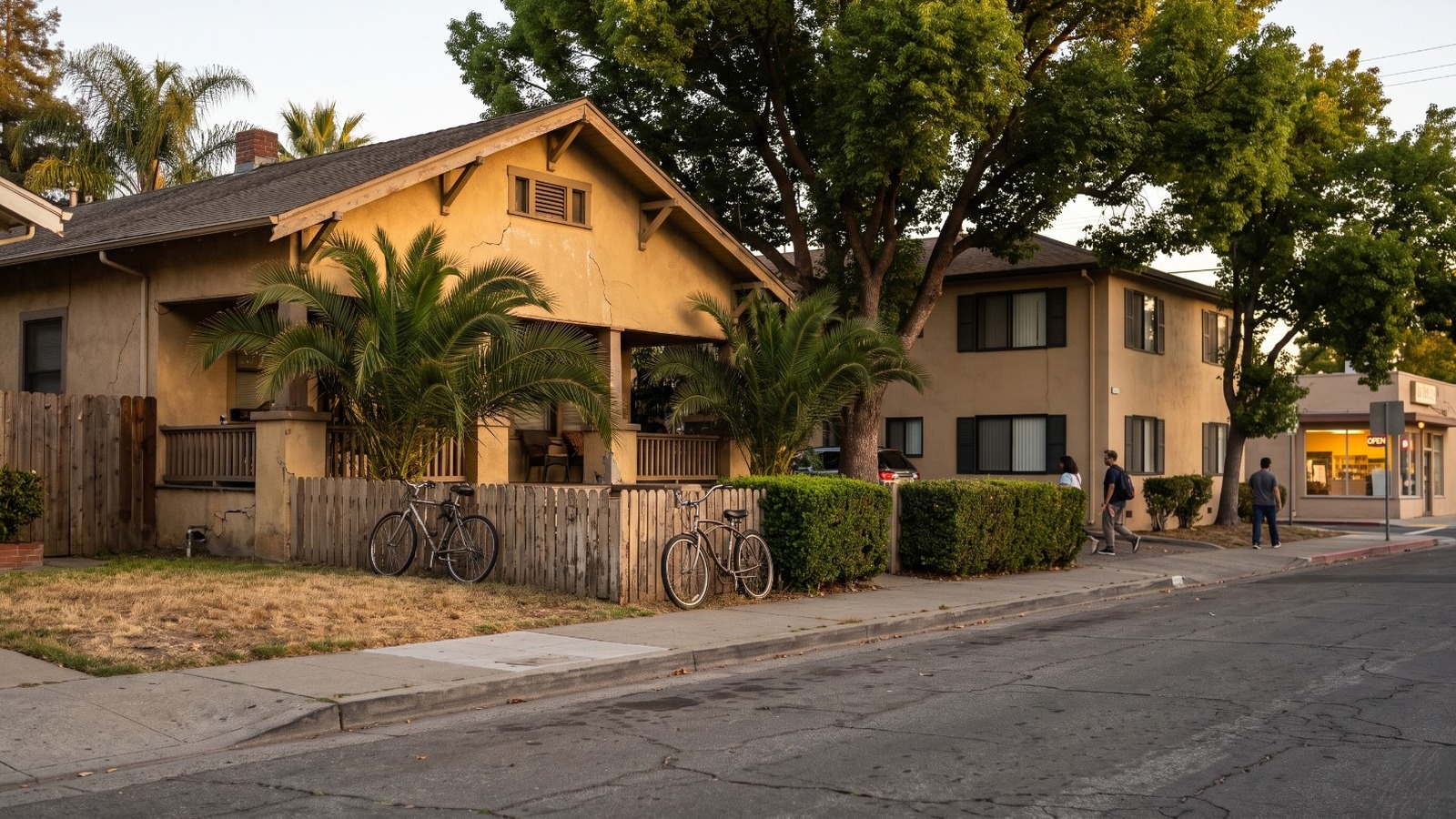
A bungalow block with bikes and a corner storefront beside Santa Clara University, one of the Bay Area campus neighborhoods in our scoring. Photo: Houseberry
Every campus-adjacent neighborhood we score in Berkeley, San Jose and Santa Clara already rates between 3.8 and 5.0 out of 5 on nearby merchants. Their overall scores run from 1.9 to 4.3. That spread is the whole story, and almost none of it is about shops.
This comes up because The Registry reported this week that after the wave of student housing towers, the next Bay Area campus play is the grocery, retail and hotel space at their base. It is a reasonable thesis and I understand the appeal. Our data just keeps pointing somewhere else.
Walk Telegraph on a Tuesday in late August and you can count the closed roll-down gates. Walk it in October and half of them are open again. That seasonal breathing is real and worth fixing. It is not what separates a campus block that works from one that does not.
Six campus blocks, one flat merchant score
Here is the whole set, pulled from our neighborhood pages this morning. Nearby merchants is the sub-score that measures how much is actually within reach on foot, which is the closest thing we have to the metric the retail thesis is aiming at.
| Campus-adjacent neighborhood | Nearby merchants | Safety | Overall | Rank in city | Median price |
|---|---|---|---|---|---|
| South Campus, Berkeley | 5.0 | 4.8 | 4.3 | 2 of 18 | $1.63M (Aug 2026) |
| LeConte / South, Berkeley | 5.0 | 4.1 | 4.0 | 7 of 18 | $1.20M (Jul 2026) |
| Elmwood, Berkeley | 5.0 | 3.7 | 3.9 | 9 of 18 | $2.06M (Aug 2026) |
| Downtown Berkeley | 5.0 | 3.0 | 3.6 | 11 of 18 | $1.20M (Aug 2026) |
| Santa Clara East Central | 3.8 | 3.6 | 3.6 | 3 of 7 | $1.81M (Aug 2026) |
| Downtown San Jose | 4.9 | 1.3 | 1.9 | 112 of 112 | $1.14M (Aug 2026) |
Read down the merchants column and almost nothing moves. Read down the overall column and you fall from the second-best neighborhood in Berkeley to the last-ranked neighborhood in San Jose. The safety column in between explains nearly all of it.
That is not an argument against ground-floor retail. Retail near campus is genuinely useful and the year-round version of it is better than the September-to-May version. It is an argument that the retail is not the constraint, because on this evidence the constraint has already been solved everywhere.
Downtown San Jose has the shops and still ranks last of 112
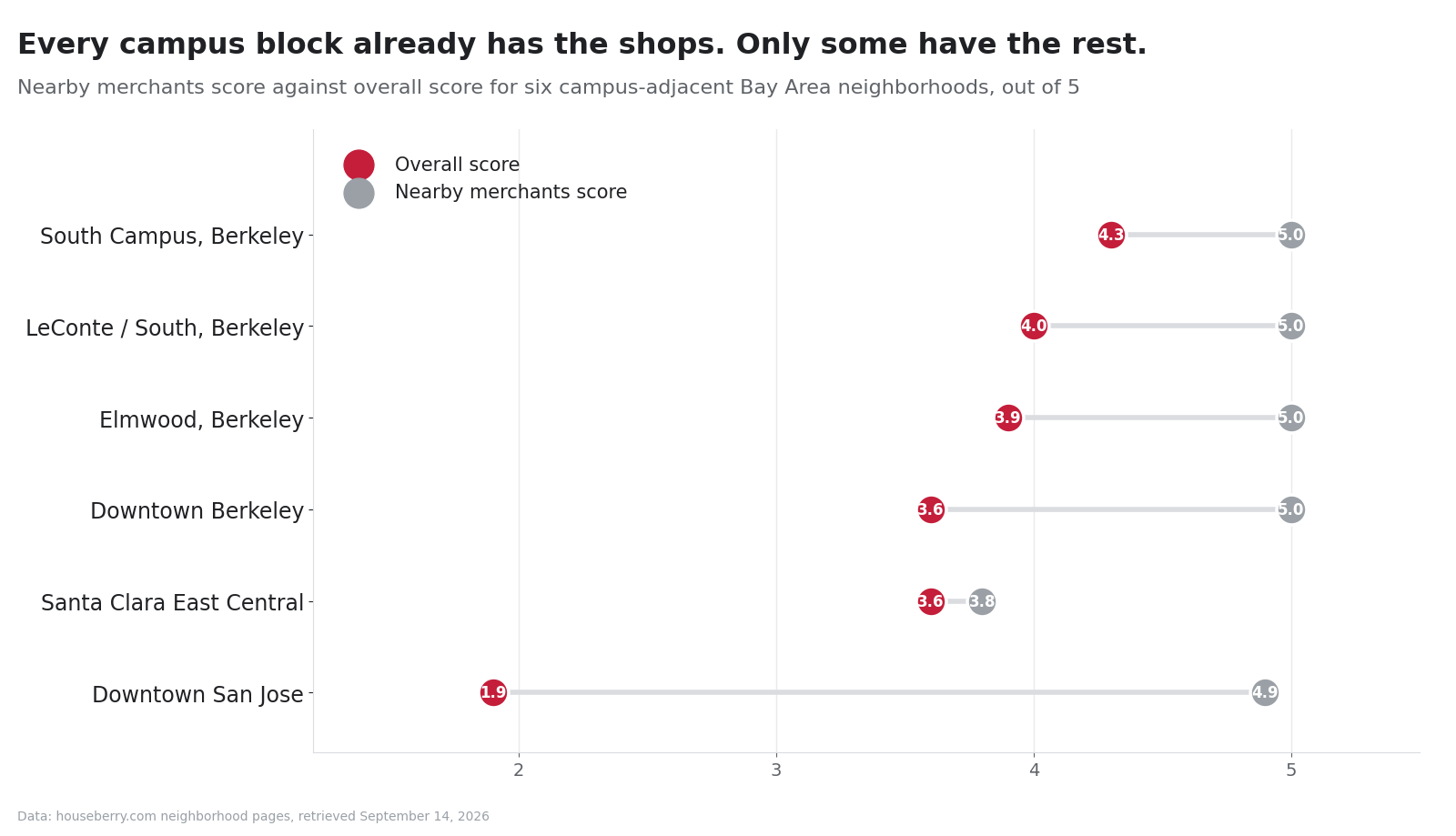
Downtown San Jose is the case that makes the point hardest. It is the historic core of the city, the original 1777 pueblo, with San Pedro Square, St. James Park and the SoFA nightlife strip all inside a ten-minute walk, and it sits directly north of San Jose State. On nearby merchants it scores 4.9 out of 5. There is more within walking distance there than in most of the South Bay.
It also scores 1.3 on safety and ranks 112th of 112 San Jose neighborhoods, with a median of $1.14M in August 2026. Adding another grocery store to that block does not move either of those numbers. The things that would are slower and less photogenic: lighting, maintained public space, consistent street-level activity after 9pm, and enough permanent residents that the daytime crowd and the nighttime crowd are the same people.
South Campus is the opposite case. Same student density, same dependence on an academic calendar, a merchants score of 5.0, and a safety score of 4.8. The difference is not the storefronts. It is that Southside is a dense residential neighborhood with people living above the shops, which is what makes the shops work in the first place, not the other way around.
A note on reading campus scores, because one number will mislead you
If you look up the University of California, Berkeley entry on our site, you will see a safety score of 0.7 out of 5. Do not take that at face value as a read on the surrounding neighborhoods.
That polygon is the campus itself, and campus crime reporting concentrates incidents inside it in a way that no residential boundary does. It is the university, not a place people live. The blocks where students actually rent, South Campus at 4.8 and LeConte at 4.1, score very differently, and those are the numbers that matter if you are signing a lease.
This is a general habit worth having with any neighborhood data, ours included. Check what the boundary actually contains before you let one score decide something.
What this means if you are choosing a block near a campus
The practical version is short. Do not shop for storefront count, because you will get it almost anywhere near a Bay Area campus and it will not distinguish between the options.
Shop for the things the merchant score cannot see. Does the block have residents who are there in August, or does it empty out? Is there a maintained park or plaza, not just a sidewalk? What does the safety score look like relative to the rest of the city, which is the comparison that matters more than the raw number? And is there a full grocery store rather than four places to buy a sandwich, because that is the single amenity that separates a neighborhood from a strip of student services.
On that last point the Registry thesis and our data actually agree. The gap on Telegraph is not shops in general, it is the everyday, year-round kind, which is part of why we thought the Amoeba project’s 68 apartments were worth paying attention to this morning. More people living on the block in August is the thing that makes an August grocery store viable. The housing comes first and the retail follows it, not the reverse.
We built Houseberry around that order of operations, which is why our pages lead with the area rather than the listing. If you are weighing campus-adjacent options across the region, the East Bay ranking and our earlier piece on the student housing crunch are the two places I would start.
Sources
- After the student-housing towers, the Bay Area’s next campus play is everything at their base, The Registry, September 14, 2026
- Neighborhood scores, sub-scores and median prices: houseberry.com neighborhood pages for South Campus, LeConte / South, Elmwood, Downtown Berkeley, Santa Clara East Central and Downtown San Jose, retrieved September 14, 2026
Map of East Bay Neighborhoods
Loading map...
View Full Map
Top Neighborhoods in East Bay, CA





All information provided on this website including but not limited to - school ratings, safety, amenities, user opinions, and property data - is for general informational purposes only. We do not guarantee its reliability, accuracy, or completeness. Users should independently verify information and consult appropriate professionals as needed. By using this website, you agree Houseberry is not responsible for actions, decisions, or consequences arising from reliance on the information provided
houseberry.com - CA DRE# 01847391
 Bay East ©2025. CCAR ©2025. bridgeMLS ©2025. Information Deemed Reliable But Not Guaranteed. This information is being provided by the Bay East MLS, or CCAR MLS, or bridgeMLS. The listings presented here may or may not be listed by the Broker/Agent operating this website. This information is intended for the personal use of consumers and may not be used for any purpose other than to identify prospective properties consumers may be interested in purchasing. Data last updated at September 14, 2026 12:00 AM