The Bay Area Student Housing Crunch Is a Rent Story
Students near San Jose State and Santa Clara are competing with families for the same scarce apartments. The rent math, and what to check before signing a lease near campus.
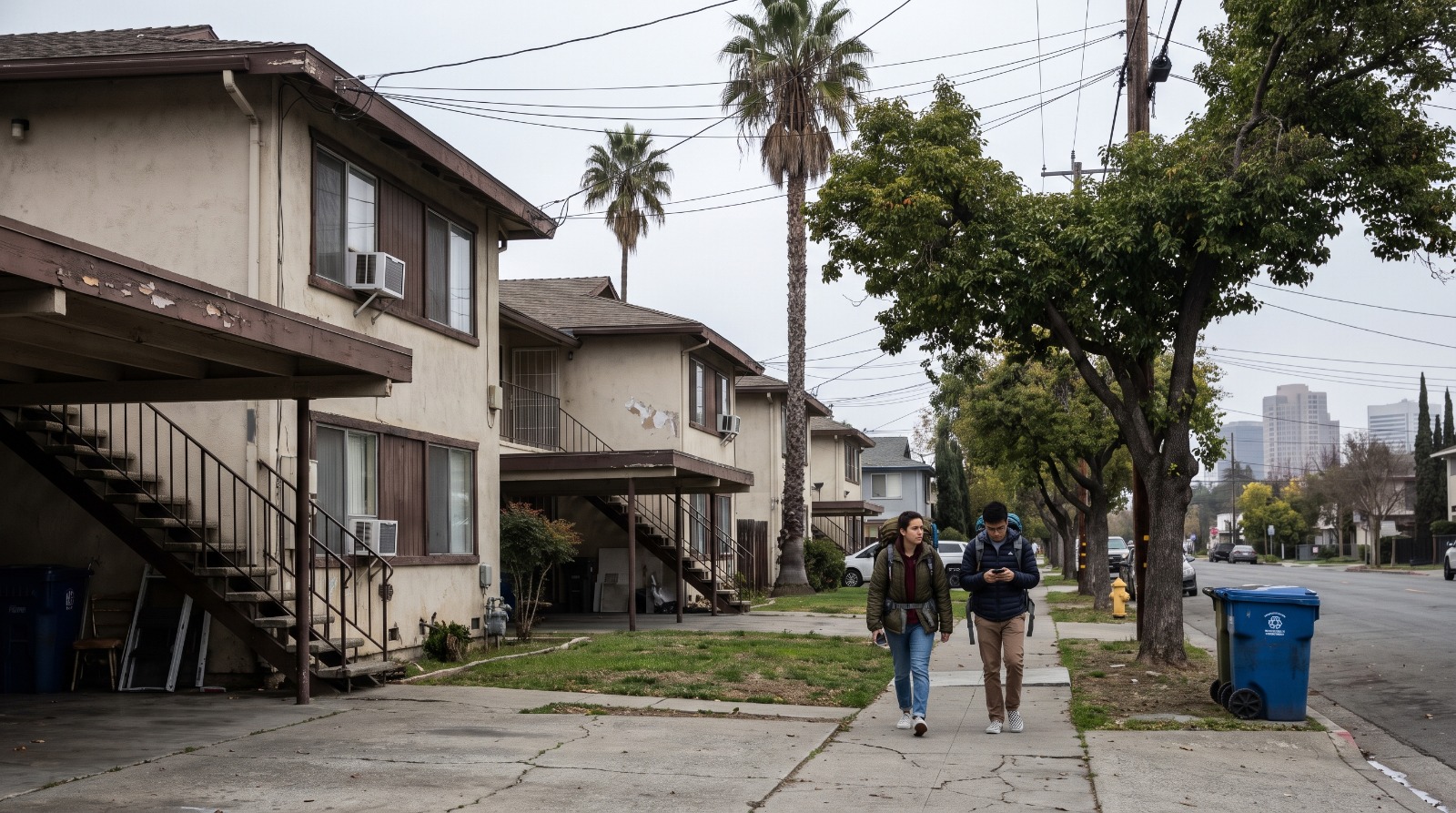
Students walking past older apartment buildings near downtown San Jose, where the Bay Area student housing crunch is hitting hardest. Photo: Houseberry
A pair of twins from Fairfield have been looking for somewhere to live since March. One starts at San Jose State this fall, the other at Santa Clara. They have toured apartments with mold in them and lost units to families bidding over asking. "We're cooked," one of them told NBC Bay Area this week.
Some version of this story runs every August. What makes this year's worth reading closely is that the numbers underneath it have quietly crossed a line.
The dorm is now the cheap option
San Jose State charges roughly $9,000 to $10,000 a semester for on-campus housing with a meal plan included. Call it about $19,000 for the academic year, with utilities, internet, and most of the food already handled.
Now the off-campus version. As of July 2026, Zumper puts the average studio near San Jose State at $2,627 a month, a one-bedroom at $3,150, and a two-bedroom at $3,815, up 8, 11, and 7 percent respectively from a year ago. A studio on a twelve-month lease is about $31,500 before utilities, before the deposit, before furniture, and before a single grocery run.
Split a two-bedroom two ways and you are near $22,900 a person, still above the dorm, and that assumes you find one and win it. This is a reversal. Moving off campus used to be how students saved money. Right now the university is the discount provider and it does not have nearly enough beds.
The blocks closest to campus are the ones our data treats most carefully
There is a pattern in our San Jose scoring that maps almost exactly onto where students look.
Our amenities ranking for San Jose puts Naglee Park, immediately east of the San Jose State campus, second in the city at 4.4 out of 5 for amenities. Its overall score is 2.6. Downtown San Jose scores 3.7 on amenities and 2.0 overall. College Park, just north of campus, runs 3.7 and 2.5. Compare that with Willow Glen at 4.2 amenities and 3.7 overall, or Almaden Valley at 4.0 and 4.1, and the shape of the trade shows up immediately.
The near-campus neighborhoods earn those amenity scores honestly. You can walk to food, transit, a library, a shift at work. What pulls their overall numbers down is the other factors, mostly safety and schools.
For a 19-year-old, that trade is usually the right one. You are buying four years of walkability and you do not have a child in the local elementary school. For a parent cosigning from Fairfield, it is better said out loud in July than discovered in October. A low overall score on a neighborhood you will rent in for four years is a genuinely different question from a low score on a house you plan to own for twenty. Same data, different decision.
Santa Clara reads differently. Our Santa Clara rankings show the blocks around the university carrying the city's best amenities score at 4.0, with the mission grounds and campus-side walkability doing most of that work. It is a smaller rental market with less turnover, which cuts both ways: fewer bad options, fewer options.
This is a supply problem wearing a student costume
It is tempting to file this as a student issue. It is not. Students are simply the least competitive bidders in a market where almost nothing new has been added.
Downtown San Jose has been entitling towers for years and building very few of them, for the same reason the rest of the region has stalled out. "The cost to build has completely outrun what it will bear in rent," a developer told the San Mateo Daily Journal in June. That was a Peninsula quote about a Peninsula slowdown, and the arithmetic is no kinder in the South Bay.
When a region adds jobs and enrollment but not units, the households with the least leverage lose first. This year that is teenagers getting outbid on two-bedrooms. Next year it will be somebody else. Every downtown San Jose tower that gets approved and then sits unbuilt is a few hundred people competing for somebody else's apartment instead.
What to check before signing anything near a campus
A short list, in the order that saves the most grief.
Take habitability seriously. Mold, broken heat, a window that will not lock, none of that is a quirk of student housing. California requires landlords to keep units habitable, and the state's tenant rights guidance is clear that repair requests should go in writing with photos, and that local code enforcement is the escalation path. Handle it before you move in rather than after.
Check the lease term against the school year. Most listings near campus are twelve months, and the summer is what breaks a student budget. Ask what subletting is allowed, and get the answer in writing before signing.
Widen the search along transit rather than by radius. VTA light rail and Caltrain both put a real number of cheaper blocks inside a reasonable commute, and two or three stops out is often several hundred dollars a month.
And research the neighborhood, not just the listing. Photos will not tell you which block goes quiet at night and which one does not, and a leasing office has no incentive to. Reading the area before the address is most of what we do at Houseberry, and it matters just as much on a twelve-month lease as it does on a thirty-year mortgage.
The part worth telling a first-time renter
The crunch is real and it is not the students' fault. But the useful version of this story is not that the Bay Area is impossible. It is that the cheapest bed near a Bay Area campus this fall is very likely the one the university is selling, that the neighborhoods with the shortest walk to class carry trade-offs worth naming in advance, and that a lease signed in a panic in August is a decision you live inside until next July.
Apply for campus housing early next time. That advice arrives too late for the twins. It is still the truest sentence in this article.
Sources
NBC Bay Area, Bay Area college students struggle to find affordable housing
Zumper, average rent near San Jose State University
San Mateo Daily Journal, new housing on the Peninsula has plummeted
All information provided on this website including but not limited to - school ratings, safety, amenities, user opinions, and property data - is for general informational purposes only. We do not guarantee its reliability, accuracy, or completeness. Users should independently verify information and consult appropriate professionals as needed. By using this website, you agree Houseberry is not responsible for actions, decisions, or consequences arising from reliance on the information provided
houseberry.com - CA DRE# 01847391
 Bay East ©2025. CCAR ©2025. bridgeMLS ©2025. Information Deemed Reliable But Not Guaranteed. This information is being provided by the Bay East MLS, or CCAR MLS, or bridgeMLS. The listings presented here may or may not be listed by the Broker/Agent operating this website. This information is intended for the personal use of consumers and may not be used for any purpose other than to identify prospective properties consumers may be interested in purchasing. Data last updated at September 15, 2026 12:00 AM