How Many Data Centers Does San Francisco Have? We Counted
City Hall does not track data centers, and published counts run from 5 to 16. We went address by address, found 12 real street addresses and 4 buildings the operators will vouch for, and mapped every one to the neighborhood it sits in.
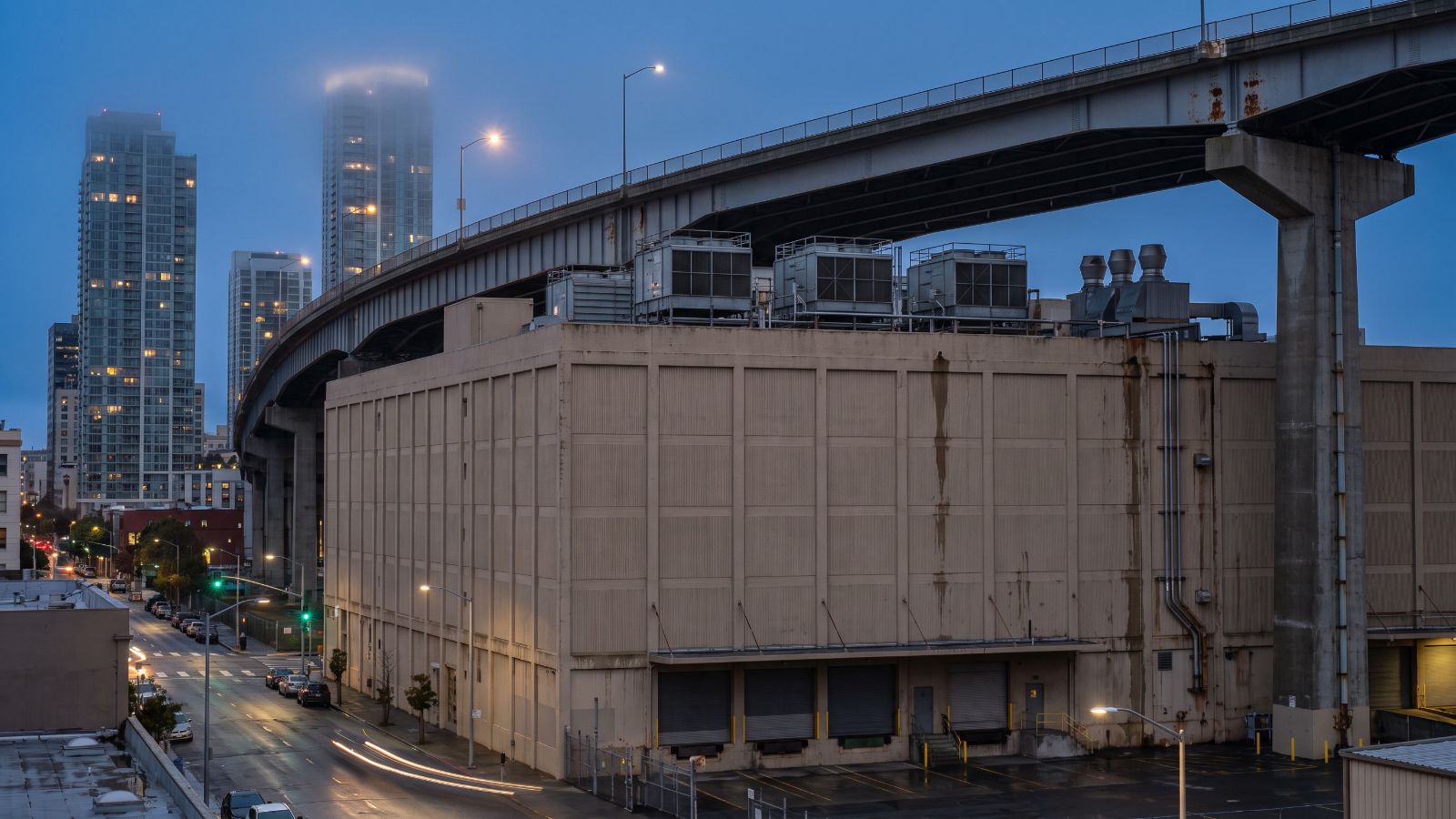
A windowless concrete building with rooftop cooling units under the Bay Bridge approach in Rincon Hill, the kind of site where San Francisco data centers hide. Photo: Houseberry
Sixteen listings. Twelve street addresses. Four buildings whose operators will still put their name on it in September 2026. That is San Francisco's data center count once you do it by hand, which, it turns out, nobody at City Hall has.
The San Francisco Standard reported on September 22 that the Planning Department does not track how many data centers the city has, and cannot say how many permits it has approved for them. So we built the list ourselves from operator websites, the commercial directories, and the one environmental filing on record. Every address we found sits in the eastern third of the city, and every neighborhood holding one scores below the San Francisco average on our data.
Why City Hall cannot tell you the number
The city cannot count data centers because its code has no category called data center. The closest thing is an internet services exchange, a use definition written in 2001 and approved case by case as a conditional use. A server hall gets filed under that label, or as an accessory to an office, or as a telecom building that has been one since the 1980s. There is no box to tick and so no list to pull.
"We do not track the number of data centers in San Francisco," Planning spokesperson Patrick Hannan told the Standard. Supervisor Shamann Walton's version was blunter: "We cannot continue to use rules from 2001 to define what data centers are."
The paper trail does exist in places, if you know the old name. The clearest one I found is a 2014 mitigated negative declaration for 320-400 Paul Avenue, filed on CEQAnet as an Internet Services Exchange. It describes a 243,000-square-foot facility on 7.3 acres of PDR-2 land bounded by Bayshore Boulevard, San Bruno Avenue and Paul Avenue, fed by two new underground 12-kilovolt circuits carrying 24 megawatts from PG&E's Martin substation. That site is Novva's campus today. It was on the public record twelve years ago, just not under a name anyone searches for.
We counted San Francisco's data centers address by address
The honest count depends on what you are counting, and the published numbers are counting different things. KQED put the figure at 12 data centers. Mission Local said 15 regional campuses. The Standard said at least six known sites with a dozen operators. The directories disagree with each other too: Compute Atlas lists 5, Datacentermap lists 10, Kadoa tracks 12, and Inflect shows 16 operator listings.
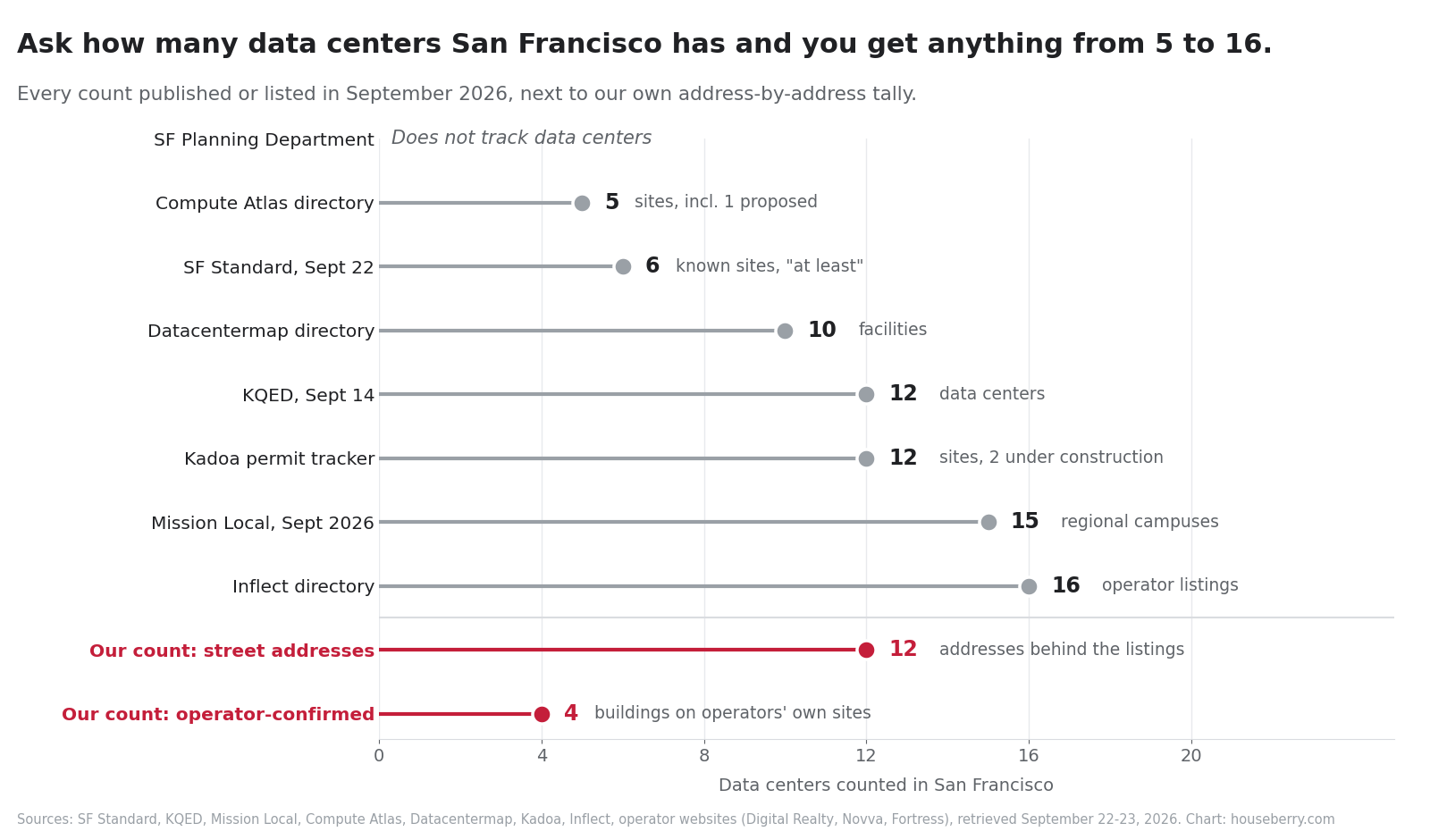
Here is how we got from 16 to 4. Many of the Inflect listings are tenants sharing one building. Four separate operators list 200 Paul Avenue alone, and two list 365 Main Street. Stripping the duplicates leaves 12 street addresses. Then we asked a harder question of each one: does the company running it still advertise it on its own website this month? Four clear that bar.
- 200 Paul Avenue. Digital Realty's SFO10, 495,000 square feet over five levels, the city's main carrier interconnection hub.
- 400 Paul Avenue. Novva's San Francisco campus, 7.5 acres with 182,000 square feet of data halls and a 36-megawatt design. Nine megawatts came online this summer, with the rest planned through 2028.
- 365 Main Street. Digital Realty's SFO12, 227,000 square feet on six levels in a building the company says was built as a military tank assembly plant.
- 274 Brannan Street. Fortress SF1, inside the 1923 Hawley Terminal Building, a telecom switching site since 1982 and a data center since 2015.
The other eight (185 Berry, 630 Third, 360 Spear, 60 Federal, 501 Second, 651 Brannan and 650 Townsend Streets, plus 375 Newhall Street) show up only in directories. Some are carrier rooms inside telecom buildings. 650 Townsend is a big office building whose server floor carries old brand names. Unconfirmed is not the same as gone. It means nobody is publicly vouching for it.
Where San Francisco's data centers actually sit
Every address in our count lands in one of three clusters, and all three are on the east side of the city. We matched each address to the Houseberry neighborhood it sits in or borders. The pattern is not subtle.
| Neighborhood | Addresses in our count | Overall score | Rank of 92 |
|---|---|---|---|
| South Beach and Rincon Hill | 365 Main, 274 Brannan, 360 Spear, 60 Federal, 630 Third, 501 Second | 3.1 | 66th |
| Mission Bay | 185 Berry | 3.3 | 59th |
| South of Market | 651 Brannan, 650 Townsend | 2.1 | 90th |
| Bayview, with Silver Terrace and Portola bordering Paul Avenue | 200 Paul, 400 Paul, 375 Newhall | 2.3 (Bayview), 2.7, 2.8 | 87th, 82nd, 78th |
| Central Waterfront/Dogpatch (proposed only) | 1215 Michigan | 2.9 | 71st |
| San Francisco citywide | 12 addresses | 3.5 | 92 ranked |
Two things jump out. Half the addresses are in the South Beach and Rincon Hill cluster, where the old warehouse and telecom buildings near the Bay Bridge now share blocks with high-rise condo towers. And the heaviest power users, the Paul Avenue pair, sit on the industrial seam where Bayview, Silver Terrace and Portola meet at the 101 interchange.
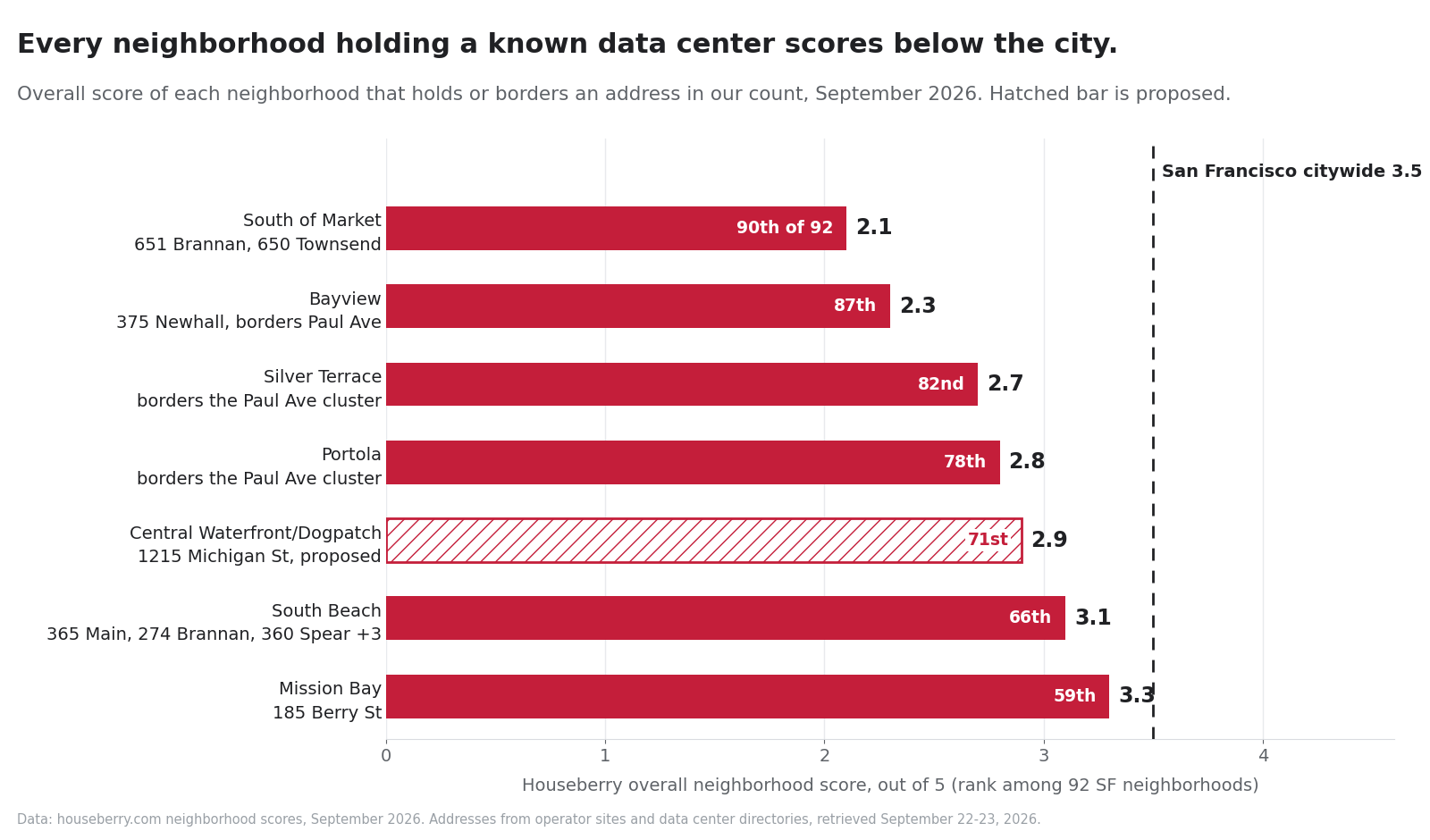
Be careful with what that chart does and does not say. Data centers did not lower these scores. A century of industrial zoning did, and data centers followed the same zoning, the same fiber routes along the old rail easements, and the same heavy power lines. What the chart does show is who absorbs the rooftop chillers and the diesel generator tests. It is never Presidio Heights or the Outer Sunset, and on the 92-neighborhood San Francisco ranking, none of the 17 neighborhoods scoring 4.0 or better holds a single address on our list.
A moratorium without an inventory is a pause on something you cannot see
Three Bay Area cities are reaching for the pause button at once. Walton introduced San Francisco's 45-day moratorium at the Board of Supervisors on September 15 with Connie Chan, Jackie Fielder and Chyanne Chen, extendable to 22 months and 15 days. Hayward's council voted 7-0 on September 15 to have staff start a moratorium, returning in October, after the 310,000-square-foot Stack project at 26203 Production Avenue was approved in May 2025. And Oakland's version, which we walked through when Carroll Fife proposed it, cleared a committee on September 23, the Oaklandside reported.
I get the impulse. But a pause does nothing about the buildings already running, and in San Francisco nobody can say with confidence how many that is. The fix is cheap and boring: define a data center by its electrical load, require a public registry of every site above that line, and put the megawatts, the backup generator count and the cooling type on it. San Jose, Santa Clara and Milpitas already have data center definitions in their codes. San Francisco is using a label from the dial-up era.
And from where I sit, the registry is also a housing tool. The big fights ahead are about land, the four acres at 1215 Michigan Street that we wrote about in our Dogpatch zoning piece being the obvious one. A city that knows exactly how much industrial land is already committed to server halls can make a much better argument about which parcels should become homes instead.
Questions people are asking
Is there a data center on my block?
If you live in the Richmond, the Sunset, the Marina, Noe Valley or anywhere else on the west side, none of the 12 addresses is near you. On the east side, check the address list above, then look up nearby parcels on the city's Property Information Map, where permits and conditional use records attach to each lot. Rows of boxy rooftop units on a windowless building are the giveaway.
Do data centers use a lot of power in San Francisco?
By city standards, yes. The 400 Paul Avenue campus was designed around 24 megawatts of new PG&E service in 2014 and now advertises 36. The proposed Dogpatch site was listed at 49.5 megawatts, which would make it the largest in the city.
Can San Francisco ban new data centers?
It can pause them. California's interim ordinance law caps a moratorium at about two years, which is why every Bay Area proposal pairs the pause with a promise of permanent rules. What it cannot easily do is undo a use already permitted.
What happens next
The next markers are close together. San Francisco's moratorium still needs a four-fifths vote of the Board, and Hayward's staff report is due back in October. Watch whether either one asks for the inventory first. If you are shopping on the east side of the city, pull up the neighborhood on our South Beach page or any other, then walk the block. Knowing what hums behind the blank wall down the street is exactly the kind of neighborhood-first homework we built Houseberry for.
Sources
KQED: San Francisco supervisors push for moratorium on new data centers, September 2026
Digital Realty: SFO10, 200 Paul Avenue
Digital Realty: SFO12, 365 Main Street
Novva Data Centers: San Francisco facility
Fortress Data Centers: SF1, 274 Brannan Street
Inflect: data centers in San Francisco
Datacentermap: San Francisco data centers
Compute Atlas: data centers in San Francisco County
Kadoa: San Francisco data center sites
The Oaklandside: Data center moratorium clears key hurdle in Oakland, September 23, 2026
San Francisco Planning: Property Information Map
Houseberry: San Francisco neighborhood rankings, September 2026
Map of San Francisco Neighborhoods
Loading map...
View Full Map
Top Neighborhoods in San Francisco, CA





All information provided on this website including but not limited to - school ratings, safety, amenities, user opinions, and property data - is for general informational purposes only. We do not guarantee its reliability, accuracy, or completeness. Users should independently verify information and consult appropriate professionals as needed. By using this website, you agree Houseberry is not responsible for actions, decisions, or consequences arising from reliance on the information provided
houseberry.com - CA DRE# 01847391
 Bay East ©2025. CCAR ©2025. bridgeMLS ©2025. Information Deemed Reliable But Not Guaranteed. This information is being provided by the Bay East MLS, or CCAR MLS, or bridgeMLS. The listings presented here may or may not be listed by the Broker/Agent operating this website. This information is intended for the personal use of consumers and may not be used for any purpose other than to identify prospective properties consumers may be interested in purchasing. Data last updated at September 25, 2026 12:00 AM