1215 Michigan St: The Dogpatch Data Center Question
A 160,000-square-foot, 49.5-megawatt data center has been floated for a four-acre crane yard on the Dogpatch waterfront. The parcel is zoned PDR-1-G, where new housing is not allowed at all, and that one fact reframes the whole argument.
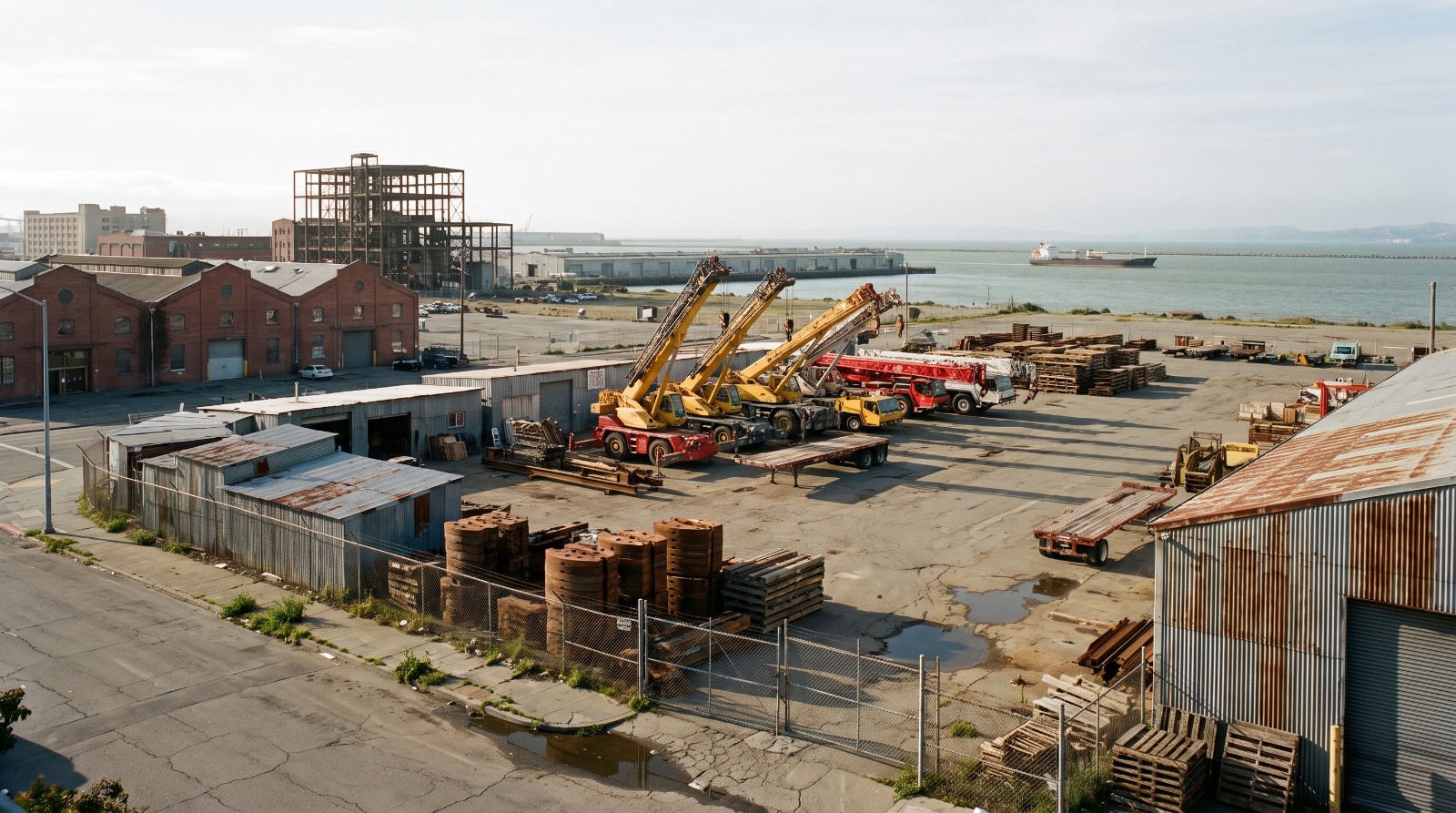
Industrial crane yard and warehouses on the Dogpatch waterfront near 1215 Michigan Street in San Francisco. Photo: Houseberry
For a few weeks this summer, Bay Area real estate people traded a rumor about a $350 million waterfront investment that nobody could actually find. It turns out to have an address, and the address is a crane yard.
The San Francisco Chronicle reported on September 19 that a firm called Nestory Park Capital has been talking to City Hall about a 160,000-square-foot data center at 1215 Michigan Street, four acres of Dogpatch that open straight onto the bay. Nothing has been filed. The property has not sold. And the single fact that decides how you should read all of this is one nobody has mentioned: housing is not legal on that parcel today. It is zoned PDR-1-G, where new residential is prohibited outright.
The rumor had an address, and it is a crane yard
The site is four acres on the central waterfront, one of the largest privately held underdeveloped industrial parcels left in Dogpatch, the low-rise former workers neighborhood between Interstate 280 and the bay south of Mission Bay. It has been Sheedy Drayage for decades, a crane rental and rigging operation still run by the owners, R.P. Stagg & Co. LLC.
The would-be buyer is Nestory Park Capital, launched in late 2024 out of El Sobrante and headed by David Flaherty, who founded Flair Diversified Properties in 1989 and whose San Francisco portfolio runs to 400 Alabama Street in the Mission and 520 Townsend Street in SoMa, Stripe's first real headquarters. Nestory Park's portfolio page lists exactly two projects: the unnamed San Francisco flagship at 49.5 megawatts, and 200 megawatts on 90 acres in Council Bluffs, Iowa.
Public records show the firm and its lobbyist Boe Hayward met last month with Ned Segal, Mayor Daniel Lurie's chief of housing and economic development, about permits for the site. A source told the Chronicle the thinking involves a tenant co-locating in office space there.
That is the whole record. No application, no CEQA filing, no recorded sale, and no comment from the owner, the developer or the Mayor's Office. Anyone telling you a data center is coming to Dogpatch is ahead of the paperwork by a considerable margin.
The parcel allows a crane yard. It does not allow an apartment.
This is the part I went and checked myself, because the whole argument turns on it. San Francisco's parcel record for Block 4241, Lot 004 lists the zoning as PDR-1-G, Production, Distribution and Repair - 1 - General, in Supervisorial District 10, current as of May 31, 2026.
PDR districts exist to keep industrial land industrial. The Planning Department's own summary of the Eastern Neighborhoods rezoning is blunt about what that means: in PDR zones, residential development is prohibited and office and retail are limited. The Central Waterfront Area Plan goes further. Objective 1.7 commits the city to retaining the area's PDR role, Policy 1.7.1 restricts conversions, and Policy 1.7.2 says any rezoning of this land should only be considered inside a five-year monitoring report, specifically so industrial acreage does not leak away one parcel at a time.
Two recent upzonings did not reach it either. The Family Zoning Plan was signed December 12, 2025 and took effect January 12, 2026, and it aimed at the west and north sides of the city. The parcel was still PDR-1-G in the city's data five months later. And San Francisco's alternative plan for SB 79, signed May 8, 2026, permanently excludes parcels inside its Industrial Employment Hubs, one of which is Bayshore-Potrero. Neither state nor local upzoning has opened this ground to homes.
Three futures for four bayfront acres. What each one is actually allowed to do on the site today, and what it delivers.
| Use | Allowed under today's zoning? | Homes delivered | What the block becomes |
|---|---|---|---|
| Sheedy crane yard, as it stands | Yes. A PDR use in a PDR district, no approval needed | 0 | Four fenced acres of parked cranes on the bay, as since the 1900s |
| Data center, 160,000 sq ft and 49.5 MW as listed | Likely, as an internet service exchange, a conditional use decided by the Planning Commission under a 2001 definition | 0 | A large tax base, a heavy electrical load and a small permanent staff behind a blank wall |
| Housing | No. New residential is prohibited in PDR-1-G. It needs a rezoning first | About 359 at the density approved one block away | Homes, street life and public access to four acres of shoreline |
Read that middle column twice. The use with the shortest legal path to this site is the data center. The use with no legal path at all, absent a rezoning nobody has proposed, is housing.
So is this a data center, or the opening bid in a land play?
The land-play theory is a good one and it deserves a real hearing. It goes like this. Lead with housing on a four-acre industrial waterfront parcel and you buy yourself a two-to-five-year entitlement fight in which every ask sounds like a favor. Lead with a 49.5-megawatt data center and the neighborhood mobilizes hard, and then housing arrives as a concession rather than a request. Anchoring. The second ask always looks reasonable next to the first one.
The counter-case is stronger than I expected. A 49.5 megawatt figure is an engineering number, not a negotiating posture. Nobody puts a specific load on a public portfolio page as theater. The firm hired a well-known City Hall lobbyist and got a meeting with the mayor's economic development chief, which is what people do when they intend to permit something. And a parcel a block from the switchyard of a decommissioned power plant is, unsentimentally, a very good data center site.
Then add the zoning, and the theory mostly inverts. A developer running the anchoring play needs housing to be the plausible fallback. Here it is the thing the code forbids. You would be opening with the easy ask and retreating to the impossible one.
The Power Station amendment is the part I would actually watch
One block north, Fifth Space, formerly Associate Capital, is building out the 29-acre Dogpatch Power Station site, approved for about 2,601 homes with 30 percent below market rate plus 1.6 million square feet of commercial space. In plans filed this summer, the company said it would study a small data center on that site.
The detail that matters is what it was filed alongside. The data center study went in as part of a package of development agreement amendments that also raised heights on future residential buildings and added zoning flexibility, changes framed as improving the project's feasibility. The Planning Commission recommended that package unanimously and sent it to the Board of Supervisors.
Enrique Landa, who runs Fifth Space, told the Chronicle the data center was only ever contemplated as an accessory use next to workforce housing, office and research space, in case a large user wanted it, and that they never intended to build a large data center. He confirmed Friday that the team is pulling that amendment before the package reaches the board, citing community sensitivity, and said they are looking forward to building housing.
Good. Now the honest question, which I cannot answer from the public record yet: do the height increases survive the retraction? If the data center comes out and the heights stay in, that is a developer who traded a study nobody wanted for entitlements everybody will live with. Not a scandal. Ordinary negotiation, and in this case it produces taller residential buildings, which I am in favor of. But it is the closest thing we have to the anchoring move done in public, and it is checkable. It shows up in the Board of Supervisors file for the development agreement amendment and the Planning Commission packet behind it.
Why 49.5 megawatts is a number worth staring at
Forty-nine and a half is conspicuously just under fifty, and fifty is a real line in California. It is not the line most people assume.
The California Energy Commission has exclusive authority to license thermal power plants of 50 megawatts or larger, and between 50 and 100 megawatts an applicant can ask for a Small Power Plant Exemption instead. That threshold measures generation capacity, not electricity consumption. A building's load does not trigger it.
But data centers do get caught by it, through their own backup plants. Microsoft filed for exactly that exemption for a 99-megawatt backup generating system at a San Jose data center, docket 19-SPPE-04, and the commission granted it on July 14, 2022.
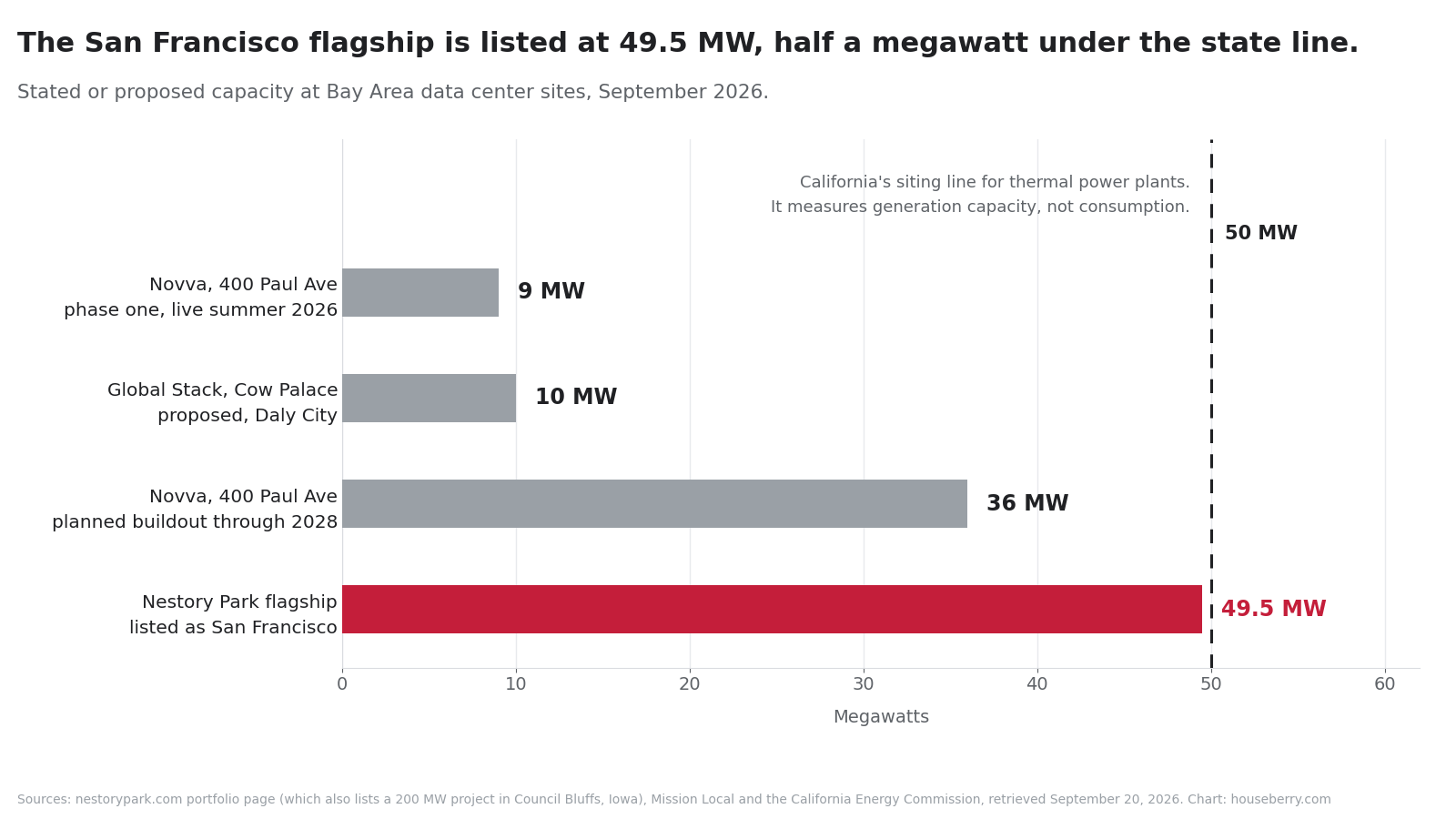
So the fair reading is narrow. A 49.5-megawatt load does not by itself dodge state review, and I am not claiming it was chosen to. What matters is the backup generation a building that size needs, and that number is not public because there is no application. If it clears 50 megawatts aggregate, Sacramento gets a say. A question for the first hearing, not an accusation.
What four acres of bayfront is worth in homes
Here is the comparison the whole debate is missing. The Power Station is approved for 2,601 homes on 29 acres, which works out to about 90 homes per acre. Apply that to the four acres at 1215 Michigan and you get roughly 359 homes on a site that currently holds none and, under its zoning, can hold none.
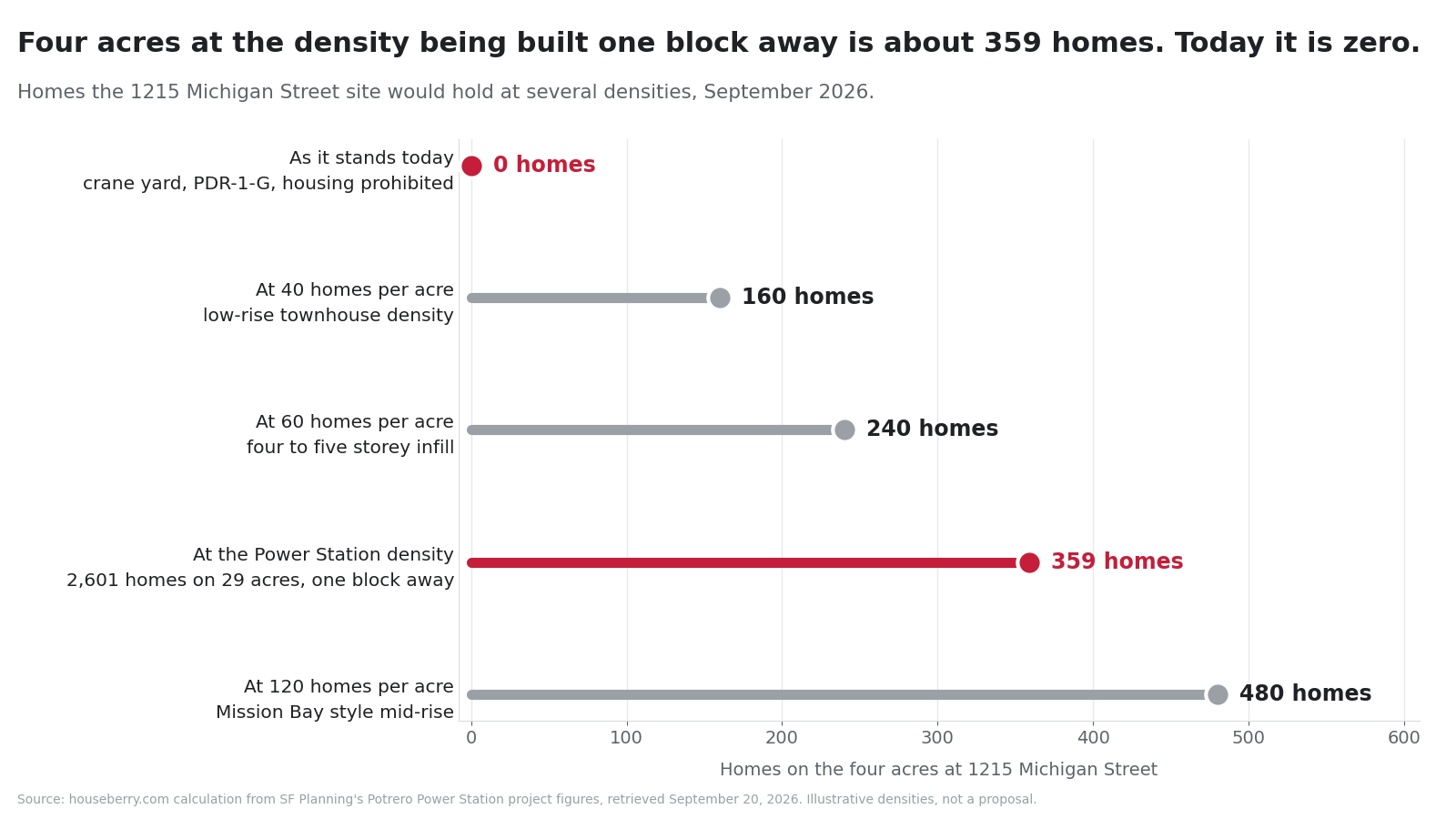
That is not a rounding error in a city that has to permit roughly 36,000 units this cycle. It is a neighborhood block, on the water, next to a Muni Metro line.
And that is why the framing of this fight bothers me. The genuinely bad outcome for Dogpatch is not a data center beating housing. It is four acres of bay-front land sitting as a fenced crane yard for another decade while everyone argues about a project that was never filed.
Dogpatch is already the neighborhood that gets the leftovers
Whatever lands here lands on a neighborhood that scores below the city on everything we measure. Central Waterfront/Dogpatch scores 2.9 out of 5 overall in September 2026, 71st of the 92 San Francisco neighborhoods we rank, against a citywide 3.5.
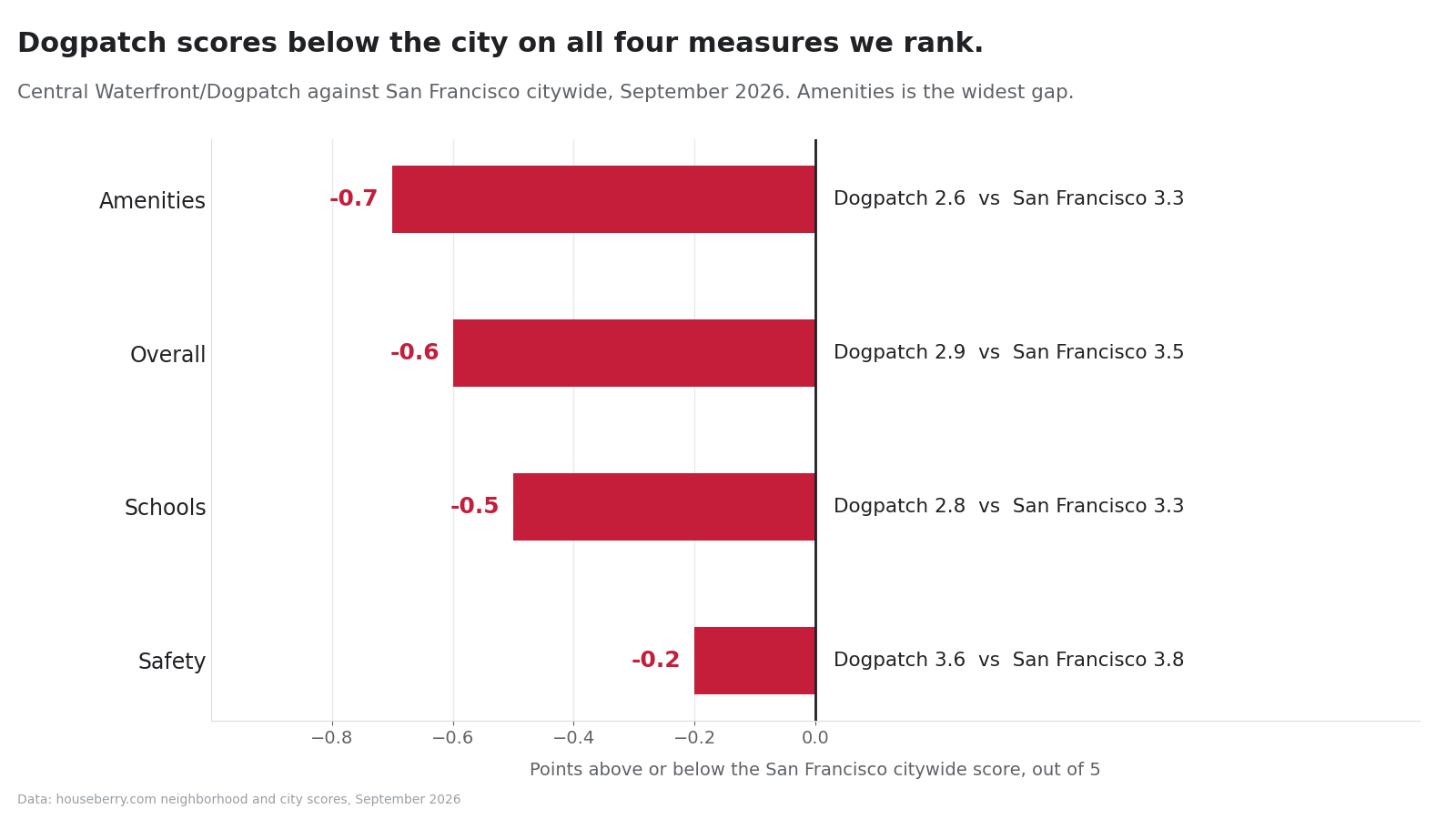
The amenities line is the one to sit with. Dogpatch rates 3.8 for nearby merchants, which is fair, and then 2.5 for public spaces and 2.0 for curb appeal. That is the profile of a neighborhood with good restaurants and almost nowhere to stand outside. Four acres of accessible shoreline would move that number. A windowless building would not, and neither will a crane yard.
On price, be careful. Our 12-month history for Dogpatch sits flat at about $2.1 million every month from September 2025 through August 2026, which is what a median looks like when barely any houses trade. We went through that problem in detail in our three-way comparison of Dogpatch, Potrero Hill and Mission Bay. Treat the neighborhood median here as a rumor with a dollar sign attached, and price specific buildings instead.
What to watch, and in what order
The moratorium is the loud thing and the least consequential. Walton introduced his 45-day District 10 pause on September 15 with Connie Chan, Jackie Fielder and Chyanne Chen, extendable to 22 months and 15 days, and framed it as a step toward a possible citywide ban. His reference points, per Mission Local, are the Novva site at 400 Paul Avenue in the Bayview and a 10-megawatt proposal at the Cow Palace. Eight California counties have done something similar, and Oakland is working through its own version.
A pause stops a data center. It does not start a single home, because the thing standing between this parcel and housing is not a data center application. It is the zoning.
So, in order. Watch the Board of Supervisors file on the Power Station development agreement amendment, for whether the heights survive the retraction. Watch what Planning produces after Segal asked it on September 17 to study criteria for data center pitches, because that is where the 2001 internet service exchange definition gets replaced or does not. And watch whether anyone at City Hall says the quiet part: if San Francisco wants homes on its industrial waterfront rather than a fight about servers, somebody has to propose the rezoning. Nobody has.
Until then, if you own in Dogpatch or you are shopping there, do not price in a data center. Price in uncertainty about four acres you can see from the end of your street, and check how a parcel is zoned before assuming what can be built on it. That habit is most of what we do at Houseberry, and ten minutes of it on any block you are serious about is cheap.
Sources
Mission Local: Data center moratorium before the S.F. Board of Supervisors, September 2026
NBC Bay Area: San Francisco supervisors propose moratorium on new data centers
Nestory Park Capital: portfolio page
DataSF: parcel record for Block 4241, Lot 004, 1215 Michigan Street
SF Planning: Eastern Neighborhoods plans and zoning
San Francisco General Plan: Central Waterfront Area Plan
SF Planning: San Francisco Family Zoning Plan
SF Planning: Senate Bill 79 implementation in San Francisco
SF Planning: Potrero Power Station project page
The San Francisco Standard: JPMorgan pours $200M into Power Station, August 3, 2026
California Energy Commission: power plant licensing and the Small Power Plant Exemption
California Energy Commission: San Jose Data Center backup generating system, docket 19-SPPE-04
Map of San Francisco Neighborhoods
Loading map...
View Full Map
Top Neighborhoods in San Francisco, CA





All information provided on this website including but not limited to - school ratings, safety, amenities, user opinions, and property data - is for general informational purposes only. We do not guarantee its reliability, accuracy, or completeness. Users should independently verify information and consult appropriate professionals as needed. By using this website, you agree Houseberry is not responsible for actions, decisions, or consequences arising from reliance on the information provided
houseberry.com - CA DRE# 01847391
 Bay East ©2025. CCAR ©2025. bridgeMLS ©2025. Information Deemed Reliable But Not Guaranteed. This information is being provided by the Bay East MLS, or CCAR MLS, or bridgeMLS. The listings presented here may or may not be listed by the Broker/Agent operating this website. This information is intended for the personal use of consumers and may not be used for any purpose other than to identify prospective properties consumers may be interested in purchasing. Data last updated at September 21, 2026 12:00 AM