Livermore Las Colinas Deal: Up to 900 Homes, Signed
Livermore executed the Las Colinas Road development agreement on August 5, 2026, setting a ceiling of 605 to 900 homes above Springtown. Here is what the signed deal actually locks in, and what still has to happen.
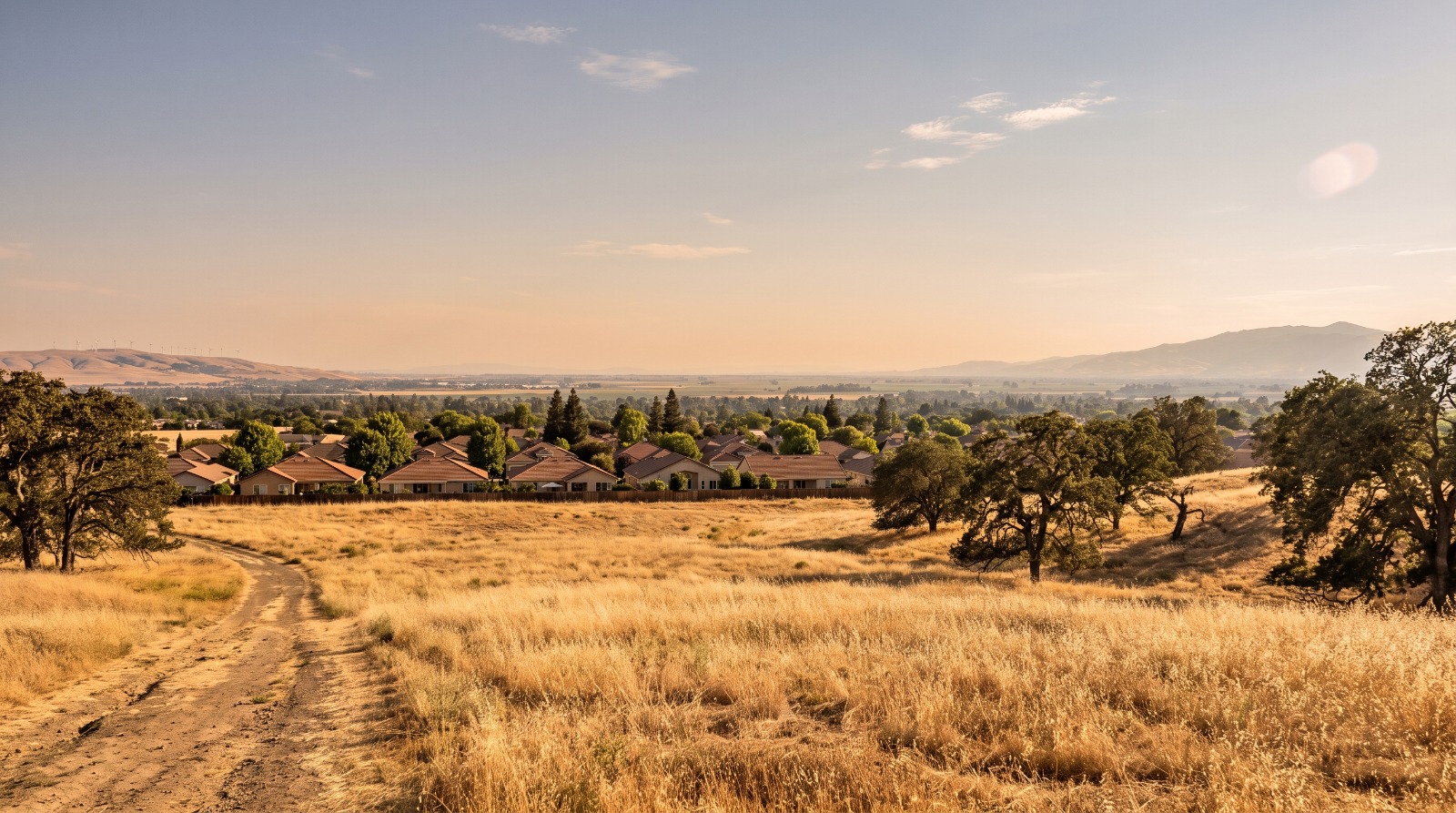
Open golden grassland off Las Colinas Road on Livermore's northern edge above the rooftops of the Springtown neighborhood. Photo: Houseberry
A Catholic high school that never got built just became as many as 900 homes. On August 5, 2026, the City of Livermore filed the Notice of Exemption for Development Agreement 24-004, the paperwork confirming it had executed the agreement covering 3658 Las Colinas Road, a 122-acre property on the city's northern edge above Springtown. The council had voted for it eight days earlier. The filing is what turned that vote into a signed deal.
Nobody is pouring foundations. The agreement grants vested rights and sets a unit ceiling, and that is all it does. But in a city where two voter-approved growth boundaries decide most of what can be built at all, a signed ceiling on 50 developable acres is the part that actually matters.
What the August 5 filing actually did
It moved the project from authorized to negotiate to signed. That distinction is the entire story, because the earlier coverage in July described a council vote, and a council vote on a development agreement is not the same thing as an executed one.
The notice cites CEQA sections 15183(b) and 15183(d) along with the common sense exemption at 15061(b)(3), and it is careful to say the ordinance proposes no specific development and authorizes no physical change. City senior planner Shannon Pagan is listed as the contact. The applicant is Adventus, a nonprofit corporation tied to the Diocese of Oakland that has held the land since the 1990s, with the Diocese's chief financial officer signing as the applicant contact.
The 2005 version of this agreement was for a high school. The Real Deal reported in February 2025 that Adventus had given up on the school and asked for residential zoning instead, initially floating up to 500 homes. Eighteen months of negotiation later the ceiling came in considerably higher, and Adventus agreed to put $6 million into a community benefit fund for Springtown-area infrastructure and amenities.
The agreement at a glance
The specifics worth writing down, because the next round of hearings will be argued against these numbers:
| Item | Detail |
|---|---|
| Site | 3658 Las Colinas Road, Livermore, APN 902-8-1 |
| Total property | About 122 acres |
| Developable area | About 50 acres |
| Unit ceiling | 605 to 900 homes |
| Density range | 8 to 30 units per acre |
| Applicant | Adventus, a nonprofit tied to the Diocese of Oakland |
| Community benefit | $6 million toward Springtown-area infrastructure and amenities |
| Council vote | Unanimous, July 27, 2026 |
| Executed | Confirmed by CEQA filing, August 5, 2026 |
| Still required | Neighborhood Plan, PD zoning, tentative maps, site plan review, project-level CEQA, impact fees |
605 to 900 homes is a large number for a city this size
At the high end this one site would deliver about a fifth of everything Livermore is supposed to build in eight years. The city's 2023-2031 Housing Element carries a Regional Housing Needs Allocation of 4,570 units, and 900 homes is roughly 20 percent of that. Even the 605-unit floor is about 13 percent.
That is unusual. Most Bay Area housing arrives in 40-unit and 130-unit increments, which is why the pipeline math rarely works. A single parcel that can absorb a double-digit share of a city's entire obligation is the kind of site planners quietly build their numbers around.
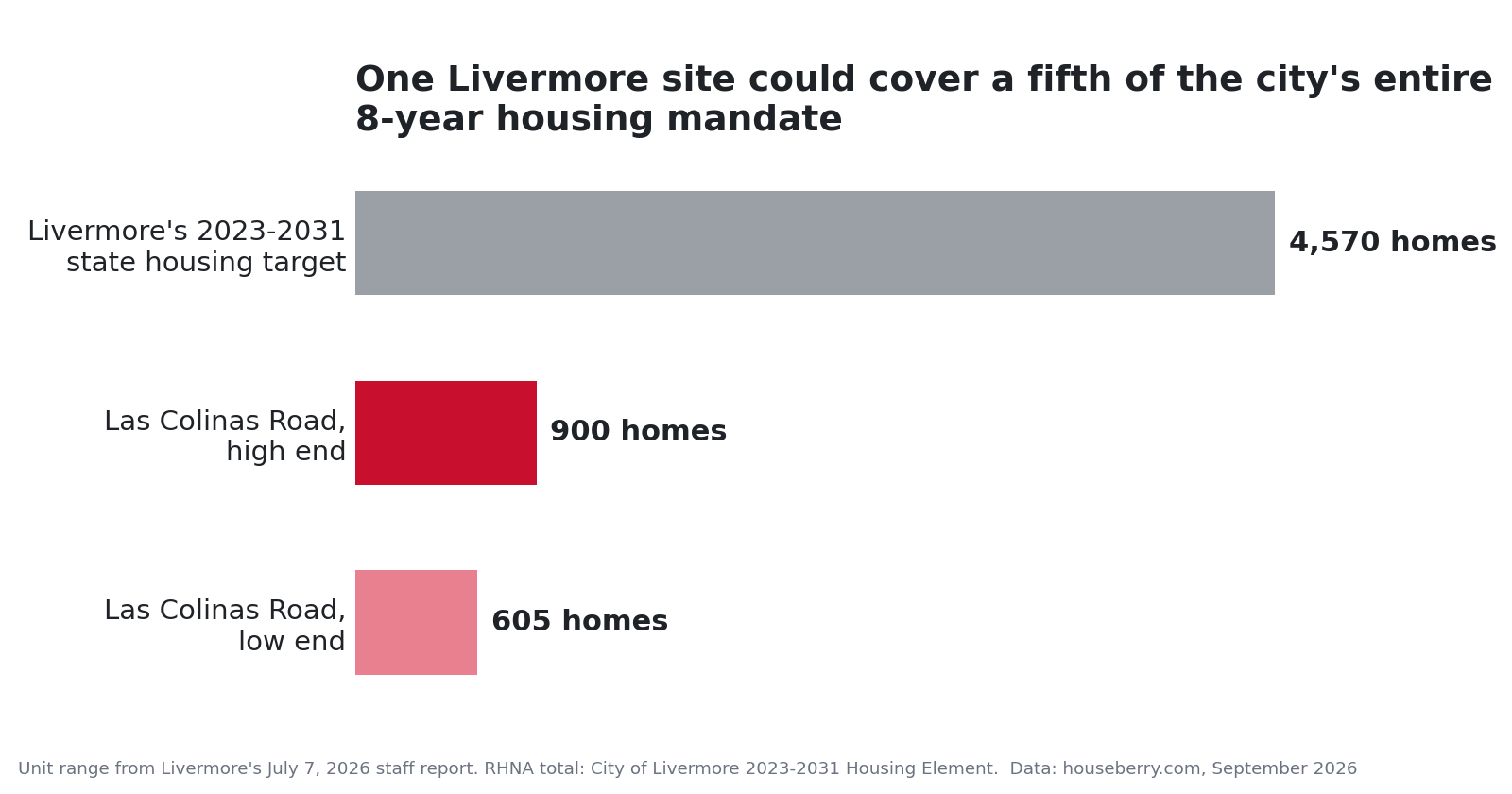
The catch is that a development agreement ceiling is permission, not production. Livermore has been here before. Our earlier look at the Wente family's 1,500-acre land sale found a property roughly twelve times this size that could legally hold about fifteen houses, because the growth boundaries and a 100-acre minimum lot size sit in the way. Las Colinas is the rarer case where the land is actually inside the line.
This lands on the cheaper side of Livermore, and that matters
Springtown is not where Livermore's expensive homes are, which makes it the more interesting place to add several hundred of them. The neighborhood, the planned community on the city's north side off Springtown Boulevard above the I-580 corridor, had a median sale price of about $892,700 in August 2026, according to our Springtown neighborhood page. Livermore's citywide median that same month was about $1.25 million.
That is a 29 percent gap inside one city. For anyone priced out of South Livermore or the vineyard edge, Springtown is already the answer, and it is about to get a few hundred more of whatever gets built next to it.
Springtown ranks 31st of the 42 Livermore neighborhoods we score, with an overall 3.0 out of 5. The interesting part is where that number comes from.
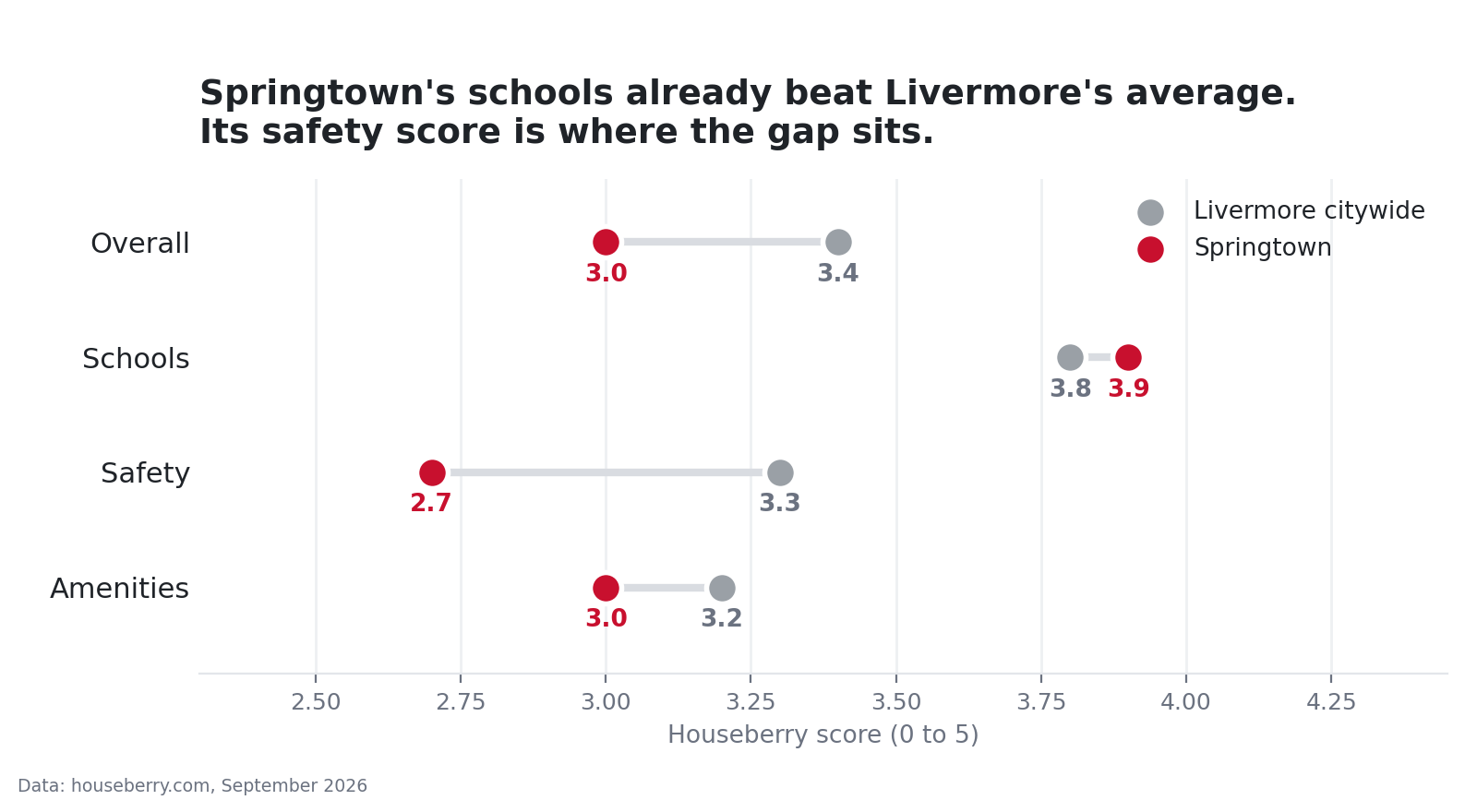
Schools are not the weak link. Springtown scores 3.9 for schools against a citywide 3.8. The gap is safety, at 2.7 against 3.3, which puts it 26th of 42 on our Livermore safety ranking. Fifteen Livermore neighborhoods score a 4 or better on safety. Springtown is not one of them.
A 0.6-point safety gap is not a reason to write off a neighborhood. It is a reason to ask what 605 to 900 new homes, a neighborhood park, new internal streets and a trail network do to it. Streets with more eyes on them and better lighting tend to move that number, slowly. That is the wager the $6 million benefit fund is making.
The school capacity question has an answer most people will not guess
Livermore's school district has been shrinking, not straining. Livermore Valley Joint Unified cut staff positions for the 2025-26 year after a $1.3 million drop in outside funding driven partly by declining enrollment, and it was running reserves of 3.9 percent on a $206 million budget.
So the usual hearing argument, that new homes will overwhelm the schools, does not fit the district's actual finances. Homes delivered over a decade into a district losing students look less like an overcrowding event and more like enrollment backfill, and enrollment is what funds California schools.
The schools nearest the site are on Livermore's north side, including Altamont Creek Elementary and Junction Avenue TK-8, with Granada High serving the north end of town. Attendance boundaries get drawn at the Neighborhood Plan stage, not now, and that document is where the real school analysis will live. Read it when it drops.
The honest downside is the calendar
This is years out, and anyone telling you otherwise is selling something. Nine of the 13 people who spoke at the July 27 hearing raised traffic, safety and access road concerns, which is a reasonable thing to raise about a site reached by two-lane roads. Labor representatives asked for apprenticeship and wage standards and got a non-binding recommendation instead of binding language.
Before a single home is permitted, Adventus needs a Neighborhood Plan, Planned Development zoning, tentative maps, site plan review, project-level environmental review and development impact fees. Livermore is also still working through its General Plan 2045 update, which is the document this land use change rides on. Call it three to five years to first shovels if everything goes smoothly, and Bay Area entitlements rarely go smoothly.
What to do with this if you are shopping north Livermore
Treat it as a reason to look at Springtown now rather than a reason to wait. The pricing gap against the rest of Livermore is real today, the school score is already above the city average, and the thing that would most plausibly change the area, a few hundred new homes with a park and trails attached, is now legally on the table rather than hypothetical.
The way we look at it when we compare neighborhoods, a signed development agreement is a data point about the next ten years, not the next ten months. Watch for the Neighborhood Plan hearing. That is when the 605-to-900 range narrows to an actual number, and when the street layout, the park siting and the school boundaries stop being adjectives. You can see how Springtown currently stacks up against the other 41 neighborhoods on our Livermore rankings while you wait.
Sources
The Real Deal: Diocese scraps school plan in Livermore for up to 500 homes, February 27, 2025
City of Livermore: 2023-2031 Housing Element
The Independent: Livermore school district board reaches decision on final cuts for 2025-26 year
Map of Livermore Neighborhoods
Loading map...
View Full Map
Top Neighborhoods in Livermore, CA


All information provided on this website including but not limited to - school ratings, safety, amenities, user opinions, and property data - is for general informational purposes only. We do not guarantee its reliability, accuracy, or completeness. Users should independently verify information and consult appropriate professionals as needed. By using this website, you agree Houseberry is not responsible for actions, decisions, or consequences arising from reliance on the information provided
houseberry.com - CA DRE# 01847391
 Bay East ©2025. CCAR ©2025. bridgeMLS ©2025. Information Deemed Reliable But Not Guaranteed. This information is being provided by the Bay East MLS, or CCAR MLS, or bridgeMLS. The listings presented here may or may not be listed by the Broker/Agent operating this website. This information is intended for the personal use of consumers and may not be used for any purpose other than to identify prospective properties consumers may be interested in purchasing. Data last updated at September 21, 2026 12:00 AM