Climate money will put 64 homes on Oakland's empty Chinatown lot
The state put $35.9 million behind 64 affordable apartments at 12th and Harrison, and 41 cents of every dollar goes to Broadway and MLK. Here is what the corner gets, what changed in the design, and what Chinatown prices are doing.

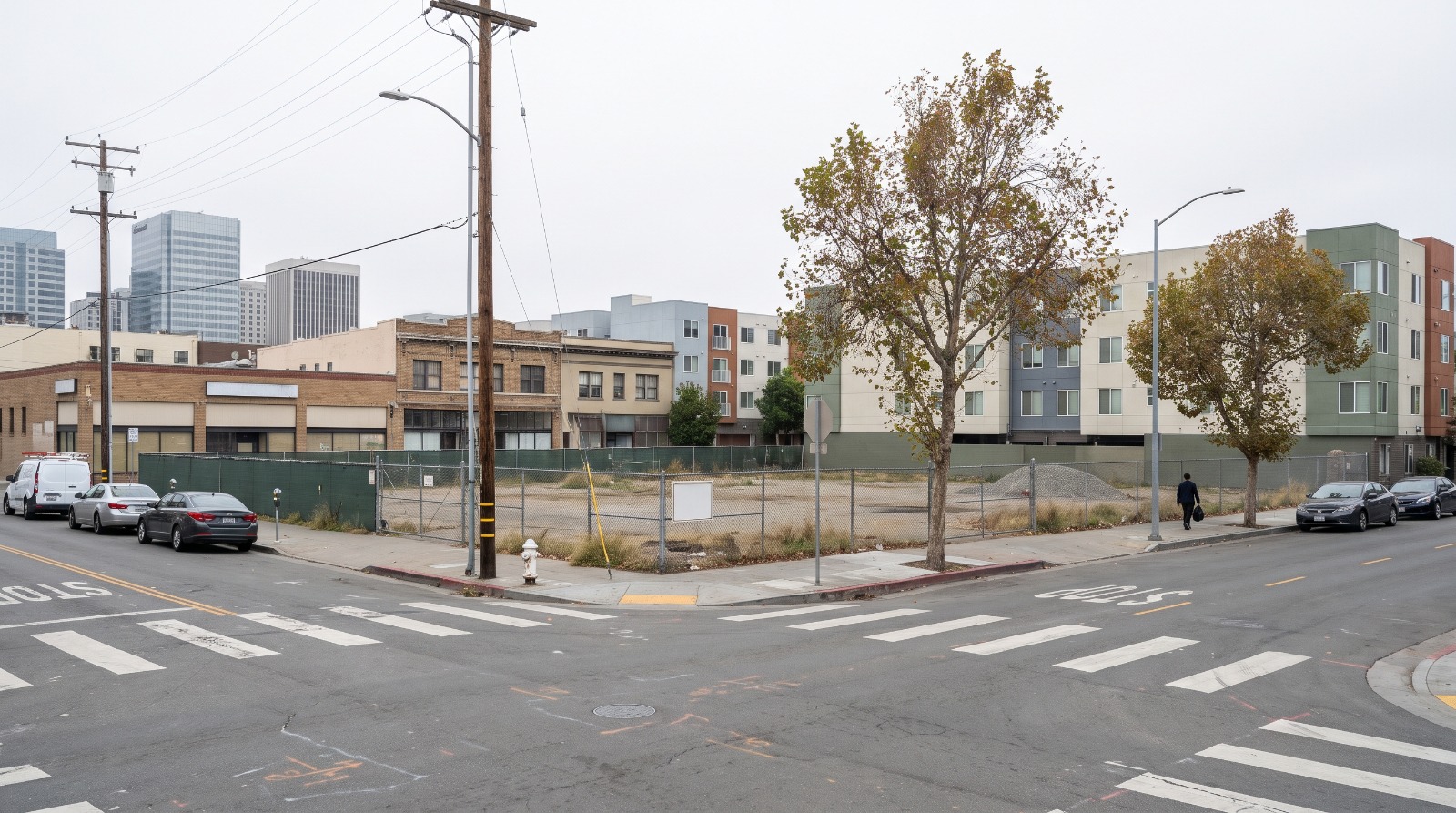
AI-rendered view of the fenced, empty corner lot at 12th and Harrison streets in Oakland's Chinatown on an overcast day Photo: Houseberry
The corner of 12th and Harrison in Oakland's Chinatown is a fenced, empty lot. The only structure a 2021 federal environmental assessment found on it was an unused used-car sales office from 1965. In recent years the ground has served as a charter school's play yard and a construction staging area.
Now it has $35,873,066 from the state behind it. The money comes from California's Affordable Housing and Sustainable Communities program, which spends cap-and-trade dollars on affordable homes only when they come paired with better transit and safer streets. It will help the East Bay Asian Local Development Corporation (EBALDC), Chinatown's longtime nonprofit builder, put 64 rent-restricted apartments and a manager's unit on the lot. The block it sits in is cheap by Oakland standards: Houseberry data puts the typical Chinatown home at about $323,300 in October 2026.
This is a story about what one housing grant buys. About $20.9 million of it is the housing loan. Another $14.6 million, roughly 41 cents of every dollar, goes to bus lanes on Broadway and protected bike lanes on Martin Luther King Jr. Way. On November 2, Oakland's transportation department introduced a resolution amending the March deal in which the council accepted the money. The Public Works and Transportation Committee hears it November 17, and the full council votes after that.
A smaller building than the one approved in 2016
The lot has been approved for apartments for ten years. In August 2016 the Planning Commission approved the Martin Group's two-building Station on 12th plan for 285 and 301 12th Street, with 77 homes on this quarter block, according to the commission's staff report. In 2017 the 285 parcel went to EBALDC for affordable housing. In 2020 the council authorized a $4 million state infill grant application for it. Nothing rose.
The design kept changing. Plans filed in 2024 showed a seven-story, 84-foot building with 17 three-bedroom apartments. The version described in SF YIMBY's July 2026 report on the grading permits is a 60-foot building by David Baker Architects with 11 studios, 42 one-bedrooms and 12 two-bedrooms, 15 parking spaces and room for 70 bikes. The city's own award announcement lists only studios, one-bedrooms and two-bedrooms.
That is the honest trade-off. The three-bedrooms are gone, and those are the hardest affordable units to find in Oakland. We would still take 64 homes with grading permits in hand over 65 on a drawing. The 12th Street BART station is about 0.3 miles away, and Lake Merritt BART is six blocks off.
Four of every ten dollars go to Broadway and MLK
The state does not hand this program's money to housing alone. A project wins by pairing homes with transportation that cuts driving, and Oakland bid two street projects it already had on the books. The city's December 2025 announcement describes them.
| Piece of the award | Amount | What it pays for |
|---|---|---|
| Housing loan | $20,873,066 | 64 affordable apartments at 285 12th Street |
| Transportation | $14,621,000 | Broadway bus lanes, MLK Jr. Way and 7th Street bikeways |
| Programs | $379,000 | Project programs (the award list does not itemize them) |
| Total | $35,873,066 |
On Broadway, the money helps build more than a mile of bus-only lanes, transit signal priority along Broadway and 7th Street, and new boarding islands and shelters. More than 15 AC Transit routes use that stretch. On Martin Luther King Jr. Way and the 7th Street Connection, it pays for more than two miles of protected bike lanes, rebuilt curb ramps, high-visibility crosswalks and pedestrian lighting. Both corridors run through Council Districts 2 and 3.
This is why the transportation department, not the housing department, is carrying the amendment. The housing loan goes to EBALDC. The street work is OakDOT's to deliver, and the city is co-applicant on the whole award. The title posted with the November 2 item says it amends Resolution 91092, adopted March 16, without saying which terms change.
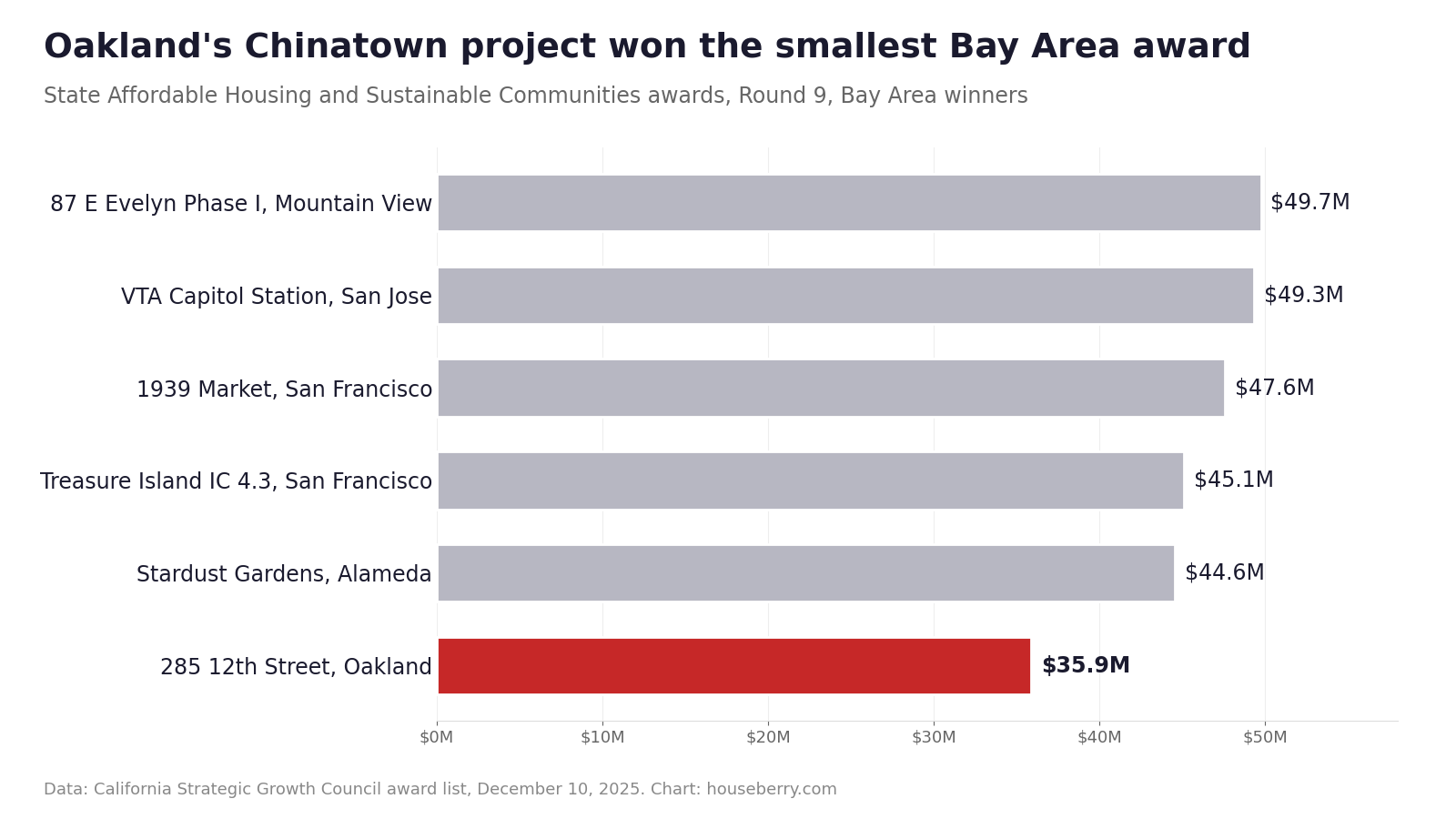
The award is modest by this round's standards. The Strategic Growth Council funded 21 projects statewide for $835.3 million, out of 47 applications. Of the six Bay Area winners, 285 12th Street got the least. North Berkeley BART's Lot D asked for $35.7 million, about the same, and was not funded.
Per home, it runs the other way.
Spread across the 64 affordable apartments, the full award comes to about $560,500 each, against $349,100 per home across all 2,393 homes funded statewide in the round. The transportation share explains the gap. A small building next to two big street projects carries a heavy transit bill per unit.
Chinatown prices fell while the money lined up
The housing goes into a neighborhood where ownership is already cheap and getting cheaper. Houseberry's price history shows the typical Chinatown home at $367,790 in December 2025 and $323,320 in October 2026, down $44,470.
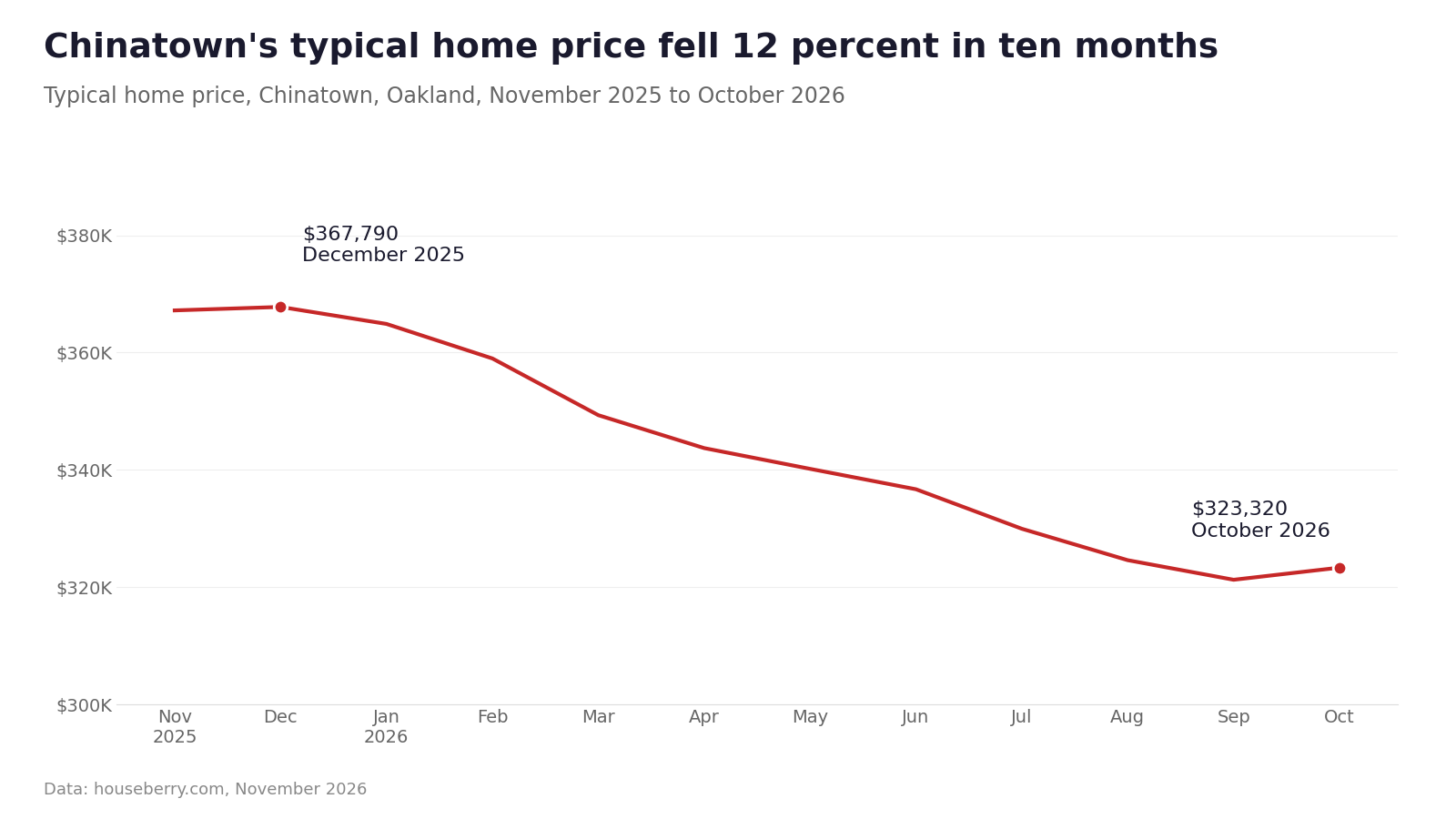
That is about 57 percent below Oakland's typical home price of $743,500 across its priced neighborhoods, on the Houseberry Oakland city page. Chinatown scores 2.5 out of 5 overall on Houseberry, 50th of the 130 neighborhoods on the Oakland ranking. Its school score is 3.1, 24th in the city, and its nearby-merchants score is a perfect 5.0. Its safety score is 1.9, 102nd of 130.
Sixty-four rent-restricted apartments will not move a sales median, but they do change what rent looks like three blocks from the 12th Street BART station. These are rentals priced to fixed shares of the area median income, and 13 of them go to people with no housing at all. The Oakland Housing Authority committed $12 million and 24 project-based vouchers, eight of them for veterans, and the city's housing department added $8.26 million backed by Measure U bonds.
We found no organized opposition in the public record. The holdup has been assembling the money. Once a building like this opens, the next wait is the leasing list, which we walked through in our post on The Eliza, 97 senior apartments in Uptown. District 2 Councilmember Charlene Wang put the Chinatown case plainly in the city's release: "Affordable housing is a continuation of that struggle."
We think the committee should pass the amendment on November 17 and send it on without a fight. The site has had approval since 2016, state money since December and grading permits since July. Every month of paperwork is another month the corner stays fenced.
Who gets in, and when
- Who can live there? Households earning 30 to 60 percent of the area median income, with 13 units for people leaving homelessness. No leasing date is public.
- When could it open? SF YIMBY's 2024 report put construction at 18 to 24 months. No groundbreaking date is public.
- Does the bus lane work wait on the housing? The Broadway and MLK projects are separate city projects that this award helps pay for, and Streetsblog reported in 2024 that neither would start construction before 2026.
The committee vote is November 17, ten years and three months after the Planning Commission first approved homes on this corner. To see where Chinatown sits against Lake Merritt, Old Oakland and every other part of the city, check the Oakland neighborhood ranking.
Sources
- City of Oakland, Legistar file 27-0203, amendment to Resolution 91092, introduced November 2, 2026
- California Strategic Growth Council, Round 9 award list, December 10, 2025 and staff report
- City of Oakland, Oakland awarded $35M from state climate action programs, December 18, 2025
- SF YIMBY, Initial grading permits submitted for 285 12th Street, July 2026
- City of Oakland, 285 12th Street environmental assessment, March 2021
- Oakland Planning Commission, staff report for 285 and 301 12th Street, August 3, 2016
The Houseberry Research Team is Houseberry's reporting team: Bay Area real estate analysts, data specialists and longtime local market watchers. Every day we check the public record: building permits, city council and planning agendas, county recorder filings, state housing bills, police incident data and school results. Then we tie each story to what it means for specific neighborhoods, using Houseberry's own neighborhood data on prices, appreciation, safety, schools and amenities. Questions or corrections: Contact us.
Map of Oakland Neighborhoods
Loading map...
View Full Map
Top Neighborhoods in Oakland, CA






All information provided on this website including but not limited to - school ratings, safety, amenities, user opinions, and property data - is for general informational purposes only. We do not guarantee its reliability, accuracy, or completeness. Users should independently verify information and consult appropriate professionals as needed. By using this website, you agree Houseberry is not responsible for actions, decisions, or consequences arising from reliance on the information provided
houseberry.com - CA DRE# 01847391
 Bay East ©2025. CCAR ©2025. bridgeMLS ©2025. Information Deemed Reliable But Not Guaranteed. This information is being provided by the Bay East MLS, or CCAR MLS, or bridgeMLS. The listings presented here may or may not be listed by the Broker/Agent operating this website. This information is intended for the personal use of consumers and may not be used for any purpose other than to identify prospective properties consumers may be interested in purchasing. Data last updated at November 4, 2026 12:00 AM