A record label bought SF's landmark bank. Now come the bars
Empire filed a $15 million permit to put bars in the 1908 bank at One Montgomery. We follow the money, the vault and the public roof the city gave up.

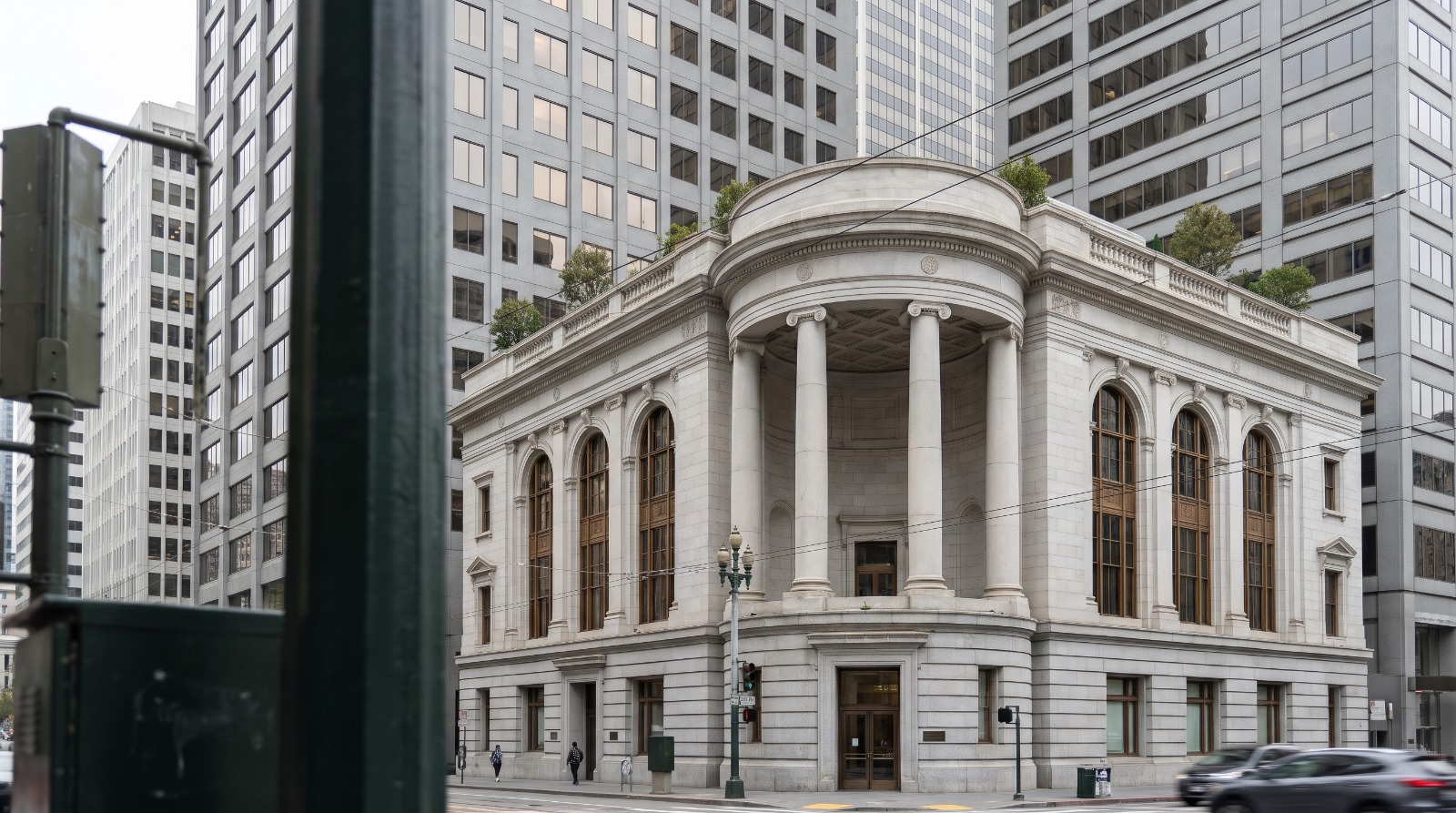
AI-rendered telephoto view of One Montgomery Street, the 1908 granite bank at Market and Montgomery in San Francisco's Financial District Photo: Houseberry
Stand where Market, Post and Montgomery streets meet and look for the round granite porch with the Tuscan columns. That is One Montgomery Street, a bank Willis Polk designed in 1908. On October 6, its owner filed a $15 million permit to put bars in it.
The filing, permit 202609158114 in the city's building permit data, covers the basement, ground floor, mezzanine and second floor at 1 and 25 Montgomery. It adds "bars at basement and g/f levels," makes minor changes to the exterior and the roof deck, and ties every change to the landmark's historic features to an approval the city already granted. The owner is Empire, the San Francisco record label that has released music by Kendrick Lamar and Cardi B. The building sits in the Financial District, which Houseberry scores 5.0 out of 5 for nearby merchants and 2.5 for public spaces.
That gap is the story. Downtown San Francisco is trading a public rooftop garden of about 7,500 square feet for a restaurant in a banking hall, a bar in the old vault, roughly 150 Empire employees and four free concerts a year. We think the city made the right trade, and we think it should hold Empire to every concert.
A bank that lost ten floors
The corner was a twelve-story tower once. Polk built it for the First National Bank, with bronze ornament by Arthur Putnam, and a two-story banking hall was added to the north at 25 Montgomery around 1920. Crocker National Bank took it over in 1926. Between 1979 and 1984 the upper floors came off as the Crocker Galleria and the 38-story One Montgomery Tower went up behind it at Post and Kearny, and the flat roof of the old bank became a garden open to the public.
Wells Fargo ran a branch there until 2019. The city made the building Landmark No. 297 in 2022, which protects its marble banking halls, the bronze squirrel on the spiral stair newel and the ornate safe deposit vault.
Here is what Empire wants to do with those rooms, according to the plan the Historic Preservation Commission approved on July 1, 2026, as summarized in a history of the building by a former Wells Fargo employee who worked there. The 1908 hall gets a restaurant run by a subtenant. The 1920 hall becomes event space, with the raised banker's platform replaced by a glass floor. The old teller line turns into a bar. The vault becomes a speakeasy. Offices go in the basement and on the second floor.
The October permit is that plan, priced. A bar on the ground floor and a bar in the basement are exactly what the filing describes.
The price fell 70 percent before anyone poured a drink
None of this pencils at 2019 prices. The table below follows the money, and the numbers explain why a record label could buy a Market Street landmark at all.
| Date | What happened | Dollars |
|---|---|---|
| July 2019 | Redco Development and AEW Capital buy the building | $82 million |
| March 2023 | The owners stop paying a $65 million loan and hand the keys to the lender | No sale |
| January 2025 | Empire buys it from the lender, Affinius Capital | About $24.5 million |
| December 2025 | Empire commits to renovation | $40 million |
| October 2026 | Empire files the bars and roof deck permit | $15 million |
Reports on the 2025 price differ. SFist put it at $22.5 million, and The Real Deal and the SF Standard at $24.5 million. We use the higher figure. For a building of nearly 100,000 square feet, that is about $250 a square foot, close to the $260 a foot that 417 Montgomery fetched a few blocks up Montgomery in August 2026.
The $15 million permit alone equals 61 percent of what Empire paid. It is also one of 61 office permits of $3 million or more that we counted in San Francisco's permit data for 2026 through late October, and one of the few that turns office floors into something other than offices.
The roof is the real fight
On December 18, 2025, the Planning Commission agenda.pdf) asked commissioners to drop the public access requirement on "the approximately 7,500 square foot Rooftop Terrace," a condition carried in three earlier commission approvals for the site. Empire first offered three free public concerts a year and the option to pay a fee instead after five years.
The first vote tied 3-3. During a recess Empire added a fourth concert and dropped the fee option, and the commission approved it 5-1, according to the San Francisco Chronicle. Commissioner Kathrin Moore voted no both times. "I do not like to be pushed into a corner," she said. Empire's lawyer called closing the roof "the key that unlocks the project."
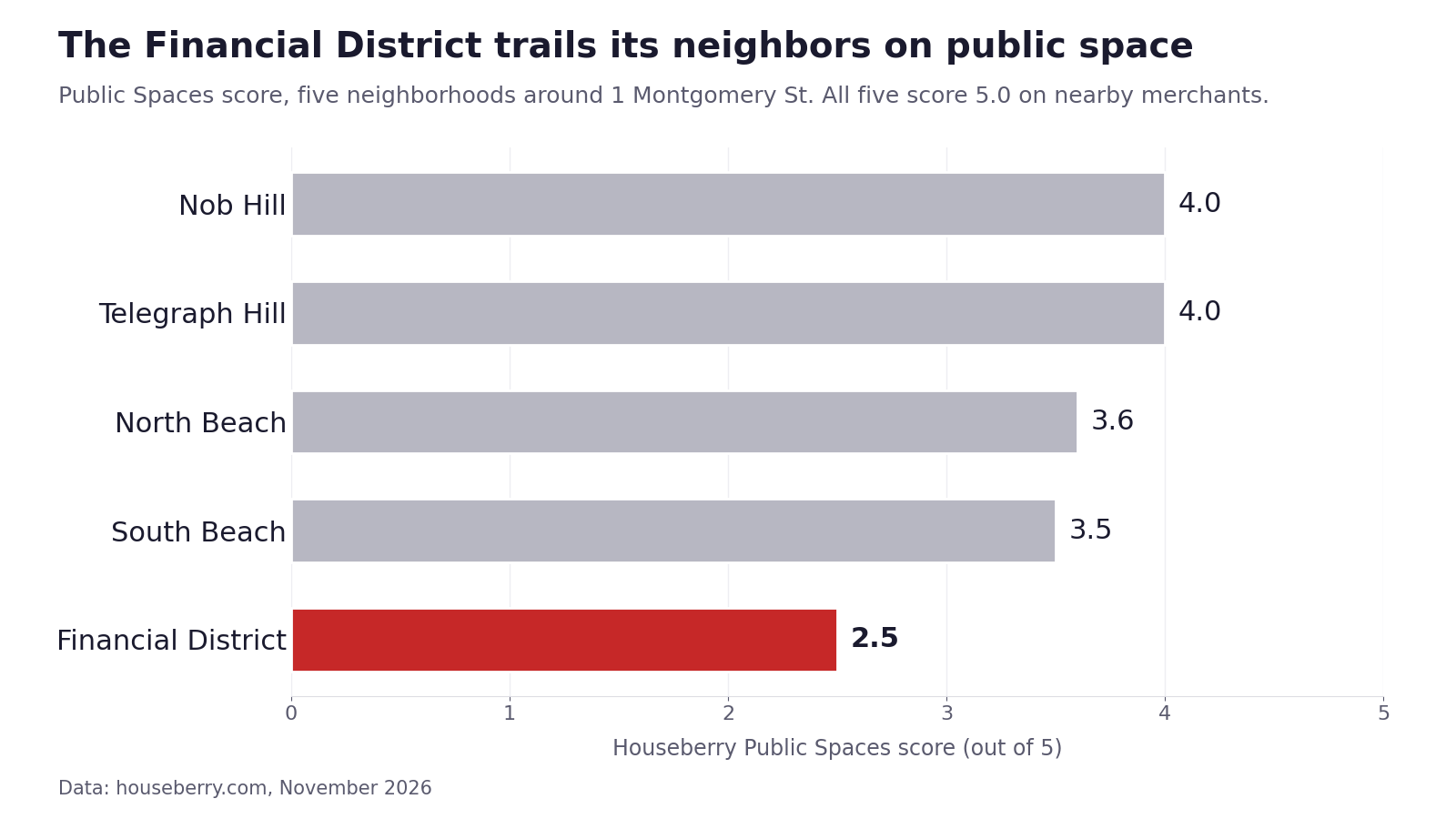
Our scores show why the roof mattered. Nob Hill and Telegraph Hill each score 4.0 on public spaces on Houseberry. North Beach is 3.6 and South Beach is 3.5. The Financial District is 2.5. All five score a perfect 5.0 for nearby merchants. Downtown has never lacked places to buy a drink. It lacks places to sit outside without buying one.
So the city gave up a garden in the neighborhood that can least spare one. We still think it was the right call. A public garden on top of a bank that has sat mostly empty since Wells Fargo left in 2019 does less for the corner than 150 workers, a restaurant and a bar in the vault. The cost is the precedent. Other owners of downtown public plazas will cite this vote, and the city should make them offer as much.
Emptier offices are filling, and few people live here
The office market is giving the bet some cover. Vacancy in the city's central business district fell to 24.6 percent in the third quarter of 2026, from 30.2 percent a year earlier, according to Lee and Associates. Mayor Daniel Lurie's office called Empire's plan "exactly the kind of forward thinking" downtown needs.
Few people live on these blocks. The homes that do trade nearby are condos, and the Financial District page on Houseberry lists sales from $623,000 at 201 Sansome to $2.69 million at 288 Pacific between March and June 2026. Citywide, the typical San Francisco home reached $2.2 million in October 2026, up from $1.89 million in November 2025, according to Houseberry's San Francisco price history.
Houseberry's safety score for the Financial District is 2.3 out of 5, against 3.8 for the city as a whole. Late-night foot traffic from a restaurant and two bars is the kind of change that score will pick up over time, in either direction.
Can you still visit the roof?
Mostly no, once Empire's plan is in place. The 7,500 square foot terrace becomes private event space, opened to the public for the four free concerts the commission required each year.
When will the bars open?
Empire has not announced a date. The permit was still listed as filed, not issued, as of early November 2026, with the Department of Building Inspection's premium review flag.
Is this the 500-foot tower once proposed for the site?
No. A 2016 plan floated a tower over the bank. Empire's permit keeps the building at three levels and adds no height.
We first flagged this permit in one line of our October count of San Francisco office remodel permits. Now it has a name, a vault and a roof that the public is about to lose. Before the first of those four concerts, see how the Financial District compares with the other 91 neighborhoods on our San Francisco neighborhood ranking.
Sources
- San Francisco building permit 202609158114, DataSF
- San Francisco Planning Commission agenda, December 18, 2025, case 2025-007116DRM.pdf)
- Landmark designation fact sheet, One Montgomery Street
- The Real Deal, Planning Commission confirms Empire's plans
- KTVU, rooftop venue proposal
- Lee and Associates, San Francisco office market, Q3 2026
The Houseberry Research Team is Houseberry's reporting team: Bay Area real estate analysts, data specialists and longtime local market watchers. Every day we check the public record: building permits, city council and planning agendas, county recorder filings, state housing bills, police incident data and school results. Then we tie each story to what it means for specific neighborhoods, using Houseberry's own neighborhood data on prices, appreciation, safety, schools and amenities. Questions or corrections: Contact us.
Map of San Francisco Neighborhoods
Loading map...
View Full Map
Top Neighborhoods in San Francisco, CA





All information provided on this website including but not limited to - school ratings, safety, amenities, user opinions, and property data - is for general informational purposes only. We do not guarantee its reliability, accuracy, or completeness. Users should independently verify information and consult appropriate professionals as needed. By using this website, you agree Houseberry is not responsible for actions, decisions, or consequences arising from reliance on the information provided
houseberry.com - CA DRE# 01847391
 Bay East ©2025. CCAR ©2025. bridgeMLS ©2025. Information Deemed Reliable But Not Guaranteed. This information is being provided by the Bay East MLS, or CCAR MLS, or bridgeMLS. The listings presented here may or may not be listed by the Broker/Agent operating this website. This information is intended for the personal use of consumers and may not be used for any purpose other than to identify prospective properties consumers may be interested in purchasing. Data last updated at November 4, 2026 12:00 AM