417 Montgomery Street Sale: What It Means Downtown
The 1936 Lurie Building sold for $25.2 million, about $260 a square foot, against a $54 million assessed value. Discounted Class B trades are the mechanism that makes downtown San Francisco housing conversions pencil, and this one is the clearest example yet.

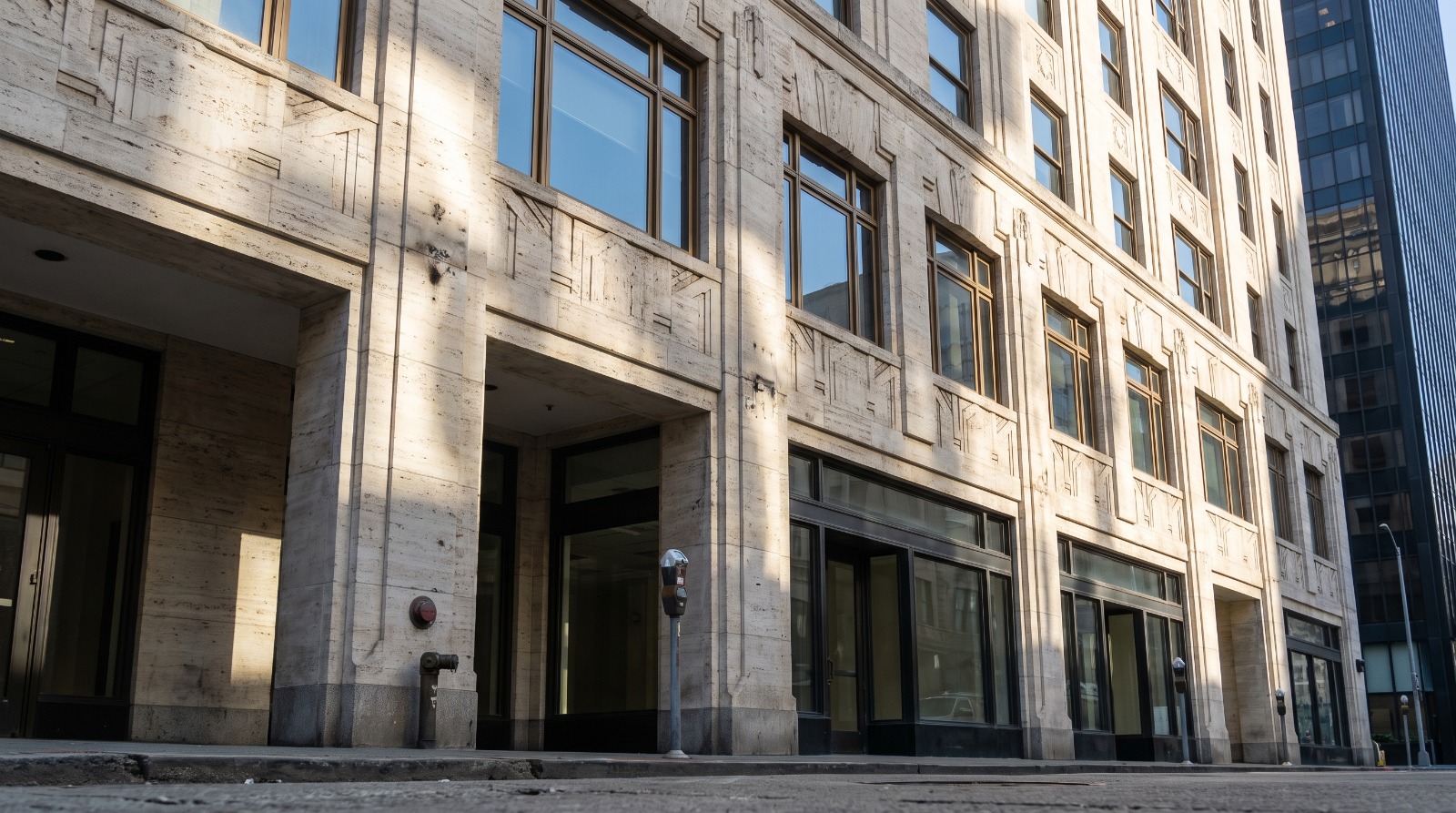
The limestone facade of a 1930s ten-story office building on Montgomery Street in San Francisco’s Financial District, where 417 Montgomery recently sold at a deep discount. Photo: Houseberry
A ten-story limestone building on Montgomery Street sold for $25.2 million on August 31, 2026. It is assessed at about $54 million. It sold for $30 million in 2006.
The short version: 417 Montgomery, the 1936 Lurie Building, traded at roughly $260 a square foot in a city where the average office building sold for $543 a foot last month. The buyers are not turning it into apartments, and it is still the most useful housing number to come out of downtown San Francisco this month, because the price at which Class B buildings change hands is the input that decides whether anything downtown gets converted into homes.
What sold, and to whom
A Menlo Park joint venture bought a mostly empty Depression-era office building and started construction the next day.
The buyer is 417 Montgomery LLC, a partnership of Kenson Ventures Real Estate and Wheatley Properties, with East West Bank lending $28.5 million against a $25.2 million purchase. The extra $3.3 million is renovation capital, which tells you the lender underwrote the repositioning rather than just the dirt. The seller was a legacy family ownership group. Cushman and Wakefield brokered it. The building runs about 96,000 square feet across ten floors and was roughly 70 percent vacant at closing, after Planet Fitness was evicted in August owing more than $500,000 in back rent.
John Fong of Kenson told the SF Standard that the building has great history and great bones and just needs a little love, and that the plan is to finish construction within six months and fill it inside a year with AI companies, venture firms and design tenants. Two of those are already in the building alongside a law firm.
The history is better than the average deal sheet. 417 Montgomery was the first major San Francisco office project to break ground after the Depression, designed by Wilbur D. Peugh for developer Louis Lurie, who put up hundreds of buildings in this city. A building that got built as the city climbed out of one downturn just changed hands on the way out of another. That is a nice piece of symmetry, and it is not the reason to care.
Why $260 a foot is the number that matters
It is less than half the citywide average office sale price and about a quarter of the 2020 peak.
The average San Francisco office building sold for $543 per square foot in August 2026, second in the country only to Manhattan, according to CommercialCafe’s monthly report published August 25. The city’s 2020 average was $1,060. But that citywide average is being carried by a handful of trophy assets. In the second quarter, 1 De Haro traded at $814 a foot. Class B stock in the Financial District is trading at a third of that.
Here is the recent run of discounted trades, each with the price the building last carried.
| Building | Price | Per square foot | Date | Prior value |
|---|---|---|---|---|
| 417 Montgomery Street | $25.2M | About $260 | August 31, 2026 | $30M in 2006, assessed at $54M |
| 1155 Market Street | $8M | Not disclosed | August 2026 | $80M in 2015 |
| 1128 Market Street | $7.6M | $99 | March 27, 2026 | About $50M in 2018 |
| 1 De Haro, for contrast | Not disclosed | $814 | Second quarter 2026 | Largest office trade of the quarter |
The spread inside that table is the whole point. A market where the best buildings fetch $814 a foot and the ordinary ones fetch $99 to $260 is not a market in free fall. It is a market repricing two different products, and only one of them is a candidate for housing.
The office backdrop is genuinely improving, which is worth saying plainly. CBRE put San Francisco office vacancy at 29.2 percent at the end of the second quarter of 2026 with 963,980 square feet of positive net absorption. Kidder Mathews, using a different definition, measured total vacancy at 27.2 percent, down 440 basis points from 31.6 percent a year earlier, with leasing activity up 23 percent year to date. Those are different numbers from different methodologies and they point the same direction.
The conversion math a cheap basis unlocks
Office-to-housing conversions in San Francisco run $500,000 to $600,000 per unit against roughly $1 million per unit for new ground-up construction, and the acquisition price is the variable that decides whether that holds.
That figure comes from Jack Sylvan of SDG, one of the developers behind the 150 Hayes conversion, speaking to Axios in July. Marc Babsin of Emerald Fund, his partner on that project, put it more bluntly to the SF Standard in August: stuff is starting to pencil now.
The policy scaffolding is already built. The 2023 adaptive reuse ordinance waives lot coverage, open space, unit mix and Planning Commission hearings for qualifying conversions in the C-3 districts, which include the Financial District. Proposition C in March 2024 waived transfer tax on up to five million square feet of conversions. A 2025 measure waived inclusionary requirements and impact fees on up to seven million square feet. And the Downtown Revitalization and Economic Recovery Financing District, effective February 12, 2026, lets qualifying projects reinvest incremental property tax revenue for up to 30 years, with an enrollment window running to 2032. The city projects roughly 4,400 homes across about 50 properties from that last one alone.
What actually got filed is smaller and more honest: about 322 homes across four buildings between July and August 2026, at 901 Market with 136 units, 150 Hayes with 104, 2300 Stockton with 70, and 575 Sutter with 12. Four buildings is not a wave. It is a proof of concept, and every one of them needed a purchase price that made the arithmetic work.
What a buyer should actually take from this
The demand side of downtown housing is tighter than the office numbers suggest.
San Francisco’s apartment vacancy rate was around 2 percent in August 2026 with a median one-bedroom rent of $3,881, according to Apartment List. San Francisco Travel projects $9.9 billion in visitor spending and 24.2 million visitors in 2026, which would pass the 2019 record of $9.6 billion for the first time. Downtown SF Partnership’s counts show Saturday foot traffic at 75 percent of 2019 and Muni weekend ridership at 94 percent, against 76 percent on weekdays. Downtown is recovering faster as a place to be than as a place to commute to, which is precisely the condition under which residential conversion makes sense.
On prices, the citywide median was $2.20 million in August 2026, up 16.4 percent from $1.89 million a year earlier. Here is where the districts near Montgomery Street actually sit.
| Neighborhood | Median price | Month |
|---|---|---|
| Yerba Buena | $2.65M | July 2026 |
| Mission Bay | $2.21M | August 2026 |
| Russian Hill | $1.84M | August 2026 |
| Van Ness and Civic Center | $1.22M | August 2026 |
| San Francisco citywide | $2.20M | August 2026 |
The Financial District itself is missing from that table for a reason worth stating out loud. There are so few home sales inside the Financial District and Barbary Coast that we fall back to the citywide figure on that page rather than publish a neighborhood median off a handful of transactions. That absence is the story. Compare it with Mission Bay at $2.21 million or Russian Hill at $1.84 million, both real neighborhood medians from real sales. A district of 96,000-square-foot office buildings has almost no housing market to measure yet. Conversions are how it gets one, and the day there are enough sales there to compute a real median is the day downtown has actually changed.
Until then, the honest read for anyone considering living down there is our earlier walk through what daily life is actually like in downtown San Francisco right now, which is a story about grocery stores more than about cap rates.
The part that is easy to overread
417 Montgomery is not becoming apartments, and its buyers have said so clearly.
Fong is filling it with office tenants and expects to be done inside a year. So this is not a conversion story, it is a basis story, and the difference matters. There is also a real tension in the recovery itself. AI leasing is strong enough that Class A and even good Class B space is re-tightening, and a building that can be leased to a growing company is not going to be gutted for housing. The faster the office market recovers, the fewer buildings get converted.
That is the trade-off worth watching over the next two years. San Francisco needs the office recovery and it needs the housing, and every improving quarter makes the second one slightly harder to finance. The buildings that end up as homes will be the ones nobody wants as offices at any price, which is a narrower set than the 42 million square feet of vacancy makes it sound. Four filings and roughly 322 units in two months is the realistic pace, and it is worth measuring against that rather than against the 4,400-unit projection.
For a buyer, none of this changes what to do this month. It changes what to expect from a five-year hold in a neighborhood that currently has almost no residents. The full San Francisco ranking is the place to see how the downtown districts compare to the rest of the city today, and it is the baseline against which any of this will eventually be measured.
Sources
Hoodline, Menlo Park firms buy historic FiDi tower, September 2026
CBRE, San Francisco Office Figures, Q2 2026
Kidder Mathews, San Francisco Office Market Report, Q2 2026
CommercialCafe, national office report, August 25, 2026
Traded, 1128 Market Street sale, March 2026
The San Francisco Standard, 1155 Market Street buyer, August 28, 2026
Axios San Francisco, the office-to-housing push takes shape, July 13, 2026
The San Francisco Standard, turning offices into housing is a boutique business, August 10, 2026
San Francisco Planning, Downtown Adaptive Reuse Program
CoStar, San Francisco passes law to boost office conversions, February 17, 2026
San Francisco Travel Association, visitor spending projection, May 7, 2026
Downtown SF Partnership, data on downtown’s evolution beyond the 9 to 5
Houseberry, San Francisco neighborhood and city data, September 2026
The Houseberry Research Team is Houseberry's reporting team: Bay Area real estate analysts, data specialists and longtime local market watchers. Every day we check the public record: building permits, city council and planning agendas, county recorder filings, state housing bills, police incident data and school results. Then we tie each story to what it means for specific neighborhoods, using Houseberry's own neighborhood data on prices, appreciation, safety, schools and amenities. Questions or corrections: Contact us.
All information provided on this website including but not limited to - school ratings, safety, amenities, user opinions, and property data - is for general informational purposes only. We do not guarantee its reliability, accuracy, or completeness. Users should independently verify information and consult appropriate professionals as needed. By using this website, you agree Houseberry is not responsible for actions, decisions, or consequences arising from reliance on the information provided
houseberry.com - CA DRE# 01847391
 Bay East ©2025. CCAR ©2025. bridgeMLS ©2025. Information Deemed Reliable But Not Guaranteed. This information is being provided by the Bay East MLS, or CCAR MLS, or bridgeMLS. The listings presented here may or may not be listed by the Broker/Agent operating this website. This information is intended for the personal use of consumers and may not be used for any purpose other than to identify prospective properties consumers may be interested in purchasing. Data last updated at October 23, 2026 12:00 AM