SF's Office-to-Housing Wave Reaches Union Square
A small permit at 575 Sutter is the first Union Square office-to-housing conversion filed under San Francisco's adaptive reuse program. The size of it is the story.
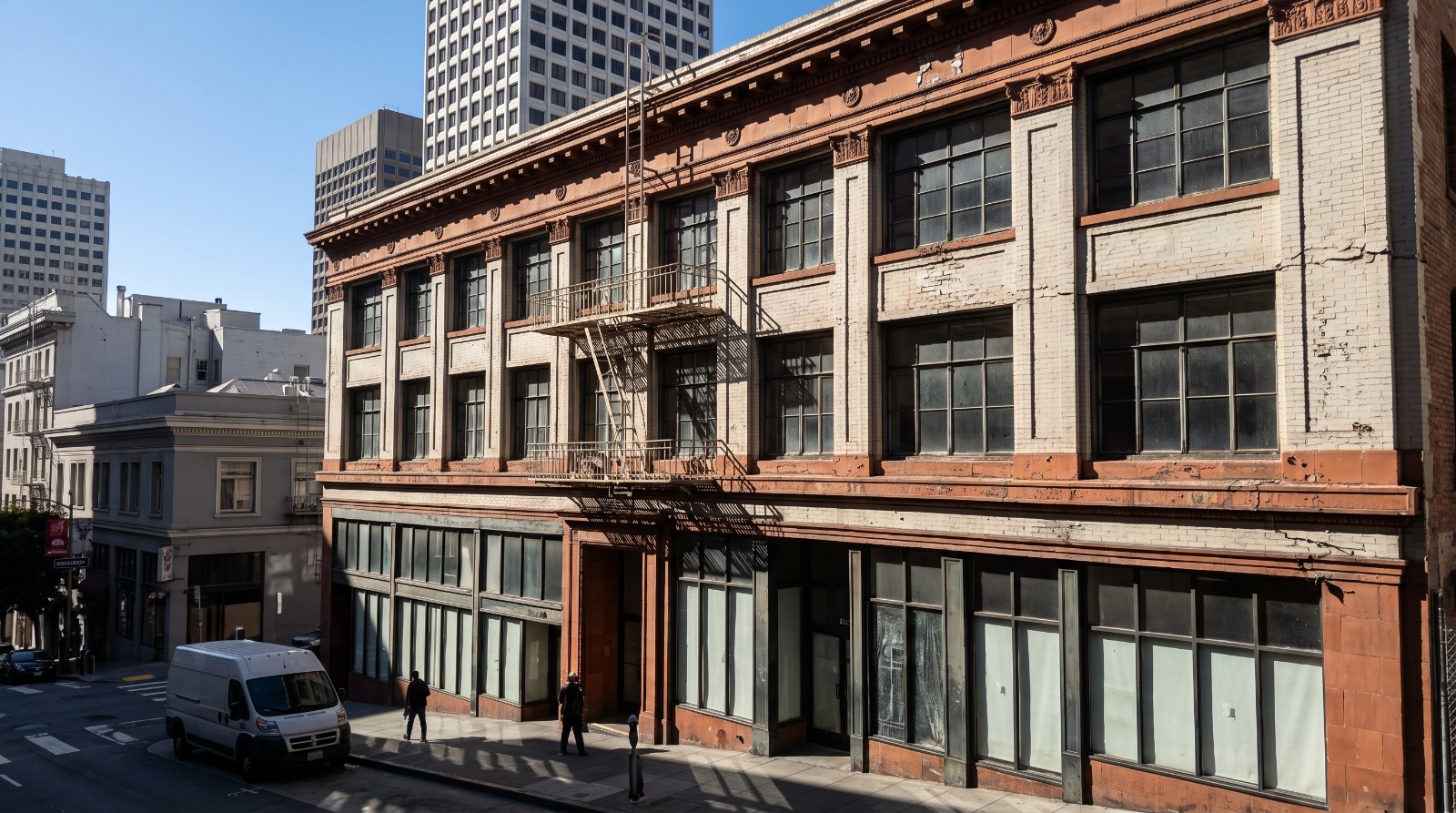
A 1920s masonry mid-rise on Sutter Street near Union Square in San Francisco, the kind of building now filing for office-to-housing conversion. Photo: Houseberry
Twelve apartments. That is the whole ask in the permit AHK Group filed for 575 Sutter Street, a narrow older building between Mason and Powell, three blocks uphill from the Union Square cable car turnaround. Nine one-bedrooms and three two-bedrooms on the second and third floors, ground floor and basement staying commercial, the facade untouched except for one new exit door onto Sutter. San Francisco YIMBY put the renovation budget at just under a million dollars.
By the standards of downtown San Francisco office-to-housing conversion coverage, that is a rounding error. It is also the first Union Square filing in a program that was built for towers, and the reason it deserves attention has nothing to do with twelve units.
What is actually in the filing
The particulars, because they matter for what comes next:
- Address: 575 Sutter Street, Union Square, between Mason and Powell
- Units: 12 total, nine one-bedrooms and three two-bedrooms
- Floors converted: second and third only
- Ground floor and basement: retained as commercial office
- Architect: Schaub Li Architects
- Owner and sponsor: AHK Group, filed through One Timberlake Inc.
- Pathway: San Francisco's Downtown Adaptive Reuse program
- Renovation cost: just under $1 million, excluding other development costs
- Exterior work: essentially none beyond a new Sutter Street exit
No elevator in the plans. No new massing. No demolition. This is a building whose upper floors stopped earning their keep as offices, being turned into apartments by its owner rather than by a national developer with a capital stack.
A 12-unit filing is the more interesting kind
Everything San Francisco has published about conversions for three years has been framed around big buildings. The transfer tax waiver is capped in millions of square feet. The fee waivers are capped in millions of square feet. The named projects are the ones you would expect: 901 Market Street's 136 homes, 2300 Stockton, 150 Hayes. Axios reported in July that those three together, roughly 300 units, were the wave finally breaking, after five years of the city rewriting rules to make the math work.
Three hundred units is real. It is also three buildings. A downtown that needs residents on a few hundred blocks cannot get there three trophy conversions at a time, and the developers have been honest about why: structural upgrades, seismic work, and plumbing risers on a 1920s tower are the kind of cost that eats a pro forma before you ever price a kitchen.
Which is why the small one matters. Jack Sylvan of SDG told Axios that a project like 150 Hayes can deliver apartments at $500,000 to $600,000 each, against roughly $1 million per unit for new construction. Now look at 575 Sutter. Two floors, no elevator, no facade work, no structural gymnastics, and a renovation line under $1 million for twelve homes. That is not the same species of project. It is closer to a very large remodel, and there are hundreds of buildings downtown built at exactly that scale.
If the conversion pipeline ends up being a hundred filings like this one instead of ten filings like 901 Market, downtown fills in faster and it fills in more evenly. I would take that trade.
The stack of rules that made this possible
Nobody converts an office because they woke up feeling civic. Four separate policy layers sit under this filing, and they arrived in order:
- July 2023. The Board of Supervisors adopted the Downtown Adaptive Reuse program through Ordinance 159-23, now Planning Code Section 210.5. It waives or modifies lot coverage, open space, unit mix, dwelling exposure, bike parking, off-street loading, streetscape requirements, and the Planning Commission hearing itself, and lets a qualifying building add up to 33 percent more volume.
- March 2025. Inclusionary housing and impact fee waivers were extended to cover up to 7 million square feet of conversions, on top of a real estate transfer tax waiver covering 5 million.
- October 2025. The governor signed AB 507, Assemblymember Matt Haney's adaptive reuse streamlining bill, as part of that month's housing package. Conversions now have a streamlined path statewide, not only inside San Francisco.
- February 2026. The city stood up the Downtown Revitalization Financing District, letting a conversion recapture part of the future property tax growth it creates to help pay for construction.
Read that list as a five-year experiment in removing one excuse at a time. The excuse that remained longest was hearings and fees on small projects, because a 12-unit conversion cannot absorb a two-year entitlement fight. Section 210.5 waiving the Planning Commission hearing is the single line in that ordinance that makes 575 Sutter possible.
Union Square's numbers explain the timing
Sutter Street is not converting because someone in planning wished for it. It is converting because the office market on those blocks broke and the retail market only half healed.
Union Square retail vacancy sat around 15 percent this spring, down from a 22 percent peak in 2025 but still miles from the 6.4 percent of 2019, per ABC7's reporting. The Powell Street corridor specifically ran at 71 percent retail vacancy in 2025. Office vacancy in the district is about 28 percent against 4 to 6 percent pre-pandemic. Zara, Uniqlo, and Chanel have all been reshuffling into better space at lower rents, and the district still generates something like 40 percent of the city's general fund tax base, which is why City Hall keeps writing checks for Powell Street improvements.
An owner looking at those numbers on a small Sutter Street building has a simple choice. Keep marketing 3,000 square feet of walk-up office into a 28 percent vacancy market, or spend under a million dollars and rent nine one-bedrooms in a neighborhood with a cable car line, a BART and Muni station four blocks downhill, and no residential competition.
What actually changes for the blocks around it
Not much, from twelve apartments. Quite a lot, if this becomes the pattern.
The thing Union Square has never had is people who are still there at 8 p.m. on a Tuesday. Downtown scores well on the things that come from density of buildings and poorly on the things that come from density of residents, and our own scoring shows that split plainly. Nob Hill, four blocks uphill, carries a 4.4 out of 5 for amenities in our San Francisco amenities ranking, because it has grocery stores, dry cleaners, and corner restaurants that exist for residents. The core commercial blocks do not, because until recently there were no residents to serve.
That is the honest frame for anyone thinking about buying a condo in or near the core right now. The buildings are there. The transit is genuinely excellent, which is why downtown keeps showing up in our look at the San Francisco neighborhoods that work without a car. What is still thin is the everyday retail layer that only shows up once enough people live nearby, and my colleague Priya's walk-through of whether you can actually live downtown right now found exactly that gap, block by block. Groceries, not vacancy rates, are the metric that tells you when a commercial district has turned into a neighborhood.
What to watch between now and the fall
Three things, in order of how much they will tell you.
First, whether 575 Sutter gets its permits without a hearing. If Section 210.5 works as written on a small project, other small owners will copy it within months, and their architects talk to each other.
Second, whether the three big filings from July hold their unit counts through plan check. Conversions shrink. They almost always shrink.
Third, whether any small conversion downtown includes ground-floor retail that actually opens. A converted upper floor with a dead storefront underneath it produces residents and no street life, which is the worst of both outcomes.
The pipeline is finally moving after five years of policy work, and that is good news for a region that needs homes anywhere it can put them. Just do not read a permit as a neighborhood. If you are weighing a downtown purchase against somewhere else in the city, compare it the way you would compare any two areas, on schools, safety, amenities, and price rather than on the pipeline, and check how San Francisco neighborhoods rank overall before the conversion story does your thinking for you.
Three questions we keep getting about downtown conversions
Does an office-to-housing conversion make nearby condos worth more?
Not by itself, and not on a twelve-unit scale. What conversions plausibly change over years is the mix of businesses that can survive on a block, because retail follows residents. That shows up in amenity quality long before it shows up in a price index, and a single filing is not evidence of either.
How many office-to-housing conversions has San Francisco actually completed?
Fewer than the coverage implies. As of July 2026 the pipeline is a handful of filings, roughly 300 units across 901 Market, 2300 Stockton, and 150 Hayes, plus smaller projects like 575 Sutter. Nearly a third of the city's office space is still vacant. Treat the completed count, not the filed count, as the real scoreboard.
Is Union Square a residential neighborhood now?
No. It is a commercial district with its first residential filing under the adaptive reuse program. The blocks with actual residential fabric are uphill in Nob Hill and Lower Nob Hill, and the difference is obvious the moment you try to buy groceries.
Sources
- San Francisco YIMBY: Office-to-housing conversion for 575 Sutter Street
- SF Planning: Downtown Adaptive Reuse Program
- Axios San Francisco: SF incentives spark first major office-to-housing conversions
- Office of the Governor: October 10, 2025 housing legislation signing, including AB 507
- ABC7 News: San Francisco's Union Square showing signs of recovery
All information provided on this website including but not limited to - school ratings, safety, amenities, user opinions, and property data - is for general informational purposes only. We do not guarantee its reliability, accuracy, or completeness. Users should independently verify information and consult appropriate professionals as needed. By using this website, you agree Houseberry is not responsible for actions, decisions, or consequences arising from reliance on the information provided
houseberry.com - CA DRE# 01847391
 Bay East ©2025. CCAR ©2025. bridgeMLS ©2025. Information Deemed Reliable But Not Guaranteed. This information is being provided by the Bay East MLS, or CCAR MLS, or bridgeMLS. The listings presented here may or may not be listed by the Broker/Agent operating this website. This information is intended for the personal use of consumers and may not be used for any purpose other than to identify prospective properties consumers may be interested in purchasing. Data last updated at September 14, 2026 12:00 AM