Can You Actually Live in Downtown San Francisco Now?
Offices are refilling and apartments are on the way, but daily life downtown still splits between SoMa, the Financial District, and Mid-Market. A 2026 livability check.

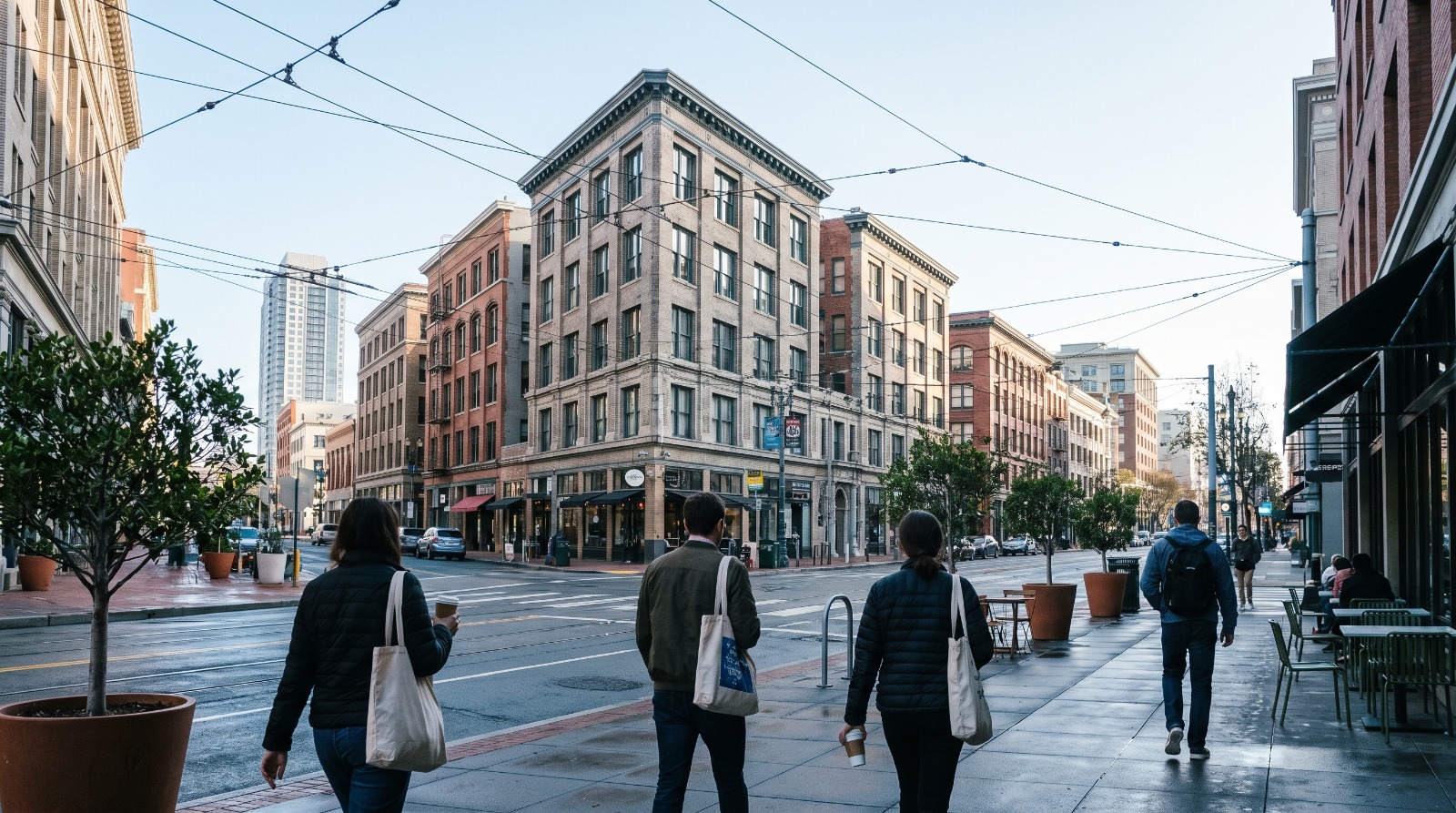
A SoMa and Mid-Market sidewalk in downtown San Francisco with active storefronts and pedestrians, part of a look at whether downtown is a place to live. Photo: Houseberry
Try running a normal Saturday errand in the Financial District. You can get a very good bagel, an oat-milk cortado, and a natural-wine bottle within two blocks of Montgomery Street. What you cannot easily do is buy a week of groceries. That gap, more than any office-vacancy headline, is the real test of whether living in downtown San Francisco actually works in 2026.
The question is fair to ask right now, because the ingredients are finally moving. Offices are refilling, empty towers are being lined up for conversion into apartments, and the neighborhood is adding residents for the first time in years. Whether it adds up to a place you would want to live depends on which downtown you mean.
The office numbers are turning. That is the setup, not the story.
Downtown's office market is genuinely healing. San Francisco's office vacancy has come down from a peak of about 34.7% in early 2025 to 29.7% a year later, and by some brokerage counts the space actually leased and occupied is tighter than that, with direct vacancy nearer 25%. AI companies are doing most of the leasing.
Some of those towers are also headed for a second life as housing. A city financing district approved earlier this year is meant to make office-to-home conversions pencil out, and around 300 conversion units are filing this month, including a 136-unit project at 901 Market that we wrote about when it filed. All of that adds residents. Downtown's residential population has historically sat under 30,000, and the conversions could push it up by more than a fifth.
But new apartments only matter if the neighborhood around them works for daily life. So the more useful question for anyone weighing a downtown address is not how many offices refilled. It is whether you can live there without a car and a lot of patience.
Groceries split downtown into thirds
Here is where downtown stops being one place. On the errand test, it splits into three very different neighborhoods.
SoMa is the bright spot, and it is not close. The western edge around Ninth Street already has a Trader Joe's and a Container Store in one center, and the old Nordstrom Rack space is slated to become San Francisco's first Sprouts Farmers Market, though not until around 2028. If you want the version of downtown living where you can walk to a full grocery run, SoMa and the blocks toward Mission Bay are the honest answer today. It is also why that stretch tends to score better on the everyday-convenience measures that show up in San Francisco's amenity rankings.
The Financial District and Mid-Market are the harder cases. The FiDi has the cafes and the foot traffic but still no full-service grocery at its core, a hole that the shuttered Whole Foods at Eighth and Market has come to symbolize. Mid-Market is adding small businesses through a city storefront program but remains the thinnest stretch for daily needs. And the biggest symbol of the problem is still sitting empty. The deal to sell the downtown mall at Fifth and Market fell apart again in July 2026, leaving the neighborhood's largest retail anchor dark for now.
What is opening, and who is moving in
It is not all gaps. Downtown is busier than the doom-loop story suggests. The area averaged more than 100,000 pedestrians a day last summer, and the ground floors are slowly refilling, with new cafes, bars, and restaurants opening across the Financial District over the past year. The energy is real. It is just skewed toward going out, not staying in and cooking. For a renter or buyer, that is the honest trade-off to weigh: strong nightlife and coffee, thinner daily-errand infrastructure, with the balance improving fastest in SoMa.
So, is downtown a place to live?
The honest verdict has three parts, because downtown does.
If you want walkable, full-life convenience today, SoMa and the Mission Bay edge deliver it, and they are only getting better as more housing and a real grocery arrive. If you are drawn to the Financial District or Mid-Market, you are betting on a neighborhood that is clearly on the way up but is not all the way there, where you will love the coffee and still drive or order in for a proper grocery run. Neither answer is wrong. They are just different trade-offs, and the mistake is treating downtown as one decision.
On the questions people actually ask, plain answers help. Is it cheaper to rent or buy down here? Downtown condos have been one of the softer corners of the SF market, so the rent-versus-buy math is more forgiving than in the single-family neighborhoods, but run your own numbers on a specific building before deciding. Is it safe and lively enough? Foot traffic is back and the blocks are refilling, though conditions still vary corner to corner, especially in Mid-Market. The move is to walk your specific blocks at the hours you would actually live them, then check how that pocket scores against the rest of the city rather than trusting the neighborhood's reputation, good or bad. That is the whole reason we compare places at the neighborhood level, right down to downtown San Francisco itself, instead of judging the city as a whole. Downtown is not one place, and in 2026 that is finally starting to work in a resident's favor.
Sources
- The Real Deal, San Francisco office vacancy down 5 points in a year
- Kidder Mathews, San Francisco office market report, Q2 2026
- Planetizen, office conversion is picking up steam in San Francisco
- SF Standard, Sprouts opening in SoMa
- SF Standard, San Francisco Centre mall deal falls apart
- Downtown SF Partnership, latest ground-floor business openings
The Houseberry Research Team is Houseberry's reporting team: Bay Area real estate analysts, data specialists and longtime local market watchers. Every day we check the public record: building permits, city council and planning agendas, county recorder filings, state housing bills, police incident data and school results. Then we tie each story to what it means for specific neighborhoods, using Houseberry's own neighborhood data on prices, appreciation, safety, schools and amenities. Questions or corrections: Contact us.
All information provided on this website including but not limited to - school ratings, safety, amenities, user opinions, and property data - is for general informational purposes only. We do not guarantee its reliability, accuracy, or completeness. Users should independently verify information and consult appropriate professionals as needed. By using this website, you agree Houseberry is not responsible for actions, decisions, or consequences arising from reliance on the information provided
houseberry.com - CA DRE# 01847391
 Bay East ©2025. CCAR ©2025. bridgeMLS ©2025. Information Deemed Reliable But Not Guaranteed. This information is being provided by the Bay East MLS, or CCAR MLS, or bridgeMLS. The listings presented here may or may not be listed by the Broker/Agent operating this website. This information is intended for the personal use of consumers and may not be used for any purpose other than to identify prospective properties consumers may be interested in purchasing. Data last updated at October 21, 2026 12:00 AM